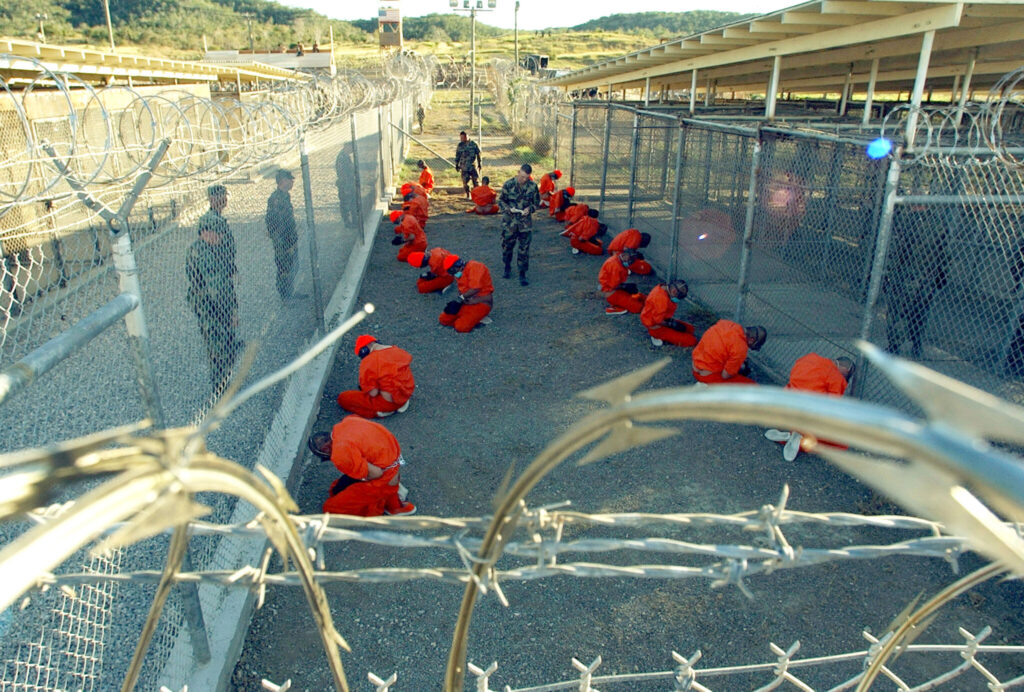
Guantánamo Naval Base Also Used for Migrant Detentions in 2025
On January 11, 2026, thousands of citizens of many countries held vigils for the 15 men still in the U.S. military prison at the U.S. Naval Base at Guantánamo, Cuba.
As these citizens have been doing for more than two decades, from London to Washington, D.C., to Honolulu, Hawaii, they are the voices of conscience for one of the most brutal episodes in U.S. history: the torture and imprisonment of hundreds of men who had nothing to do with the events of September 11, 2001.
24 Years Ago
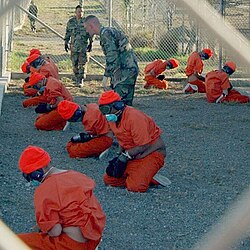
On January 11, 2002, 24 years ago, the first 20 detainees from Afghanistan arrived by military aircraft to the U.S. Naval Base in Guantánamo, Cuba.
In Guantánamo, they were initially kept—in a place called Camp X-Ray—in cages in the open air with snakes and rodents free to enter the cages.
Over the next months and years, a total of 780 detainees from 48 countries were brought to the prison from Afghanistan, Pakistan and “dark sites” in many countries that signed on to help extract information from detainees through torture overseen by the CIA.
Many of the 780 (86%) were purchased by the CIA and U.S. military from neighbors or others with a grudge.

Flight of first 20 prisoners to Guantánamo was a classified, “need-to-know” CIA/Military Operation
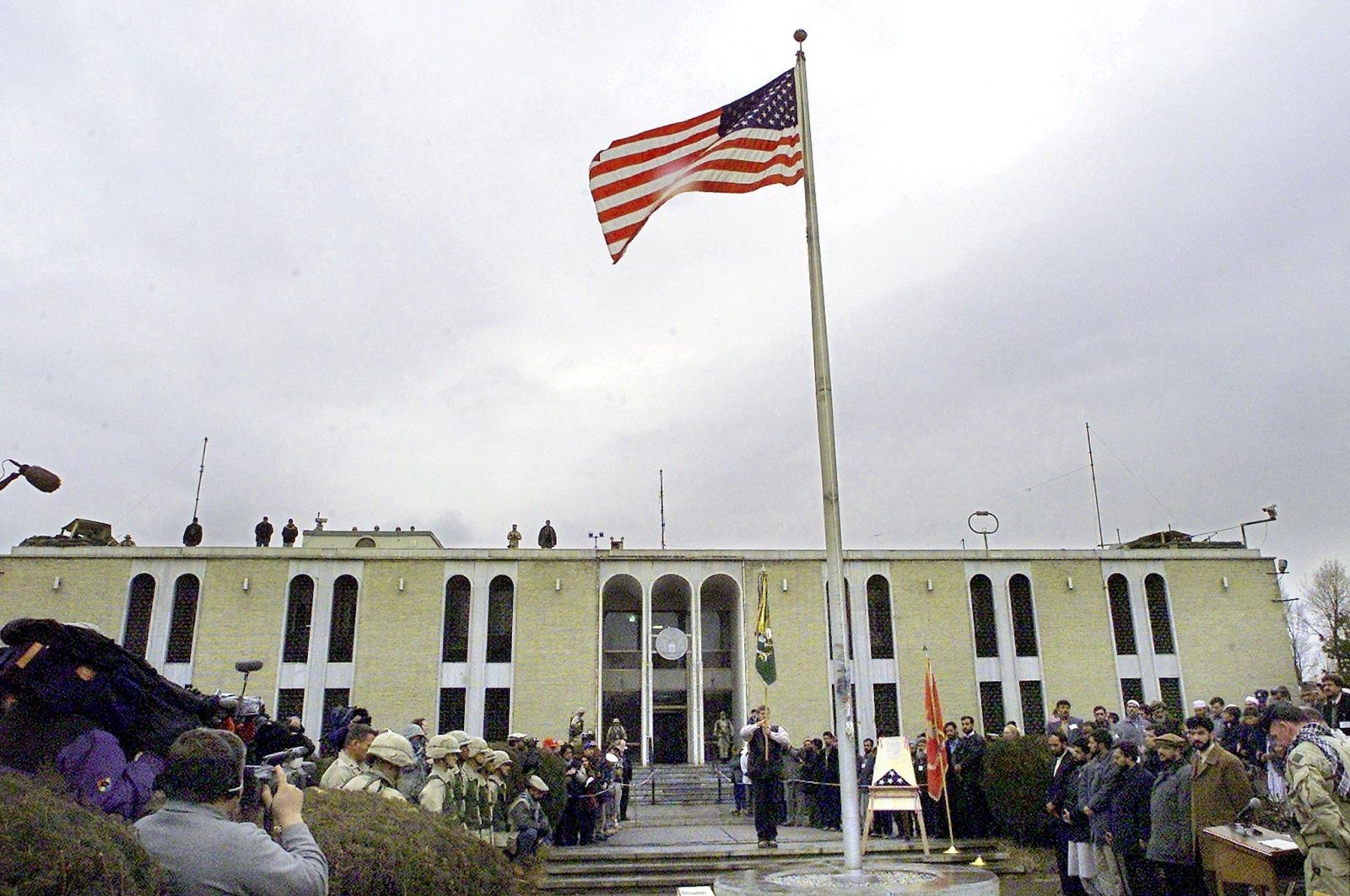
On January 11, 2002, I was working at the recently reopened U.S. Embassy in Kabul, an embassy that had been closed for 12 years.
The CIA operation in Afghanistan had been running since October 2001. The CIA had built up its own air transport service, hotel and fleet of ground vehicles.
The tiny U.S. Embassy had five Foreign Service employees who arrived in mid-December and lived in a bunker on the Embassy grounds.
A contingent of U.S. Marines provided security services and lived on top of the Embassy and inside a few rooms of the Embassy.
U.S. Army Special Forces teams were riding horses with one of the friendly warlords, brutal General Abdul Rashid Dostum, who was later vice president of the country. Bagram Air Base was controlled by the U.S. military. The international airport in Kabul was closed as the U.S. had bombed the runways.
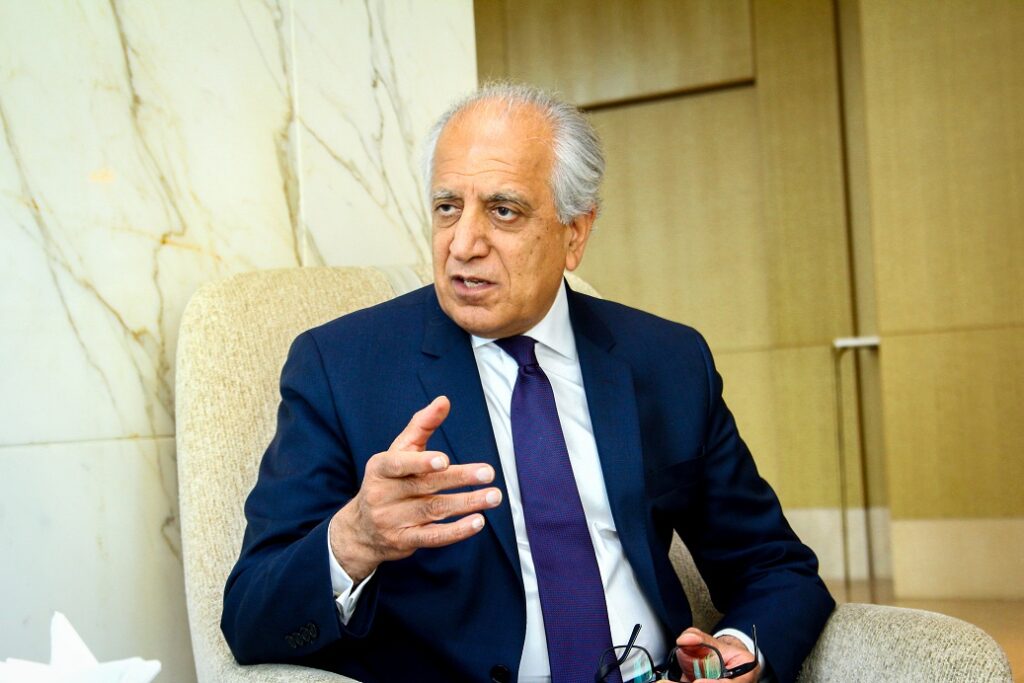
To my knowledge, Bush administration Special Envoy to Afghanistan Zalmay Khalilzad was the only person associated with the Embassy in Kabul who knew about the classified, “need-to-know” transfer of detainees from U.S. detention facilities in Afghanistan to the new prison in Guantánamo, Cuba.
Certainly, State Department officials in Washington had to sign off on the Department of Defense’s recommendation to transfer detainees to Cuba, outside the reach of the U.S. civilian judicial system, but the decision on timing of flying detainees to Cuba was so sensitive that those of us at the Embassy did not know of it.
780 Detainees Have Been in Guantánamo Prison in the Past 24 Years
Of the 780 prisoners who have been held by the U.S. military at Guantánamo since the prison opened on January 11, 2002, 755 have been released or transferred, including one who was transferred to the U.S. to be tried and subsequently convicted.

A timeline of the history of Guantánamo prison is here.
More than 500 detainees were transferred out of Guantánamo during the George W. Bush administration. President Barack Obama brought the number down to 41 and only one detainee was transferred during the first Trump administration.
During the Biden administration, 25 detainees were transferred out of the facility. None has been transferred during the first year of the second Trump administration.
Nine prisoners died while in the U.S. Guantánamo prison, the last of these being Adnan Latif, in September 2012.
15 Prisoners Remain in Guantánamo Prison
15 men are still held in the Guantánamo prison.
Three inmates—a Libyan, a Somali and a stateless Rohingya—were approved for transfer years ago but remain imprisoned.
The Libyan and Somali cannot be returned to their homelands because those countries, like Yemen, are on Congress’s no-transfer list due to security concerns, so the U.S. must find other countries in which to resettle them.
Three other prisoners have been described as “forever prisoners,” held without charge or trial, and with their cases only reviewed via an administrative, rather than a legal, process—the Periodic Review Boards, which were established under President Obama.
Nine others are facing or have already faced trials in the military commission system.
Six have active cases in the military commission system.
One is serving a life sentence, largely in solitary confinement, after a one-sided trial in 2008 in which he refused to mount a defense.
Another prisoner agreed to a plea deal in 2022. The last of the nine is in legal limbo, after a Pentagon Sanity Board ruled that he was unfit to stand trial in 2023.
The profiles of the 15 who remain imprisoned at Guantánamo are here.
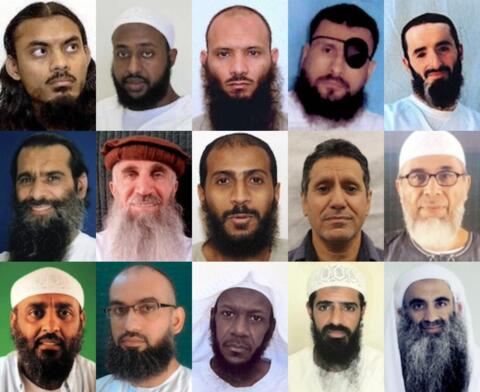
Biden administration transferred 15 from Guantánamo in last weeks of the administration
On January 6, 2025, just two weeks before his term ended, President Biden authorized the transfer of 11 Yemeni detainees to Oman, which agreed to help resettle them and provide security monitoring. Oman has accepted at least 30 other Guantánamo prisoners in the past.
The transfer of the 11 Yemenis had been scheduled for October 2023 but had been on hold for more than two years due to the Biden administration’s weapons support to the Israeli military’s bombing and destruction of Gaza and the resulting instability in the region.
In mid-December 2024, four other Guantánamo inmates—a Kenyan, a Tunisian and two Malaysians—were transferred by the Biden administration to their home countries.
All of them were approved for transfer by national security officials more than two years ago, October 2023, and sometimes long before that—one had been cleared for transfer since 2010—yet had remained behind bars due to political and diplomatic factors.
Trump Administration Used Guantánamo for Migrant Detentions
On January 29, 2025, President Trump signed an executive order directing the expansion of detention operations for “high-priority criminal aliens unlawfully present in the United States.”
He suggested that 30,000 migrants could be held at Guantánamo.
On September 25, 2025, 18 men, the last migrants awaiting deportation and sent to Guantánamo, were flown by Immigration and Customs Enforcement (ICE) officials back to the United States.
Reporter Carol Rosenberg, who has covered Guantánamo prison and court proceedings since the first detainees were brought to the U.S. base in 2002, has written on the use of the U.S. Naval Base by ICE to house migrants.
Since the Migrant Detention Center was set up at Guantánamo in February 2025, around 700 foreign citizens have been held there awaiting deportation which was established to hold tens of thousands of unauthorized immigrants in tent cities.
Thankfully, the tent city never reached that capacity, with the largest number of migrants held there on a single day being 178 on February 19, 2025. They were all Venezuelans and all but one was deported back to Venezuela.
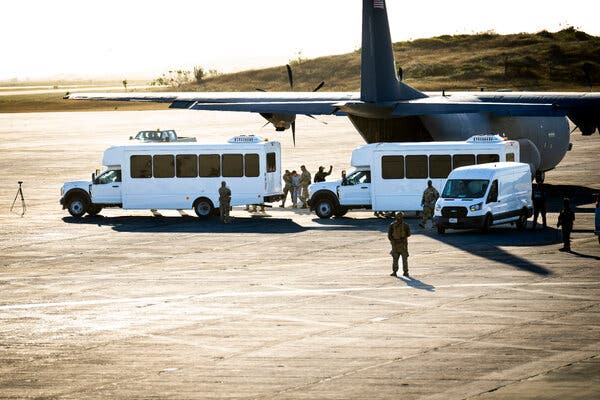
Since February 19, the deportee population has ranged from a single migrant to dozens. At the end of July, 61 people were being held at Guantánamo in the custody of ICE.
Since then, 16 ICE flights have picked up deportees, to either return them to the United States or add to flights already loaded with other migrants and continue on to other countries.
According to Thomas Cartwright, who tracks deportations with the immigrant rights group Witness at the Border, their destinations have included Colombia, Ecuador, Egypt, El Salvador, Great Britain, Guatemala, Honduras, India, Laos, Nigeria, Romania, St. Kitts, Sierra Leone and Vietnam.

In June 2025, lawyers from the American Civil Liberties Union (the ACLU), the Center for Constitutional Rights (CCR) and the International Refugee Assistance Project (IRAP) filed a class action lawsuit, Luna Gutierrez v. Noem, on behalf of two Nicaraguan nationals who were held at Guantánamo at the time, but also on behalf of every other migrant in “a similarly situated class,” namely, “all immigration detainees originally apprehended and detained in the United States, and who are, or will be held at Naval Station Guantánamo Bay, Cuba.”
On December 5, 2025, ten months after the detention of migrants with final deportation orders from the U.S. began at Guantánamo Naval Base, Judge Sparkle L. Sooknanan, a federal District Court judge in Washington, D.C., ruled that the Trump administration’s policy of holding migrants at Guantánamo was both “impermissibly punitive” and, therefore, a violation of the Fifth Amendment’s Due Process Clause, and was also completely unauthorized under the Immigration and Nationality Act (INA).
So far, the Trump administration has not attempted to send migrants to Guantánamo in the month since Judge Sooknanan’s ruling.
Costs of the Guantánamo Prison Are Incalculable
There are many costs for the U.S. prison at the U.S. Naval Base near Guantánamo, Cuba.
The psychological and physical cost to each person who has been imprisoned in Guantánamo is incalculable and will last the rest of the lives who were imprisoned there as well as to their families.
The cost to the reputation of the United States after the scenes of torture and of the extra-judicial treatment of prisoners by military courts instead of civilian courts is also incalculable.

To U.S. taxpayers, each inmate held in Guantánamo now costs an estimated $15 million a year, compared to about $80,000 annually per inmate at the U.S. supermax facility in Florence, Colorado.
There are 500 U.S. federal prisoners serving major sentences for terrorist-related offenses, and dedicated supermax units housing them, including the shoe bomber, the underwear bomber, the Boston Marathon bomber and the so-called 20th hijacker.
In February 2025, the closing of Guantánamo prison should have been at the top of the list for the DOGE money-savings, but in a rare show of bipartisanship, Congress has prohibited any Guantánamo detainee from being brought to the United States for trial or imprisonment.

- For previous articles on Guantánamo Bay published in CovertAction Magazine, see here, here and here.
CovertAction Magazine is made possible by subscriptions, orders and donations from readers like you.
Blow the Whistle on U.S. Imperialism

Click the whistle and donate
When you donate to CovertAction Magazine, you are supporting investigative journalism. Your contributions go directly to supporting the development, production, editing, and dissemination of the Magazine.
CovertAction Magazine does not receive corporate or government sponsorship. Yet, we hold a steadfast commitment to providing compensation for writers, editorial and technical support. Your support helps facilitate this compensation as well as increase the caliber of this work.
Please make a donation by clicking on the donate logo above and enter the amount and your credit or debit card information.
CovertAction Institute, Inc. (CAI) is a 501(c)(3) non-profit organization and your gift is tax-deductible for federal income purposes. CAI’s tax-exempt ID number is 87-2461683.
We sincerely thank you for your support.
Disclaimer: The contents of this article are the sole responsibility of the author(s). CovertAction Institute, Inc. (CAI), including its Board of Directors (BD), Editorial Board (EB), Advisory Board (AB), staff, volunteers and its projects (including CovertAction Magazine) are not responsible for any inaccurate or incorrect statement in this article. This article also does not necessarily represent the views the BD, the EB, the AB, staff, volunteers, or any members of its projects.
Differing viewpoints: CAM publishes articles with differing viewpoints in an effort to nurture vibrant debate and thoughtful critical analysis. Feel free to comment on the articles in the comment section and/or send your letters to the Editors, which we will publish in the Letters column.
Copyrighted Material: This web site may contain copyrighted material the use of which has not always been specifically authorized by the copyright owner. As a not-for-profit charitable organization incorporated in the State of New York, we are making such material available in an effort to advance the understanding of humanity’s problems and hopefully to help find solutions for those problems. We believe this constitutes a ‘fair use’ of any such copyrighted material as provided for in section 107 of the US Copyright Law. You can read more about ‘fair use’ and US Copyright Law at the Legal Information Institute of Cornell Law School.
Republishing: CovertAction Magazine (CAM) grants permission to cross-post CAM articles on not-for-profit community internet sites as long as the source is acknowledged together with a hyperlink to the original CovertAction Magazine article. Also, kindly let us know at info@CovertActionMagazine.com. For publication of CAM articles in print or other forms including commercial internet sites, contact: info@CovertActionMagazine.com.
By using this site, you agree to these terms above.
About the Author
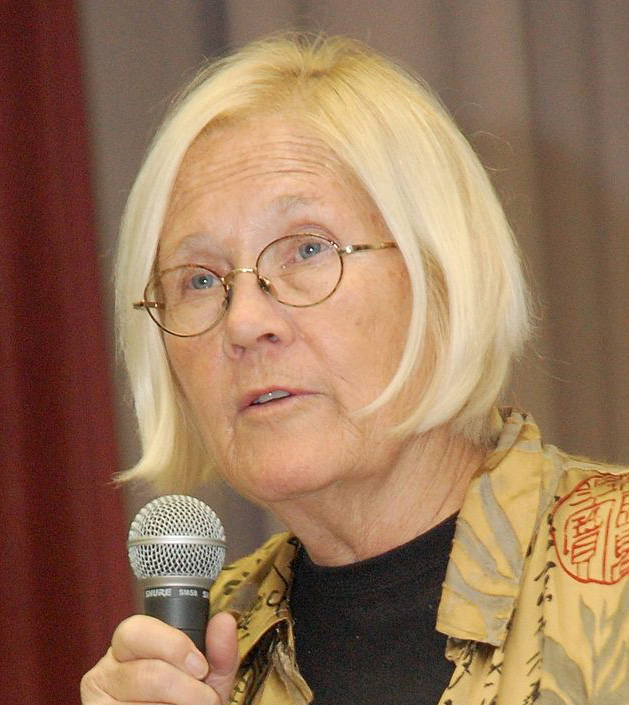
Ann Wright is a retired United States Army colonel and retired U.S. State Department official.
She was one of three State Department officials to publicly resign in direct protest of the 2003 Invasion of Iraq.
Since that time Colonel Wright has been a dedicated peace activist.
Ann can be reached at annw1946@gmail.com.



Six injured after knife attack at Kurdish demonstration in Antwerp
Incident outside Opera House that left two people in critical condition is not being investigated as terrorism, police say
Nadeem Badshah
Thu 22 Jan 2026 23.59 CET
Share
Six people have been injured after a knife attack at a demonstration in Belgium on Thursday evening, police said.
Two of the victims were in a critical condition in hospital after the incident in the port city of Antwerp near the Operaplein (Opera Square), police spokesperson Wouter Bruyns said.
Bruyns said police apprehended the two suspects who, based on initial findings, had mingled with the demonstrators.
Four of the people who were stabbed were found in the square, with two others nearby in the vicinity of Rooseveltplaats and Sint-Elisabethstraat, local reports suggested.
Police said the incident was being investigated as a case of attempted murder, “not terrorism”, and that officers were looking at CCTV footage to ensure no other suspects had evaded arrest.
The demonstration outside the Opera House, attended by about 50 people, was initially peaceful, according to the newspaper Het Laatste Nieuws.
Flags of the Kurdistan Workers’ party and national flags were waved during the protest in support of Kurds in northern Syria, where Kurdish-led forces have been fighting a government advance.
However, shortly after the demonstration ended at about 7.20pm local time, the situation escalated.
Orhan Kilic, a spokesperson for Navbel, a group representing the Kurdish diaspora in Belgium, said families, women, young people and children attended the protest.
He said: “Just as the protest was disbanding, the Kurdish demonstrators were attacked by a group of men.
“These men had sneaked into the demonstration and suddenly pulled out knives and began stabbing people indiscriminately.
“It is clear that this attack is not an isolated instance of senseless violence, but a motivated attack on a community.”
Forensic officers were seen at the square, and police have urged people to stay away from the area.
https://www.theguardian.com/world/2026/jan/22/six-injured-after-knife-attack-at-kurdish-demonstration-in-antwerp-belgium?utm_source=kurir&utm_medium=web_article&utm_campaign=adria_internal
Trump needs to be locked up for a long prison sentence.
I hope that Guantanamo torturer and chief guard Ron de Santis will kill the biblical beast (DUMP) one day.
https://gospanews.net/2026/01/04/diaboliche-menzogne-dellanti-cristo-trump-vaccini-killer-di-fauci-genocidi-sionisti-rapito-il-cristiano-maduro-per-finta-guerra-ai-narcos-usati-dalla-cia/