The condemnation by local, national and international labor organizations of the illegal January 3, 2026, U.S. attack on Venezuela and the kidnapping of President Nicolás Maduro and his wife, Cilia Flores, is a welcome development.
The AFL-CIO has declared, succinctly and without elaboration, “We join the international labor community in condemning President Trump’s unconstitutional actions in Venezuela.”
The Labor Council for Latin American Advancement (LCLAA) released a similar statement.
Both major international labor confederations, the ITUC (International Trade Union Confederation) and the anti-imperialist and non-aligned World Federation of Trade Unions (WFTU), denounced the U.S. attacks on Venezuela.
Resolutions have been passed by the United Electrical Workers (UE) and the Professional Staff Congress representing staff at the City University of New York (CUNY). The San Francisco Labor Council passed a resolution on December 8, 2025, a month before the January 3rd attacks, denouncing the threat of war with Venezuela and declaring itself a “Peace Labor Council.”
Five United Auto Workers union locals representing 28,000 workers have denounced the attacks and called for the release of Maduro and Flores, adding the “demand that our tax dollars be used to meet social needs, not to bankroll imperialist war.” The May Day Strong Coalition called for January 10th protests across the U.S. at Citgo and Chevron stations.
Some unions have been speaking out in solidarity with Venezuela for years. The Chicago Teachers Union sent members to Venezuela in 2017 and, in 2019, passed a prescient resolution that the CTU will
“…advocate for the suspension of the current sanctions against Venezuela, and for the U.S. to cease all threats, military mobilization, and interference in the economic and internal politics and affairs of the Venezuelan people….”
While these resolutions correctly denounce the assaults and threats to Venezuela, they do not call for systemic change within the AFL-CIO, whose Solidarity Center has a long history of collaboration with U.S. government regime-change efforts.
Perhaps this explains why the federation’s labor resolution stopped short of calling for the release of Maduro and Flores.
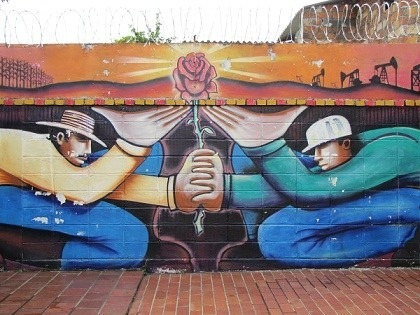
An exception is the Tucson National Writers Union’s unanimous passage, on January 13, 2026, of the No War on Venezuela—Build Peace, Unity, and Trust Among Workers Worldwide resolution. That resolution will be sent to the national union for passage and forwarded to the AFL-CIO. Similar measures are being considered by other unions. The Tucson NWU resolution calls for systemic change so that the AFL-CIO’s Solidarity Center will never again collaborate with regime-change activities in the name of U.S. labor.
Labor has a clear opportunity to fix the broken system of AFL-CIO international relations.
While the AFL-CIO may be hoisting a banner of peace and non-intervention at the present moment, only by systemic change can it reverse its support of U.S. imperialism.
The Solidarity Center is the AFL-CIO’s organization that oversees its foreign policy program.
It is historically 90-96% funded by the U.S. government. Solidarity Center policies have not been developed in consultation with unions and union members, however, but with the State Department and the Center’s other core partners in the National Endowment for Democracy (NED): the International Republican Institute, the National Democratic Institute, and the Centers for International Private Enterprise (of the U.S. Chamber of Commerce).
Since its founding by President Ronald Reagan in 1983, NED has channeled approximately $1 billion to the AFL-CIO for its operations in Venezuela and 70 countries or so around the world.
The Trump administration has orphaned the NED and, thus, the Solidarity Center, by gutting USAID (United States Agency for International Development), through which its funding flows, and acted to severely restrict the machinery of “soft coups” in favor of a more direct and belligerent approach.
Cut off from the U.S. government teat and rather than embrace independence, the Solidarity Center filed suit in April of last year to reclaim more than $80 million in federal funding.
But if there is any truth to the idea that crisis creates opportunity, both the crisis of world affairs and internal crisis at the Solidarity Center have done just that.
The AFL-CIO is presented with a grand opportunity to come clean and establish itself as a truly independent confederation that advances the true international interests of labor: AFL-CIO should seize the opportunity to build worker-to-worker, union-to-union solidarity that is set and implemented and funded by unions, not by whoever happens to be presiding at the White House.
Even a much lower funded international solidarity program would better serve workers than hidden activities and foreign interference directed by Capitol Hill and Wall Street.
Labor independence and anti-war sentiment have been growing since the groundbreaking passage of Resolution 53—“The War in Iraq”—at the 2005 national convention in Chicago.
That resolution, brought forward by U.S. Labor Against the War, was the first time the AFL-CIO had criticized a U.S. war and formally broken with the official edicts of U.S. international relations.
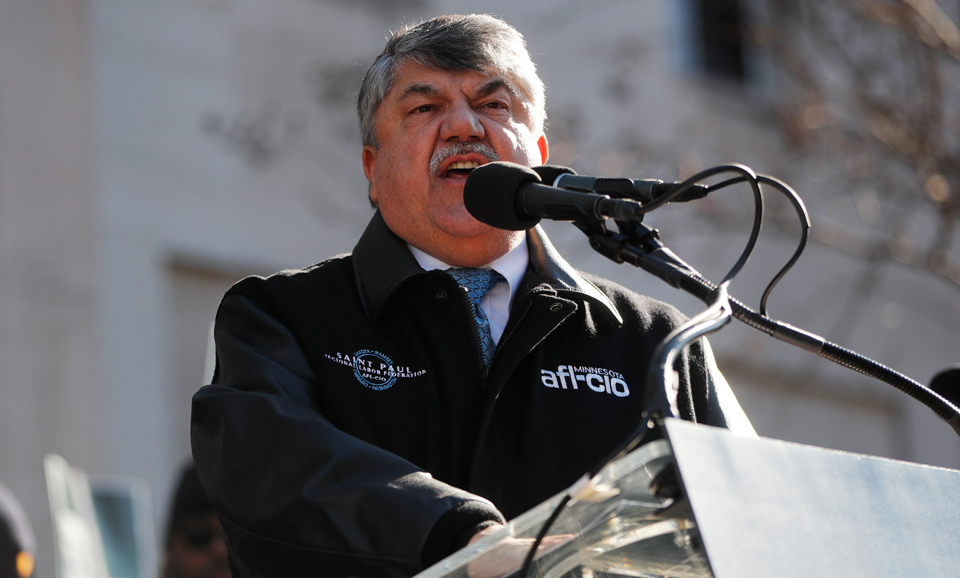
Since then, there have been more examples: One was in 2019 when then-AFL-CIO President Richard Trumka denounced the U.S.-supported coup in Bolivia.
What has not occurred recently has been a call for labor to reckon with its long history of collaboration with U.S. government regime-change institutions and the electoral interference, coups and coup attempts, and wars that are the tools of the imperialist trade.
Criticizing the Solidarity Center and demanding that it open its books and wean itself from U.S. government funding and oversight is aimed at building relations and avenues for labor internationalism that emanate from and represent workers, be they through a reformed and restructured Solidarity Center, or its closure in favor of other avenues of worker-to-worker solidarity.
The question of whether the Solidarity Center engages in good activities or not is not the point. Few deny that the Solidarity Center has undertaken useful activities that have benefited workers’ struggles internationally. Unfortunately, good work can also function to provide cover for and divert attention from more troublesome undertakings.
For the Solidarity Center, even the “good work” is connected to a strategy of depoliticizing labor struggles abroad. We see this revealed by a WikiLeaks cable dated August 11, 2008, entitled COLOMBIAN UNIONS, IDEOLOGY, AND THE ARMED CONFLICT, which states,
“Labor advocacy groups complain that Colombia’s three main confederations focus too much on politics, hindering efforts to improve wages and worker conditions….Rhett Doumitt [of the Solidarity Center’s Colombia and Venezuela office]…complained of a “Stalinist” approach taken by Communist and other hard-left labor leaders within the CUT….Doumitt complains that the politics of the labor movement in Colombia impede positive, practical advances on labor issues.”
Despite this, the Solidarity Center often supports center-right political activities by unions. The Solidarity Center has supported right-wing movements and even coup attempts in Venezuela. In Haiti, it supported a labor organization that called for President Jean-Bertrand Aristide to step down, refusing to defend the elected government in the midst of a bloody International Republican Institute-orchestrated coup. During this time, the Solidarity Center gave nothing to the largest union in the country, the CTH (Confederation of Haitian Workers), which was heavily repressed.
In Colombia, I personally have heard testimony by various unions about the right-leaning influence of the Solidarity Center on the traditionally left-leaning CUT (Unitary Workers Center). This corroborates testimony from a long-time member of the Pipefitters Union and labor and international solidarity activist, the late Fred Hirsch, who reported as far back as 2002 that, “I interviewed, on camera, Domingo Rafael Tovar Arrieta, one of the top officers of the Central Unitaria de Trabajadores (CUT)….He told me that the Solidarity Center had been working within the CUT to divide it and steer it in a rightward direction.”

Because of the lack of open books on its finances and operations, it is impossible to fully assess Solidarity Center activities, be they “good” or “bad.” Their books have essentially become Labor’s own “Epstein files.” Despite years of union members calling for “the files to be released,” the response has been silence.
What we do know gives workers reason to ask questions and to make demands. The AFL-CIO long provided cover for the CIA and U.S. regime change in other countries through its old system of “Institutes” covering different areas of the globe.
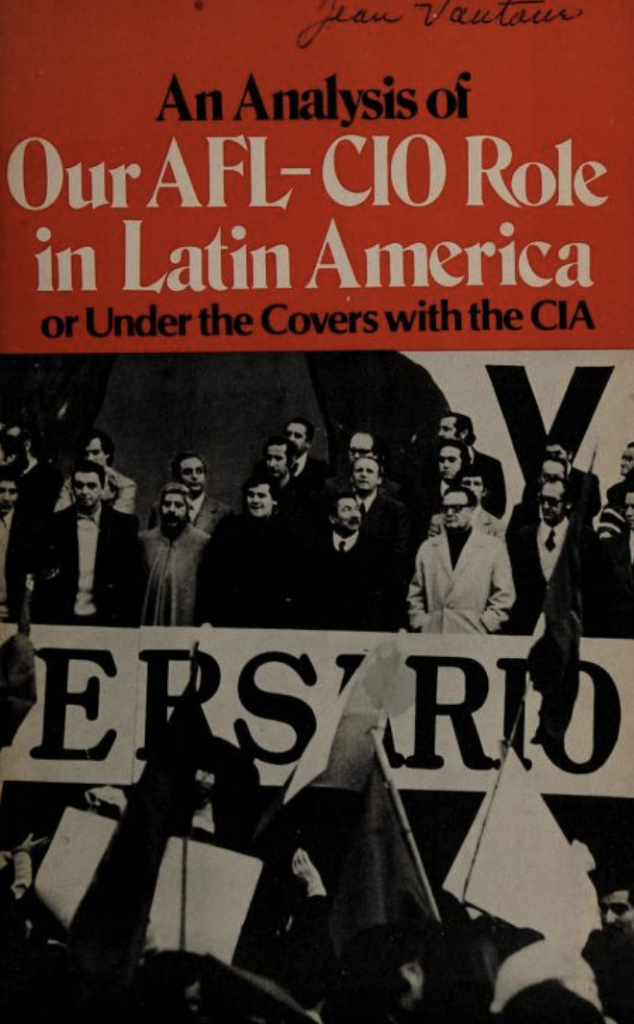
In 1973, the American Institute for Free Labor Development (AIFLD) played a supportive role in the overthrow of Chile’s President Salvador Allende by Augusto Pinochet, according to Hirsch, who wrote the pamphlet exposing the collaboration of the AFL-CIO.
During the 1980s, a massive movement against U.S. policies in Central America significantly impacted affected labor unionists, helping secure an AFL-CIO-wide change in leadership in 1995 with the election of John J. Sweeney as AFL-CIO President.
In 1997, Sweeney replaced the institute system with a new organization for international relations, American Center for International Labor Solidarity (ACILS), initially informally known as the Solidarity Center, although that has now been changed to its formal name.
The Solidarity Center was supposed to herald in a new era of openness and labor engagement.
However, the appointment of Harry Kamberis as director was a clear signal that the connection with the Institute system was not completely broken. Kamberis was formerly the program director for the Asian-American Free Labor Institute. Labor sociologist Kim Scipes writes,
“And should there be any remaining doubt on this issue, it was a man—Harry Kamberis—who had worked in both the Philippines and South Korea during times of incredible labor repression by states and labor movements supported by the AFL-CIO, a former U.S. State Department official, that Mr. Sweeney promoted to serve as the head of the American Center for International Labor Solidarity.”
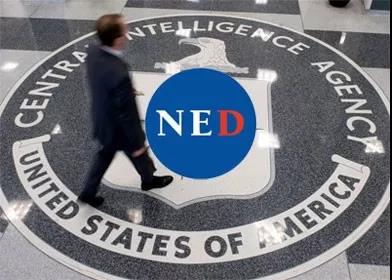
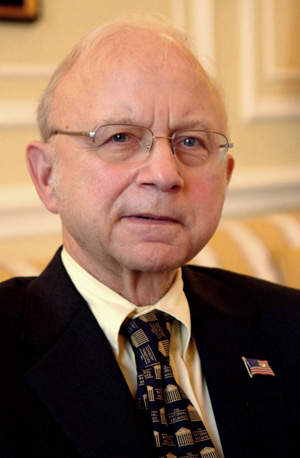
Under Kamberis, the Solidarity Center became one of the four core institutes of NED. The mission of the NED, as with the Solidarity Center, was considered a more open replacement for CIA activities.
There is virtually no reporting about the interventionist nature of the NED that does not include the following quotation, so far be it from this article to break that tradition. In a 1991 interview with The Washington Post, NED co-founder Allen Weinstein said, “A lot of what we do today was done covertly 25 years ago by the CIA.”
The sense of betrayal felt by many from the grassroots international labor community was deep, especially among those Central America solidarity activists who had played such a pivotal role in the changes they hoped for under the Sweeney administration.
This reached new levels when it was revealed that the Solidarity Center had channeled hundreds of thousands of dollars to the right-wing labor Confederation of Venezuelan Workers (CTV, Confederación de Trabajadores de Venezuela) during the coup attempt against President Hugo Chávez in 2002.
Scipes explains in another article:
“…NED provided $4,039,331 to Venezuelan and American organizations working in Venezuela between 1992 and 2001: 60.4 percent of that, or $2,439,489 was granted between 1997-2001. Of that $2.4-plus million since 1997, $587,926 (or almost one-quarter) went to ACILS for its work with the Confederation of Venezuelan Workers (CTV in Spanish). In 2002, the last year for which details are available, NED pumped in another $1,099,352, of which ACILS got $116,001 for its work with CTV. Altogether, ACILS received $703,927 between 1997-2002 for its work in Venezuela alone. [During 2000-2001, ACILS received $8,889,009 from NED for its worldwide operations.]
The AFL-CIO gives a different accounting. Stanley Gacek, the Assistant Director of the AFL-CIO’s International Affairs Department, writing in the Spring 2004 issue of New Labor Forum, claims “…our total solidarity program with the CTV amounted to less than $20,000 in support of the Confederation’s highly successful internal democratization process….”
Yet what has been that work in Venezuela for which the Solidarity Center claims it was paid only $20,000 but which NED reports as costing over $700,000?
…According to a report to be published in New Labor Forum by Robert Collier… the CTV has worked with FEDECAMARAS, the nation’s business association, to carry out general strikes/lockouts of in December 2001, March-April 2002, and December 2002-February 2003….
Professor Hector Lucena, another labor observer, reports that these April actions were led by the CTV and joined by FEDECARAMAS. Christopher Marquis of The New York Times reported on April 25, 2002, ‘…the Confederation of Venezuelan Workers led the work stoppages that galvanized the opposition to Mr. Chavez. The union’s leader, Carlos Ortega, worked closely with Pedro Carmona Estanga, the businessman who briefly took over from Mr. Chavez, in challenging the government.’ Further, Collier reports, ‘For months before, CTV Secretary-General Carlos Ortega created a tight political alliance with FEDECAMARAS leader Pedro Carmona, and they repeatedly called for the overthrow of Chavez.’ In short, Collier concludes that ‘…in Venezuela, the AFL-CIO has…supported a reactionary union establishment as it tried repeatedly to overthrow President Hugo Chavez—and in the process, wrecked the country’s economy.’”
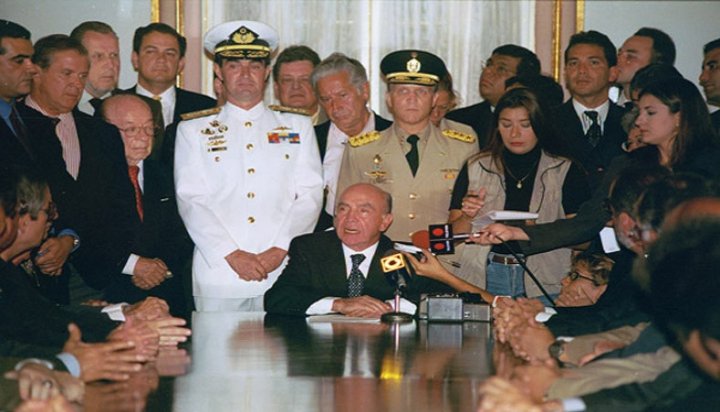
Fortunately, the April 2002 coup was short-lived. Venezuela’s workers and their families poured into the streets of Caracas and successfully demanded Chávez’s return. However, since the coup’s failure, the Solidarity Center has not ceased activities in Venezuela which can be described to the present day as taking place in the shadows. About a month before the coup took place, the Venezuela office of the Solidarity Center moved from Caracas to its current location in Bogotá, Colombia, where it coordinates work in both Colombia and Venezuela.
Tim Gill has written extensively about Solidarity Center involvement in Venezuela between 2006 and 2014 in a piece published for Jacobin titled “Newly Revealed Documents Show How the AFL-CIO Aided US Interference in Venezuela.” Gill shows how the Solidarity Center tried to influence and direct internal discussions within the Venezuelan labor movement, helped organize meetings of opposition leaders, continued to bolster the CTV, while helping organize a new labor federation to oppose the Chávez government from the left.
After 2014, little is known about Solidarity Center activities in Venezuela. Regarding the NED as a whole, in 2021, it designated some $4,562,625 for activities in Venezuela. That is a more than $2 million increase over 2020’s already-significant total funding for grants equaling $2,432,932.
There was another $1,234,000 in regional grants that were either intended partially for activities in Venezuela, or were wholly directed toward Venezuela, but listed nonetheless as regional grants. One such example is a $250,000 allocation for “Tracing Chinese Financing to Venezuela.”
It becomes clear, then, that NED funding has constituted a black budget for U.S. regime-change efforts in Venezuela that is worth millions of dollars on an annual basis.
The Solidarity Center receives a minimum of hundreds of thousands of dollars every year for their Colombia/Venezuela office. I wrote in a related article published by the Orinoco Tribune in October 2021, that
“The Solidarity Center’s activities in Venezuela and Colombia skyrocketed last year. Funding from the mis-named National Endowment for Democracy (NED) soared to almost 60% over the previous year’s awards. The 2020 funding, alone, represents over 40% of the total for similar grants for the last five years on record ($3,617,000). In 2020, the Solidarity Center’s Bogotá office received $1,470,000 in regional NED funding. That is up from $626,000 in 2019….
The Solidarity Center works closely with long-time partners, the Confederation of Venezuelan Workers (CTV, for Confederación de Trabajadores de Venezuela), as well as the Labor Solidarity Movement (MSL for Movimiento de Solidaridad Laboral), which includes current and former CTV officials in its leadership, as well as Orlando Chirino, who was a candidate for president of Venezuela against Hugo Chávez in 2012. According to Tim Gill, ‘In its 2010 program description, the SC [Solidarity Center] bluntly states that it helped form the coordinating body [for the MSL], which was ‘launched in an [SC]-supported national conference in July 2009’.’”
What reporting that exists about Solidarity Center activities in Venezuela is notable for its vagueness. Based on my own research of NED records, partners are unnamed, language is general, and projects are described in the most non-descriptive terms possible.
For one 2020 grant for activities for $626,000, and for a supplemental grant of $199,000, or $825,000 in total, the description only says it is from the NED to the Solidarity Center (listing no on-the-ground partners in Venezuela or Colombia), “To address the closing space for civil society and the growing repression of democratic freedoms in Venezuela…and defend recent gains in fundamental labor rights in Colombia….”
The final 2020 grant from the NED, explicitly to the Solidarity Center for
Venezuela-related activities, is a $645,389 grant for projects with Venezuelan migrants,
“To promote the human and labor rights and the democratic participation of workers in Colombia, Ecuador, Brazil, and Peru, the center will develop the capacity of its union partners to build relationships with Venezuelan migrant workers to collectively advocate for decent work and promote greater respect for labor rights.”
One might question how a grant to give much-needed support for Venezuelan migrants might contribute to destabilization of the elected government inside Venezuela.
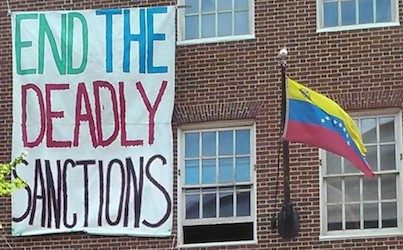
However, with an examination of the overall approach of the U.S. toward Venezuela, we can see that it is literally the U.S.-enforced blockade and sanctions against Venezuela that are at the foundation of economic disruptions, shortages, and poverty in the country today and, thus, the main impetus behind the migration crisis.
Most of the grants for supporting Venezuelan migrants have been for operations in Colombia and Peru, traditionally the U.S.’s two closest allies in South America and hosts of the largest U.S. troop concentrations.
Colombia is an official “Global Partner” with NATO, and there has been discussion about bringing in Peru. In effect, Solidarity Center support for Venezuelan migrants is a way of addressing the negative effects to our closest allies of the sanction regime that has displaced so many.
As usual, who is getting the funds is not mentioned, nor any details of what activities are being undertaken. The very few times a recipient of grants is named in NED records, we find the funds are not going directly to actual Venezuelans. They are almost invariably grants “awarded” to various of the core institutes that make up the NED, including the Solidarity Center. Basically, the NED is informing us that it has awarded these grants to itself. Who they are further distributed to is not for labor’s rank-and-file to know.
This is in contrast to descriptions for most other countries that receive NED funding. While the grant descriptions are also vague, they do usually give the titles of recipients. That at least gives something to go on for those pursuing more in-depth investigations. Grants for Venezuela, Nicaragua, and a few other especially targeted countries are unusual in that they are vague to the point of saying nothing.
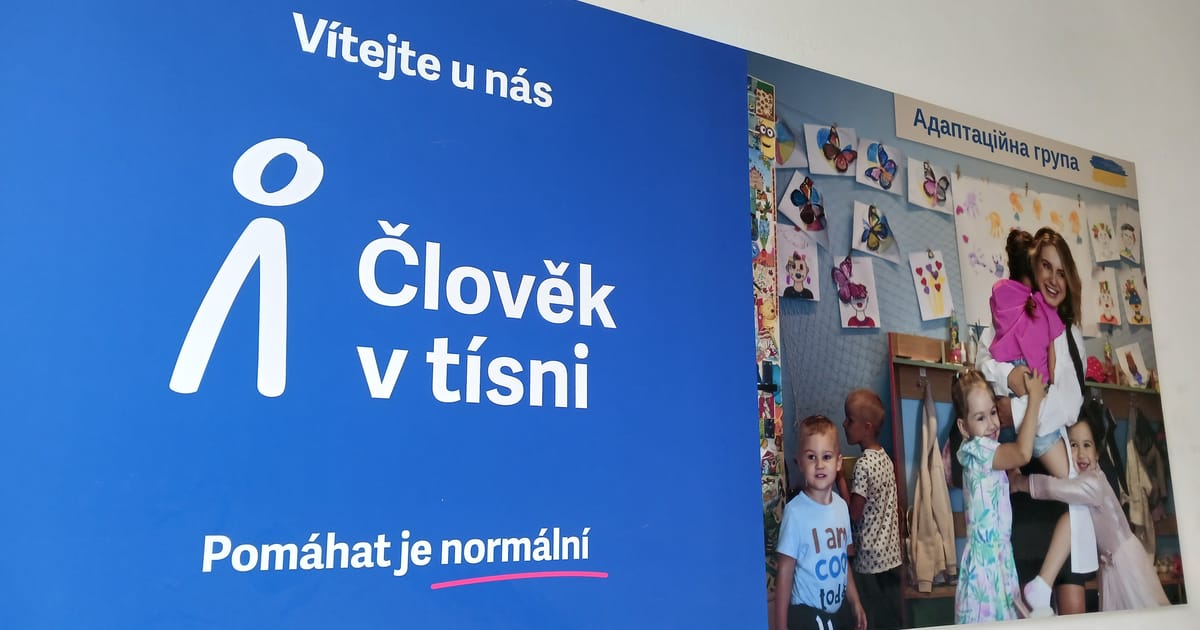
If we look at the Venezuela-related grants for 2020, we will see the only other case I could find from the years 2020 and 2021 where an actual recipient of NED funds was named. It was a 2020 grant to “Clovek v tisni, o.p.s. (People in Need).”
Clovek v Tisni is a Czech organization that has received funding in the past from the NED, including for its work against the socialist government of Cuba. It is also involved in documenting war crimes by Russia in Ukraine as part of the information war directed against Russia and financing anti-Russian media, which indicated further intelligence connection.
In reports for South America funding for 2021, we find the Solidarity Center received $975,000 through the National Endowment for Democracy for activities in Colombia and Venezuela. It received another $975,000 for its activities in Ecuador and Peru.
But even though these figures are already high, they are dwarfed by the recent $12 million awarded in 2022 by the Department of Labor to the Solidarity Center for its activities in Peru, Brazil and Colombia. (As previously mentioned, the Colombia Solidarity Center office doubles as the headquarters for Venezuela.)
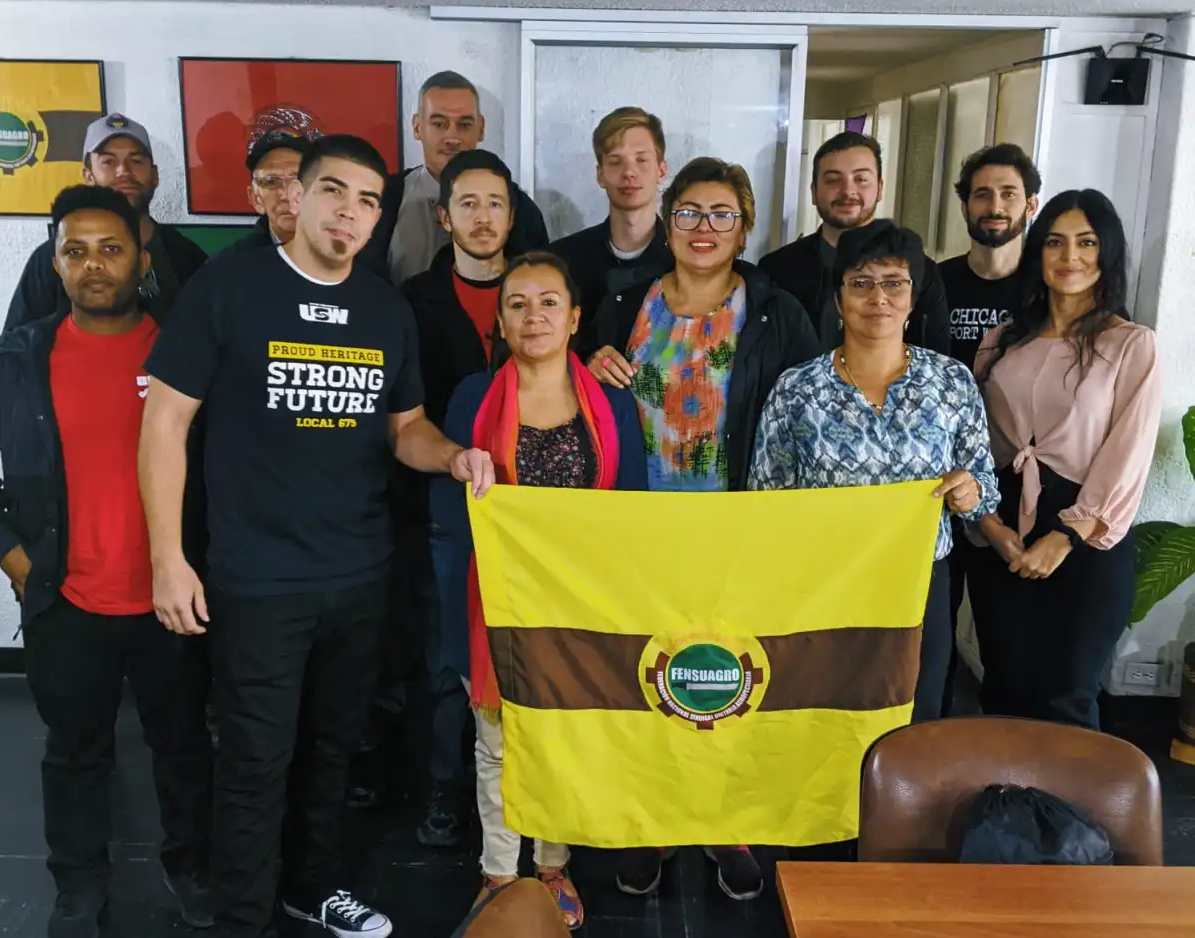
It bears mention that U.S. solidarity with Colombian unions has often been presented as an example of the good work the Solidarity Center is doing. Yet, in 2009, the Solidarity Center acted against the establishment of an ongoing relationship between the U.S. Steelworkers and FENSUAGRO, the largest confederation of Colombian farmers and farm workers, and what many have described as the most persecuted union in the most dangerous place in the world to be a union member.
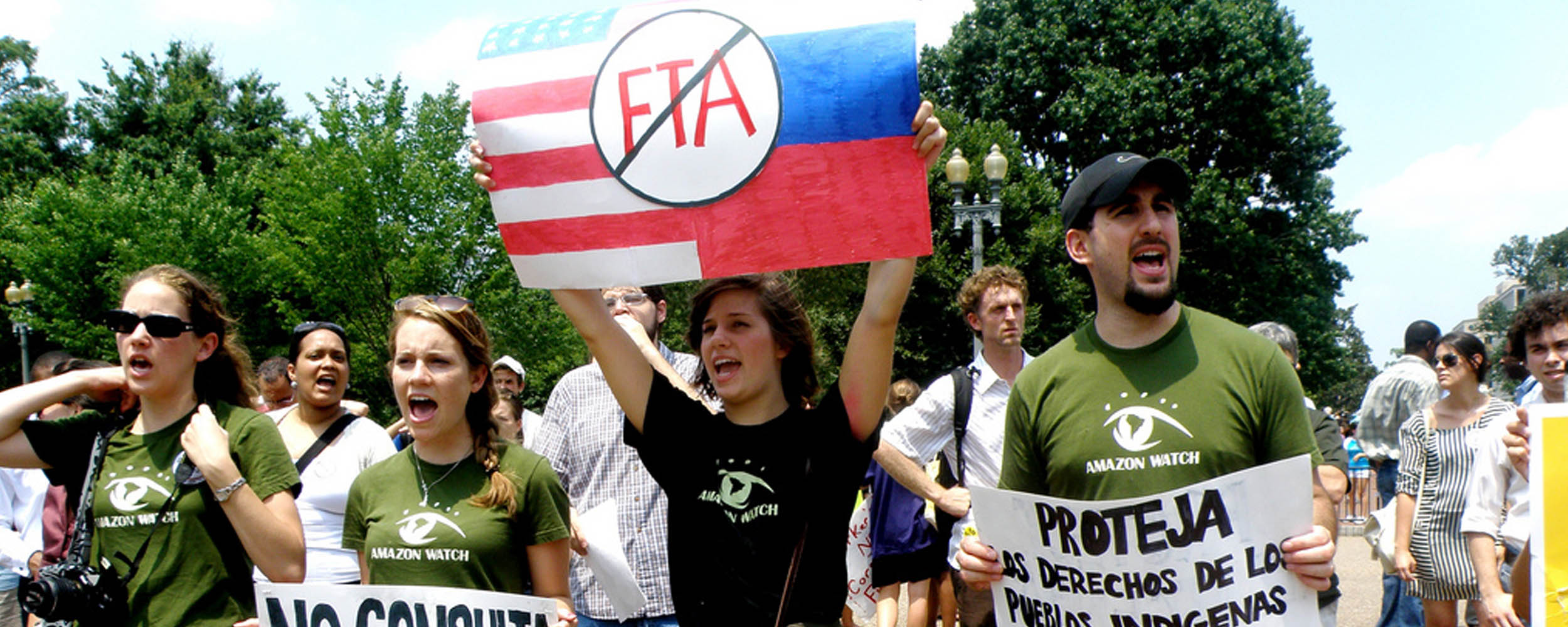
That same year, the Solidarity Center was meeting with the U.S. Embassy to give advice regarding their efforts to build union organizations that would support a U.S.-Colombia Free Trade Agreement, despite the fact that Colombian and U.S. unions were mobilizing to defeat the agreement.
Andrea Lobo writes in her September 12, 2024, article, “The AFL-CIA’s Solidarity Center expands operations in Latin America,” that
“The American trade union federation operates internationally through its misnamed Solidarity Center, which was granted a budget of $15 million for Latin America and the Caribbean in 2022, according to its latest yearly report. This represented a massive jump of between 58 and 138 percent above all other years reported on its website since 2010. Globally, the Center has also more than doubled its budget in this period and has opened offices in numerous new countries.”
It is important and illustrative for us to return to the fateful year of 2005, and the AFL-CIO convention in Chicago that summer. It was a difficult convention in that it was when Change to Win—formed by a number of major AFL-CIO affiliates—split away from the AFL-CIO. But it was a promising one, too, with the passage of U.S. Labor Against the War (USLAW) Resolution 53: The War in Iraq.
This was the first resolution passed by the AFL-CIO that broke with U.S. foreign policies. The resolution called for the government to bring its soldiers home “rapidly.”
The “Build Unity and Trust Among Workers Worldwide” resolution was also brought to the AFL-CIO convention that year. That resolution had been authored by Fred Hirsch and fellow unionist Dave Welsh and was originally passed by the South Bay Labor Federation, before being passed unanimously by the California Labor Federation.
It would soon be passed, as well, by the Pima Area Labor Federation in Arizona, the Washington State Labor Federation, the New York City Central Labor Council, as well as other labor organizations.
The Worker-to-Worker Solidarity Committee was formed by union, anti-war, and solidarity activists to campaign for its passage.
The resolution was a result of concern regarding the Solidarity Center’s support for the Venezuelan coup attempt of 2002, as well as the Solidarity Center’s negative role during the overthrow of the elected government of Haiti under President Jean-Bertrand Aristide.
The campaign was further motivated by the collaborative role the Solidarity Center under Kamberis was playing in the occupation of Iraq. The irony was not lost that, while the USLAW resolution against the war was receiving significant support, the Solidarity Center was still operating in the shadows in Iraq.
In fact, top leadership of the AFL-CIO, the International Affairs Department, and the Solidarity Center participated regularly in meetings organized by the State Department of the Advisory Committee on Labor Diplomacy to discuss state building and “diplomacy and security” in places like Afghanistan, Israel/Palestine, and Iraq.
“…George W. Bush called for doubling the NED’s Middle East budget to $40 million. Within two days, AFL-CIO President John Sweeney said that ‘training and other kinds of support from the international trade union movement should be encouraged’ in Iraq. He has since applied for $3-5 million in grants from the NED.
That money would be used to smother independent labor organizing by leftist groups such as the Union of the Unemployed in Iraq (UUI), which has sponsored and supported strikes and demonstrations for jobs and against the U.S. occupation.”
According to the Solidarity Center’s then-Director Kamberis, “Republican administrations tend to see trade unions as part of a civil society that is dedicated to democracy and building democracy abroad…They see it as important to U.S. strategic interests.”
The Unity and Trust resolution would not pass the 2005 convention vote. Its discussion was delayed until the very end of the convention, when most delegates had left or were leaving. During that discussion, the head of the convention’s Resolutions Committee, AFSCME President Gerald McEntee, cut off discussion and called for a vote before letting supporters of the resolution speak, even though there were delegates lined up to do so.
But the effort was not a complete loss. The light had been shone on the shadowy nature of the Solidarity Center to a much larger audience of union members than had been previously reached.
Two months after the convention, Kamberis stepped down from his position as director. In 2005, members of the Worker-to-Worker Solidarity Committee were less than welcome in many labor discussions. That situation has reversed remarkably.
I was a member of that committee and can attest to the open reception I received when I went to the 2012 AFL-CIO convention in Los Angeles. I was invited into proceedings even though I was not a delegate. I was allowed to pass out literature I had, and when I brought questions about the Solidarity Center to workshops, I was not cut off, and my questions were discussed and answered.
Trump’s cutting off money to USAID is an opportune moment to bring meaningful systemic change to how U.S. labor conducts its international relations, rather than clinging to old practices that are anachronistic and reactionary in today’s context. This is not the time for the Solidarity Center to be suing the Trump administration to release its federal monies to them, and to let them back to a State Department table presided over by Marco Rubio. Rather, this is the time for labor to end a dysfunctional relationship and plot an independent course.
It would be better to have a vastly underfunded Solidarity Center that nevertheless represents workers, that is funded and operated by workers, rather than a Solidarity Center rolling in cash, but joining the White House and corporate interests in their reactionary projects around the world.
There are other models of international solidarity to be explored. The UE, one of the nation’s largest independent unions, autonomously conducts its own international solidarity affairs. The formation of Unite the Union bringing together the USW with union counterparts in Canada and the UK is an example of independent and international worker-to-worker relations.
The unity of miners in the U.S., Mexico and Peru in struggles with the Grupo Mexico transnational corporation is another. There are much smaller examples—like international work exchanges and investigative delegations, where U.S. unionists partner directly with host unions.
And right now, we are seeing labor unions speak out internationally against the U.S. attack on Venezuela and the threats to other countries such as Palestine, Cuba and Colombia. We are seeing the emergence of independent and militant voices for international solidarity with Venezuela that break with years of subterfuge.
U.S. labor and unions belonging to the AFL-CIO, specifically, have a historic opportunity to create a new era of real international labor solidarity. We have the opportunity to Build Peace, Unity, and Trust Among Workers Worldwide.
We must not pass up this chance. We must push the AFL-CIO to abandon its “labor imperialism” and systematically change for building global labor solidarity.
There are two excellent books, written by labor activists—that extensively detail the AFL and then AFL-CIO foreign policy program—that I highly recommend. The first is by Jeff Schuhrke, titled Blue-Collar Empire: The Untold Story of US Labor’s Global Anticommunist Crusade (Brooklyn, NY: Verso, 2024), which details their operations during the Cold War. (See review in CovertAction Magazine)
The other, a little older, is by Kim Scipes and talks about labor’s foreign policy from the late 1890s until 2007, but which includes a specific look at the AFL-CIO’s operations in Venezuela around the 2002 coup attempt against Hugo Chávez; it is titled AFL-CIO’s Secret War against Developing Country Workers: Solidarity or Sabotage? (Lanham, MD: Lexington Books, 2011).
Scipes has written extensively on this, and his writings can be found on-line for free here.

CovertAction Magazine is made possible by subscriptions, orders and donations from readers like you.
Blow the Whistle on U.S. Imperialism

Click the whistle and donate
When you donate to CovertAction Magazine, you are supporting investigative journalism. Your contributions go directly to supporting the development, production, editing, and dissemination of the Magazine.
CovertAction Magazine does not receive corporate or government sponsorship. Yet, we hold a steadfast commitment to providing compensation for writers, editorial and technical support. Your support helps facilitate this compensation as well as increase the caliber of this work.
Please make a donation by clicking on the donate logo above and enter the amount and your credit or debit card information.
CovertAction Institute, Inc. (CAI) is a 501(c)(3) non-profit organization and your gift is tax-deductible for federal income purposes. CAI’s tax-exempt ID number is 87-2461683.
We sincerely thank you for your support.
Disclaimer: The contents of this article are the sole responsibility of the author(s). CovertAction Institute, Inc. (CAI), including its Board of Directors (BD), Editorial Board (EB), Advisory Board (AB), staff, volunteers and its projects (including CovertAction Magazine) are not responsible for any inaccurate or incorrect statement in this article. This article also does not necessarily represent the views the BD, the EB, the AB, staff, volunteers, or any members of its projects.
Differing viewpoints: CAM publishes articles with differing viewpoints in an effort to nurture vibrant debate and thoughtful critical analysis. Feel free to comment on the articles in the comment section and/or send your letters to the Editors, which we will publish in the Letters column.
Copyrighted Material: This web site may contain copyrighted material the use of which has not always been specifically authorized by the copyright owner. As a not-for-profit charitable organization incorporated in the State of New York, we are making such material available in an effort to advance the understanding of humanity’s problems and hopefully to help find solutions for those problems. We believe this constitutes a ‘fair use’ of any such copyrighted material as provided for in section 107 of the US Copyright Law. You can read more about ‘fair use’ and US Copyright Law at the Legal Information Institute of Cornell Law School.
Republishing: CovertAction Magazine (CAM) grants permission to cross-post CAM articles on not-for-profit community internet sites as long as the source is acknowledged together with a hyperlink to the original CovertAction Magazine article. Also, kindly let us know at info@CovertActionMagazine.com. For publication of CAM articles in print or other forms including commercial internet sites, contact: info@CovertActionMagazine.com.
By using this site, you agree to these terms above.
About the Author
AFL-CIO Must Break Its Ties with U.S. Imperialism
By James Patrick Jordan
[Source: indybay.org]
The condemnation by local, national and international labor organizations of the illegal January 3, 2026, U.S. attack on Venezuela and the kidnapping of President Nicolás Maduro and his wife, Cilia Flores, is a welcome development.
The AFL-CIO has declared, succinctly and without elaboration, “We join the international labor community in condemning President Trump’s unconstitutional actions in Venezuela.”
The Labor Council for Latin American Advancement (LCLAA) released a similar statement.
Both major international labor confederations, the ITUC (International Trade Union Confederation) and the anti-imperialist and non-aligned World Federation of Trade Unions (WFTU), denounced the U.S. attacks on Venezuela.
Resolutions have been passed by the United Electrical Workers (UE) and the Professional Staff Congress representing staff at the City University of New York (CUNY). The San Francisco Labor Council passed a resolution on December 8, 2025, a month before the January 3rd attacks, denouncing the threat of war with Venezuela and declaring itself a “Peace Labor Council.”
Five United Auto Workers union locals representing 28,000 workers have denounced the attacks and called for the release of Maduro and Flores, adding the “demand that our tax dollars be used to meet social needs, not to bankroll imperialist war.” The May Day Strong Coalition called for January 10th protests across the U.S. at Citgo and Chevron stations.
Some unions have been speaking out in solidarity with Venezuela for years. The Chicago Teachers Union sent members to Venezuela in 2017 and, in 2019, passed a prescient resolution that the CTU will
“…advocate for the suspension of the current sanctions against Venezuela, and for the U.S. to cease all threats, military mobilization, and interference in the economic and internal politics and affairs of the Venezuelan people….”
While these resolutions correctly denounce the assaults and threats to Venezuela, they do not call for systemic change within the AFL-CIO, whose Solidarity Center has a long history of collaboration with U.S. government regime-change efforts.
Perhaps this explains why the federation’s labor resolution stopped short of calling for the release of Maduro and Flores.
An exception is the Tucson National Writers Union’s unanimous passage, on January 13, 2026, of the No War on Venezuela—Build Peace, Unity, and Trust Among Workers Worldwide resolution. That resolution will be sent to the national union for passage and forwarded to the AFL-CIO. Similar measures are being considered by other unions. The Tucson NWU resolution calls for systemic change so that the AFL-CIO’s Solidarity Center will never again collaborate with regime-change activities in the name of U.S. labor.
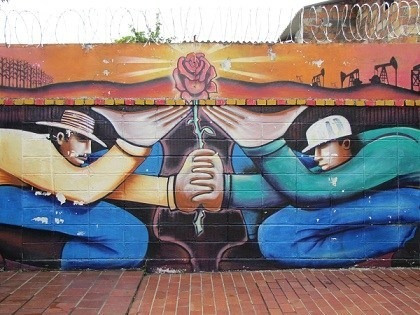
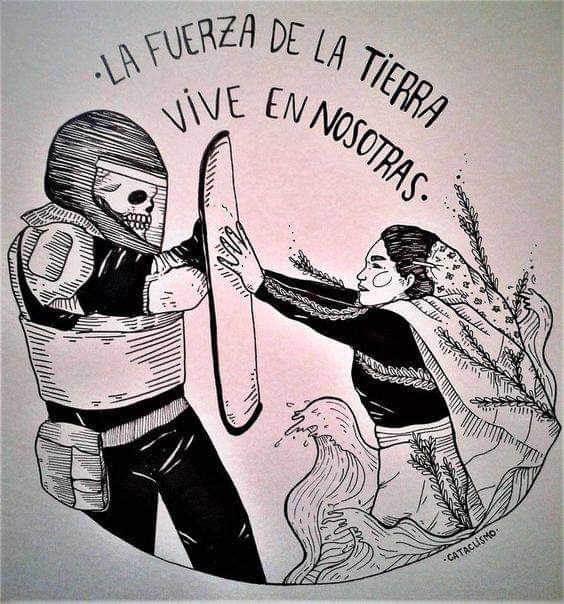
Mural promoting vision of solidarity between laborers in the U.S. and Venezuela. [Source: afgj.org]
Labor has a clear opportunity to fix the broken system of AFL-CIO international relations.
While the AFL-CIO may be hoisting a banner of peace and non-intervention at the present moment, only by systemic change can it reverse its support of U.S. imperialism.
The Solidarity Center is the AFL-CIO’s organization that oversees its foreign policy program.
It is historically 90-96% funded by the U.S. government. Solidarity Center policies have not been developed in consultation with unions and union members, however, but with the State Department and the Center’s other core partners in the National Endowment for Democracy (NED): the International Republican Institute, the National Democratic Institute, and the Centers for International Private Enterprise (of the U.S. Chamber of Commerce).
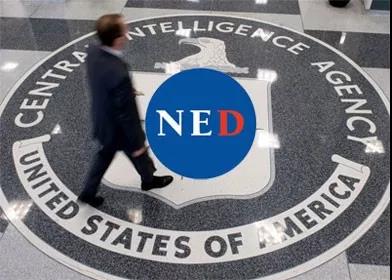
Since its founding by President Ronald Reagan in 1983, NED has channeled approximately $1 billion to the AFL-CIO for its operations in Venezuela and 70 countries or so around the world.
[Source: chinadaily.com]
The Trump administration has orphaned the NED and, thus, the Solidarity Center, by gutting USAID (United States Agency for International Development), through which its funding flows, and acted to severely restrict the machinery of “soft coups” in favor of a more direct and belligerent approach.
Cut off from the U.S. government teat and rather than embrace independence, the Solidarity Center filed suit in April of last year to reclaim more than $80 million in federal funding.
But if there is any truth to the idea that crisis creates opportunity, both the crisis of world affairs and internal crisis at the Solidarity Center have done just that.
The AFL-CIO is presented with a grand opportunity to come clean and establish itself as a truly independent confederation that advances the true international interests of labor: AFL-CIO should seize the opportunity to build worker-to-worker, union-to-union solidarity that is set and implemented and funded by unions, not by whoever happens to be presiding at the White House.
Even a much lower funded international solidarity program would better serve workers than hidden activities and foreign interference directed by Capitol Hill and Wall Street.
Labor independence and anti-war sentiment have been growing since the groundbreaking passage of Resolution 53—“The War in Iraq”—at the 2005 national convention in Chicago.
That resolution, brought forward by U.S. Labor Against the War, was the first time the AFL-CIO had criticized a U.S. war and formally broken with the official edicts of U.S. international relations.
Since then, there have been more examples: One was in 2019 when then-AFL-CIO President Richard Trumka denounced the U.S.-supported coup in Bolivia.
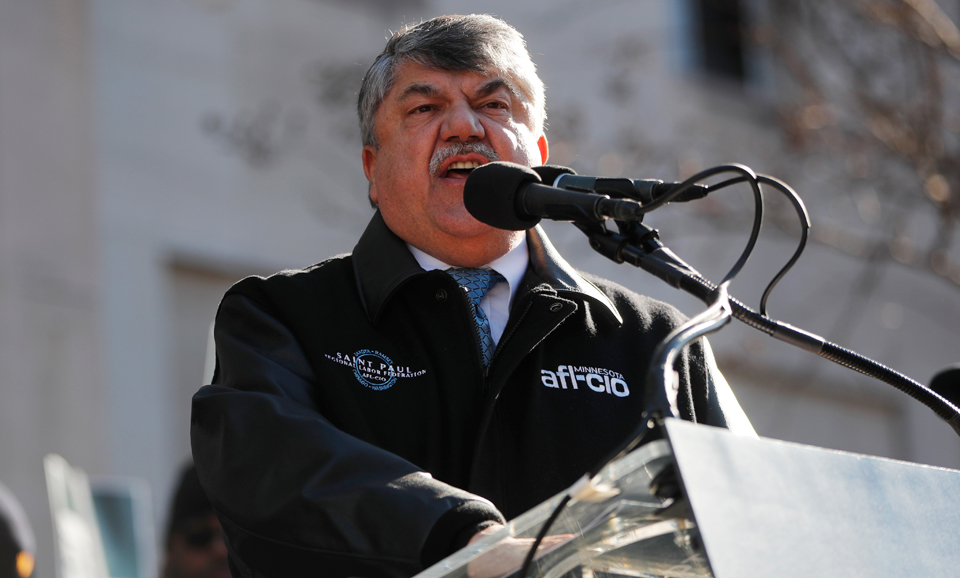
Richard Trumka [Source: peoplesworld.org]
What has not occurred recently has been a call for labor to reckon with its long history of collaboration with U.S. government regime-change institutions and the electoral interference, coups and coup attempts, and wars that are the tools of the imperialist trade.
Criticizing the Solidarity Center and demanding that it open its books and wean itself from U.S. government funding and oversight is aimed at building relations and avenues for labor internationalism that emanate from and represent workers, be they through a reformed and restructured Solidarity Center, or its closure in favor of other avenues of worker-to-worker solidarity.
The question of whether the Solidarity Center engages in good activities or not is not the point. Few deny that the Solidarity Center has undertaken useful activities that have benefited workers’ struggles internationally. Unfortunately, good work can also function to provide cover for and divert attention from more troublesome undertakings.
[Source: colorrevolutionsandgeopolitics.blogspot.com]
For the Solidarity Center, even the “good work” is connected to a strategy of depoliticizing labor struggles abroad. We see this revealed by a WikiLeaks cable dated August 11, 2008, entitled COLOMBIAN UNIONS, IDEOLOGY, AND THE ARMED CONFLICT, which states,
“Labor advocacy groups complain that Colombia’s three main confederations focus too much on politics, hindering efforts to improve wages and worker conditions….Rhett Doumitt [of the Solidarity Center’s Colombia and Venezuela office]…complained of a “Stalinist” approach taken by Communist and other hard-left labor leaders within the CUT….Doumitt complains that the politics of the labor movement in Colombia impede positive, practical advances on labor issues.”
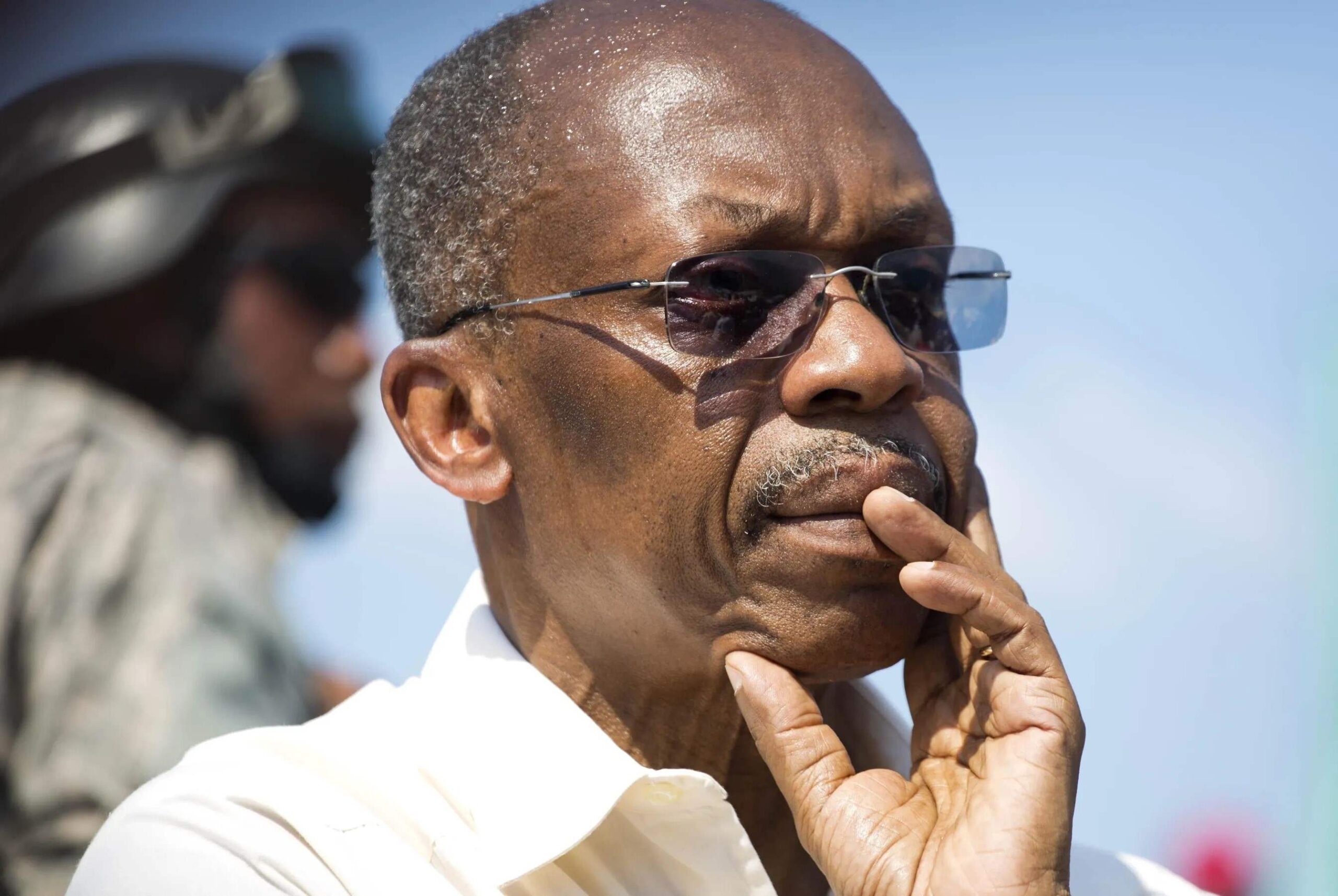
Despite this, the Solidarity Center often supports center-right political activities by unions. The Solidarity Center has supported right-wing movements and even coup attempts in Venezuela. In Haiti, it supported a labor organization that called for President Jean-Bertrand Aristide to step down, refusing to defend the elected government in the midst of a bloody International Republican Institute-orchestrated coup. During this time, the Solidarity Center gave nothing to the largest union in the country, the CTH (Confederation of Haitian Workers), which was heavily repressed.
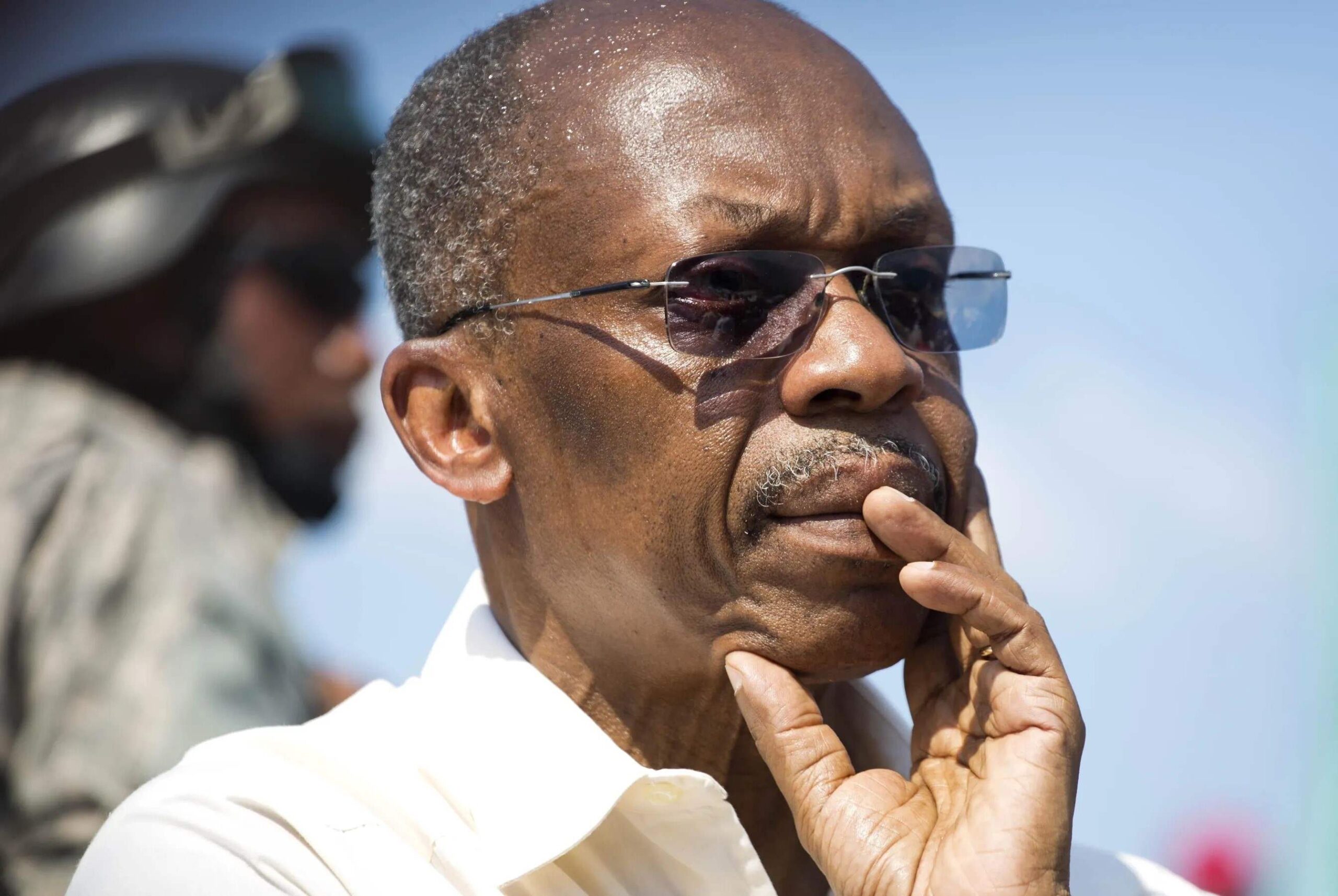
Jean-Bertrand Aristide [Source: facts.net]
In Colombia, I personally have heard testimony by various unions about the right-leaning influence of the Solidarity Center on the traditionally left-leaning CUT (Unitary Workers Center). This corroborates testimony from a long-time member of the Pipefitters Union and labor and international solidarity activist, the late Fred Hirsch, who reported as far back as 2002 that, “I interviewed, on camera, Domingo Rafael Tovar Arrieta, one of the top officers of the Central Unitaria de Trabajadores (CUT)….He told me that the Solidarity Center had been working within the CUT to divide it and steer it in a rightward direction.”

Fred Hirsch [Source: afgj.org]
Because of the lack of open books on its finances and operations, it is impossible to fully assess Solidarity Center activities, be they “good” or “bad.” Their books have essentially become Labor’s own “Epstein files.” Despite years of union members calling for “the files to be released,” the response has been silence.
What we do know gives workers reason to ask questions and to make demands. The AFL-CIO long provided cover for the CIA and U.S. regime change in other countries through its old system of “Institutes” covering different areas of the globe.
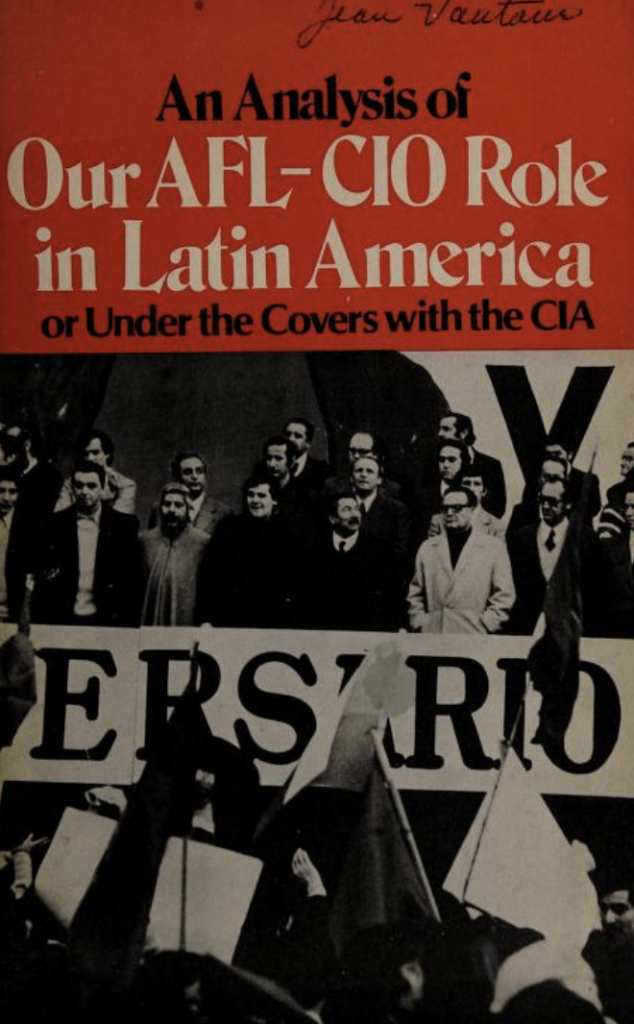
In 1973, the American Institute for Free Labor Development (AIFLD) played a supportive role in the overthrow of Chile’s President Salvador Allende by Augusto Pinochet, according to Hirsch, who wrote the pamphlet exposing the collaboration of the AFL-CIO.
[Source: archive.org]
During the 1980s, a massive movement against U.S. policies in Central America significantly impacted affected labor unionists, helping secure an AFL-CIO-wide change in leadership in 1995 with the election of John J. Sweeney as AFL-CIO President.
In 1997, Sweeney replaced the institute system with a new organization for international relations, American Center for International Labor Solidarity (ACILS), initially informally known as the Solidarity Center, although that has now been changed to its formal name.
The Solidarity Center was supposed to herald in a new era of openness and labor engagement.
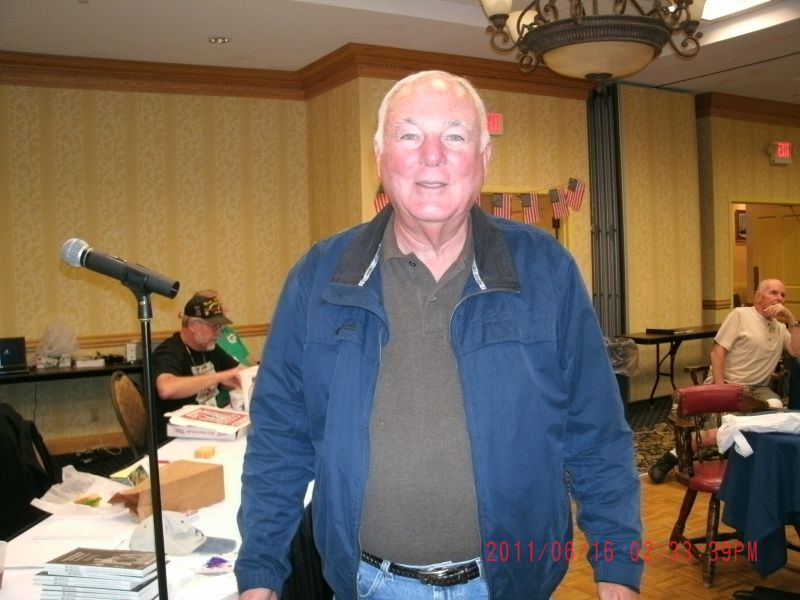
However, the appointment of Harry Kamberis as director was a clear signal that the connection with the Institute system was not completely broken. Kamberis was formerly the program director for the Asian-American Free Labor Institute. Labor sociologist Kim Scipes writes,
“And should there be any remaining doubt on this issue, it was a man—Harry Kamberis—who had worked in both the Philippines and South Korea during times of incredible labor repression by states and labor movements supported by the AFL-CIO, a former U.S. State Department official, that Mr. Sweeney promoted to serve as the head of the American Center for International Labor Solidarity.”
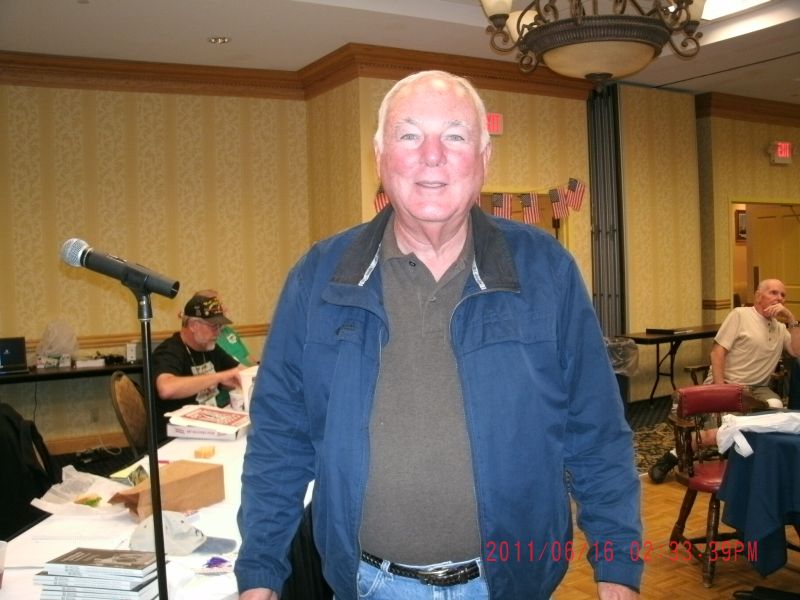
Harry Kamberis [Source: oldspooksandspies.org]
Under Kamberis, the Solidarity Center became one of the four core institutes of NED. The mission of the NED, as with the Solidarity Center, was considered a more open replacement for CIA activities.
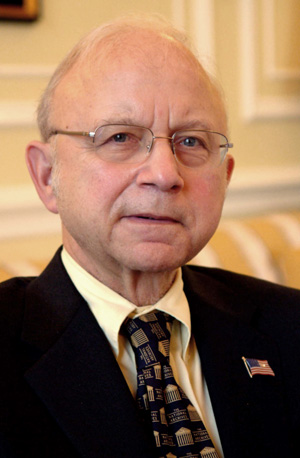
There is virtually no reporting about the interventionist nature of the NED that does not include the following quotation, so far be it from this article to break that tradition. In a 1991 interview with The Washington Post, NED co-founder Allen Weinstein said, “A lot of what we do today was done covertly 25 years ago by the CIA.”
Allen Weinstein [Source: archives.gov]
The sense of betrayal felt by many from the grassroots international labor community was deep, especially among those Central America solidarity activists who had played such a pivotal role in the changes they hoped for under the Sweeney administration.
This reached new levels when it was revealed that the Solidarity Center had channeled hundreds of thousands of dollars to the right-wing labor Confederation of Venezuelan Workers (CTV, Confederación de Trabajadores de Venezuela) during the coup attempt against President Hugo Chávez in 2002.
Scipes explains in another article:
“…NED provided $4,039,331 to Venezuelan and American organizations working in Venezuela between 1992 and 2001: 60.4 percent of that, or $2,439,489 was granted between 1997-2001. Of that $2.4-plus million since 1997, $587,926 (or almost one-quarter) went to ACILS for its work with the Confederation of Venezuelan Workers (CTV in Spanish). In 2002, the last year for which details are available, NED pumped in another $1,099,352, of which ACILS got $116,001 for its work with CTV. Altogether, ACILS received $703,927 between 1997-2002 for its work in Venezuela alone. [During 2000-2001, ACILS received $8,889,009 from NED for its worldwide operations.]
The AFL-CIO gives a different accounting. Stanley Gacek, the Assistant Director of the AFL-CIO’s International Affairs Department, writing in the Spring 2004 issue of New Labor Forum, claims “…our total solidarity program with the CTV amounted to less than $20,000 in support of the Confederation’s highly successful internal democratization process….”
Yet what has been that work in Venezuela for which the Solidarity Center claims it was paid only $20,000 but which NED reports as costing over $700,000?
…According to a report to be published in New Labor Forum by Robert Collier… the CTV has worked with FEDECAMARAS, the nation’s business association, to carry out general strikes/lockouts of in December 2001, March-April 2002, and December 2002-February 2003….
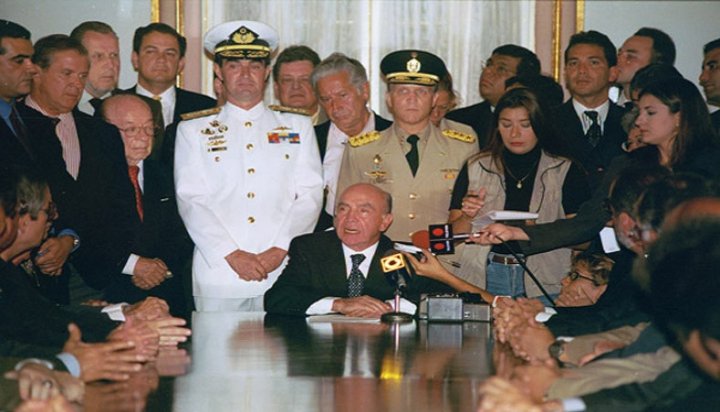
Professor Hector Lucena, another labor observer, reports that these April actions were led by the CTV and joined by FEDECARAMAS. Christopher Marquis of The New York Times reported on April 25, 2002, ‘…the Confederation of Venezuelan Workers led the work stoppages that galvanized the opposition to Mr. Chavez. The union’s leader, Carlos Ortega, worked closely with Pedro Carmona Estanga, the businessman who briefly took over from Mr. Chavez, in challenging the government.’ Further, Collier reports, ‘For months before, CTV Secretary-General Carlos Ortega created a tight political alliance with FEDECAMARAS leader Pedro Carmona, and they repeatedly called for the overthrow of Chavez.’ In short, Collier concludes that ‘…in Venezuela, the AFL-CIO has…supported a reactionary union establishment as it tried repeatedly to overthrow President Hugo Chavez—and in the process, wrecked the country’s economy.’”
Businessman Pedro Carmona proclaims himself president of Venezuela after the April 11, 2002, coup against the government of Hugo Chávez. The CIA, NED and AFL-CIO contributed to the coup. [Source: laizquierdadiario.com]
Fortunately, the April 2002 coup was short-lived. Venezuela’s workers and their families poured into the streets of Caracas and successfully demanded Chávez’s return. However, since the coup’s failure, the Solidarity Center has not ceased activities in Venezuela which can be described to the present day as taking place in the shadows. About a month before the coup took place, the Venezuela office of the Solidarity Center moved from Caracas to its current location in Bogotá, Colombia, where it coordinates work in both Colombia and Venezuela.
Tim Gill has written extensively about Solidarity Center involvement in Venezuela between 2006 and 2014 in a piece published for Jacobin titled “Newly Revealed Documents Show How the AFL-CIO Aided US Interference in Venezuela.” Gill shows how the Solidarity Center tried to influence and direct internal discussions within the Venezuelan labor movement, helped organize meetings of opposition leaders, continued to bolster the CTV, while helping organize a new labor federation to oppose the Chávez government from the left.
After 2014, little is known about Solidarity Center activities in Venezuela. Regarding the NED as a whole, in 2021, it designated some $4,562,625 for activities in Venezuela. That is a more than $2 million increase over 2020’s already-significant total funding for grants equaling $2,432,932.
There was another $1,234,000 in regional grants that were either intended partially for activities in Venezuela, or were wholly directed toward Venezuela, but listed nonetheless as regional grants. One such example is a $250,000 allocation for “Tracing Chinese Financing to Venezuela.”
It becomes clear, then, that NED funding has constituted a black budget for U.S. regime-change efforts in Venezuela that is worth millions of dollars on an annual basis.
The Solidarity Center receives a minimum of hundreds of thousands of dollars every year for their Colombia/Venezuela office. I wrote in a related article published by the Orinoco Tribune in October 2021, that
“The Solidarity Center’s activities in Venezuela and Colombia skyrocketed last year. Funding from the mis-named National Endowment for Democracy (NED) soared to almost 60% over the previous year’s awards. The 2020 funding, alone, represents over 40% of the total for similar grants for the last five years on record ($3,617,000). In 2020, the Solidarity Center’s Bogotá office received $1,470,000 in regional NED funding. That is up from $626,000 in 2019….
The Solidarity Center works closely with long-time partners, the Confederation of Venezuelan Workers (CTV, for Confederación de Trabajadores de Venezuela), as well as the Labor Solidarity Movement (MSL for Movimiento de Solidaridad Laboral), which includes current and former CTV officials in its leadership, as well as Orlando Chirino, who was a candidate for president of Venezuela against Hugo Chávez in 2012. According to Tim Gill, ‘In its 2010 program description, the SC [Solidarity Center] bluntly states that it helped form the coordinating body [for the MSL], which was ‘launched in an [SC]-supported national conference in July 2009’.’”
What reporting that exists about Solidarity Center activities in Venezuela is notable for its vagueness. Based on my own research of NED records, partners are unnamed, language is general, and projects are described in the most non-descriptive terms possible.
For one 2020 grant for activities for $626,000, and for a supplemental grant of $199,000, or $825,000 in total, the description only says it is from the NED to the Solidarity Center (listing no on-the-ground partners in Venezuela or Colombia), “To address the closing space for civil society and the growing repression of democratic freedoms in Venezuela…and defend recent gains in fundamental labor rights in Colombia….”
The final 2020 grant from the NED, explicitly to the Solidarity Center for
Venezuela-related activities, is a $645,389 grant for projects with Venezuelan migrants,
“To promote the human and labor rights and the democratic participation of workers in Colombia, Ecuador, Brazil, and Peru, the center will develop the capacity of its union partners to build relationships with Venezuelan migrant workers to collectively advocate for decent work and promote greater respect for labor rights.”
One might question how a grant to give much-needed support for Venezuelan migrants might contribute to destabilization of the elected government inside Venezuela.
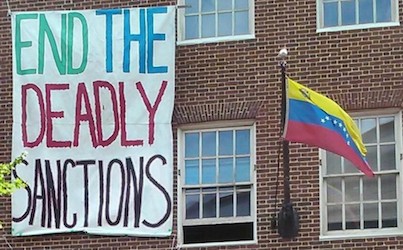
However, with an examination of the overall approach of the U.S. toward Venezuela, we can see that it is literally the U.S.-enforced blockade and sanctions against Venezuela that are at the foundation of economic disruptions, shortages, and poverty in the country today and, thus, the main impetus behind the migration crisis.
[Source: codepink.org]
Most of the grants for supporting Venezuelan migrants have been for operations in Colombia and Peru, traditionally the U.S.’s two closest allies in South America and hosts of the largest U.S. troop concentrations.
Colombia is an official “Global Partner” with NATO, and there has been discussion about bringing in Peru. In effect, Solidarity Center support for Venezuelan migrants is a way of addressing the negative effects to our closest allies of the sanction regime that has displaced so many.
As usual, who is getting the funds is not mentioned, nor any details of what activities are being undertaken. The very few times a recipient of grants is named in NED records, we find the funds are not going directly to actual Venezuelans. They are almost invariably grants “awarded” to various of the core institutes that make up the NED, including the Solidarity Center. Basically, the NED is informing us that it has awarded these grants to itself. Who they are further distributed to is not for labor’s rank-and-file to know.
This is in contrast to descriptions for most other countries that receive NED funding. While the grant descriptions are also vague, they do usually give the titles of recipients. That at least gives something to go on for those pursuing more in-depth investigations. Grants for Venezuela, Nicaragua, and a few other especially targeted countries are unusual in that they are vague to the point of saying nothing.
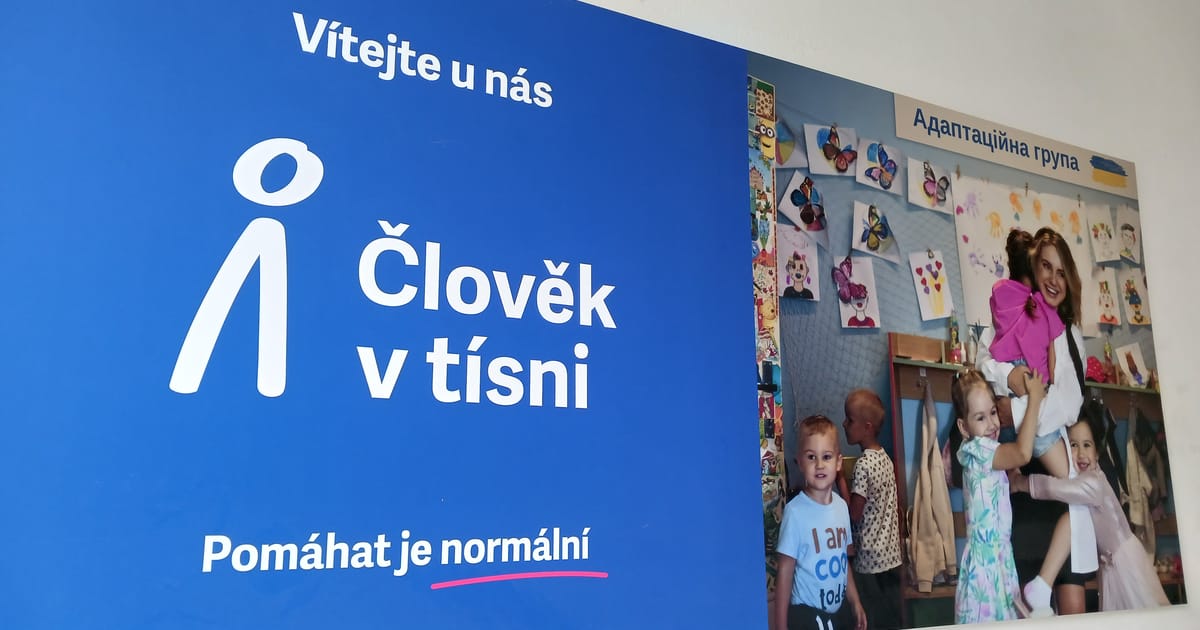
If we look at the Venezuela-related grants for 2020, we will see the only other case I could find from the years 2020 and 2021 where an actual recipient of NED funds was named. It was a 2020 grant to “Clovek v tisni, o.p.s. (People in Need).”
Clovek v Tisni is a Czech organization that has received funding in the past from the NED, including for its work against the socialist government of Cuba. It is also involved in documenting war crimes by Russia in Ukraine as part of the information war directed against Russia and financing anti-Russian media, which indicated further intelligence connection.
[Source: deutsch.radio.tz]
In reports for South America funding for 2021, we find the Solidarity Center received $975,000 through the National Endowment for Democracy for activities in Colombia and Venezuela. It received another $975,000 for its activities in Ecuador and Peru.
But even though these figures are already high, they are dwarfed by the recent $12 million awarded in 2022 by the Department of Labor to the Solidarity Center for its activities in Peru, Brazil and Colombia. (As previously mentioned, the Colombia Solidarity Center office doubles as the headquarters for Venezuela.)
It bears mention that U.S. solidarity with Colombian unions has often been presented as an example of the good work the Solidarity Center is doing. Yet, in 2009, the Solidarity Center acted against the establishment of an ongoing relationship between the U.S. Steelworkers and FENSUAGRO, the largest confederation of Colombian farmers and farm workers, and what many have described as the most persecuted union in the most dangerous place in the world to be a union member.
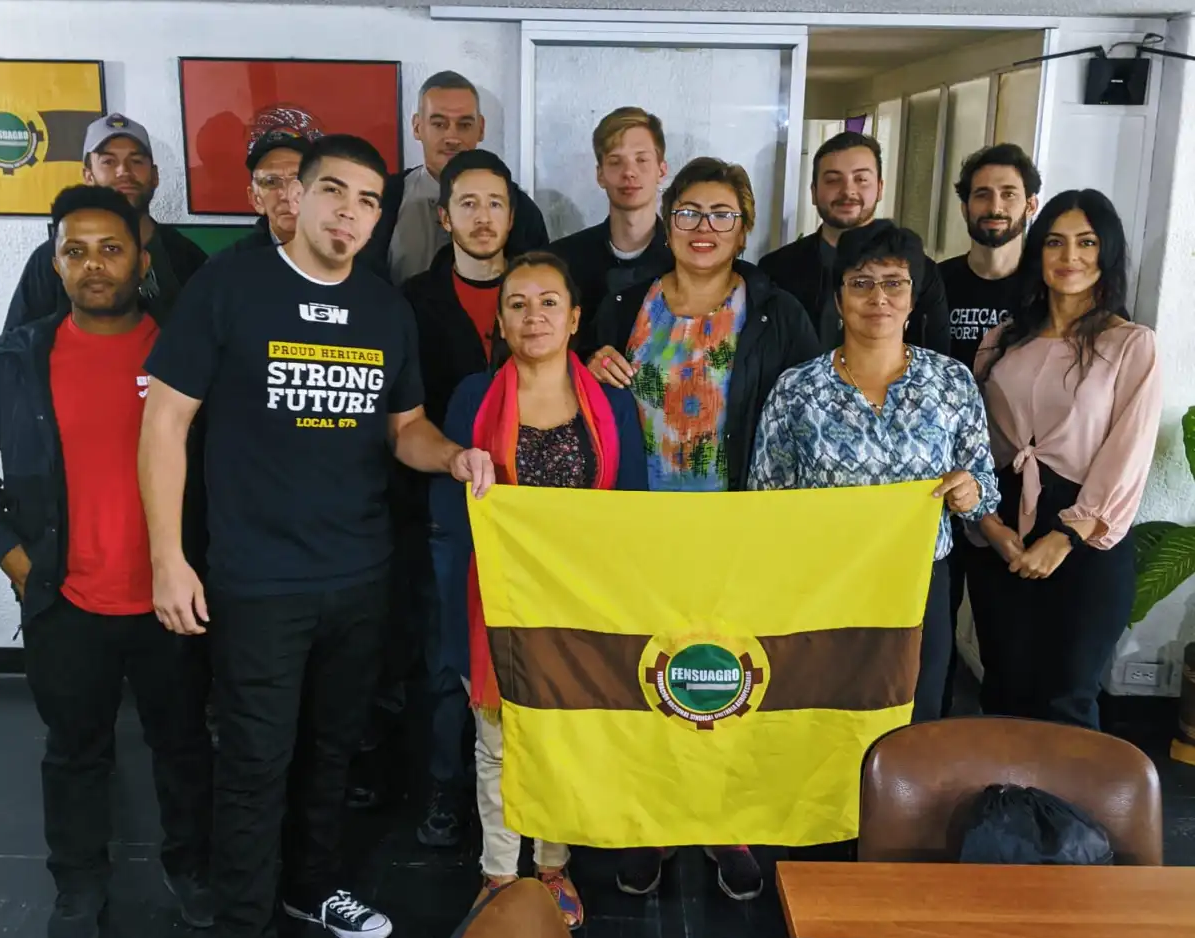
Photo of U.S. and Colombia union activists at the offices of the Fensuagro farmers and farm workers union in Colombia. [Source: Photo Courtesy of James Patrick Jordan]
That same year, the Solidarity Center was meeting with the U.S. Embassy to give advice regarding their efforts to build union organizations that would support a U.S.-Colombia Free Trade Agreement, despite the fact that Colombian and U.S. unions were mobilizing to defeat the agreement.
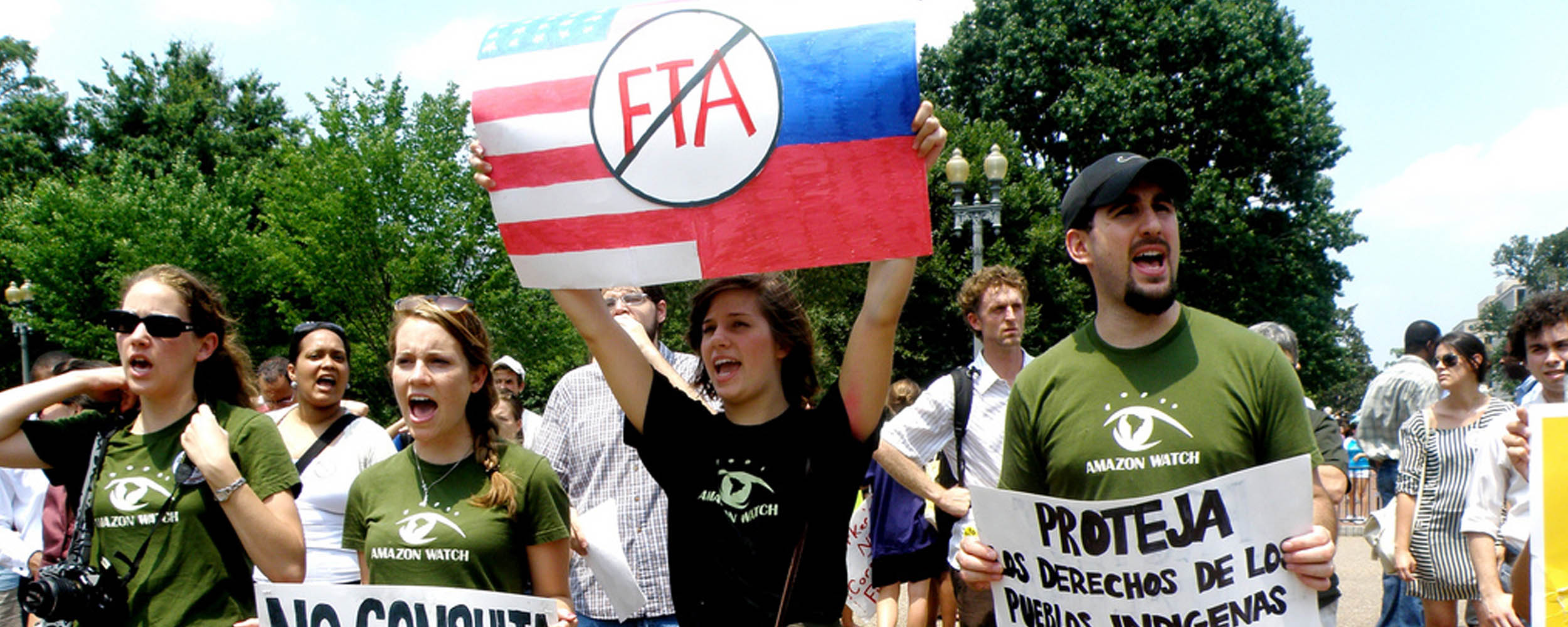
Protests against U.S.-Colombia Free Trade Agreement. [Source: citizen.org]
Andrea Lobo writes in her September 12, 2024, article, “The AFL-CIA’s Solidarity Center expands operations in Latin America,” that
“The American trade union federation operates internationally through its misnamed Solidarity Center, which was granted a budget of $15 million for Latin America and the Caribbean in 2022, according to its latest yearly report. This represented a massive jump of between 58 and 138 percent above all other years reported on its website since 2010. Globally, the Center has also more than doubled its budget in this period and has opened offices in numerous new countries.”
It is important and illustrative for us to return to the fateful year of 2005, and the AFL-CIO convention in Chicago that summer. It was a difficult convention in that it was when Change to Win—formed by a number of major AFL-CIO affiliates—split away from the AFL-CIO. But it was a promising one, too, with the passage of U.S. Labor Against the War (USLAW) Resolution 53: The War in Iraq.
This was the first resolution passed by the AFL-CIO that broke with U.S. foreign policies. The resolution called for the government to bring its soldiers home “rapidly.”
The “Build Unity and Trust Among Workers Worldwide” resolution was also brought to the AFL-CIO convention that year. That resolution had been authored by Fred Hirsch and fellow unionist Dave Welsh and was originally passed by the South Bay Labor Federation, before being passed unanimously by the California Labor Federation.
It would soon be passed, as well, by the Pima Area Labor Federation in Arizona, the Washington State Labor Federation, the New York City Central Labor Council, as well as other labor organizations.
The Worker-to-Worker Solidarity Committee was formed by union, anti-war, and solidarity activists to campaign for its passage.
The resolution was a result of concern regarding the Solidarity Center’s support for the Venezuelan coup attempt of 2002, as well as the Solidarity Center’s negative role during the overthrow of the elected government of Haiti under President Jean-Bertrand Aristide.
The campaign was further motivated by the collaborative role the Solidarity Center under Kamberis was playing in the occupation of Iraq. The irony was not lost that, while the USLAW resolution against the war was receiving significant support, the Solidarity Center was still operating in the shadows in Iraq.
[Source: afgj.org]
In fact, top leadership of the AFL-CIO, the International Affairs Department, and the Solidarity Center participated regularly in meetings organized by the State Department of the Advisory Committee on Labor Diplomacy to discuss state building and “diplomacy and security” in places like Afghanistan, Israel/Palestine, and Iraq.
“…George W. Bush called for doubling the NED’s Middle East budget to $40 million. Within two days, AFL-CIO President John Sweeney said that ‘training and other kinds of support from the international trade union movement should be encouraged’ in Iraq. He has since applied for $3-5 million in grants from the NED.
That money would be used to smother independent labor organizing by leftist groups such as the Union of the Unemployed in Iraq (UUI), which has sponsored and supported strikes and demonstrations for jobs and against the U.S. occupation.”
According to the Solidarity Center’s then-Director Kamberis, “Republican administrations tend to see trade unions as part of a civil society that is dedicated to democracy and building democracy abroad…They see it as important to U.S. strategic interests.”
The Unity and Trust resolution would not pass the 2005 convention vote. Its discussion was delayed until the very end of the convention, when most delegates had left or were leaving. During that discussion, the head of the convention’s Resolutions Committee, AFSCME President Gerald McEntee, cut off discussion and called for a vote before letting supporters of the resolution speak, even though there were delegates lined up to do so.
But the effort was not a complete loss. The light had been shone on the shadowy nature of the Solidarity Center to a much larger audience of union members than had been previously reached.
Two months after the convention, Kamberis stepped down from his position as director. In 2005, members of the Worker-to-Worker Solidarity Committee were less than welcome in many labor discussions. That situation has reversed remarkably.
I was a member of that committee and can attest to the open reception I received when I went to the 2012 AFL-CIO convention in Los Angeles. I was invited into proceedings even though I was not a delegate. I was allowed to pass out literature I had, and when I brought questions about the Solidarity Center to workshops, I was not cut off, and my questions were discussed and answered.
[Source: peoplesworld.org]
Trump’s cutting off money to USAID is an opportune moment to bring meaningful systemic change to how U.S. labor conducts its international relations, rather than clinging to old practices that are anachronistic and reactionary in today’s context. This is not the time for the Solidarity Center to be suing the Trump administration to release its federal monies to them, and to let them back to a State Department table presided over by Marco Rubio. Rather, this is the time for labor to end a dysfunctional relationship and plot an independent course.
It would be better to have a vastly underfunded Solidarity Center that nevertheless represents workers, that is funded and operated by workers, rather than a Solidarity Center rolling in cash, but joining the White House and corporate interests in their reactionary projects around the world.
There are other models of international solidarity to be explored. The UE, one of the nation’s largest independent unions, autonomously conducts its own international solidarity affairs. The formation of Unite the Union bringing together the USW with union counterparts in Canada and the UK is an example of independent and international worker-to-worker relations.
The unity of miners in the U.S., Mexico and Peru in struggles with the Grupo Mexico transnational corporation is another. There are much smaller examples—like international work exchanges and investigative delegations, where U.S. unionists partner directly with host unions.
And right now, we are seeing labor unions speak out internationally against the U.S. attack on Venezuela and the threats to other countries such as Palestine, Cuba and Colombia. We are seeing the emergence of independent and militant voices for international solidarity with Venezuela that break with years of subterfuge.
U.S. labor and unions belonging to the AFL-CIO, specifically, have a historic opportunity to create a new era of real international labor solidarity. We have the opportunity to Build Peace, Unity, and Trust Among Workers Worldwide.
We must not pass up this chance. We must push the AFL-CIO to abandon its “labor imperialism” and systematically change for building global labor solidarity.
—
There are two excellent books, written by labor activists—that extensively detail the AFL and then AFL-CIO foreign policy program—that I highly recommend. The first is by Jeff Schuhrke, titled Blue-Collar Empire: The Untold Story of US Labor’s Global Anticommunist Crusade (Brooklyn, NY: Verso, 2024), which details their operations during the Cold War. (See review in CovertAction Magazine)
The other, a little older, is by Kim Scipes and talks about labor’s foreign policy from the late 1890s until 2007, but which includes a specific look at the AFL-CIO’s operations in Venezuela around the 2002 coup attempt against Hugo Chávez; it is titled AFL-CIO’s Secret War against Developing Country Workers: Solidarity or Sabotage? (Lanham, MD: Lexington Books, 2011).
Scipes has written extensively on this, and his writings can be found on-line for free here.

James Patrick Jordan is National Co-Coordinator for the Alliance for Global Justice and is responsible for its Colombia, labor, and ecological solidarity programs.
He lives in Tucson, Arizona and is a student and occasional presenter at Salt of the Earth Labor College.
He can be reached at james@afgj.org.



When has AFL-CIO ever really opposed U.S. imperialism. Much of your mainstream labor organizations have a history of siding with government decisions in opposition to working class interests. Mainstream labor is just an extension of government to stifle working class militancy.