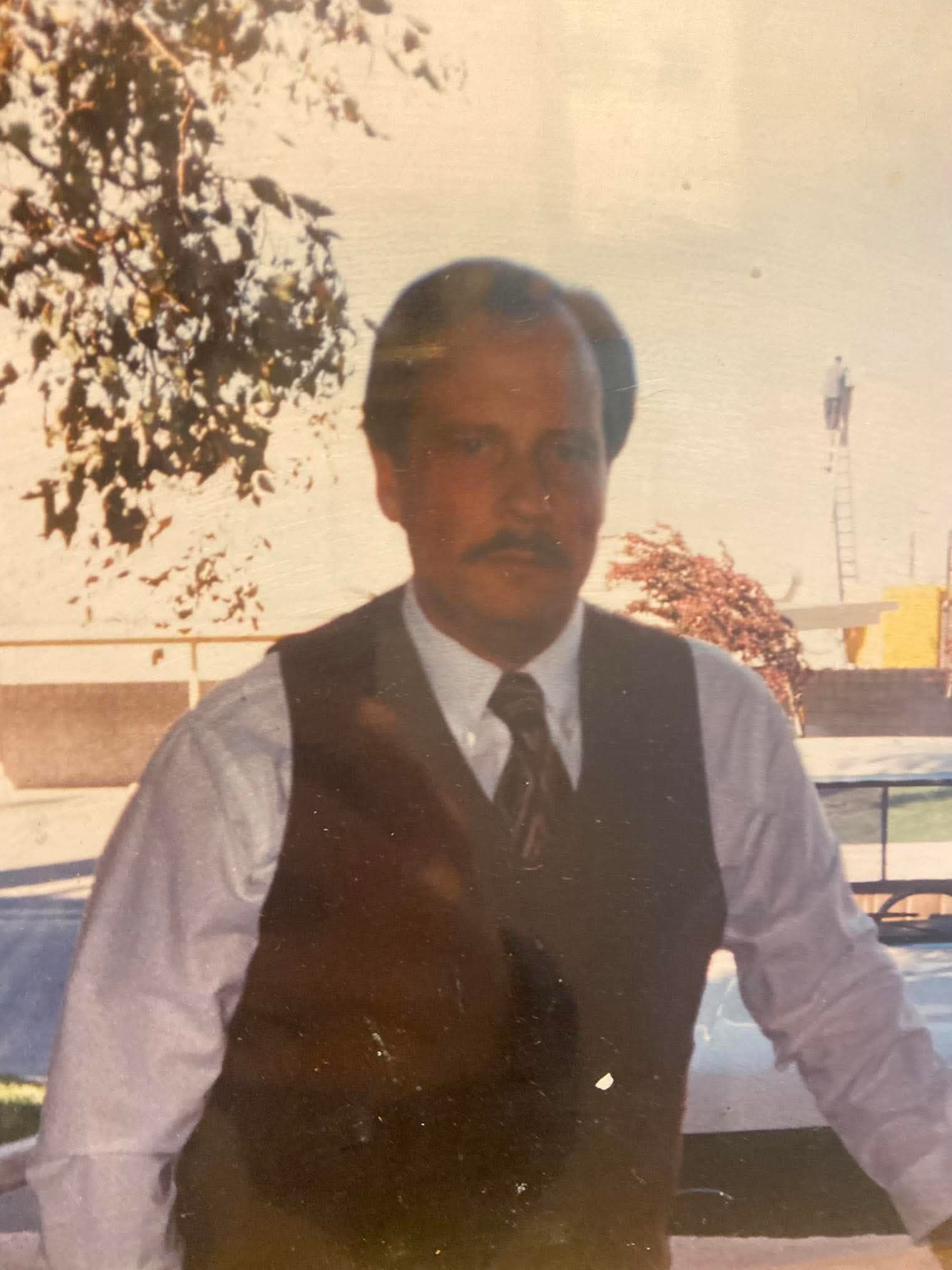
As of spring 2026, the Homicide Bureau of the Los Angeles Sheriff’s Department is re-examining the case of the unlicensed private investigator Rod Catsiff, who investigated murders and disappearances in the Antelope Valley until his declared date of death in 2001.
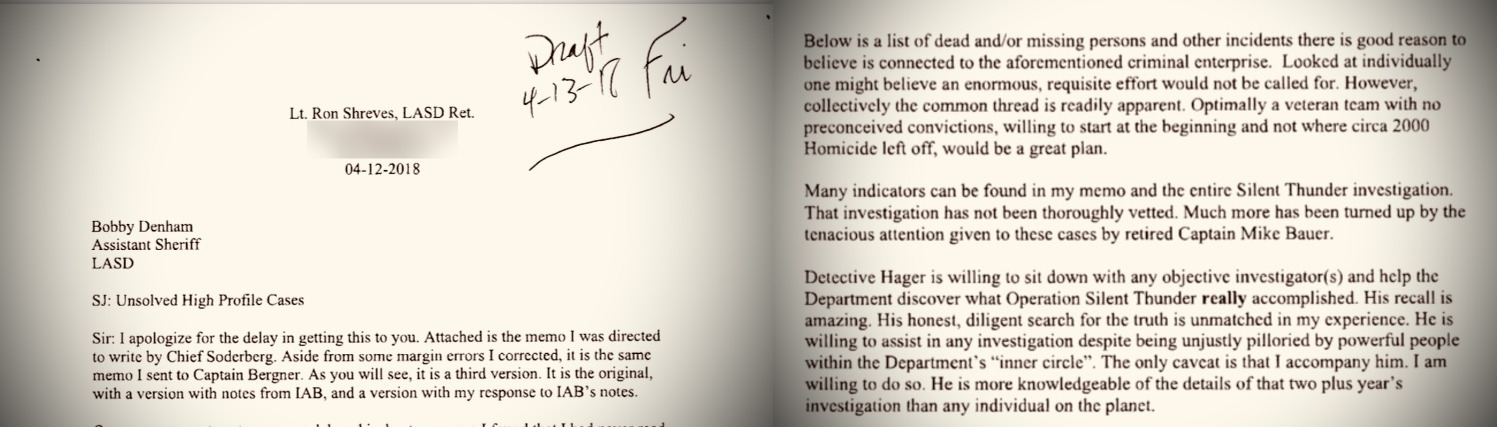
On a Friday afternoon in April 2018, retired Lieutenant Ron Shreves of the Los Angeles Sheriff’s Department penned a letter to his boss, Undersheriff Bobby Denham, titled “Unsolved High Profile Cases.”
His meticulous choice of words and the order of events swirled around in his head; he could not convey his message quickly enough. At the same time, Shreves knew he had but one shot at this: He would list all the reasons and facts that several murders and disappearances in the Antelope Valley were linked to a continuing criminal enterprise.
Shreves composed his letter almost 18 years after he had set up a joint task force of the Sheriff’s Department and the Drug Enforcement Administration (DEA) to dismantle six criminal networks in the Antelope Valley. The task force ultimately ended up arresting 300 individuals involved in methamphetamine distribution and weapons smuggling, including the criminal Thomas Dean Hinkle, aka “God.”
Even for a sanguine person like Shreves, the entire experience of the DEA/LASD task force had left a bitter taste in his mouth: Both he and his right-hand—the trusted and hard-working Deputy Hager—were scrubbed, and Hager was made persona non grata within his own agency, the Los Angeles Sheriff’s Department.
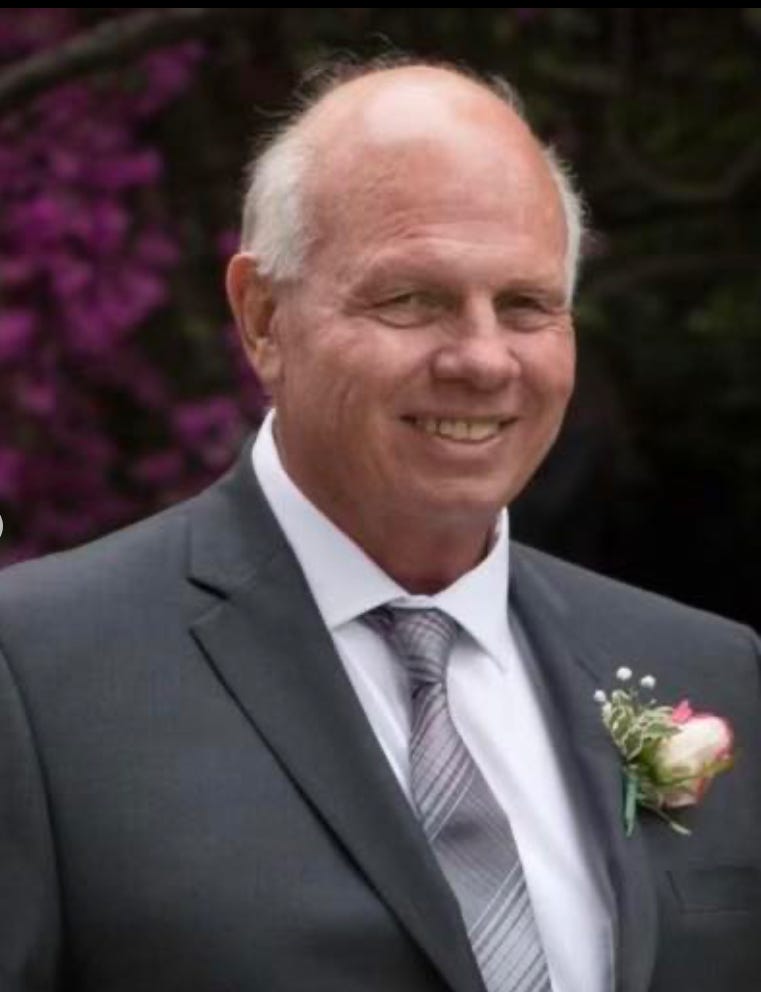
Shreves did what he could to defend and help Deputy Hager, who was then being accused of falsifying witness accounts during the course of the task force as they came across evidence that “dirty deputies were in cahoots with criminals” who were involved in the murder of Deputy Jon Aujay in 1998. Deputy Darren Hager (by then sworn in as a DEA agent) won a major whistleblower retaliation suit against his own employers.
Shreves’ theory is based on evidence he had gathered during his joint DEA task force operation, which he ran out of Lancaster, California.
Shreves writes:
“There existed in the Littlerock, Pearblossom area, an active criminal enterprise that, while somewhat diminished, still exists. This enterprise is likely responsible for numerous homicides and heavy narcotic trafficking. The LASD has failed to recognize this fact and has not adequately investigated that enterprise. Below is a list of dead and/or missing persons.”
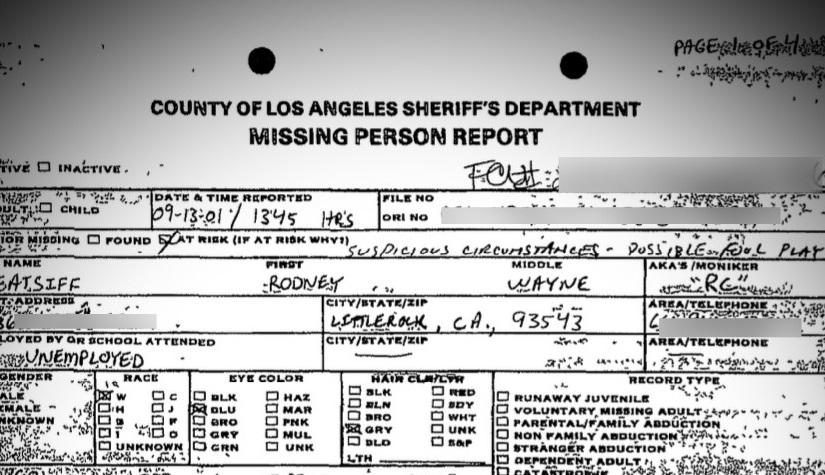
One of the disappearances/murders is the case of Rodney Wayne Catsiff, an unlicensed private investigator, who disappeared on September 13, 2001, in Littlerock, California. On the day he had disappeared, it was quickly concluded in his missing person report that there was foul play; his disappearance was noted as “suspicious”.
Shreves would later write in his ordered memo about his joint DEA task force to Chief Sams of LASD Field Operations Region I: “Catsiff gave a great deal of information to the Task Force about Thomas Dean Hinkle and his associates (Larry Crawford, Mike Booth, etc.) and about Resident Deputy Rick Engels. The Task Force is certain that Hinkle knows that he was the subject of Catsiff’s investigations. Tom Hinkle was arrested by the Task Force on April 21, 2001. Catsiff disappeared on September 13, 2001.”
“Catsiff was afraid to contact law enforcement with his information, as he had information that Los Angeles Sheriff’s personnel were criminally involved.”
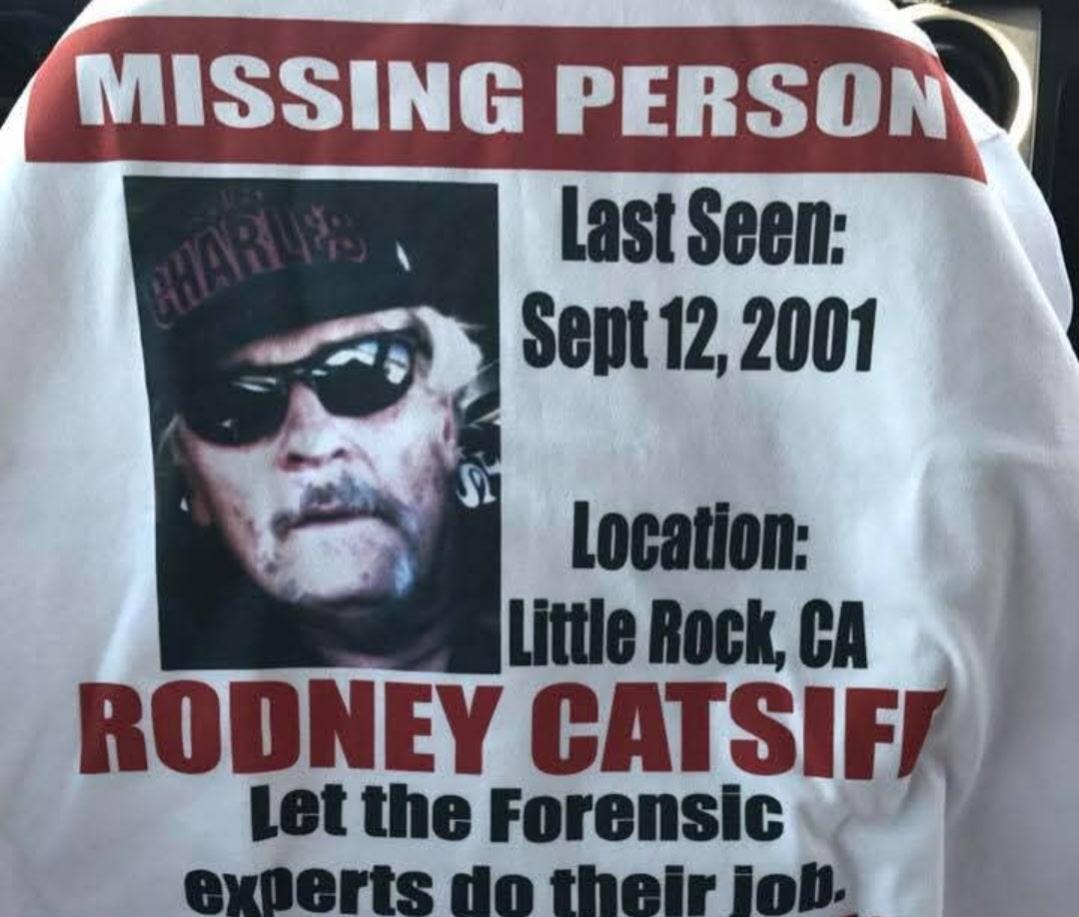
Shreves had collected memos written by his deputies and detectives with information about Rod Catsiff when he learned that Catsiff was poking around in the Antelope Valley as a private investigator.
Catsiff’s work as an informant, his liaison to criminal networks, and his recorded knowledge of who may have been involved in the disappearance of Deputy Jon Aujay, in the Lynn Standish murder, and his knowledge of witnesses who disappeared, likely put him in extreme jeopardy.
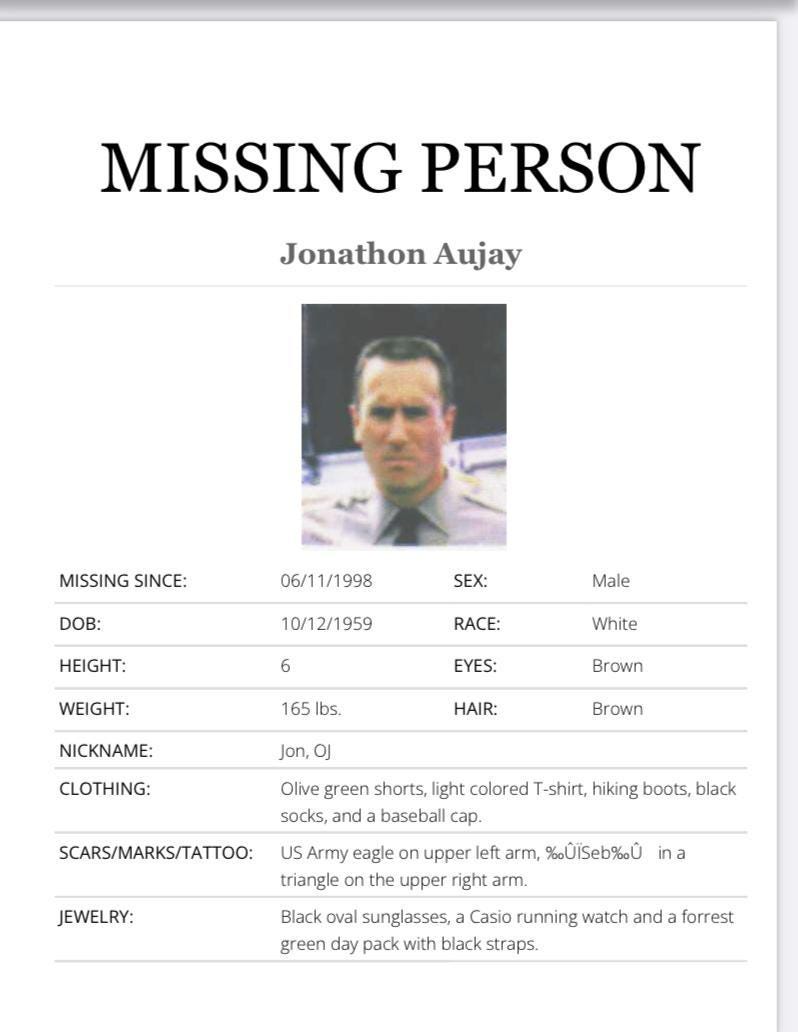
Yet, his past as a renegade and former convict may (still) be used by others (i.e., law enforcement) to conveniently ignore a thorough investigation into what truly happened to him.
To this day, Catsiff seems a key figure in the investigation of many (unsolved) murders and cases of missing persons in the Antelope Valley.
Rodney Catsiff: Father, Husband, Informant, Jailhouse Snitch, and Private Eye
Rodney Wayne Catsiff had lived a colorful life up to the date he went missing: He was a father, husband, estranged husband, grandfather, friend to many, enemy to some, a curious hustler, convicted rapist, jailhouse snitch, informant, and bon vivant.
Catsiff seemed to embody complexity with ease: With his multi-faceted character traits, however opposing ones, he dabbled with one foot in criminality and with the other in charity and justice. He was the renegade, often fueled by episodic drug use and creativity, a curious man defying convention.
And he was a fun charmer who could wow a room and converse with anyone. A blazing personality, he was magnetic, a perfect combination of qualities for a man with a passion for detective work. He could get information out of people most would have trouble getting to talk.
He also possessed darker desires, sexual appetites not accepted in society; he was charged with statutory rape and sent to prison.
That conviction would eventually be used until his “death” to smear his better angels; he seemed stigmatized for life, seemingly, an opportunity for law enforcement not to take him seriously as an informant for narcotics. As for the criminals he liaised with to get information, they would flash his RAP sheet in his face as a warning. The records of arrests and prosecutions would stick to him like honey attracting flies from hell.
However, Rod trucked on. His persistent efforts to record evidence in the case of missing Deputy Aujay and the murder of Lynn Standish almost paid off when he got the chance to relay his information to the DEA/LASD Silent Thunder/Speedy Gonzalez task force early in 2001. Before the task force could interview him again, however, he disappeared.
Rodney Wayne Catsiff was born in July 1943. He grew up in Indiana with his brother, Stephen, and their parents, Sidney R. Catsiff and Katherine Toland.
He had a wild, funny, magnetic way about him. People were drawn to him.
Rod married Barbara in 1963, and they had two children, a daughter and a son. It became clear to his adoring wife that Rod was hanging out with “shady characters.” Barbara knew he was unfaithful to her, yet her good character outshone any resentment toward him. Keeping her head high, she wanted a haven for her children.
Rod was arrested in 1964 for statutory rape and sent to Soledad Prison for seven years, where his talent for hustling and deal-making was tested when seven inmates were accused of murdering a prison guard. Among a few inmates, Catsiff was forced to sign a deposition as a witness. It was a highly contentious situation, involving seven African-American inmates who seemed to have been set up in the murder of a white prison guard.
Several inmate witnesses were forced to sign depositions and coerced into testifying against them, as alleged in the book The Soledad Seven. Catsiff became one of the prosecution’s witnesses. He was terrified and asked the FBI for immediate protection.
Among fellow inmates, Catsiff had “a reputation for being a snitch and a prostitute.” He had to be kept in protective custody.
Prison life did little to curb Rod’s tendencies to flirt with criminality. Once out, he resumed his married life with Barbara and their children, moving around a lot. He started an affair with another woman whom he married under a different name, and they raised a daughter together.
His family home with Barbara was raided multiple times and, eventually, he ended up in federal prison for years.
Barbara and Rod eventually divorced in 1987.
Rod stayed with his second wife, Jody, and continued to widen his network to make money.
A former member of the Charles Manson cult, Lynette “Squeaky” Fromme, stated in an interview about her life that, when she visited Death Valley (the Capistrano family), she met “this owner of Modoc Mine, Rodney Catsiff.” She became friendly with Catsiff, and he helped her with her car when it ran out of gas. They talked about the Capistrano family he knew when that family lived at Spahn Ranch.
It is said that Catsiff would tell the FBI about his conversation with Lynette after she had tried to assassinate President Gerald Ford in 1975.
Out of Littlerock, Rod worked his network of crystal meth cooks and distributors, and in the 1990s, he would become an informant for narcotics crews of the Los Angeles Sheriff’s Department in Palmdale.
As a natural-born charmer, he was good at getting information out of people, but his past would set him up for traps. The people he was investigating would continue to use his past convictions as insurance and as a warning.
Fear and Loathing in the Valley
With a trunk full of quaaludes, brain-drowning crystal meth and other drugs, Rod would drive through the Valley to Las Vegas, where he owned another property. He would travel back to the Antelope Valley to commit to his job as local investigator on the Lynn Standish case. Occasionally, he would check in on his children, grandchildren and his wife/ex-wife.
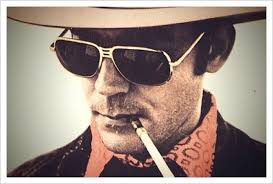
Rod’s style, in a sense, has similarities to that of journalist-author Hunter S. Thompson, best known for his pioneering “gonzo” or “neo-journalism” style starting in the 1970s. Like Thompson, author of the bestseller Fear and Loathing in Las Vegas, Rod kept defying conventional methods for retrieving information from people, and breaking accepted social norms.
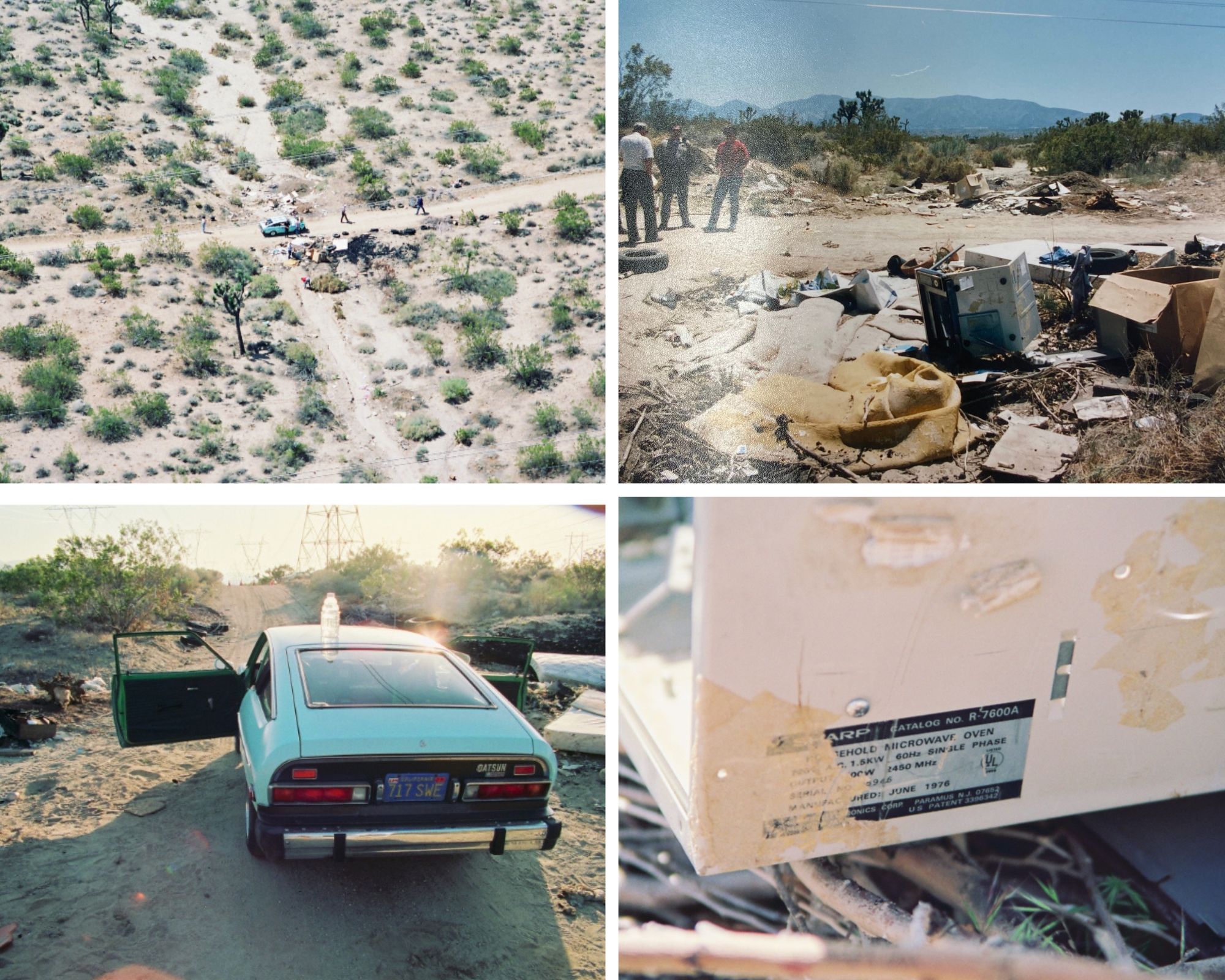
On Friday afternoon, May 20, 1994, Lynn Standish (née Lynn Dora Holmes) opened a microwave containing a pipe bomb in a rural desert area in Pearblossom.
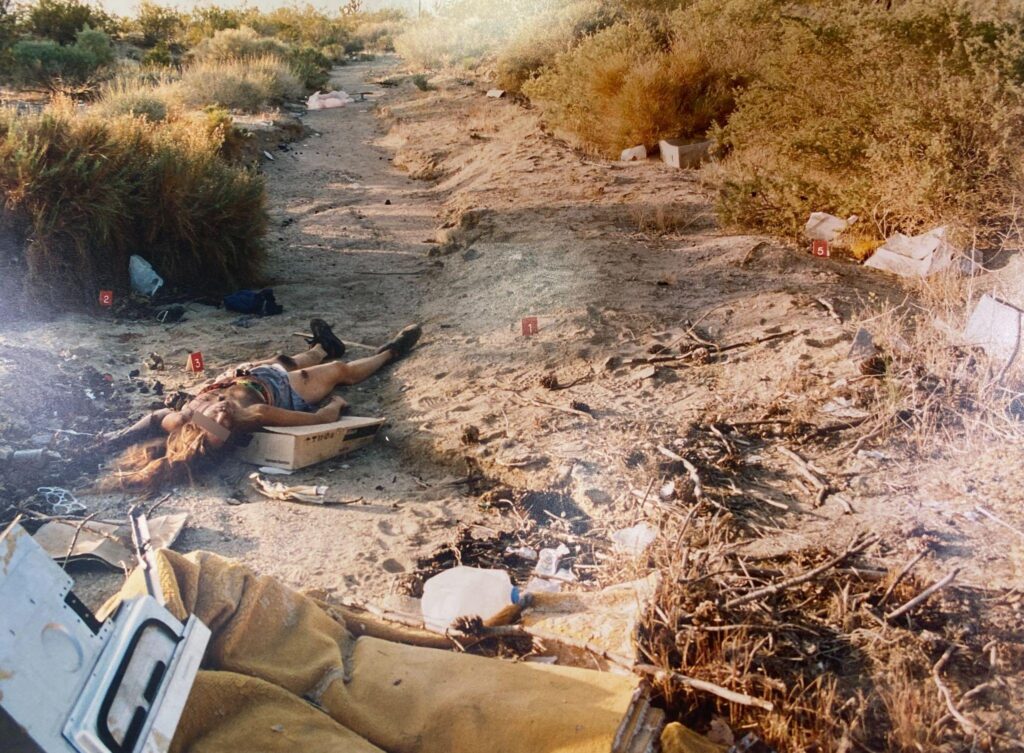
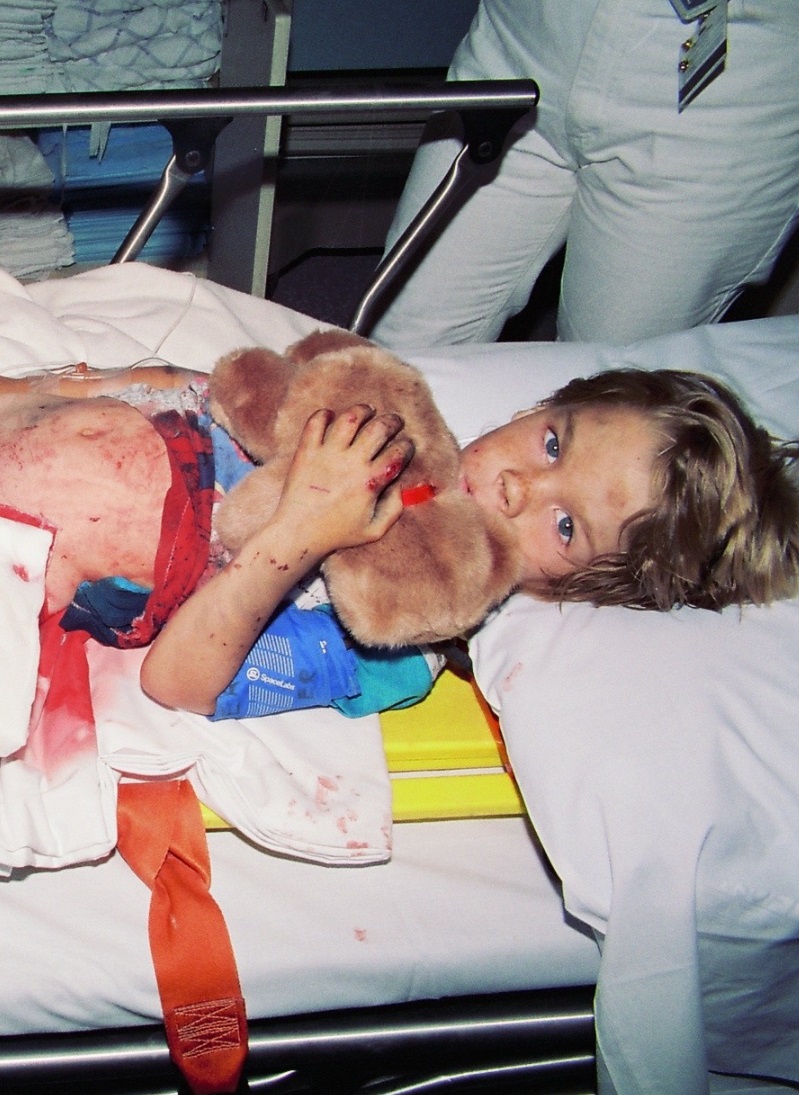
Lynn had been hunting for recyclable cans and other materials in a desert dump with two of her sons, four-year-old Michael and nine-year-old Jeffrey. Jeffrey was at a different spot when he heard a “pop” and his mother screaming, and heard his brother crying. He ran toward his mother and Michael. Lynn lay on the ground amidst rubble and a microwave. Jeffrey carried his injured brother to the car. The boys would remain there until people found them and called the police.
Deputies escorted the boys to the hospital, where four-year-old Michael had to be treated for burn injuries. Deputy Osterthaler interviewed them.
At the same time, paramedics pronounced Lynn Standish dead at the scene. As they each responded to the call, several deputies contained the scene. Resident Deputy Rick Engels was directed to her body and saw her lying on her back with her head in a southerly direction, and her left arm was raised above her head, with part of her hand missing. Detectives of Arson and Explosives arrived around 5:45 p.m.
Homicide Detective Sergeant Joe Holmes would lead the investigation. Deputies would follow the tire tracks of an all-terrain vehicle and a motorcycle on foot. The tracks would lead them to the property of notorious meth distributor Tom Hinkle and his wife, Virginia “Gigi” Sinclair.
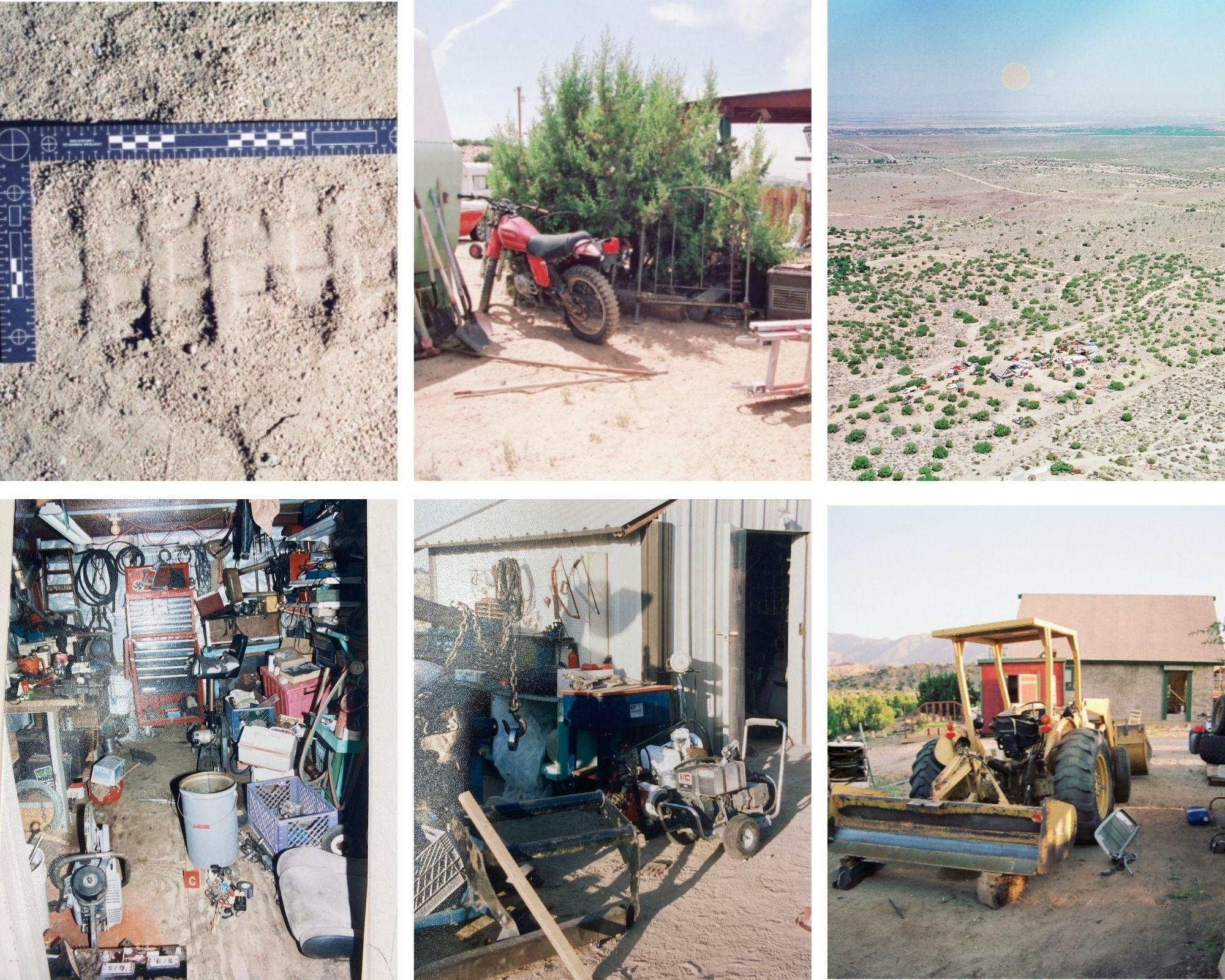
Armed with a search warrant, Deputy Rick Engels and Deputy Darren Hager would approach Hinkle’s house.
But why did Deputy Rick Engels ask his fellow Deputy Hager to stay behind and go up on a hill with an AR-15 rifle to guard the scene, while Engels would enter the house alone, effectively abandoning officer safety policy?
It can be theorized that Deputy Engels tried to warn Tom Hinkle of the search warrant. However,
Hinkle was not in his house. Instead, as Hager witnessed from his position on the hill, Deputy Engels was talking to a welder, who was working on Hinkle’s A-frame house on the property.
A shed with bomb-making materials was found. It appeared that Scott H. and his wife temporarily stayed in a travel trailer on Hinkle’s property and the shed was used by workers, including Scott, who worked on the under construction of the A-frame house belonging to Hinkle. Scott and his wife had fled.
Sergeant Holmes and Detective Rick Graves eventually interviewed Tom Hinkle and Gigi Sinclair, and many witnesses who knew both Scott and his girlfriend, Hinkle and Gigi.
With all the physical evidence taken from Hinkle’s house and the crime scene, the question about latent fingerprints on the microwave remains.
Sergeant Holmes was convinced that Scott was responsible for Lynn Standish’s death. There was no other suspect in his book. He concluded that this suspect had created a bomb, and had placed it in a microwave in a pile of rubble out in the desert.
Latent fingerprints on the microwave were at some point recovered, but Scott’s attorneys never received the lab results, and the recorded interview with Tom Hinkle was “missing.”
Scott was eventually found guilty and sentenced to life in prison.
Omissions and Creative Police Report Writing
The leading Homicide investigator in the Lynn Standish case, Sergeant Joseph Holmes, has had a long career working as a detective in the gang units of Firestone and Lynwood areas of Los Angeles. He trained at the Homicide School and quickly advanced to Sergeant in Homicide. His detective and policing methods seem to show exactly the kind of misconduct Federal District Court Judge Terry Hatter identified in his ruling in the Darren Thomas class action lawsuit, aka the Lynwood Vikings case, a landmark civil rights case against the Los Angeles Sheriff’s Department in 1990, which was concluded in 1996. Defendants were accused of omitting evidence and creative police report writing.
Among the allegations in the case were: “Deputies adhere to an unwritten ‘code of silence’ which consists of one simple rule: a deputy does not provide adverse information against a fellow deputy.” And: “Deputies fabricate evidence following incidents involving the improper use of firearms or the use of excessive force, violence, racial or ethnic bias, or other misconduct. These practices include, but are not limited to, using so-called “creative report writing,” i.e., filing materially false police reports, and making false statements to prosecution authorities to obtain the filing of false charges and the institution of false and malicious prosecutions against victims of the deputies’ misconduct.”
Sergeant Joseph Holmes, then already a young, ambitious detective at Lynwood Station, was one of the many defendants in that case. He was accused of eight causes of action and of being a member of the Lynwood Vikings, one of the most notorious deputy gangs in the history of the Los Angeles Sheriff’s Department.
Sergeant Holmes had a habit of stopping tape recordings of interviews. Holmes said this about his method: “Sometimes when you’re interviewing people, they’ll tell you a certain point, but they don’t want to say it on tape. Sometimes you want to cut it off. They’ll tell you because they will feel safe, and that nobody is going to hear it. But almost always when you turn the tape back on, they’ll say it. Sometimes they do, sometimes they don’t. It’s an investigative tool. Sometimes they don’t care. But my experience many times in investigations, especially homicides, a lot of times people will tell you things off tape they won’t tell you on tape.”
When Holmes became the lead Homicide investigator in the murder of Lynn Standish, and quickly honed in on the only suspect in his book, Scott H., he failed to include background searches he had done in the Murder Book on convicted meth distributor Tom Hinkle. He knew that Tom Hinkle used various aliases, Thomas Dean Hinkle, Thomas Gene Hinkle, Robert Meredith Foster, and that Hinkle had prior charges for robbery and kidnap in 1967. Tom Hinkle would testify at the 1997 trial as a star witness for the prosecution. His criminal records were never brought up.
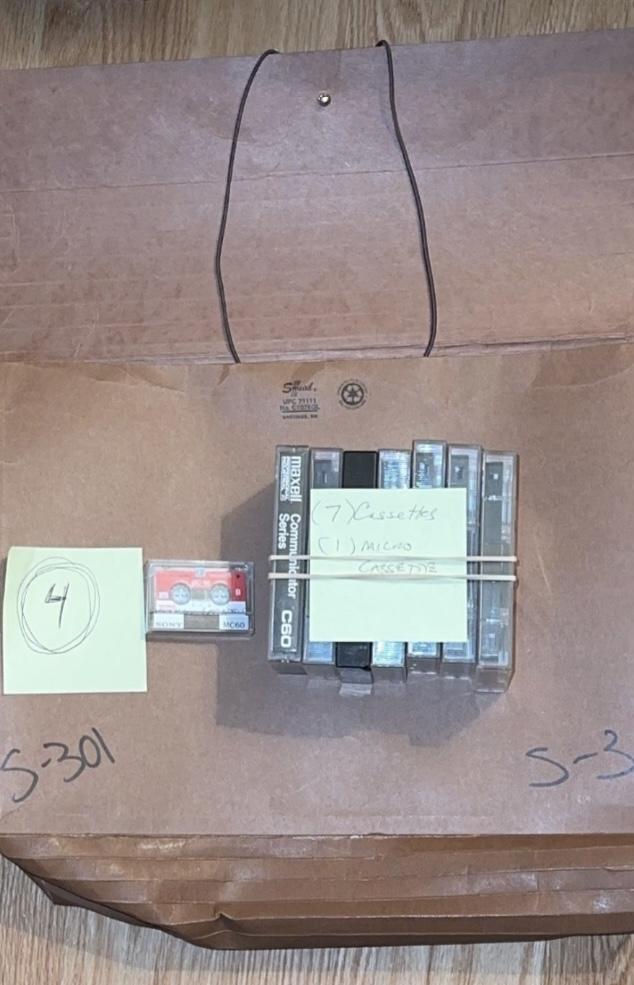
Furthermore, Sergeant Holmes, together with his partner Detective Rick Graves, interviewed many witnesses on tape, including Tom Hinkle. Yet, Hinkle’s recorded interview is not included in the eight cassettes found in the Homicide archives.
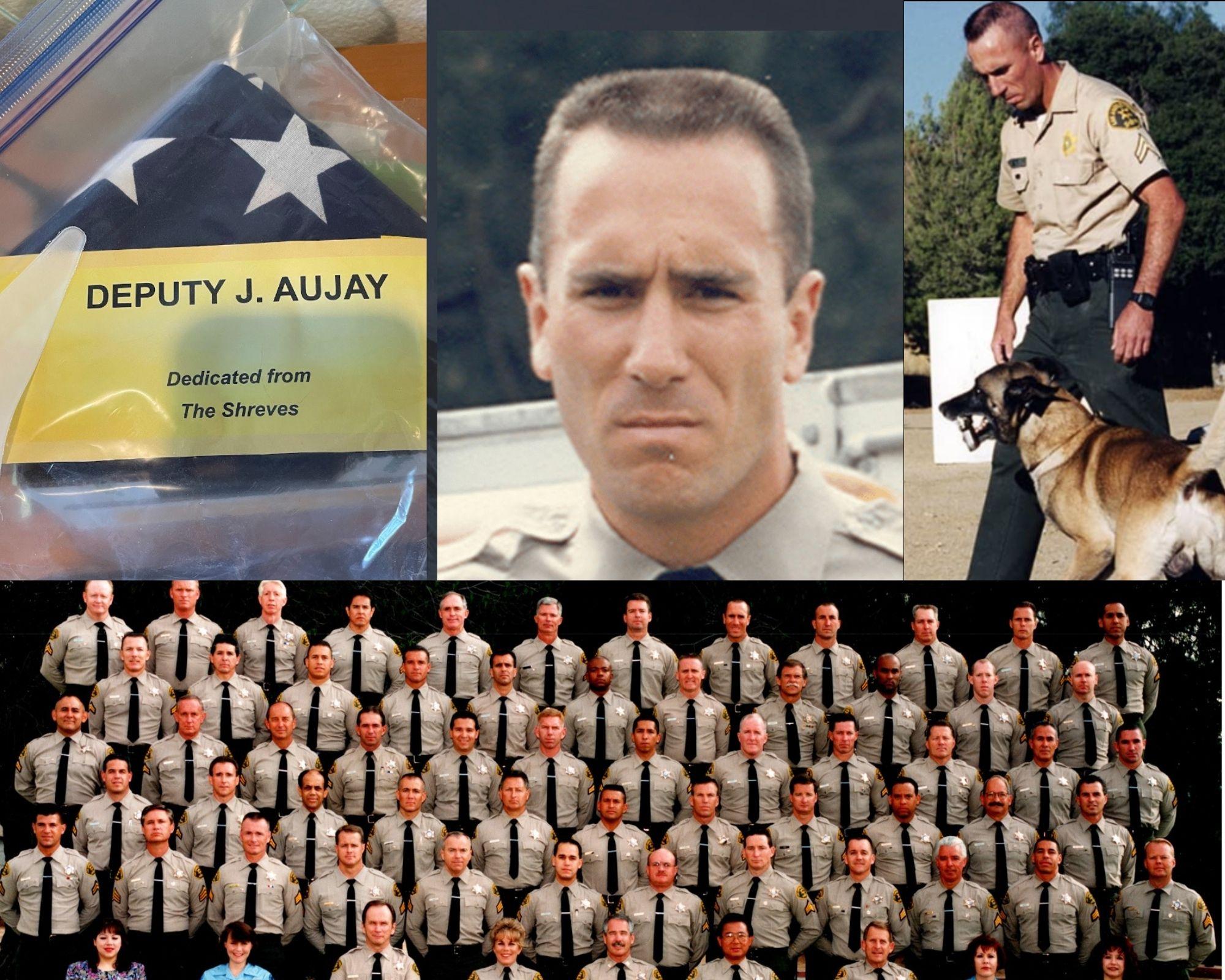
After the conclusion of the Lynn Standish case, Sergeant Holmes went on to replace Homicide Detective Larry Brandenburg to investigate the disappearance of Sheriff deputy Jonathan Aujay.
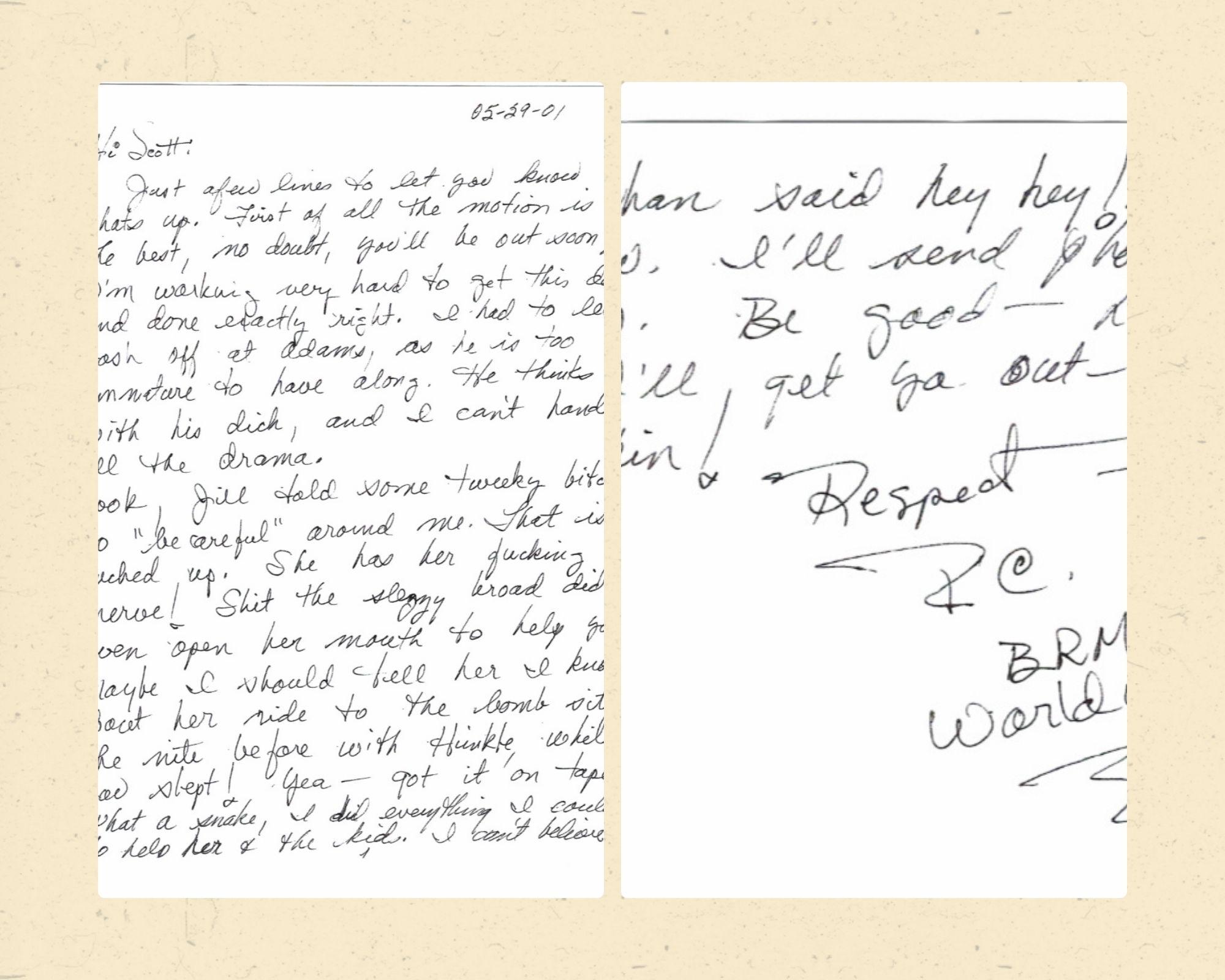
In 1998, attorney John Reed hired Rod Catsiff as his “local” investigator to gather information about Tom Hinkle’s involvement in the murder of Lynn Standish. Catsiff tape-recorded his conversations with Tom Hinkle, his wife, and his associates, like Larry Crawford and Mike Booth.
Catsiff was in his element doing this work, and wrote Scott H. compassionate letters that he would get him out of prison.
He managed to talk to a retiring member of the local Sheriff’s station, who informed him that a latent fingerprint on the microwave was found. Catsiff told John Reed the news immediately. However, the lab results of that fingerprint were never produced.
While snooping around for Scott’s case on the Lynn Standish murder, Catsiff stumbled upon sensitive information about Deputy Aujay’s disappearance.
His investigations were noticed by Detective Darren Hager, who at that time led the joint task force together with Lieutenant Ron Shreves and DEA agents Kent Bailey and Mark Corey. They already had some information about Catsiff’s work as an informant for various narcotics personnel.
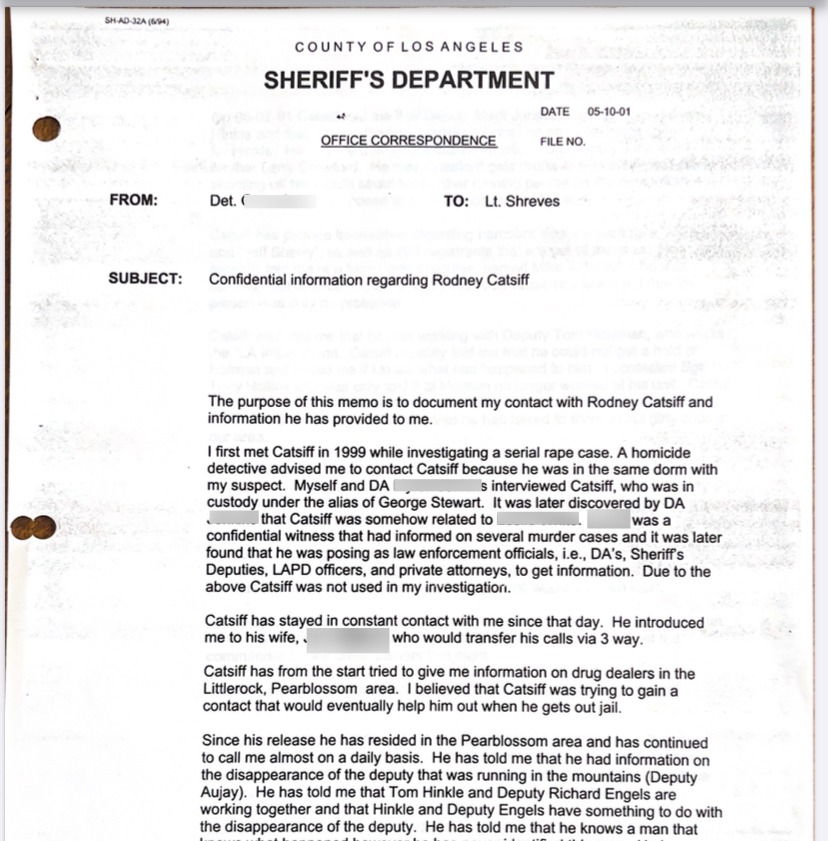
According to one deputy, Deputy Gonzales, Catsiff was an unreliable informant as he never produced concrete evidence or subjects who could tell him who was responsible for missing Deputy Aujay. He also stated that “Catsiff had relations with a certain Leslie White, who was at some point a confidential witness until law enforcement found out that White had posed as an agent/officer for various agencies. For that reason, Catsiff was not used as an informant.”
In the first few days of January 2001, the task force searched Catsiff’s house, where they found his investigative work.
A few months later, on May 10, 2001, Catsiff agreed to talk to the task force; Detective Hager interviewed him.
Catsiff made clear that he feared talking to the Los Angeles Sheriff’s Department. He knew several personnel were involved in criminal activities tied to the people he had interviewed, and advised them he had information linking Hinkle and Deputy Engels to the Aujay disappearance. Catsiff would stay in touch with Hager after the initial interview.
Hager and Shreves would document what Catsiff told them:
“Tom Hinkle, Larry Crawford [owner of Crawford Chevron in Pearblossom], Michael Booth, and a man named Blaylock [owner of Crystalaire (now Crystal) Airport] are involved in a complex criminal conspiracy. He said they refer to themselves as a ‘corporation.’
Tom Hinkle and Hans Schmidt assist each other in running multiple meth labs, counterfeiting, and child pornography.
Schmidt is also associated with Deputy Engels. Deputy Engels advises the men when law enforcement is close, and they should shut down their illegal activity.
Schmidt once shut down a lab on 121st St. East because Deputy Engels told him a narcotics team was looking into it.
An individual named David Pittman gave bomb making materials to Hinkle and Scott Hamby for the bomb that killed Lynn Standish. Hamby, Hinkle, and Shary routinely built bombs in a shed on Hinkle’s property. Deputy Engels protected Hinkle from prosecution in the Standish murder because of their collective involvement in criminal activities.”
In April 2001, the DEA/LASD task force arrested Thomas Dean Hinkle. Hinkle, also known as “GOD,” pleaded guilty to conspiracy to distribute methamphetamine. All other counts, like possession with intent to distribute methamphetamine, aiding and abetting, possession with intent to distribute methamphetamine, aiding and abetting, and possession of a firearm, were dismissed in “the interest of justice” upon a motion by the government. He would serve a “minimal” sentence of 57 months in prison.
Meanwhile, Catsiff continued to cruise around the desert, interview subjects, drive to his second house in Las Vegas, and visit his children. But he must have felt the heat was coming fast.
At one point, Rod Catsiff told Detective Hager, “I was at Crawford’s Chevron station one day when Crawford and Hinkle were there. They had a copy of my RAP sheet. Crawford told him he got the RAP sheet from Deputy Mark Johnston.”
In early September 2001, Catsiff was unpleasantly surprised by “two men” who would chase him when he was driving his black Chevy Blazer. He called his son to inform him what happened, and he wanted to know “if the kids are okay,” referring to his grandchildren. A week later, Catsiff disappeared.
The Renegade Vanishes
On September 12, 2001, Resident Deputy Rick Engels was assigned to a call of a vehicle fire in the Angeles Forest. Apparently, Engels was just about to clock out and asked to have the call reassigned.
The next day, Deputy Engels found the burned-out vehicle on Mt. Emma Road and 66th Street. The torched car was Rod Catsiff’s black Chevy Blazer.
Something was up. Lieutenant Shreves made the following observation about Deputy Engels:
“Mobile data terminal records indicate Deputy Engels ran the plate immediately and therefore knew the vehicle belonged to Catsiff before going off duty.”
By finding Catsiff’s torched car the next day, Deputy Engels seemed to have delayed an investigation into the incident and a possible abduction of Rodney Catsiff.
However, in his own words, Deputy Engels was actually trying to find Rod Catsiff when he disappeared. During his deposition in Hager v. County of Los Angeles/Sheriff’s Department, Deputy Engels testified that he knew Rod Catsiff.
“Rod Catsiff was a parolee living in my area. He was a child molester, and I think I arrested him one time for having a gun while he was out on parole.”
Engels continued, explaining that the Palmdale Sheriff’s station had received a phone call from Catsiff’s daughter regarding information she had received from Hans Schmidt’s daughter. Catsiff’s daughter was told that “her dad was buried out in the desert behind your house’ and ‘something about cops knowing about this.’”
“I tried to find Rod Catsiff when he ended up missing. Tony Gonzales, Detective Gonzales asked me to go out and assist in the investigation on that, see what was going on.”
Rod Catsiff himself had given the DEA/LASD task force information that Hans Schmidt was an associate of Tom Hinkle. Catsiff’s information was memorialized in multiple task force memos:
“Tom Hinkle and Hans Schmidt assist each other in running multiple meth labs, and Schmidt is also associated with Deputy Rick Engels. And according to Catsiff, ‘Deputy Engels forewarned Schmidt and Hinkle when law enforcement was close, and that they should shut down their illegal activity.’”
Catsiff’s family was notified that his car was found; they reported him missing the following day, September 13, 2001.
Law enforcement searched Catsiff’s house in Littlerock. Deputy Randell J Heberle wrote in the missing person report that Catsiff’s disappearance was “suspicious,” and that “foul play was indicated.” He notified Deputy Gonzales who, earlier that year, reported to Lieutenant Shreves that Catsiff was a potential informant.
Three detectives from Homicide, Detectives Diane Harris, Martin Rodriguez, and Chris Carnes, investigated Rod’s disappearance, interviewed witnesses, and searched the car scene and his house.
One of Catsiff’s housemates witnessed the detectives taking boxes with Rod’s material from his house. Rod kept most of his investigative work, such as tape-recorded conversations, notes and cash, as well as possible dope, in a large safe.
It is important to note that, a month before he vanished, Rod’s landlord had begun an eviction process and removed his belongings some time after he disappeared. This was revealed in the eviction court proceedings, where the judge scolded the landlord for dumping Rod’s belongings within the 90-day limit. He ordered the landlord to return Rod’s belongings forthwith.
It is not clear who took exactly what from the house but, in the end, Rod’s tapes and notes went missing, and the 300-pound safe could not be accounted for.
Rumors were swirling around town that “he was shot in the neck,” and “because he was a former child molester that he had it coming,” that “he mixed with the wrong crowd because of his lifestyle.”
A former California Parole Agent, Larry Dorsey, informed Detective Harris that he got a tip about the location of Catsiff’s body. “Rod Catsiff’s body may have been buried in the desert,” they had used a backhoe.
The detectives followed up, but nothing was found.
Several months later, early in 2002, attorney John Reed, who had hired Catsiff, met with the DEA task force to discuss Catsiff’s disappearance.
John Reed was reluctant to talk to anyone from the Los Angeles Sheriff’s Department. During the meeting, Reed told DEA Special Agent Kent Bailey and Detective Darren Hager sensitive information involving the possible murder of Deputy Jon Aujay, the Lynn Standish murder, and proof that Deputy Rick Engels’s involvement in ephedrine sales and the narcotic trade in the Antelope Valley.
Now that Catsiff was missing, John Reed was desperate to retrieve the lab results for Scott’s case. To date, no lab receipts for the latent prints have been found.
Reed became confused when the forensic photographer, Watson Lee, who took all the photos at the Lynn Standish crime scene for the Scientific Services Bureau, had changed three digits of the official case file number. Perhaps this was a clerical error, but it was utterly confusing, according to Reed.
Homicide had several suspects in the Catsiff disappearance case. One suspect died from reported electrocution, while another, Mike Z., was released after the Los Angeles District Attorney’s office determined there was insufficient evidence against him.
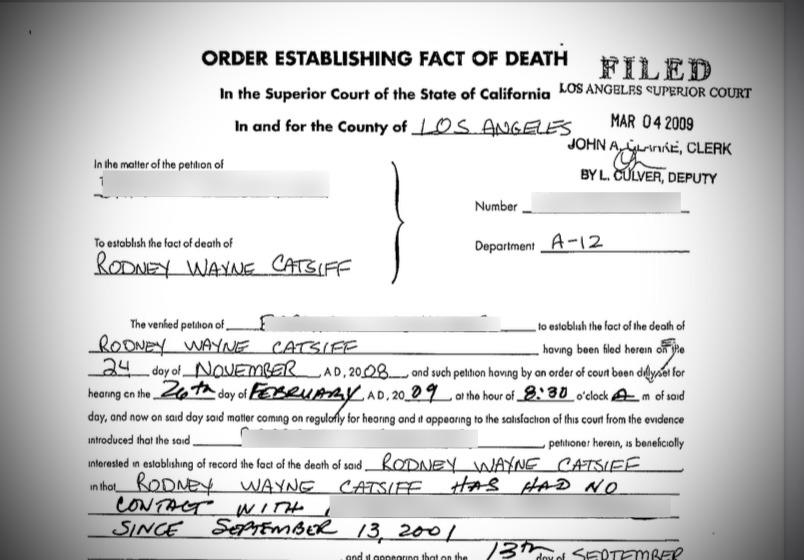
In 2009, Los Angeles Superior Court Judge David Bianchi established that Rodney Wayne Catsiff had died on September 13, 2001.
Catsiff’s life brought him to a critical turning point where he discovered evidence of crimes committed by individuals with whom he was associated. The discovery of his body and personal belongings is essential for uncovering the truth behind the Lynn Standish murder and the disappearance of Deputy Jon Aujay. While Catsiff’s history is marked by various crimes and misdemeanors, it does not overshadow the good he attempted to do for others. His reputation should not serve as a reason to avoid investigating the possibility of his murder.
To this day, Scott H. fights for his innocence in the Lynn Standish murder. It is reasonable to believe that his confinement is unlawful because evidence was suppressed by investigators and prosecutors, who may have knowingly allowed false testimony to be presented at the trial.
Recently, in a rare occurrence, the California Supreme Court issued an order to show cause, returnable in the Superior Court of Los Angeles, on all claims in his petition.
In 2025, Judge William C. Ryan, a well-respected judge, ruled that there was a reasonable likelihood that Scott H. was entitled to exoneration; he ordered an evidentiary hearing.
Unfortunately, Judge Ryan passed away unexpectedly on March 25, 2026.
For years, he oversaw the work on criminal habeas corpus cases, most notably the Raymond Lee Jennings habeas case in the murder of Michelle O’Keefe.
William C. Ryan was at the head of the Conviction Review Unit at the Los Angeles District Attorney’s office, established by then-District Attorney Jackie Lacey. Ryan ultimately exonerated Raymond Lee Jennings in 2017.
In his last hearing as a judge on this case, William Ryan called Scott H.’s case “convoluted.” Ryan could not have known that one of his most high-profile cases was more than intricate: The case has also dredged up ongoing issues like “deputy gangs” and unconstitutional policing.
Was Judge Ryan aware of the historical issues regarding deputy gangs and how these issues still affect organizational policing, as well as the current Sheriff’s election in Los Angeles County?
Former Sheriff Alex Villanueva recently published an op-ed in the New York Post denying the existence of deputy gangs. He wrote: “After years of accusations, hearings, and political theater by the Los Angeles County Civilian Oversight Commission (COC), the truth has finally been acknowledged: So-called deputy gangs do not exist.” And: “For years, the ‘deputy gang’ label was used as a political weapon, amplified by county leadership, oversight bodies, and segments of the media, to discredit the Sheriff’s Department, influence elections, and justify weakening traditional law enforcement under the banner of ‘reform.’”
Did Villanueva publish this piece in a bid for his re-election as Sheriff this year? He faces tough opposition: Incumbent Sheriff Robert Luna is running for re-election and has fought hard to restore the public trust and reform the Sheriff’s Department.
Former Sheriff’s Captain Unearthed Valuable Pearls
John Michael Bauer, a former Captain of the Special Enforcement Bureau (SEB), began investigating Rod Catsiff’s disappearance after going on a mission to determine what happened to his missing Deputy Jon Aujay, who vanished on June 11, 1998. A few weeks after the intensive search for Deputy Aujay in and around Devil’s Punchbowl, Pearblossom, Captain
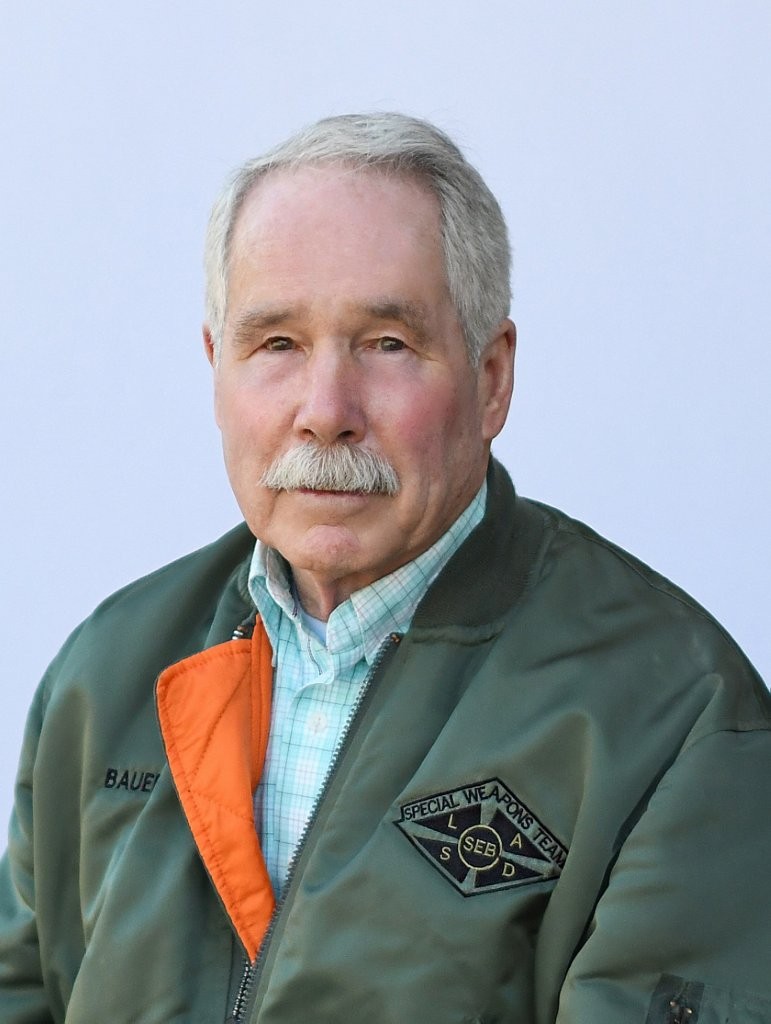
Bauer’s divers at SEB recovered the body and car of Hollywood screenwriter Gary DeVore from the California Aqueduct.
For more than two decades, Bauer has searched for Aujay, discussing the case frequently with the late Lieutenant Shreves and Detective Hager. Shreves, impressed by Bauer’s detailed investigative work and memory, urged Undersheriff Bobby Denham to explore a link between Aujay’s case and other high-profile murder and missing-person cases to an ongoing criminal enterprise in the Antelope Valley.
Bauer recovered crucial information indeed. He interviewed hundreds of people and gathered physical evidence. A natural-born detective with razor-sharp instincts and people skills, Mike has a particular talent for interviewing subjects or persons of interest.
While investigating the circumstances of Aujay’s disappearance, Captain Bauer started looking into the murder of Lynn Standish as a pro bono investigator for defendant Scott H. It was then that he found out that Rod Catsiff had gathered information about Aujay and the Standish murder.
He produced an extensive investigation and submitted a Conviction Review Application on Scott’s behalf to the District Attorney’s Conviction Review Unit. Former LASD Detective Gilbert Brisco, who served as Scott’s court-appointed investigator, briefed Captain Bauer on his belief that there is a strong connection between the June 11, 1998, disappearance and potential murder of Sheriff’s Deputy Aujay and the murder of Lynn Standish, for which Scott H. was accused.
According to Bauer, his reinterviewing of the two polygraph operators in the Aujay case report, written by Sergeant Holmes and Detective Steinwand, approved by Lt Larry Lincoln, revealed that the inclusion of a false polygraph result exonerating suspect Tom Hinkle of any involvement in Deputy Aujay’s 1998 disappearance was actually found to be demonstrably false according to both operators, suggesting dishonesty as well as a recurrence of “Viking” behaviors as alleged and restrained by Federal Judge Hatter earlier.
It has been a harrowing, long 20-plus years, but Bauer is still going at it. He believes that uncovering who is responsible for Rodney Catsiff’s kidnapping and murder may reveal information relevant to both Deputy Aujay’s case and the Lynn Standish murder.
According to Mike, it is very important to find the bodies of Catsiff and Deputy Aujay. “When a person is murdered and the body is hidden, never found, there’s never a murder investigation. There is a missing persons investigation, and there is always a theory among either inexperienced or frustrated homicide/missing person detectives that the missing person left voluntarily and that they are living somewhere else. Therefore, the killers are never investigated for murder. These are ‘no-body’ homicide investigations, and these cases are very rare. Very unusual. But that is the situation with Rodney Catsiff. It was rumored that he ran away to Las Vegas, that he just ran away. But when his skeleton is found, and there is some sort of a hammer mark in his skull or some bullet hole in his head, then it’ll be murder, and then everybody will start taking this bullshit seriously. Then they will understand that Catsiff was in danger because he was investigating what appeared to be corruption. Now we have foul play drifting off into other areas, don’t we?”
Rodney Catsiff wrote in his letters to defendant Scott H. that he had tape-recorded witnesses in his case. Mike collected Catsiff’s letters as part of his pro bono work in the murder case of Lynn Standish. Finding Catsiff’s notes and tape recordings is crucial to recovering the physical evidence.
Scott’s fight is receiving slow progress in the legal sphere. Recently, the DA’s office received discovery materials that could still be utilized by Scott’s attorney, as much of the 32-year-old physical evidence could contain important information that may have been previously missed or suppressed. The LASD Homicide Bureau recently ordered a Forensic Identification Specialist to photograph all the evidence in the archive rooms, where a Sheriff’s evidence property custodian oversees the process.
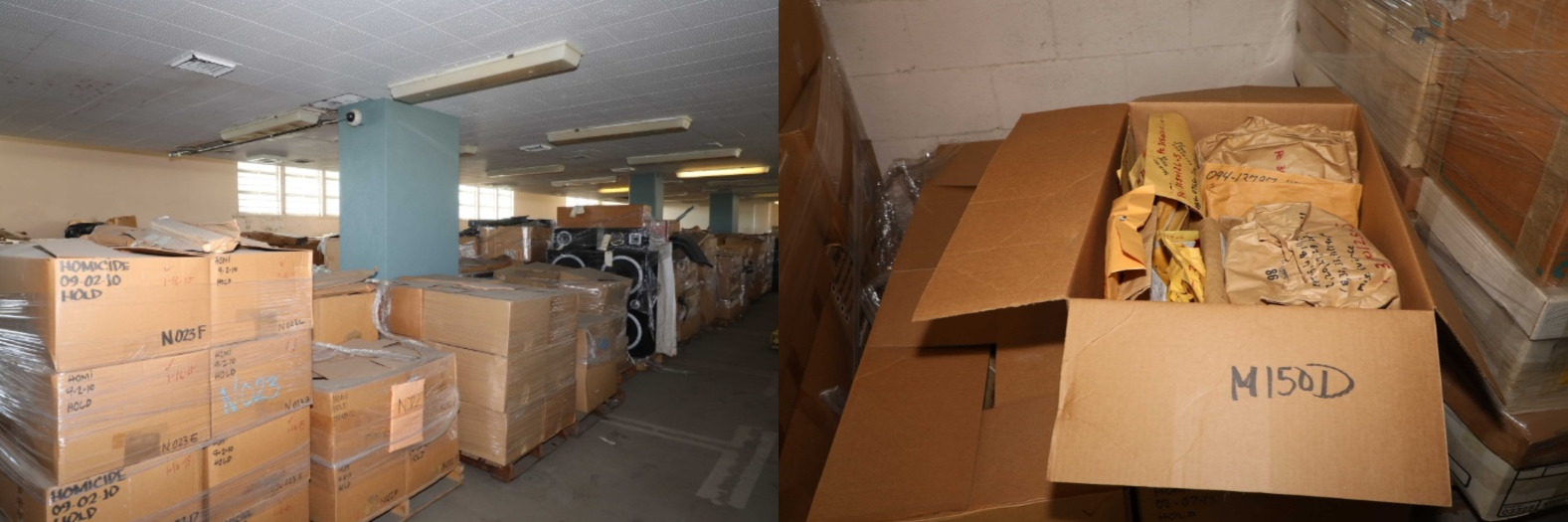
Among the thousands of pieces of physical evidence of the Standish murder scene, including hours of tape-recorded interviews, one photo immediately stood out.
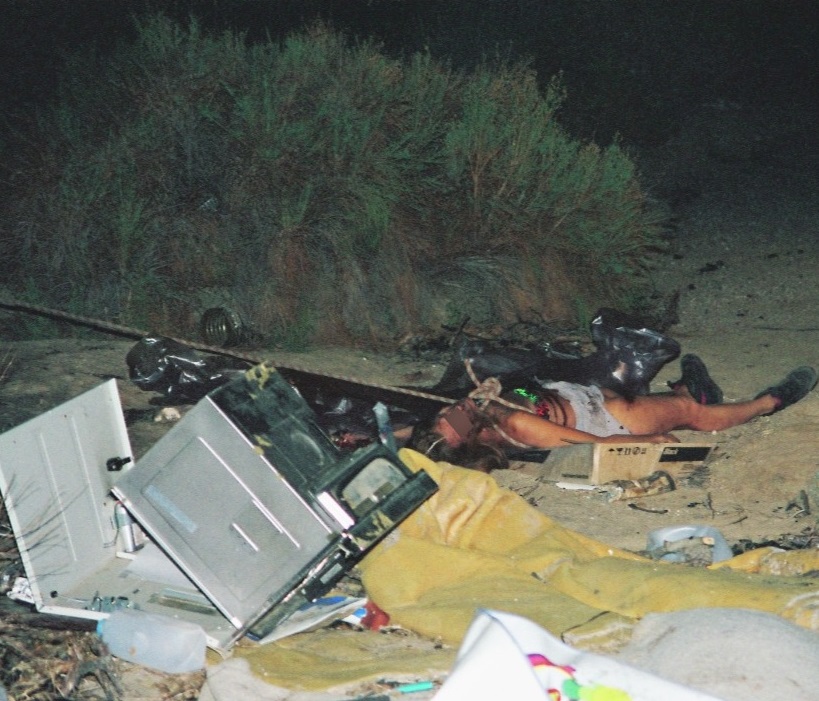
Mike analyzed this picture after the author of this article retrieved the discovery material.
“Here’s the situation with the rope. I read the trial transcript [of Scott H.’s trial], and there is no mention of anybody using a rope to drag that body and disturb the crime scene with it. However, my knowledge of bomb scenes, however limited, includes that you always have to consider that there is a secondary device that could blow up if you have a body and you’re standing next to it. Therefore, it is wise to pull or remove something from that area to make sure that you’re not killed if that secondary device goes off. But the problem in this case, being out in the desert like it was, if you don’t record the entire move of the body, you may be searching in an area for evidence that is not where the bomb went off.”
Mike found the recent discovery of this photo in the evidence dump to be significant.
“At the time of the trial, the detectives from Arson and Explosives were not questioned about the use of a rope.” Scott’s attorney, Ted Yamamoto, at that time, did not know that there was a photo of Lynn Standish’s body with a rope attached to it.
“Don’t forget, Arson and Explosives worked in the Antelope Valley, so close to all the military operations and so close to all defense contractors [Lockheed Martin, Northrop Grumman]. They never called the ATF about this case to consult or to examine any evidence. It has always struck me as very unusual that this case was kept in-house at LASD on such a serious case.”
Mike examined the photo.
“She was dragged from one point to another, but you cannot tell from the rope how far she was dragged away from the actual scene of the bombing. So if they didn’t mark the actual location for the crime scene investigators to sift through the ground. They were basically sifting through a much larger area, and some of what they found may not even have been related to that microwave. They may have found electronic parts that were from other junk thrown out there. The body should not have been moved prior to scientific services doing a crime scene inspection. I believe the body was moved for safety reasons.”
The lead detective, Sergeant Joe Holmes, did not mention anything about the body having been moved in his report. It is not mentioned in the entire Murder Book, for which Sergeant Holmes was responsible.
“Joe Holmes should have written that in his report.”
Last year, an inmate from a California prison, Daniel T., sent a letter to the Los Angeles District Attorney’s Office stating that he had information about the disappearance of Deputy Jon Aujay. It is unclear why investigators from the DA’s office decided to visit Daniel T. in prison and record their interview with him, rather than leaving the matter to the Los Angeles Sheriff’s Department.
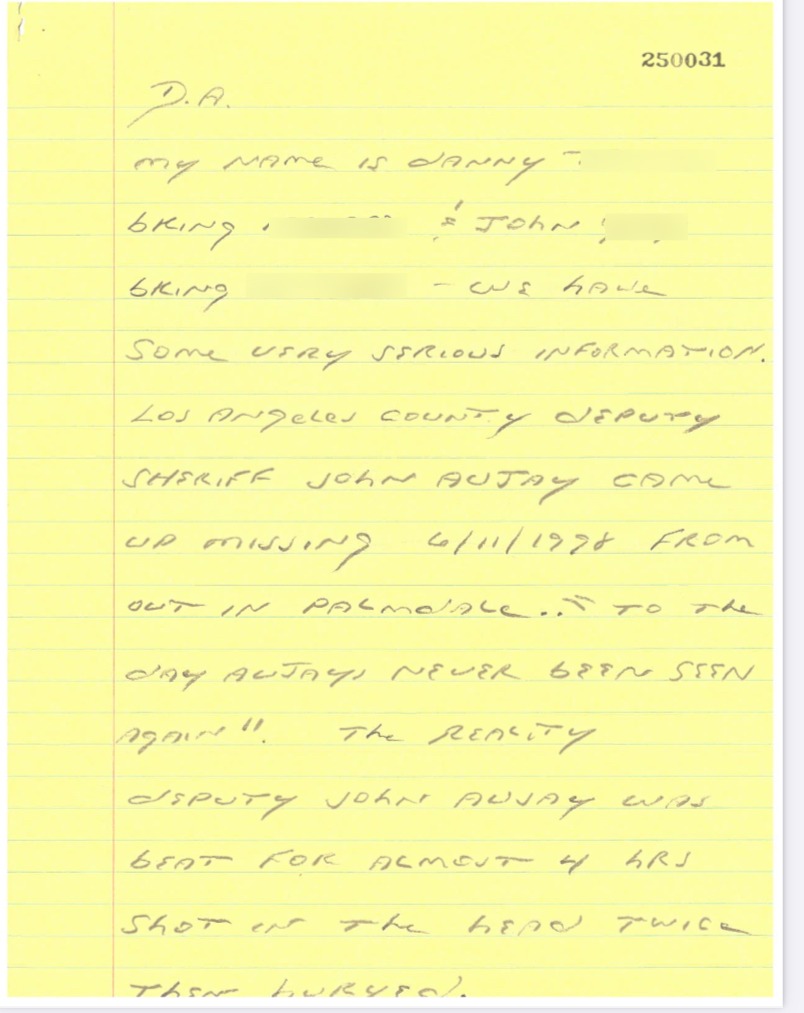
The DA’s office concluded that Daniel T. was a known “unreliable” informant, as he had been to many Homicide detectives in the past. There is a consensus among law enforcement officials that this inmate continues to spread lies about what he actually knows and witnessed, and that he has been trying to make deals in exchange for information for years.
The DA investigation resulted in a months-long delay in the further proceedings for Scott H., to the great frustration of both the defendant and his counsel.
The rare Order to Show Cause ordered by the California Supreme Court is a major turn of events in Scott’s case and, as the late Judge Ryan concluded, there is a good chance that Scott H. is entitled to be exonerated.
Now, with a new judge overseeing the habeas corpus cases at the Superior Court of Los Angeles and a new attorney for Scott, there is hope for productive future proceedings of Scott’s case.
Soon, a witness list must be presented, identifying who might be summoned to testify in the evidentiary hearing for Scott H. in his fight to prove his innocence.
Rodney Wayne Catsiff would have been a hell of a witness.

Rod Catsiff’s story is part of Code of Silence, an investigative series on Substack: How three decades of a continuing criminal enterprise silenced (unsolved) murders in the California High Desert.
CovertAction Magazine is made possible by subscriptions, orders and donations from readers like you.
Blow the Whistle on U.S. Imperialism

Click the whistle and donate
When you donate to CovertAction Magazine, you are supporting investigative journalism. Your contributions go directly to supporting the development, production, editing, and dissemination of the Magazine.
CovertAction Magazine does not receive corporate or government sponsorship. Yet, we hold a steadfast commitment to providing compensation for writers, editorial and technical support. Your support helps facilitate this compensation as well as increase the caliber of this work.
Please make a donation by clicking on the donate logo above and enter the amount and your credit or debit card information.
CovertAction Institute, Inc. (CAI) is a 501(c)(3) non-profit organization and your gift is tax-deductible for federal income purposes. CAI’s tax-exempt ID number is 87-2461683.
We sincerely thank you for your support.
Disclaimer: The contents of this article are the sole responsibility of the author(s). CovertAction Institute, Inc. (CAI), including its Board of Directors (BD), Editorial Board (EB), Advisory Board (AB), staff, volunteers and its projects (including CovertAction Magazine) are not responsible for any inaccurate or incorrect statement in this article. This article also does not necessarily represent the views the BD, the EB, the AB, staff, volunteers, or any members of its projects.
Differing viewpoints: CAM publishes articles with differing viewpoints in an effort to nurture vibrant debate and thoughtful critical analysis. Feel free to comment on the articles in the comment section and/or send your letters to the Editors, which we will publish in the Letters column.
Copyrighted Material: This web site may contain copyrighted material the use of which has not always been specifically authorized by the copyright owner. As a not-for-profit charitable organization incorporated in the State of New York, we are making such material available in an effort to advance the understanding of humanity’s problems and hopefully to help find solutions for those problems. We believe this constitutes a ‘fair use’ of any such copyrighted material as provided for in section 107 of the US Copyright Law. You can read more about ‘fair use’ and US Copyright Law at the Legal Information Institute of Cornell Law School.
Republishing: CovertAction Magazine (CAM) grants permission to cross-post CAM articles on not-for-profit community internet sites as long as the source is acknowledged together with a hyperlink to the original CovertAction Magazine article. Also, kindly let us know at info@CovertActionMagazine.com. For publication of CAM articles in print or other forms including commercial internet sites, contact: info@CovertActionMagazine.com.
By using this site, you agree to these terms above.
About the Author

Mel Elorche is a screenwriter and journalist who lives in California.

Epstein, quei legami russi del finanziere e le donne usate come trappole. L’ombra di manovre dei Servizi segreti
di Luigi Ippolito
L’eredità del padre di Ghislaine e la rete per ricattare gli amici potenti
Ragazze russe per i potenti
Da sinistra a destra Masha Drokova, Epstein e Ghislaine Maxwell, Robert Maxwell, Ehud Baral con Epstein
Ascolta l’articolo
5 min
i
new
DAL NOSTRO CORRISPONDENTE
LONDRA – Molto più che una combriccola di ricchi assatanati a caccia di giovani schiave sessuali: la rete di relazioni costruita da Jeffrey Epstein si colora sempre più come una delle più sofisticate operazioni di spionaggio degli ultimi decenni, una macchinazione che ha condotto a vette mai raggiunte la collaudata arte russa del «kompromat», ossia mettere persone-chiave in situazioni compromettenti per poi tenerle in pugno.
Come hanno sottolineato fonti di intelligence al Mail on Sunday, appare sempre più evidente come il magnate pedofilo americano avesse messo su «la più ampia operazione di “trappola al miele” del mondo» per conto del Kgb: Epstein dunque avrebbe procurato ragazze ai potenti del mondo per conto dei servizi segreti russi, e magari anche israeliani, in modo che fossero ricattabili.
Il padre di Ghislaine
Tutto risale all’amicizia di Epstein con Robert Maxwell, il magnate dei media britannici morto misteriosamente nel 1991, apparentemente per una caduta dal suo yacht alla quale nessuno ha mai creduto veramente. Maxwell era d’origine un ebreo cecoslovacco che si ritiene avesse lavorato per il Kgb così come per il Mossad, fin da quando negli anni Settanta aveva facilitato l’emigrazione degli ebrei sovietici in Israele: a presentarlo a Epstein fu un magnate del petrolio russo, anche lui a libro paga dei servizi del Cremlino. E Maxwell, con l’aiuto di Epstein, riciclava i fondi di Mosca in Occidente.
Non a caso, subito dopo la morte di Maxwell, a fianco del finanziere americano compare Ghislaine, la figlia del barone dei media, che ne diventa la complice e amante. Maxwell aveva sottratto tutti i fondi pensione dei suoi giornali e quei soldi non sono mai stati ritrovati: da più parti si ritiene che siano stati riciclati proprio da Epstein e che la gestione di quel tesoro sia il filo che univa il magnate americano a Ghislaine.
Come Maxwell, Epstein è morto misteriosamente in carcere nel 2019, apparentemente suicida, mentre Ghislaine sta scontando negli Usa una condanna a vent’anni per prostituzione minorile e sta trattando su eventuali rivelazioni.
Amicizie moscovite
Nei file appena resi pubblici, ci sono 9.629 riferimenti alla Russia e 1.056 menzioni di Vladimir Putin: risulta che Epstein abbia incontrato il dittatore russo in più occasioni, anche dopo la sua prima condanna per reati sessuali. E il finanziere si vanta nei messaggi di poter fornire informazioni al Cremlino su Donald Trump, tramite incontri con l’ambasciatore russo a New York e lo stesso ministro degli Esteri Serghej Lavrov. Si tratta di scambi di email avvenuti alla vigilia del summit del 2018 fra Trump e Putin, alla fine del quale il presidente americano sostenne di non avere prove di interferenze russe nella sua elezione.
Epstein risulta anche legato a Masha Drokova, ex leader del movimento giovanile putiniano, diventata poi una donna d’affari basata a San Francisco: ma le fonti di intelligence ritengono che la sua azienda, Day One Ventures, fosse stata messa su per rubare segreti tecnologici. La stessa Drokova era stata approcciata dall’Fbi e aveva subito sviato il discorso su Epstein.
Un libro pubblicato nel 2021 dal giornalista investigativo Craig Unger sostiene che fu proprio Epstein a fare da tramite fra Trump e la cerchia di Putin e che il magnate americano faceva ricorso alla criminalità russa per fornire giovani ragazze ai suoi amici potenti, a partire dal futuro presidente americano.
A Londra
Non stupisce dunque come in una email Epstein prometta all’allora principe Andrea una «bellissima e fidata» russa 26enne. Il biografo di Andrea, Andrew Lownie, ha appurato come giovani donne provenienti da Mosca venissero portate direttamente al principe nelle sue residenze in Inghilterra per il weekend, per poi essere riaccompagnate direttamente in aeroporto. Lownie è convinto che il Cremlino sia in possesso di un copioso dossier su Andrea, probabilmente corredato anche da immagini, con cui ricattare la famiglia reale e di conseguenza la Gran Bretagna.
Quanto a Londra, i documenti rivelati mostrano anche pagamenti per 75 mila dollari da Epstein a Lord Mandelson, l’ex ambasciatore britannico negli Usa costretto alle dimissioni lo scorso novembre per i suoi legami col finanziere. Mandelson, soprannominato il «principe delle tenebre», era stato uno degli architetti del New Labour e il più stretto consigliere di Tony Blair.
Altri documenti pubblicati mostrano come l’Fbi fosse convinto che Epstein fosse una spia del Mossad, addestrato da Ehud Barak, l’ex primo ministro israeliano, col quale scambiava continuamente messaggi. Insomma, un intreccio di ombre che allunga un’aura molto più inquietante sulle perversioni di un gruppo di potenti.