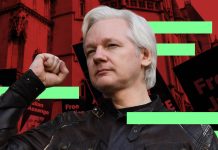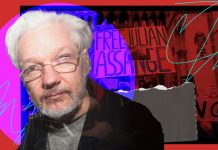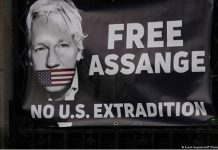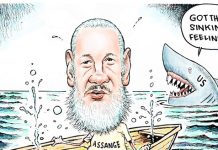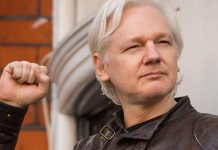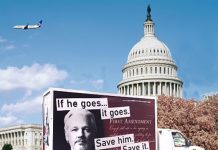
Julian Assange is back.
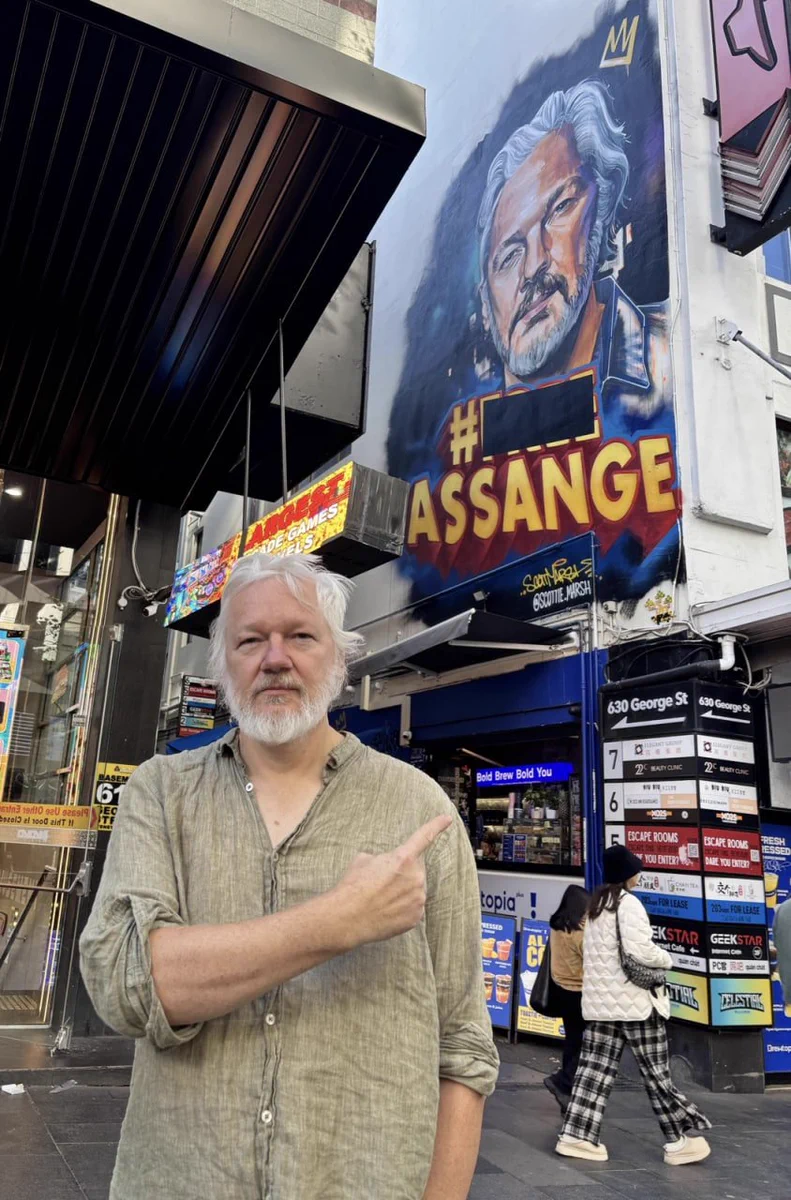
On September 17, Assange heralded his own return to X by posting a picture of himself standing in front of a Sydney street mural. The mural, painted by Scott Marsh, shows a bearded bust of Assange looking out on the world above the hashtag, “#FreeAssange,” only the “Free” has been redacted in black and the other letters are adorned in the red, yellow and blue font of the Superman comic.[1]
Can this human being help save the world from the neo-cons? How much gas does Assange have left in the tank after being tortured by the Empire?
For those who tend to forget history during this Orwellian moment, perhaps it is worth remembering where the journalist is coming back from.
In 2017, the CIA under Director Mike Pompeo discussed plans to assassinate Assange.[2] On April 11, 2019, British police arrested Assange and threw him into Belmarsh Prison, the Guantánamo Bay of London, where he remained until 2024.
Who is Julian Assange?
Assange is a home-schooled kid from Queensland, Australia. Born on July 3, 1971, the young Assange moved from home to home with his family, developing a sense of placelessness that would, perhaps, inform his cosmopolitan sensibility. The boy loved computers. He learned how to code.
In 1991, under the alias “Mendax,” Assange hacked into the master terminal of a Canadian telecom company called Nortel. In 1993, he launched Suburbia, one of the first Internet Service Providers (ISP) in Australia. In 1995, he pleaded guilty to 24 of 31 charges brought against him by the Australian Federal Police for the Nortel hack, but the judge in the case, seeing no malicious financial gain, did not make Assange spend a day in prison.[3]
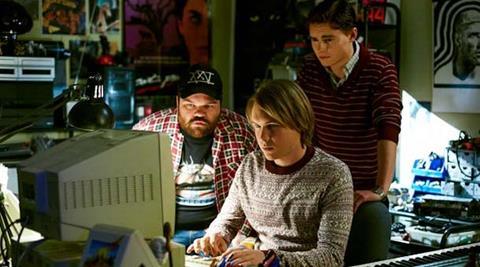
Along with a host of other activists and mathematicians, Assange formed WikiLeaks in Iceland in 2006. Central to WikiLeaks’ work was a more scientific approach to journalism in which the organization would simply publish leaked primary documents and leave the editorializing to others. The goal was to place truth over narrative.
Inspired by Daniel Ellsberg’s legendary leak of the Pentagon Papers, the reporting of WikiLeaks helped reveal the “Petrogate” scandal in Peru,[4] disclosed extrajudicial executions in Kenya[5] and, due to pulling back the curtain on counternarcotics operations in Mexico, WikiLeaks may have even helped topple the puppet government there in 2012, revealing the degree to which Felipe Calderón was controlled by the United States.[6]
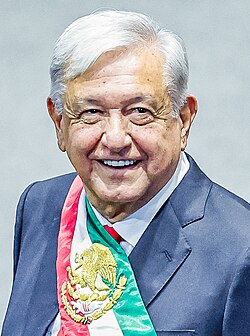
In 2021, as news of Assange’s torture in Belmarsh Prison began to spread around the world, Mexico’s president, Andrés Manuel López Obrador, offered the publisher asylum.
“Assange is a journalist and deserves a chance,” Obrador said at the time. “We’ll give him protection.”[7]
Julian Assange was the most innovative and consequential journalist of the Global War on Terror generation. Assange pulled down the pants of the CIA in 2017, publishing many of the agency’s sources and methods in the “Vault 7” leak.[8] He revealed their regime of extraordinary rendition, unconstitutional surveillance, and torture.
Assange gained fame in the United States for exposing its war crimes in Iraq and Afghanistan, as well as releasing troves of documents revealing corruption in the Democratic National Committee during the 2016 contest between Bernie Sanders and Hillary Clinton.
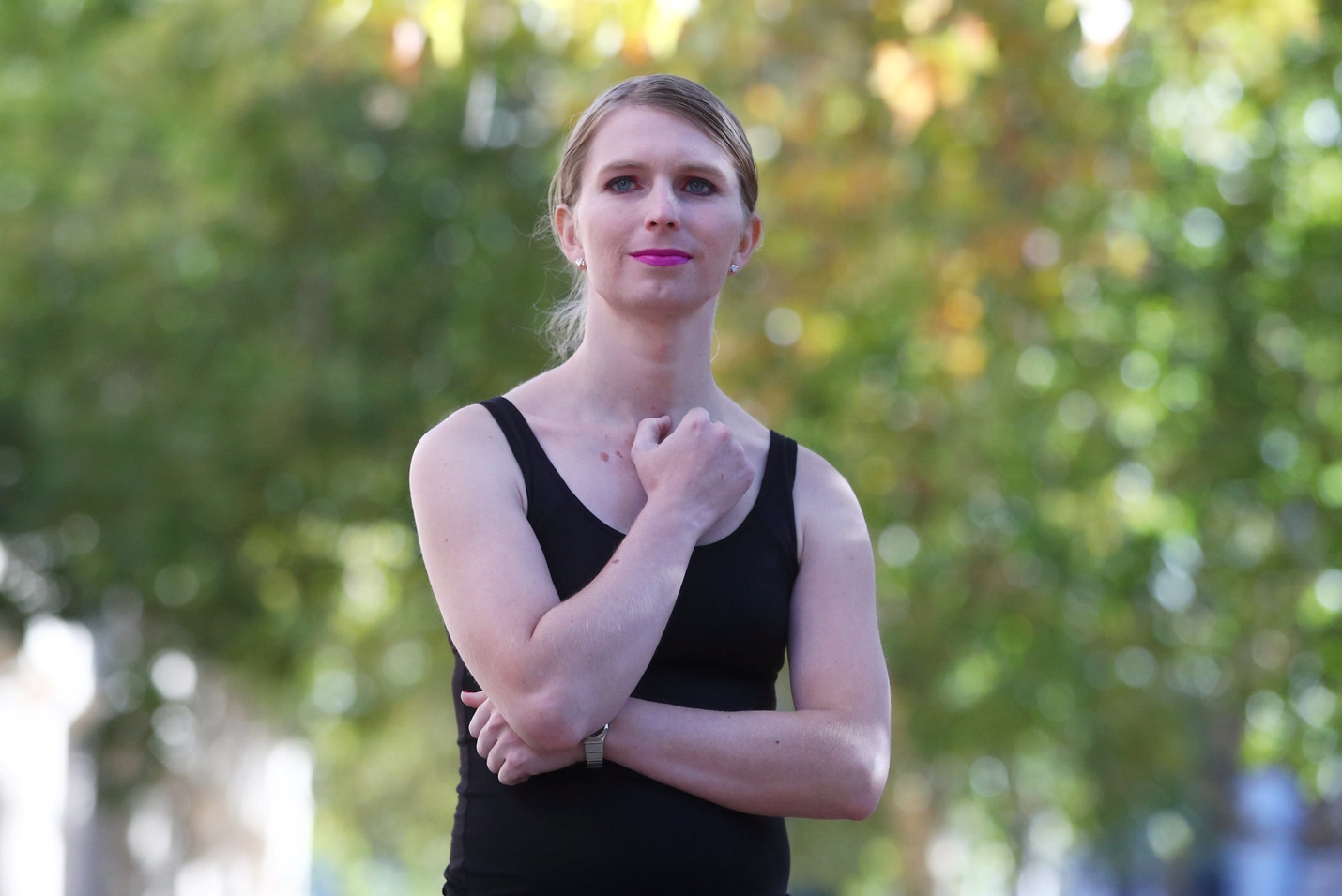
In 2019, the Trump administration, via lawyers in the Eastern District of Virginia (known as a flagrantly biased court in favor of the Security State), charged Assange with 18 counts under the infamous 1917 Espionage Act, as well as one charge of conspiracy to hack government computers back in 2010 with Air Force whistleblower Chelsea Manning.[9] Manning, for her part, refused to testify against WikiLeaks in 2019.
“What I did during my enlistment was part of a deep American tradition of rebellion, resistance and civil disobedience—a tradition we have long drawn upon to force progress and oppose tyranny,” Manning wrote in 2022.[10]
As news of the CIA assassination plot and Belmarsh torture spread like wildfire in the media, Amnesty International released the following statement on behalf of Assange: “If Julian Assange is extradited to the US for publishing sensitive material leaked by others, the message to journalists and publishers everywhere is simple: you are not safe.”[11]
Assange, perhaps more than any other journalist in the history of reporting, was a man without a country, a citizen of the world. Although Assange, as an ostensible Australian, had been largely ignored by his home country (now largely a vassal of the U.S.), people from all over the globe began to speak up for the journalist as the slow-motion assassination took place.
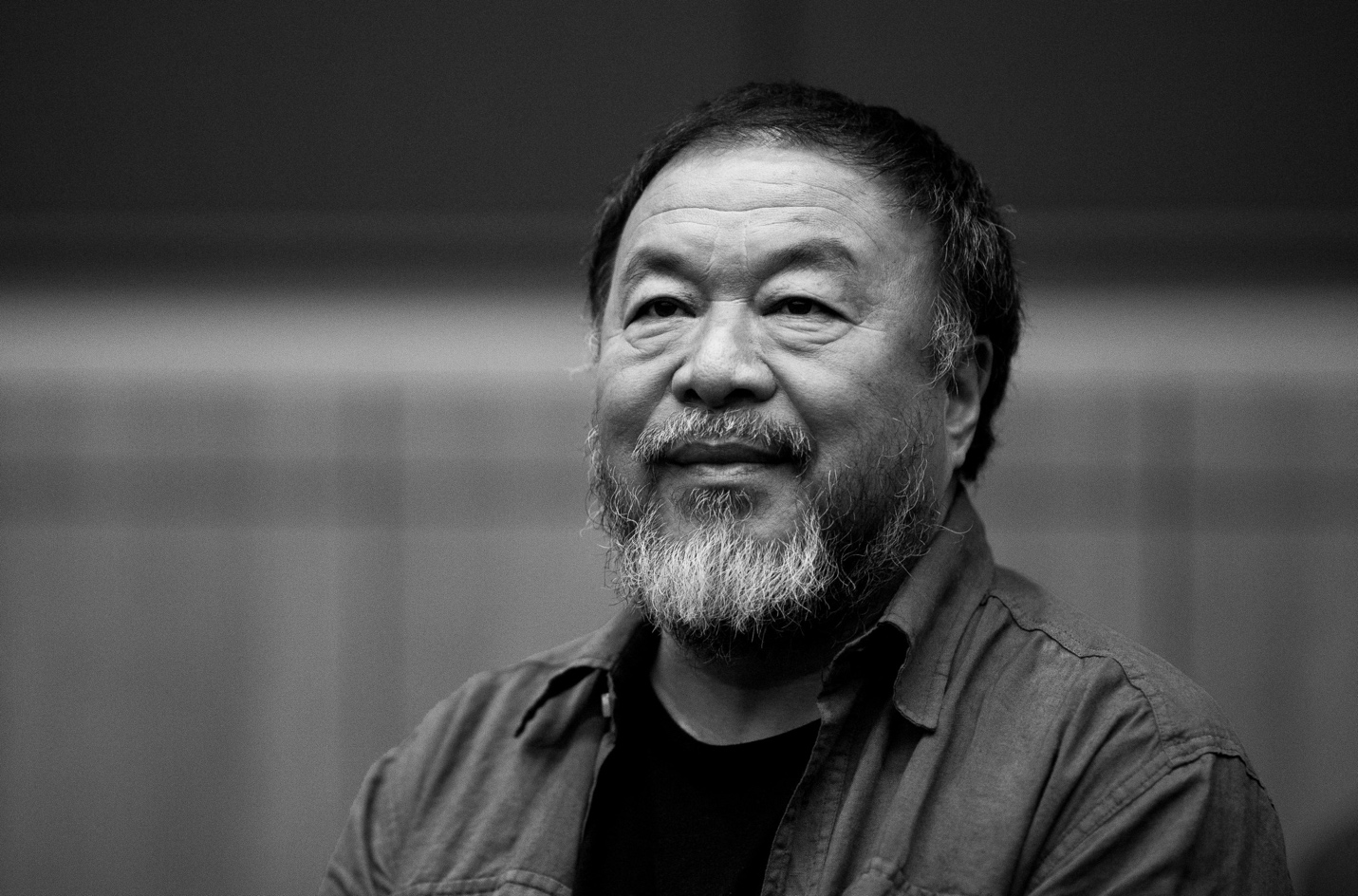
“Julian Assange truly represents a core value of why we are free—because we have freedom of the press. Let him be a free man,”[12] wrote the Chinese dissident, Ai Weiwei.
In 2023, after attending the coronation of Charles II in London, Brazil’s president, Luiz Inacio Lula da Silva, thundered at the British and American governments for criminalizing journalism.
“It is an embarrassment that a journalist who denounced trickery by one state against another is arrested, condemned to die in jail, and we do nothing to free him,” Lula said. “We talk about freedom of expression; the guy is in prison because he denounced wrongdoing. And the press doesn’t do anything in defense of this journalist. I can’t understand it.”[13]
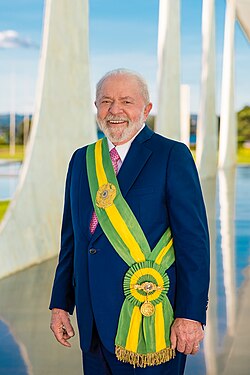
Lula had a point. Even as cities all over Europe presented Assange with honorary citizenship awards, many in America’s mainstream media pretended this publisher and peace activist did not exist.
Assange was the elephant in the room of a Biden administration that regularly gave lip service to the idea of a “rules-based international order” while at the same time sponsoring a genocide in Palestine and deadly proxy war on Russia and conducting an unprecedented escalation of censorship operations.[14]
“The free press is a pillar—maybe the pillar—of a free society, not the enemy,” Biden said in 2023.[15]
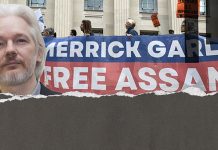
And yet, more than three years into his first term, Biden continued to persist with the Trump prosecution of Assange.
“Assange is a hero,” said Robert F. Kennedy, Jr., in November 2023, while challenging both Trump and Biden for the presidency. “Should our democracy survive, future generations will regard his persecution as a shameful episode comparable to the Army-McCarthy hearings and the Dred Scott decision.”[16]
Meanwhile, Trump, whose CIA plotted the assassination of Assange under Pompeo, went even further than Biden, stating publicly that Assange should receive “the death penalty or something.”[17]
What, ultimately, was the trial of Assange all about? Legally speaking, it was about 18 charges for allegedly transmitting classified documents to the public. Politically speaking, it was about a uni-party that privileged narratives over truth and power over people. Practically speaking, it was about making courageous journalism a crime and silencing dissent. The prosecution of Assange, according to George Washington University Law School Professor Jonathan Turley, may have been “the most important press freedom case in the U.S. in 300 years.”[18]
Turley was not the only expert alarmed by the trial. Former United Nations Special Rapporteur Nils Melzer argued that Trump and Biden’s conduct in the case amounted to “torture” and represented a gross violation of human rights.[19]
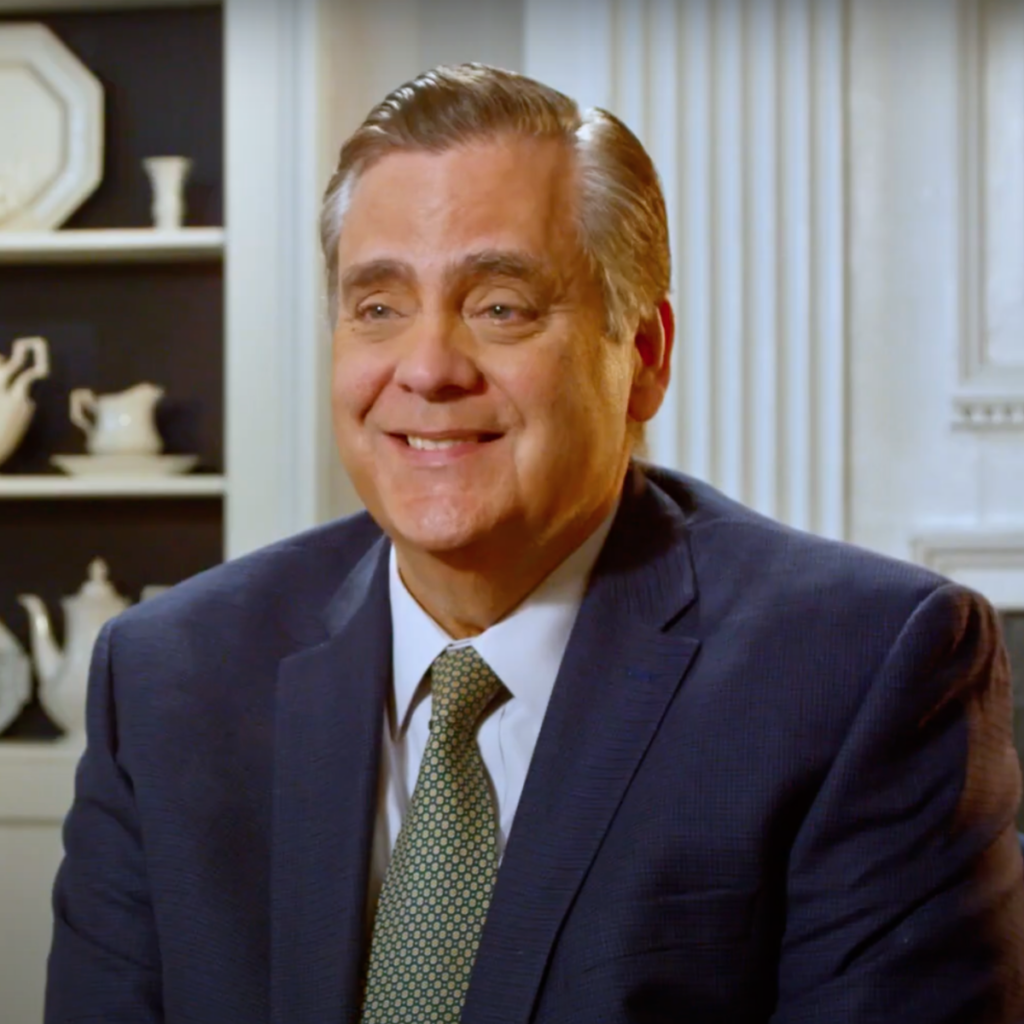
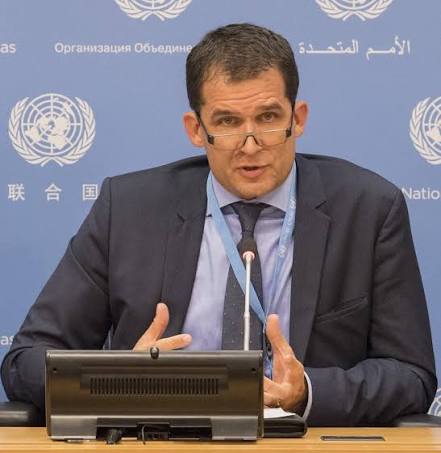
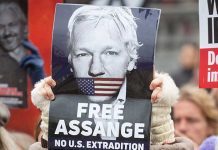
The New York Times, Amnesty International, Der Spiegel, The Guardian, and Human Rights Watch all eventually spoke up in solidarity on Assange’s behalf, as did United States presidential candidates Cornel West, Marianne Williamson, Vivek Ramaswamy, Tulsi Gabbard, and Robert F. Kennedy, Jr. As Kennedy wrote, “There’s no America without a free press. There’s no free press without a free Julian Assange.”
What eventually led to the critical mass that set Julian Assange free on June 24, 2024? What caused Main Street America to care about the fate of this Australian journalist and a media organization founded in Iceland?
Perhaps the fact that Assange risked his life to defend endangered Americans.
A decade before the death of Beau Biden and so many other American soldiers who lost their lives due to toxic exposure in Iraq and Afghanistan, Assange and WikiLeaks released a 2006 United States Air Force memorandum documenting the toxic effects of the burn pits, the open-air waste facilities that have been the Agent Orange of the Forever-War generation.[20]
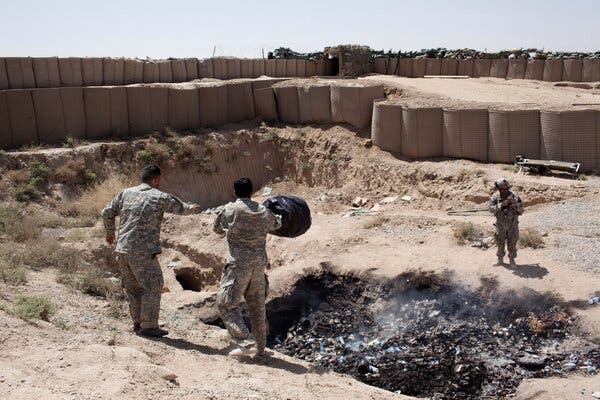
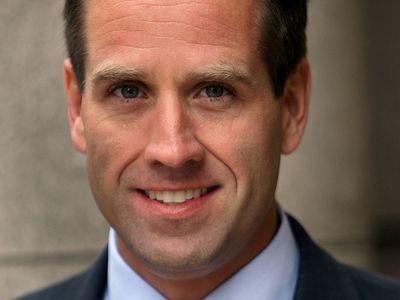
Surveys estimate that as many as 3.5 million American veterans (to say nothing of Afghans and Iraqis) were exposed to this “silent killer,” or what the scholar Rob Nixon calls “slow violence.”[21]
It was not just the CIA torture of detainees at Guantánamo Bay or the murder of foreign journalists in Iraq that Assange spoke up against through the releases by WikiLeaks. Assange risked his life to speak up for the Americans who are, to this day, still dying from the wars in Iraq, Afghanistan and elsewhere.
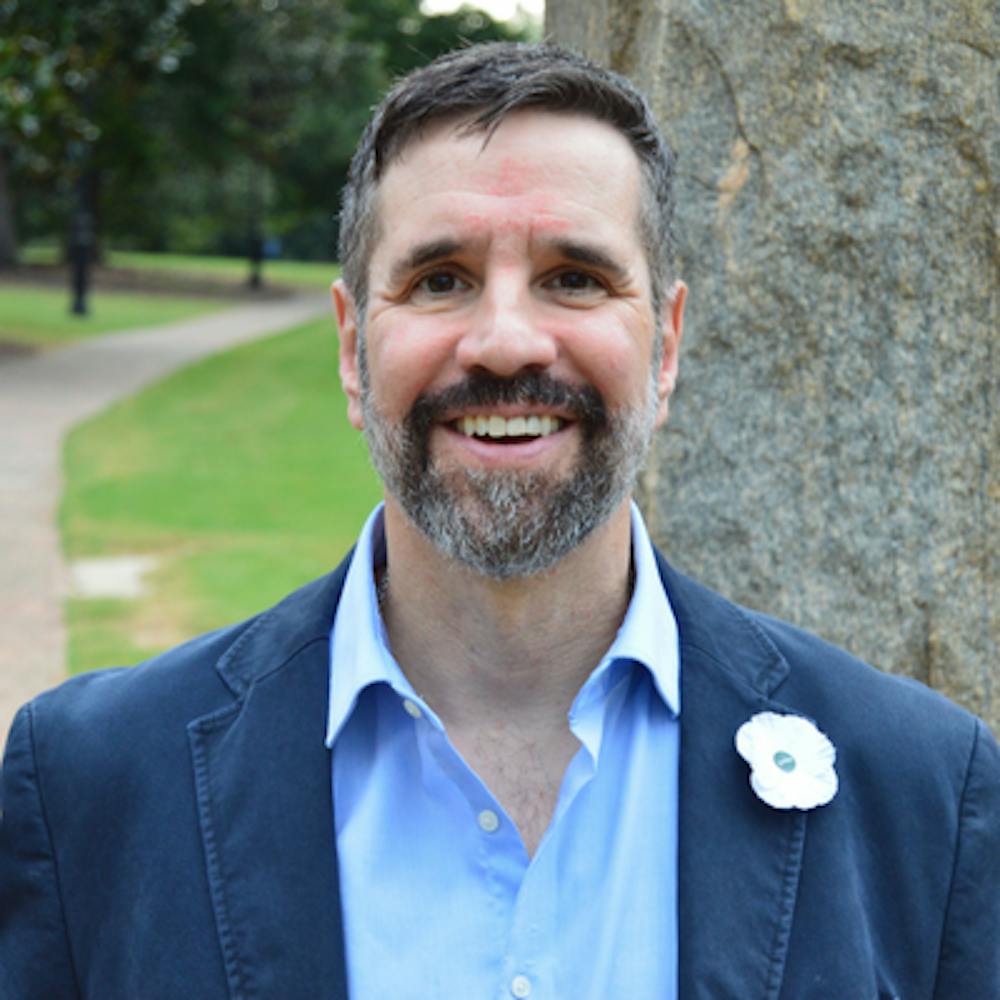
Matthew Hoh, a Global War on Terror veteran, and a 2022 North Carolina Senate candidate argued that “The ‘crime’ committed by Edward Snowden and Julian Assange was letting the people know what our government was doing. Their ongoing persecution is a national disgrace.”[22]
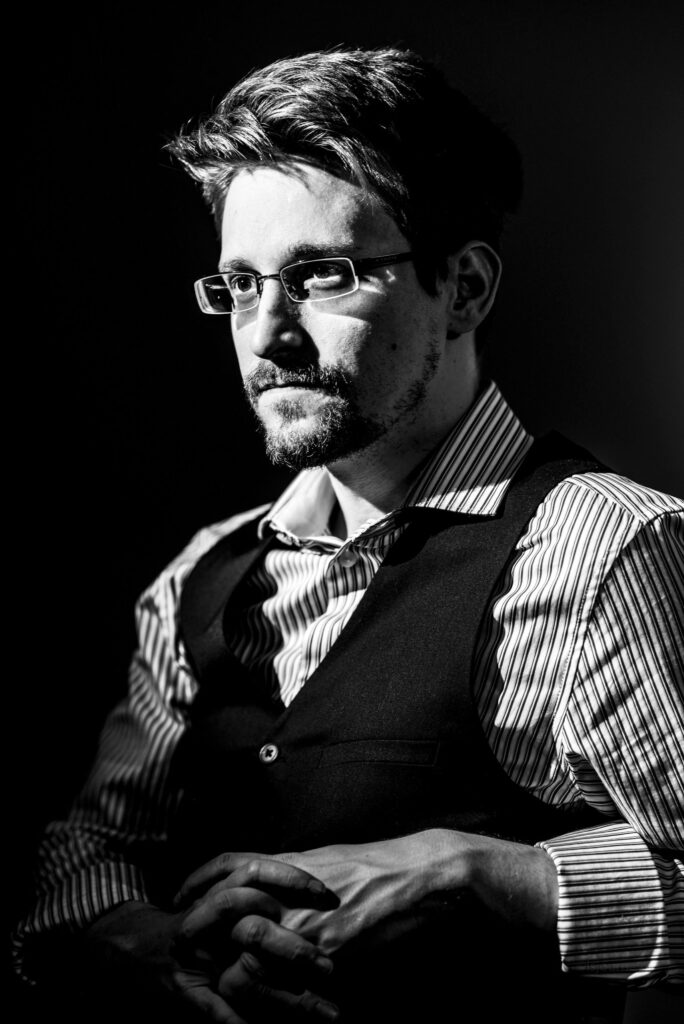
Snowden, the famous NSA whistleblower, also argued for Assange’s release, claiming that the case marked a “dark moment” in the history of the United States.[23]
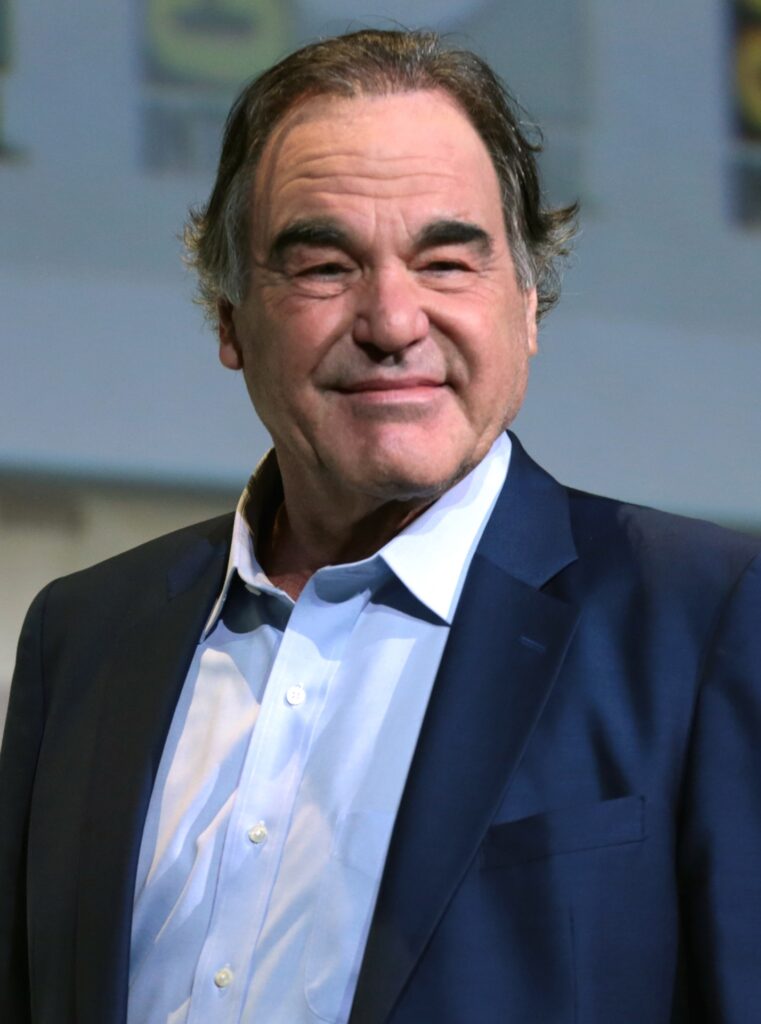
But the accord in the veteran community did not just echo from the Forever-War generation. The Vietnam veteran and director, Oliver Stone, also spoke up for Assange, saying, “I am Julian Assange because I could be next and you could too. Do you want your government telling journalists anywhere in the world what they can and can’t publish?”[24]
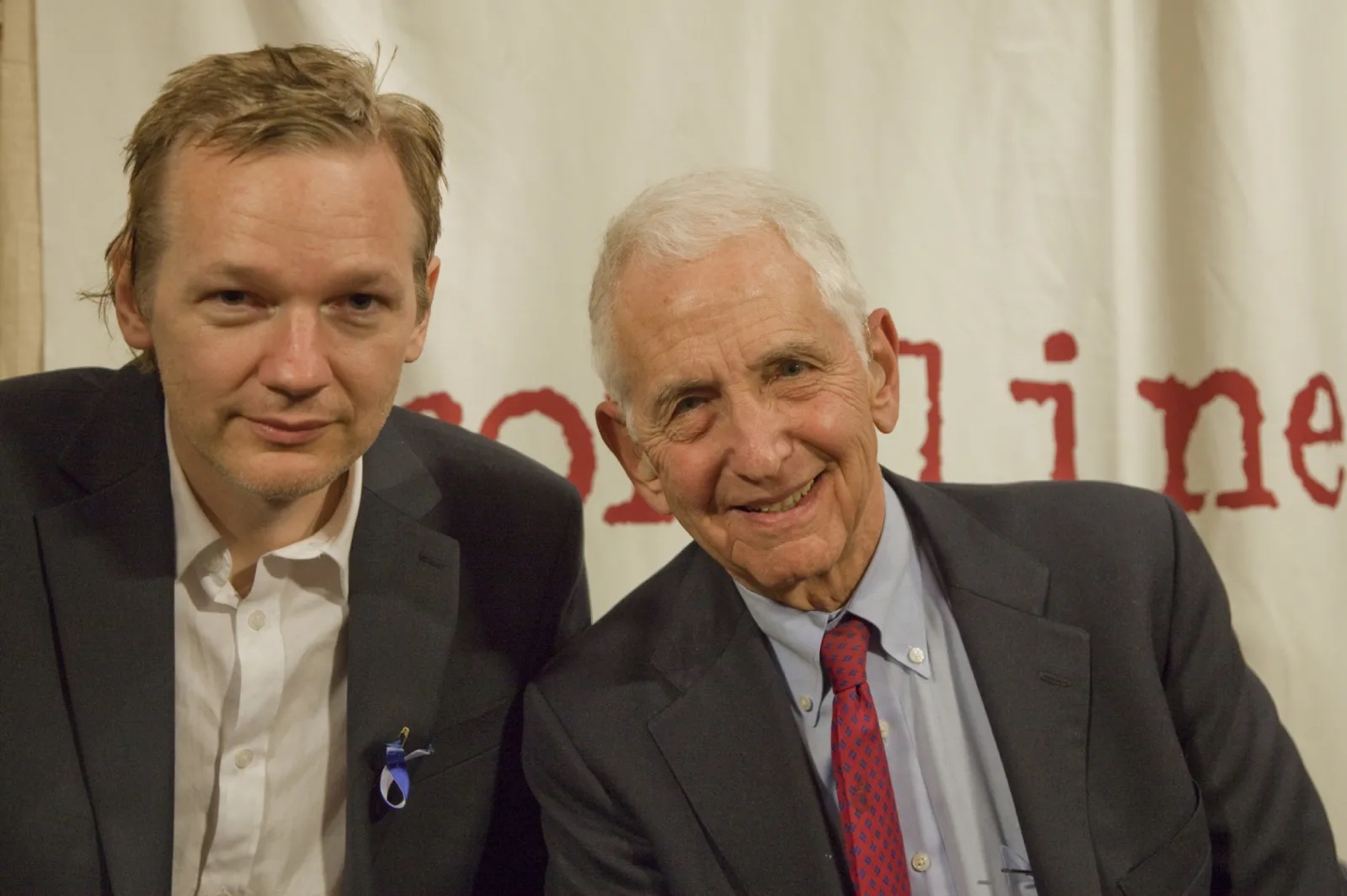
The legendary Vietnam War whistleblower Daniel Ellsberg, who originally inspired WikiLeaks with the release of the Pentagon Papers, seconded Stone’s call for Americans to identify with the cancellation, defamation, persecution, prosecution and torture of Assange. For Ellsberg, who died before Assange was freed and was also charged under the controversial 1917 Espionage Act, Assange’s liberation was one of his final wishes.
“I am Assange,” Ellsberg said in the last year of his life, joining Stone’s Spartacus call, and amplifying Kennedy’s argument that the torture of Assange was equivalent to the destruction of the First Amendment and the abuse of all Americans who cherish the Constitution.[25]
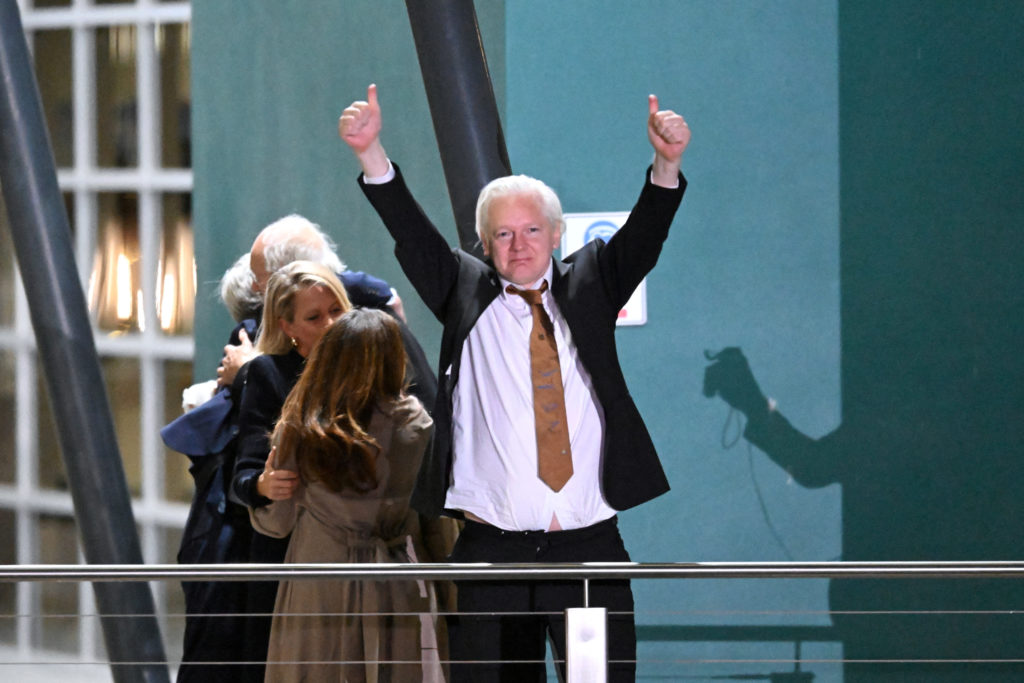
In the end, Assange pleaded guilty to several of the charges brought against him by the American government. But upon his release, as the Biden administration continued to sponsor the genocide in Palestine, Assange said the world was at a “dark crossroads.” He argued that he ultimately “chose freedom over unrealizable justice.”
“I pled guilty to seeking information from a source,” Assange said. “I pled guilty to obtaining information from a source. And I pled guilty to informing the public what that information was. I did not plead guilty to anything else.”[26]
Two years after those remarks, Assange is back. Meanwhile, there is a genocide in Gaza. There is a war in Iran. There is a war on Russia via proxy in Ukraine. There is a threat of more war with China. There is an information war over the COVID pandemic that killed millions of people around the world. And the American government is struggling to release the final JFK files.
Where will Julian Assange focus his efforts? Should he collaborate with CovertAction Magazine? Is there any possibility that the Trump administration or its successor will pardon the most consequential journalist of the 21st century?
Julian Assange on X, September 17, 2026, https://x.com/JulianAssange/status/2100571158777045331?s=20 . ↑
Zach Dorfman, Sean D. Naylor, and Michael Isikoff, “Kidnapping, assassination, and a London shoot-out: Inside the CIA’s secret war plans against WikiLeaks,” Yahoo! News, September 26, 2021. ↑
Michael Ray, “Julian Assange: WikiLeaks founder,” Britannica, https://www.britannica.com/biography/Julian-Assange . ↑
“Peru (2009) Peruvian politicians’ and officials’ involvement in the Petrogate scandal,” WikiLeaks, October 24, 2011, https://www.wikileaks.org/Peru-2009-Peruvian-politicians-and.html . ↑
“Murder in Nairobi: Wikileaks related human rights lawyer assassinated,” WikiLeaks, March 8, 2009, https://wikileaks.org/wiki/Murder_in_Nairobi:_Wikileaks_related_human_rights_lawyers_assassinated . ↑
Blanche Petrich Moreno, “WikiLeaks and the War on Drugs,” The Nation, July 25, 2012. ↑
Daina Beth Solomon and Dave Graham, “Mexican president offers Assange asylum after U.S. extradition bid thwarted,” Reuters, January 4, 2021. ↑
“Vault 7: Projects,” WikiLeaks, March 23-September 7, 2017, https://wikileaks.org/vault7/ . ↑
Matt Kennard, “The Last Days of Julian Assange in the United States,” Declassified UK, March 14, 2024. ↑
Chelsea Manning, “Chelsea Manning: ‘I’m Still Bound to Secrecy,’” The New York Times, October 8, 2022. ↑
WikiLeaks on X, May 12, 2024, https://x.com/wikileaks/status/1789613704889196611?s=20 . ↑
Artists for Assange, 2021, https://www.sotwe.com/hashtag/artistsforassange ↑
Landon Mion, “Brazil’s president says Julian Assange can’t be punished for ‘informing society’ in a ‘transparent’ way,” Fox News, September 20, 2023. ↑
Philip Hamburger and Jenin Younes, “The Biden Administration’s Assault on Free Speech,” The Wall Street Journal, July 28, 2023. ↑
Joseph Biden, The American Presidency Project, University of California at Santa Barbara, April 29, 2023, https://www.presidency.ucsb.edu/documents/remarks-the-white-house-correspondents-association-dinner-19 . ↑
Robert F. Kennedy, Jr.. on X, November 2, 2023, https://x.com/RobertKennedyJr/status/1720233517546610703?s=20 ↑
Diana Pearl, “How WikiLeaks Founder Julian Assange Went from Enemy to Embrace With Some in the GOP,” People, January 6, 2017. ↑
Jonathan Turley, “Viewpoint: What Assange charges could mean for press freedom,” BBC, May 24, 2019. ↑
Eloise Barry, “Here’s What’s Next After the U.K. Approved Julian Assange’s Extradition to the U.S.,” Time, June 17, 2022. ↑
Kelly Kennedy, “Lawmakers to hold news briefing on burn pits, Military Times and WikiLeaks, June 11, 2009, https://wikileaks.org/wiki/Lawmakers_to_hold_news_briefing_on_burn_pits. ↑
Rob Nixon, Slow Violence and the Environmentalism of the Poor, (Cambridge: Harvard University Press, 2011), 2. ↑
Matthew Hoh on X, September 26, 2022, https://x.com/MatthewPHoh/status/1574462194581999627?s=20 . ↑
“Assange arrest a ‘dark moment’ for press freedom: Snowden,” Reuters, April 11, 2019. ↑
M. C. Armstrong, “I Am Julian Assange,” Honest Media, February 1, 2024. ↑
Shaun Waterman, “‘I am Assange!’ Daniel Ellsberg, Other Allies Ask US to Prosecute Them, Too,” Newsweek, December 15, 2022. ↑
Deutsche Welle, “Julian Assange makes first public address since release,” October 1, 2024, https://www.dw.com/en/julian-assange-makes-first-public-address-since-release/a-70372957 . ↑
CovertAction Magazine is made possible by subscriptions, orders and donations from readers like you.
Blow the Whistle on U.S. Imperialism
Click the whistle and donate
When you donate to CovertAction Magazine, you are supporting investigative journalism. Your contributions go directly to supporting the development, production, editing, and dissemination of the Magazine.
CovertAction Magazine does not receive corporate or government sponsorship. Yet, we hold a steadfast commitment to providing compensation for writers, editorial and technical support. Your support helps facilitate this compensation as well as increase the caliber of this work.
Please make a donation by clicking on the donate logo above and enter the amount and your credit or debit card information.
CovertAction Institute, Inc. (CAI) is a 501(c)(3) non-profit organization and your gift is tax-deductible for federal income purposes. CAI’s tax-exempt ID number is 87-2461683.
We sincerely thank you for your support.
Disclaimer: The contents of this article are the sole responsibility of the author(s). CovertAction Institute, Inc. (CAI), including its Board of Directors (BD), Editorial Board (EB), Advisory Board (AB), staff, volunteers and its projects (including CovertAction Magazine) are not responsible for any inaccurate or incorrect statement in this article. This article also does not necessarily represent the views the BD, the EB, the AB, staff, volunteers, or any members of its projects.
Differing viewpoints: CAM publishes articles with differing viewpoints in an effort to nurture vibrant debate and thoughtful critical analysis. Feel free to comment on the articles in the comment section and/or send your letters to the Editors, which we will publish in the Letters column.
Copyrighted Material: This web site may contain copyrighted material the use of which has not always been specifically authorized by the copyright owner. As a not-for-profit charitable organization incorporated in the State of New York, we are making such material available in an effort to advance the understanding of humanity’s problems and hopefully to help find solutions for those problems. We believe this constitutes a ‘fair use’ of any such copyrighted material as provided for in section 107 of the US Copyright Law. You can read more about ‘fair use’ and US Copyright Law at the Legal Information Institute of Cornell Law School.
Republishing: CovertAction Magazine (CAM) grants permission to cross-post CAM articles on not-for-profit community internet sites as long as the source is acknowledged together with a hyperlink to the original CovertAction Magazine article. Also, kindly let us know at info@CovertActionMagazine.com. For publication of CAM articles in print or other forms including commercial internet sites, contact: info@CovertActionMagazine.com.
By using this site, you agree to these terms above.
About the Author

M.C. Armstrong is an award-winning writer of both fiction and non-fiction. The Brooklyn Rail named his 2020 memoir, The Mysteries of Haditha (Potomac Books, 2020), one of the best books of the year.
An account of his time as an embedded journalist with the Navy SEALS in Al Anbar Province, Iraq, The Mysteries of Haditha emerged from Armstrong’s regularly filed stories for his hometown newspaper, The Winchester (VA) Star, over the course of 2008.
“Veteran Activism and the Global War on Terror,” his doctoral dissertation (University of North Carolina-Greensboro, 2021), which examines post-9/11 veteran-activists, was published by Bloomsbury in 2024.
Armstrong is also the author of the YA thriller, American Delphi, and the forthcoming investigative memoir, Murder Most Foul, which is a study of Lyndon Johnson’s role in the assassination of John F. Kennedy. When he’s not teaching English literature or writing, Armstrong can be found performing with the rock band, Viva la Muerte, as its guitarist and lead singer-songwriter.
M.C. can be reached at matty8a@gmail.com.