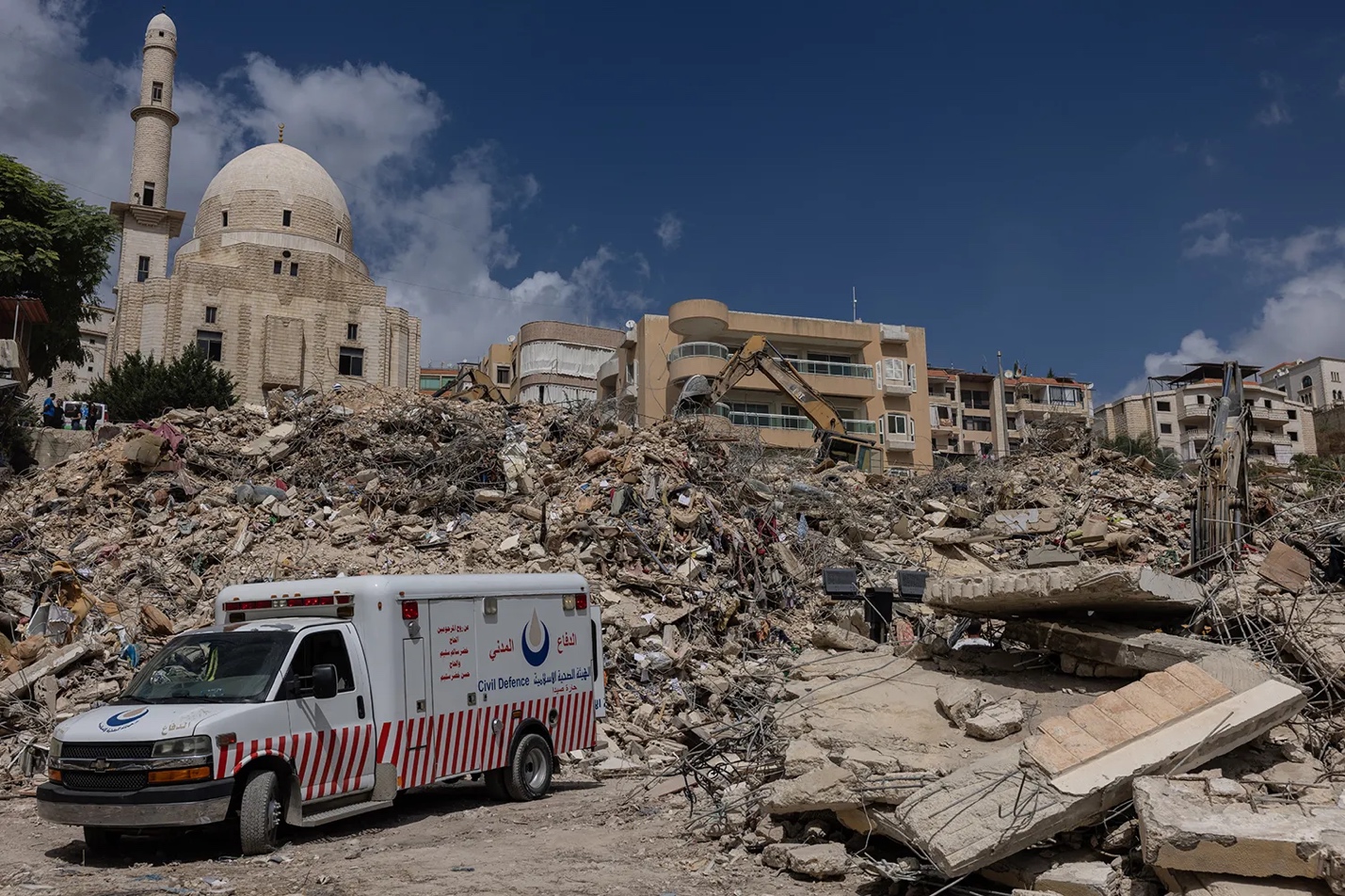
Reflections on the Carnage…and What Lebanon Used to Be
I am an American citizen, born in Beirut, Lebanon, the daughter of a diplomat/spy, which makes me immune from President Trump’s deportation efforts.
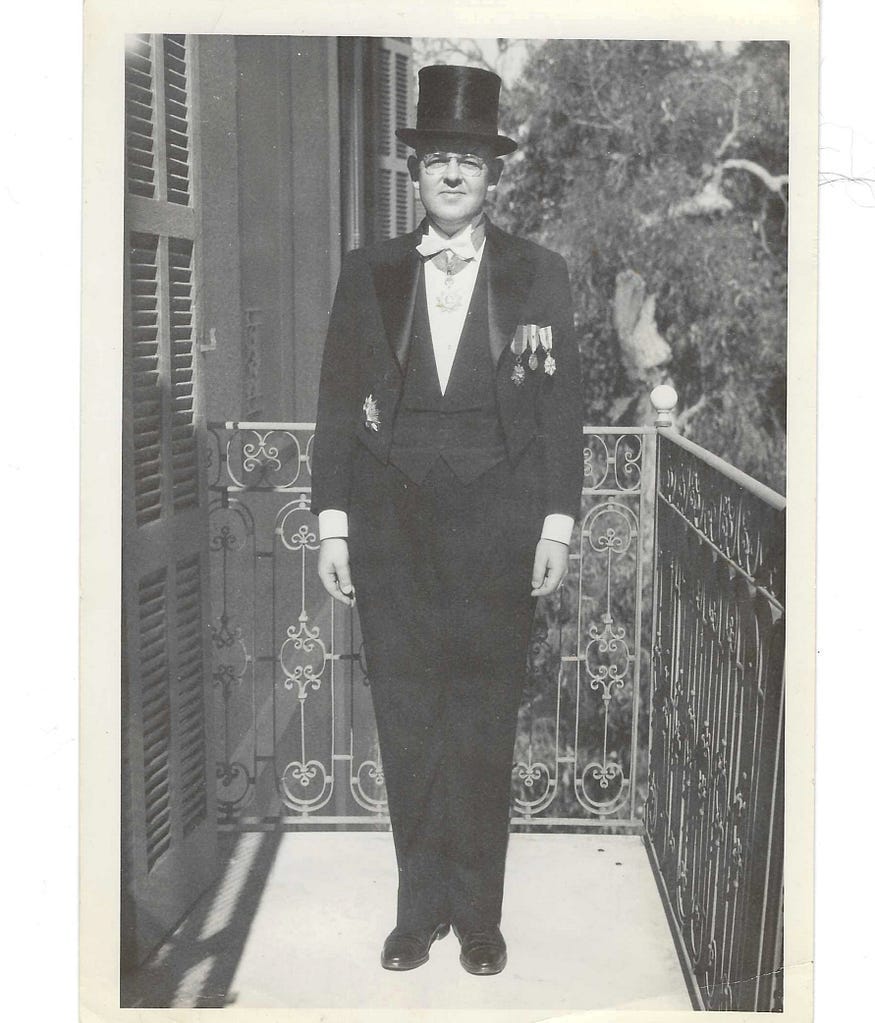
My father, Daniel Dennett, served as head of counter-intelligence for the Office of Strategic Services (OSS) and later the Central Intelligence Group (CIG), the immediate predecessor to the CIA. An expert in Middle Eastern history and languages, he was highly valued and carried the code name “Carat.” His State Department cover was cultural attaché.
He did not live to see the creation of the Jewish state of Israel in 1948 but, like many foreign service officers at the time, he worried about the impact of sending European settlers to take over Arab lands in Palestine.
For all his foreboding, he could not have imagined the expulsion and flight of 750,000 Palestinians from their homeland in 1948, or that 100,000 would settle in refugee camps in Lebanon.
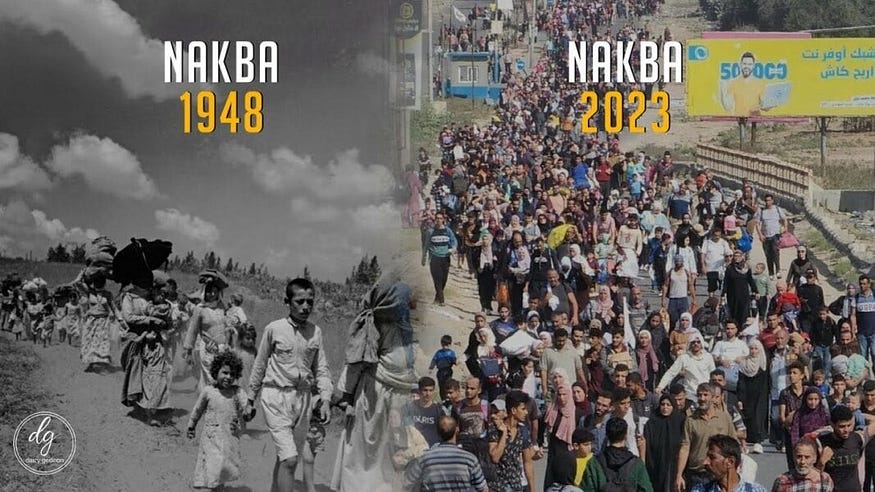
Palestinians fled their homes in Palestine; now the “Gazafication” of Lebanon is under way.
Or that, in 2026, more than one million people had been displaced from their homes in southern Lebanon and entire villages demolished.
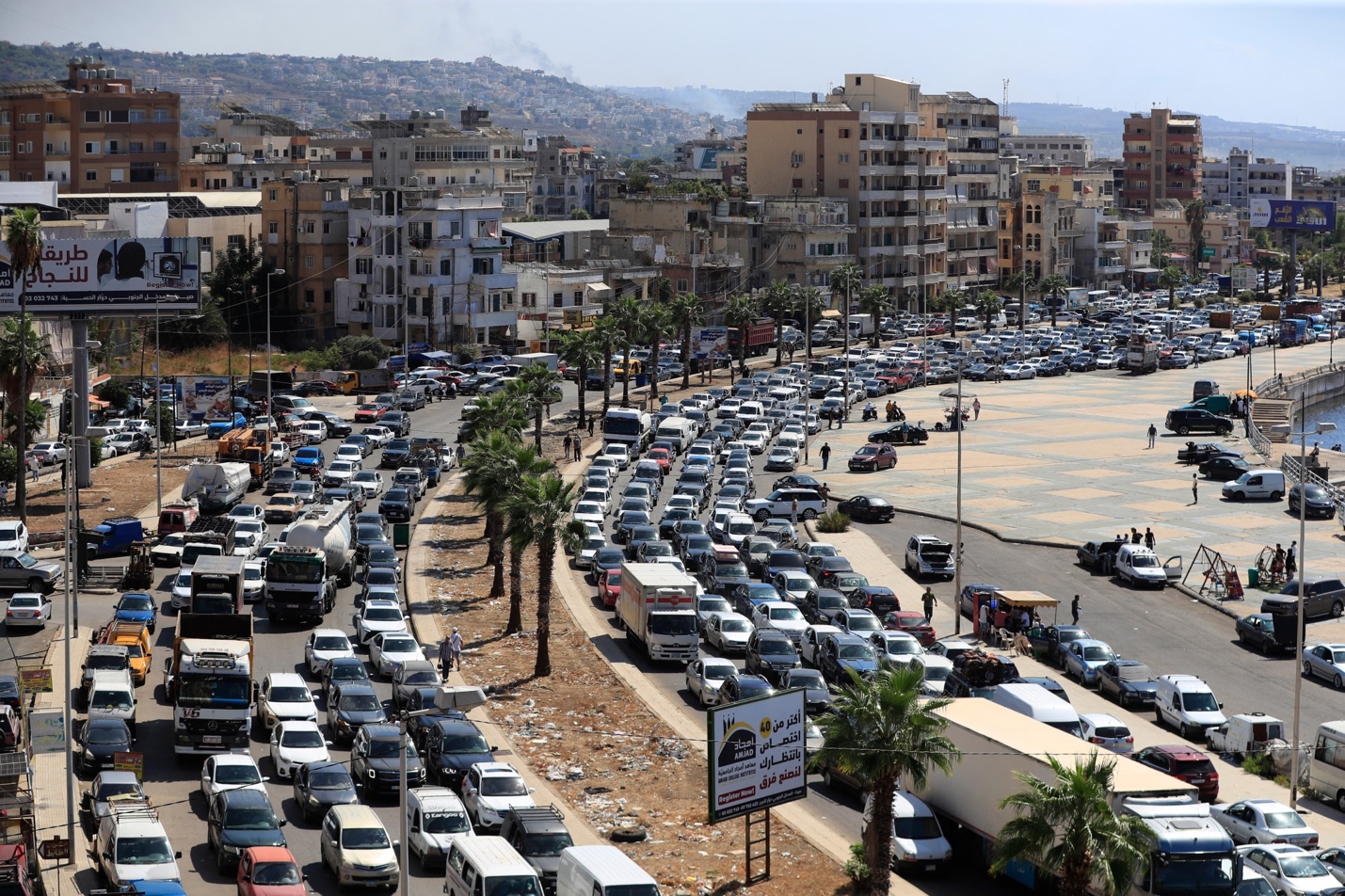
Two Lives Entwined
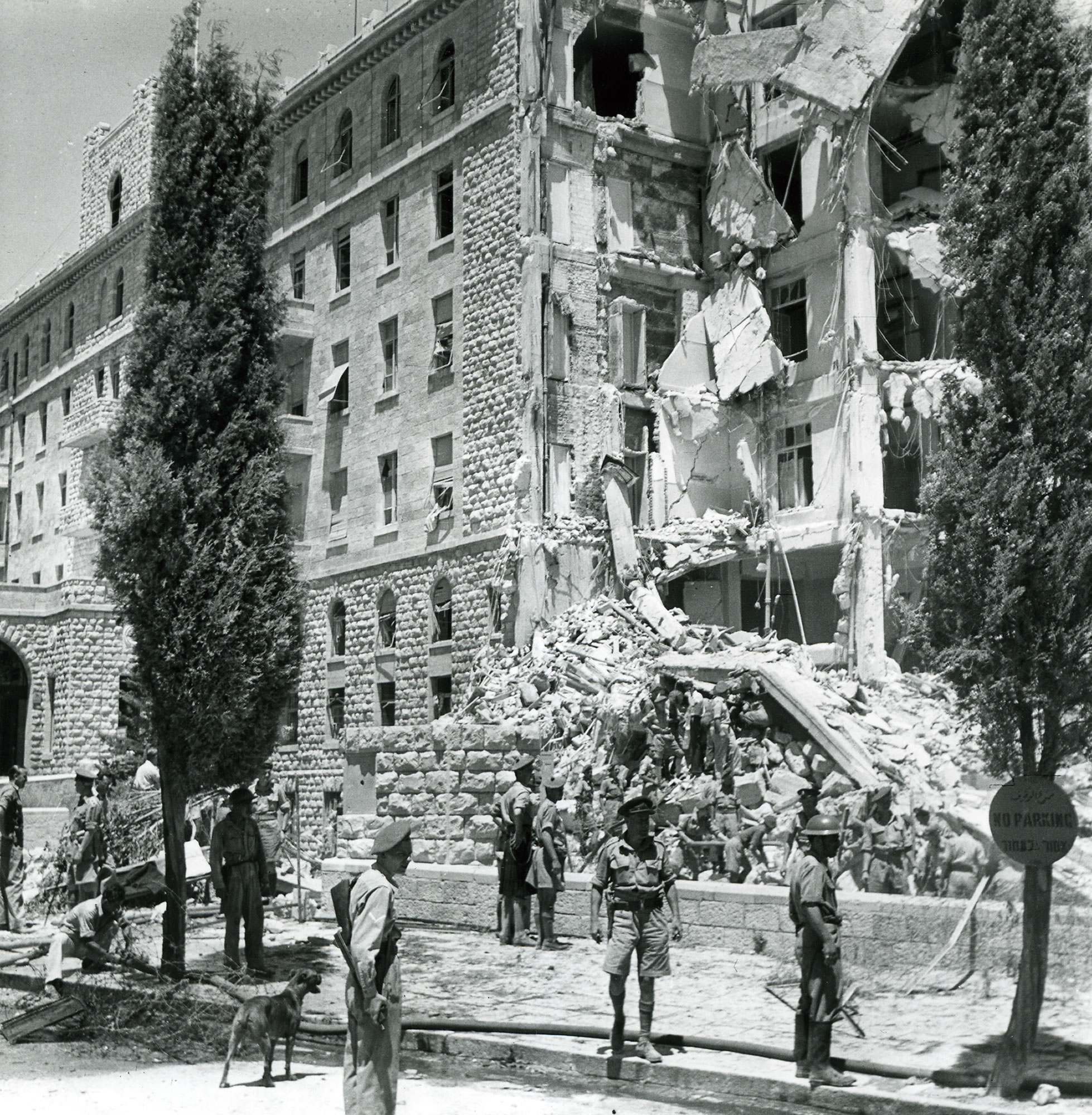
In the spring of 1946, when I was conceived in a Bedouin cave in the Jordanian ruins of Petra—Carat managed a vacation trip with my mother as cover for his investigating British post-war intentions in the region—Palestine was convulsed by violence. Jews were fighting the British, Arabs were fighting Jews, and within two months Zionist Irgun militants would bomb British headquarters at the King David Hotel in Palestine. killing 91 people—41 Arabs, 28 Britons and 17 Jews.
Several weeks later, both the British and American embassies were bombed in Beirut, the latter (including my father’s office) more heavily.
My father spent several months investigating the bombing. He wondered why the British were not concerned. He reported that the bombings were not as sophisticated as happened at the King David Hotel and concluded Arab nationalists were the likely culprits.
My Birthplace, 1947
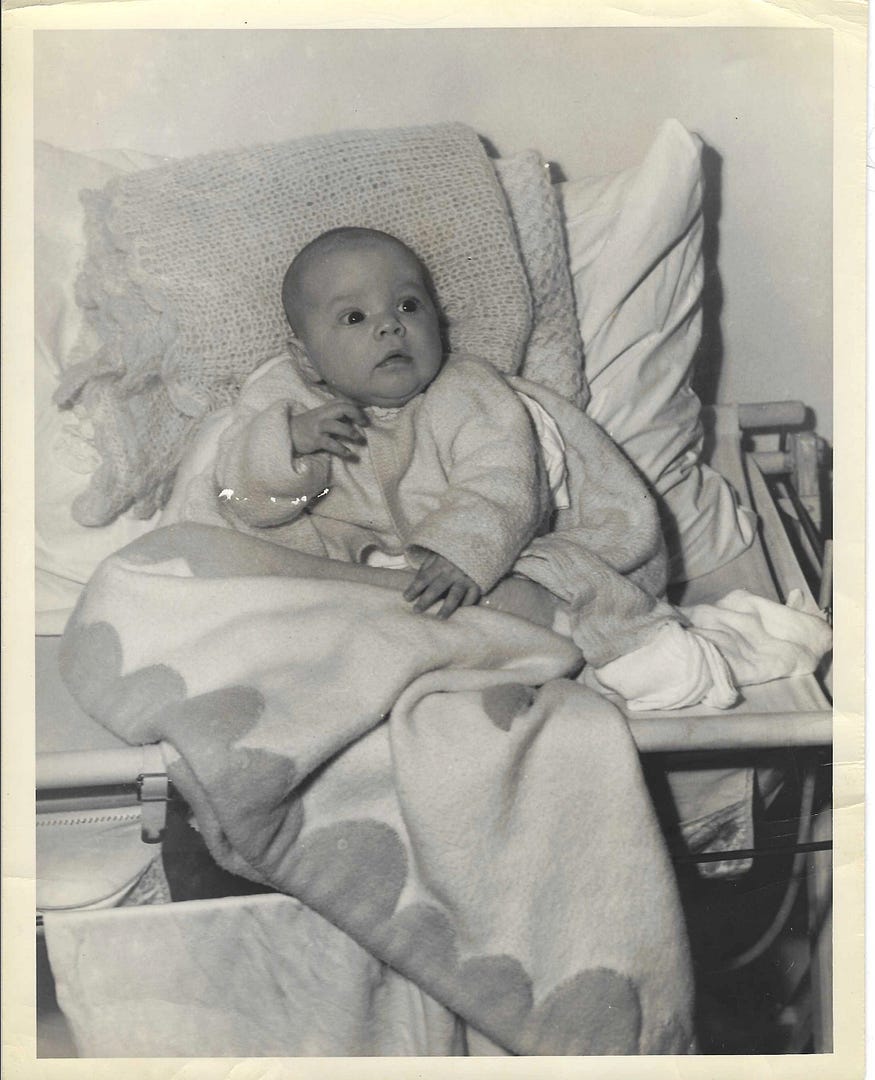
My attachment to Lebanon spans decades, beginning with the first six weeks of my life.
Shortly after my birth, my father took me to the U.S. Embassy and showed me off to embassy staffers, exulting “It’s a girl”—to which, my by then long widowed mother would later tell me, smiling gently, “no one said anything at all.”
In retrospect, this story must have stayed with me, imbuing in me a responsibility to prove his love for me right, while asserting my sense of value in a world governed largely by patriarchy. And yet, nearly three decades later, during the time I worked as a journalist in Lebanon and the Gulf countries (1972-75), I never experienced derision or disrespect. Quite the contrary. Maybe I was an object of curiosity (there were few female journalists in those days).
Or maybe there was something else…something my father revealed through his own writings: that in the 1930s and ’40s, during his time there, Americans were held in high esteem in Lebanon and much of the Middle East. And the feeling was mutual.
What ultimately connected our lives was his likely death by sabotage on March 20, 1947, in a C-47 military plane en route to Ethiopia following his top-secret mission to Saudi Arabia to determine the safest route of the Trans-Arabian pipeline.
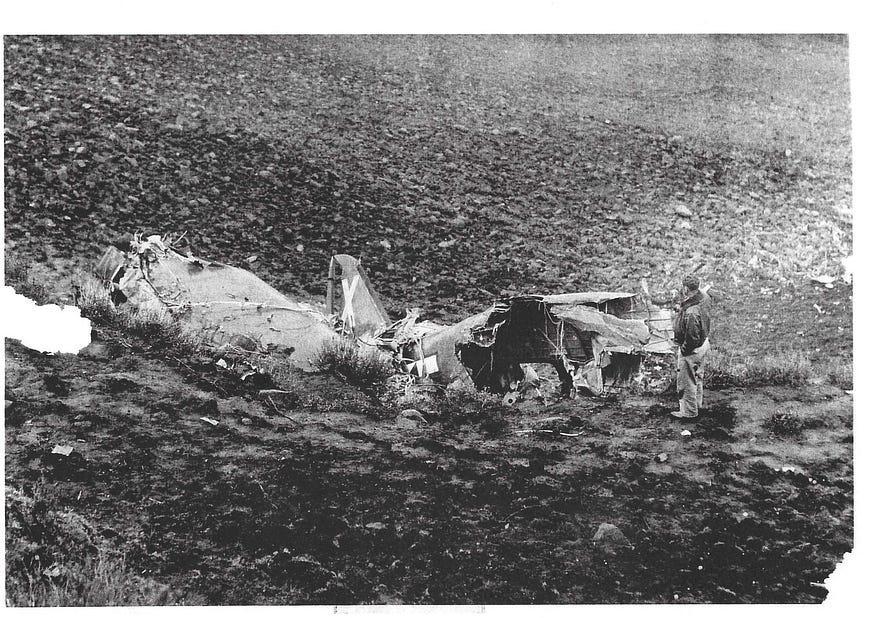
He could not wait to get back to Lebanon to tell his wife about what he witnessed at ARAMCO’s growing oil compound in the Saudi desert, and to see his baby girl, but he never made it.
I was two months old when I left Lebanon on a boat headed back to the States with my Mother, Ruth Leck Dennett, my five-year-old brother Dan and eight-year-old sister Cynthia.
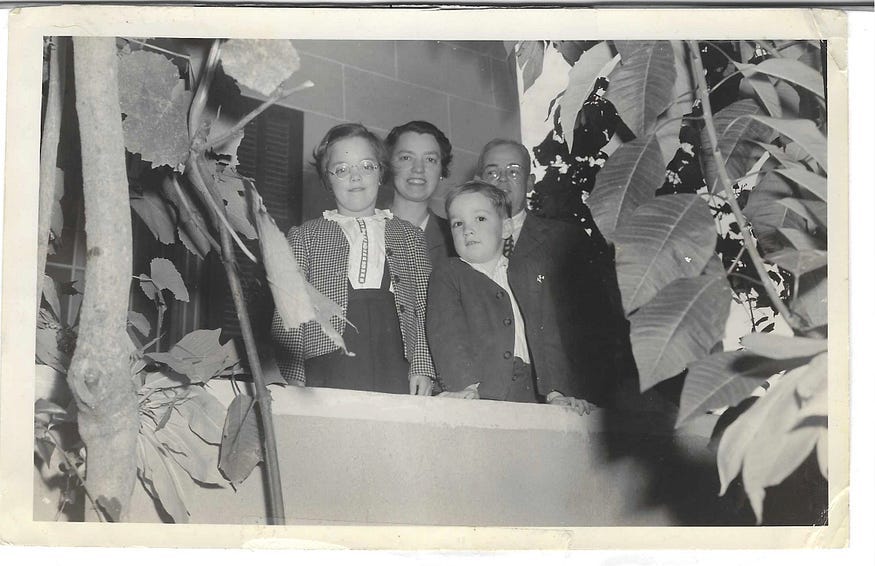
We grew up in my father’s home town of Winchester, Massachusetts, a suburb of Boston. When I turned 16, my mother asked if I would like to go back to Beirut, which she dearly missed. And small wonder.
My parents’ Beirut in the 1930s and ’40s was a thriving cosmopolitan city known as the Paris of the Middle East. The French had taken over from the defeated Ottoman Turks following World War I and, during their 20-year reign under the League of Nations’-created “French mandate,” imparted their unique flavor to an already charming orange-roofed city of merchants, bankers, university intellectuals and spies from around the world.
Beirut’s fine climate and unique location—astride the azure-blue eastern Mediterranean Sea—were perhaps its greatest gifts to foreigners and, eventually, Lebanon’s tragic undoing.
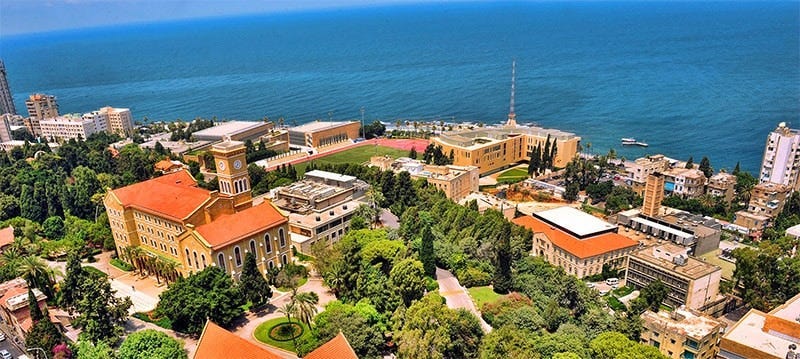
When I arrived in Beirut with my mother in 1963 to attend my junior and senior years of high school at the American Community School, I expected to find white-robed Arabs astride camels walking through its streets.
Instead, I found Beirutees dressed in Western clothes, shopping for American goods in the local Spinneys supermarket, and often frequenting lively night clubs where they drank whiskey and gin and danced to romantic French songs and American pop music.
They spoke Arabic but also French, and increasingly English, and were incredibly generous to foreigners, welcoming us into their homes saying Ahlan wa Sahlan (you are welcome) and sharing their fabulous food: humus, tabouli, babaganouche, shish-kebab, and kibbe being among my favorites.
I went on school trips to the ancient (and still lived-in) Phoenician port of Byblos just north of Beirut, to the Phoenician port of Tyre to the south, and to the marvelous Roman ruins of Baalbek. UNESCO has declared Baalbek a national heritage site, describing it as “one of the most celebrated sanctuaries of the ancient world, progressively overlaid with colossal constructions which were built during more than two centuries. Its monumental ensemble is one of the most impressive testimonies of the Roman architecture of the imperial period.”
In modern times, Baalbek’s Roman Acropolis posed as the dramatic backdrop to the Baalbek International Festival, which featured dance, theater, opera and jazz every summer. I had the thrill of watching rehearsals for the wonderful Lebanese debke dancers from my balcony in Beirut.
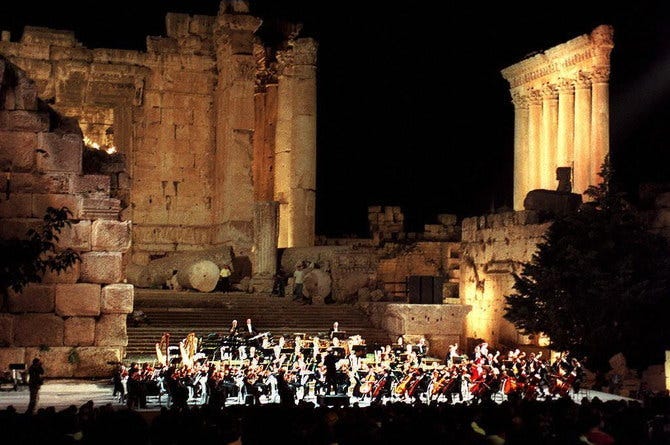
Never would I have dreamed that Baalbek and Tyre would be indiscriminately bombed by Israelis to “root out Hezbollah,” as is happening now.
My father fondly described Lebanon as a tiny country whose political life “is never dull and always highly flavored.” Famed for its cultural and religious diversity, it was the original homeland of the Phoenicians and was subsequently conquered and occupied by the Assyrians, the Greeks, the Romans, the Persians, the Arabs, the Crusaders, the Ottomans and the French.
After gaining independence from France in 1943, life in Lebanon was relatively stable for the next 30 years, its government set up so the president was a Christian, the prime minister a Sunni Muslim, and the Speaker of the House, a Shiite Muslim.
Lebanon’s Civil War
In addition to the 100,000 Palestinians who became refugees in Lebanon in 1948, the Six-Day War of 1967 created some 300,000 more refugees from lands taken over by Israel, many again escaping to Lebanon. With the growth of the Palestinian resistance movement in the 1960s and ’70s, their presence in Lebanon was resented by conservative Christian Maronites, who allied themselves with Israel.
As fate would have it, I had returned to Lebanon in 1972, following college in the U.S. and graduate school in Florence with an MA in art history. My mother died that year and, as it had with her in the early 1960s, Lebanon beckoned me to come back.
I took up a career as a journalist writing about art and architecture and, before long, about politics in Lebanon and economic development in the Gulf countries of Bahrain, Abu Dhabi, Dubai, Oman and Iran.
By 1975, anti-Palestinian ferment was growing.
I recall standing on top of my Beirut apartment and watching French Mirage jets flying overhead on their way to bomb a refugee camp in Beirut. A few weeks later, while traveling by a communal (“service”) taxi to visit a friend living near the airport, a tank came barreling down the road toward us, its turrets swinging wildly, causing my fellow occupants and me to flee the taxi. I took refuge in a Christian school and spent hours hiding under a desk, watching terrified parents dodging bullets to rescue their children.
As evening approached, a young man who had spotted me earlier came back and informed me that I had two choices: stay there, not knowing who would take over the school, or flee with him.
I went with him. We raced to his car across the street when a shot rang out. It missed, and he was able to get me lowered into the back seat of his car. He sped in reverse and took us to safety at his uncle’s house.
When his uncle saw me on the phone dictating my story to the Beirut Daily Star, he suspected a spy and asked me which side I was on. Knowing the neighborhood and prone to truth-telling, I said “the Palestinians.”
“Then you are welcome,” said the uncle, who fed me and gave me a room where I would spend the night.
Though I did not know it at the time, this was the precursor to the Lebanese Civil War. I decided on April 1, 1975 (April Fools’ Day) to take a breather in England. Two weeks later, right-wing Christian Phalangists fired on a busload of Palestinians in Lebanon, killing them all.
I knew this was serious, and so returned to the U.S. The civil war which began in April 1975 would pit (mostly Shiite) Muslims and Palestinians against Maronite Christians, lasting 15 years (1975-1990) and killing more than 150,000.
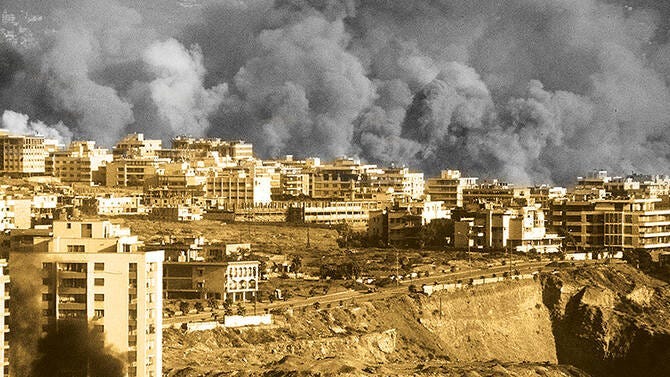
In 1982, Israeli forces entered Lebanon, and succeeded in forcing Yasser Arafat and his Palestine Liberation Organization out of the country. Shortly afterwards, Israelis encouraged Christian Phalangists to attack the Sabra and Shatila refugee camps in Beirut, slaughtering 3,000 Palestinians and Lebanese civilians over two days.
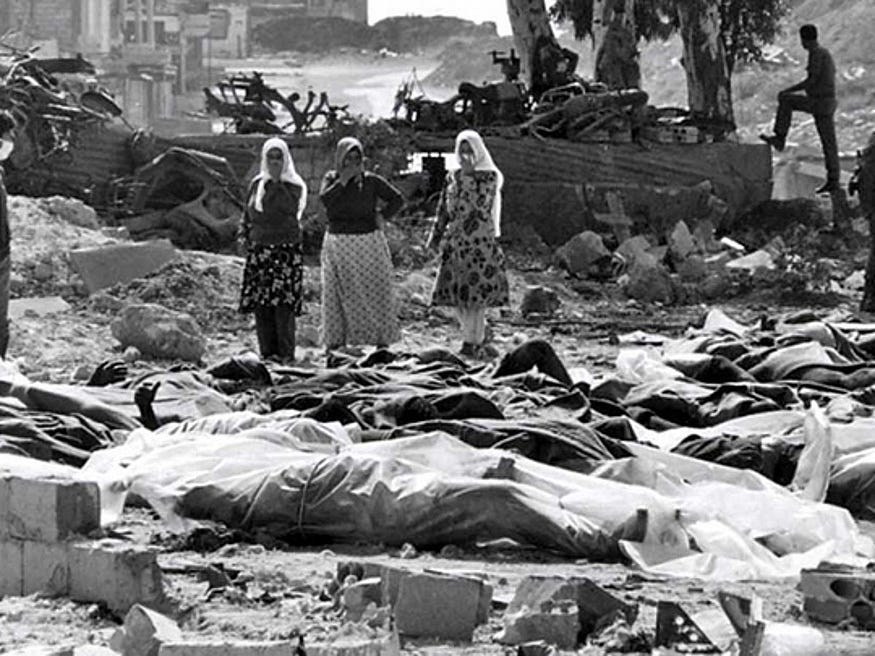
Israel occupied southern Lebanon until the year 2000. The only forces to fight the Israelis were Shiite Islamists calling themselves Hezbollah. Inspired by the Iranian Revolution of 1979 that put Ayatollah Khomeini in power, they sought support from Iran and became part of the “Axis of Resistance.”
After offering the embattled Shiites extensive humanitarian aid, including schools and health clinics, Hezbollah (the Party of God) formed a political party and became a sizable bloc in Lebanon’s parliament.
Fast forward to 2024-26. Israeli jets have pounded the city of Baalbek, damaging residential buildings and killing civilians, on the grounds that it hosts members of Hezbollah.
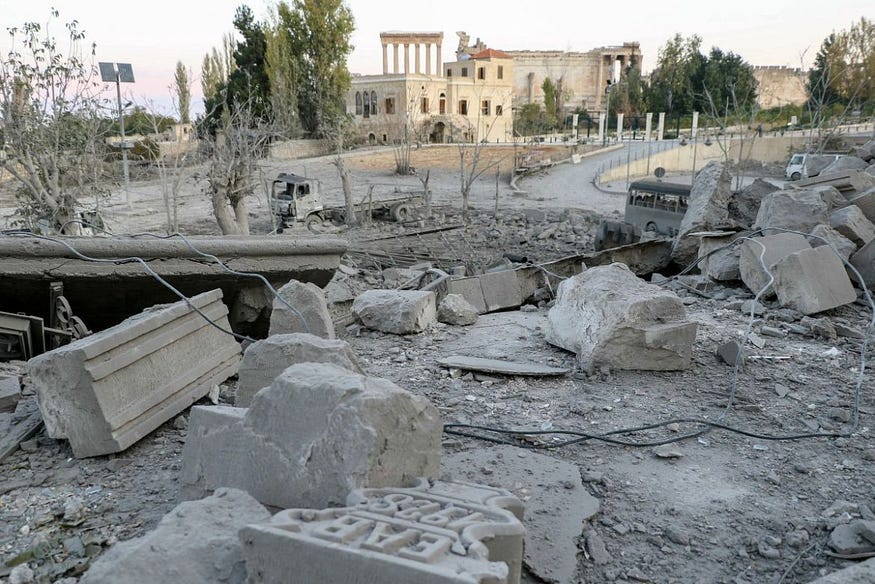
There is talk now that Israel wants to trigger another civil war, with the aim of forcing Hezbollah to disarm and abandon its Shiite followers as a condition for cessation of its bombing of southern, and now central, Lebanon.
Today, you may ask, as I did, why on earth is this happening?
The Gateway to Middle East Oil
When I first set foot in Lebanon in 1963, I learned that the Lebanese people took pride in calling this small country astride the Mediterranean Sea the “Gateway to the Middle East.” It was an apt description for anyone who cared to look at a map and view Lebanon as a land bridge to oil-rich Iraq, Saudi Arabia and Iran. I shared in that pride, and considered those two years in Lebanon a transformative experience.
Having returned in the 1970s as a rather inquisitive young adult, I discerned that Western businessmen viewed Lebanon from a slightly different perspective, as the Gateway to Middle East Oil. Lebanon hosted two Mediterranean terminal points for pipelines—one in the north carrying oil from Iraq (the French-controlled Iraq Petroleum Co, or IPC pipeline) and the other in the south carrying oil from Saudi Arabia (the U.S.-controlled Trans-Arabian Pipeline, or Tapline).
As I have described in my book, Follow the Pipelines, Tapline and the lucrative Saudi oil that flowed through it on the way to Europe transformed the U.S. into a major regional power replacing both the French and the British (who controlled Palestine) to become the world’s numero uno superpower.
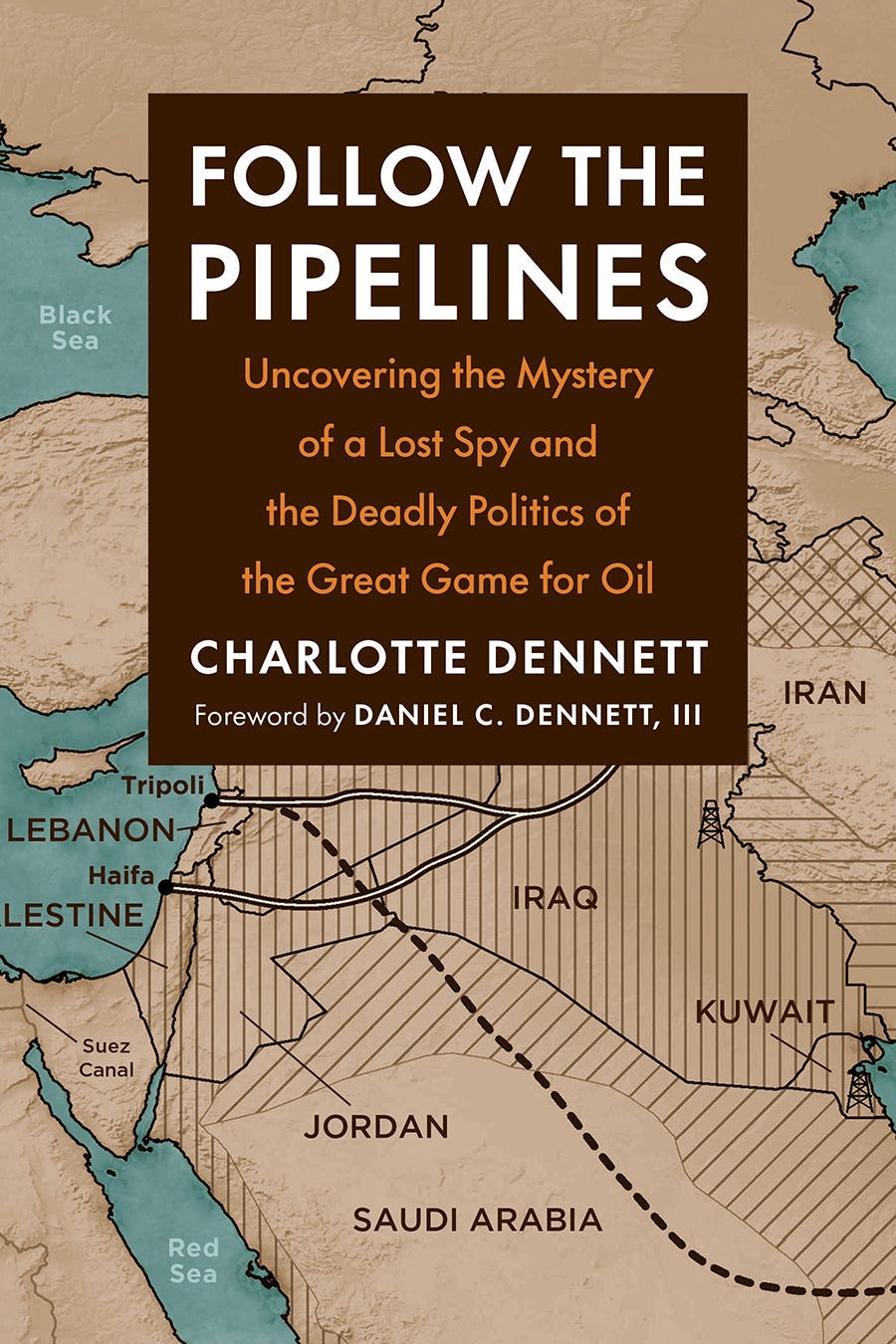
The dotted line represents the planned Trans-Arabian Pipeline (Tapline) that actually ended up terminating in southern Lebanon rather than Haifa. I wanted this map on my book’s cover to encourage readers to understand the Middle East by looking at maps and developing “pipeline consciousness.” There are 12 maps in my book.
My father understood the importance of Saudi oil the moment he set foot in Lebanon in early 1944. In a six-page “Analysis of Work,” which I got declassified after suing the CIA under FOIA, he outlined what OSS headquarters expected of him.
“Up to the outbreak of the present war,” he wrote, “the U.S. enjoyed, throughout the entire region, a greater prestige than any other foreign power.” His main points were as follows:
1. The Middle East, having been outside the sphere of our imperialistic activity, regards us as being politically neutral and therefore safe. This was an important consideration in the granting us of oil concessions in Arabia.
2. American educational, medical and scientific missions [largely centered around the American University of Beirut] has brought us to the attention of all classes of society in a highly favorable manner. The philanthropic basis of our activity was generally accepted at its face value.
I should note that, other than marveling over his term “imperialistic,” he had the invaluable experience of teaching English to Middle Eastern students at the American University of Beirut (AUB) from 1931 to 1933. As it was for me, so too for him: His time in Lebanon changed his life. He developed a love for the country’s diverse peoples, religions and cultures, causing him to switch his major at Harvard from German literature and language to Middle Eastern history, specializing in Islam.
AUB was founded by Chistian missionaries in the late 19th century. They named it the Syrian Protestant College, but it evolved into a secular institution valued for its pursuit of science, its liberal arts education and respect for all religions. It also boasted an extraordinary medical school that trained nurses and doctors while providing highly-rated health care. (I should know: I was born there!) AUB President David Dodge once aptly described the university as America’s most valuable investment in the Middle East, next to oil.
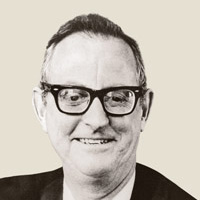
Yet, because of these advantages, my father continued writing in his 1944 report “up to 1939, a deliberate effort was made by all great Powers, Axis and Allied, to undermine our prestige.” By 1944, the Germans no longer posed a significant threat, so Dennett’s focus was spying on our allies: the French, the British and the Soviets, all of whom were intensely jealous of the U.S.’s exclusive oil concession with Saudi Arabia.
In a segment he called “Probable American post-war interests,” he cited “Oil as a vital factor,” and most significantly, the oil of Saudi Arabia. “The probable extent of these oil deposits is so great that we must control them at all costs.” [Emphasis added].
This one sentence would become a mantra for any nation hoping to become a major power in the latter half of the 20th century and up until now. And the fact that my father was spying on our allies, as they were doing with him, got me to thinking about The Great Game for Oil and the deadly politics that often underly the Game, and that likely made my father one of its first American victims.
So there you have it: my explanation for the chaos in Lebanon, or at least part of it. The quest to find and control oil, the coveted fuel of all militaries, was behind all the wars in the Middle East.
And the discovery between 2000 and 2010 of $500 billion worth of oil and natural gas off the coast of Gaza, Israel and Lebanon is a major factor behind the violence engulfing the region.
Benjamin Netanyahu’s goal is transform the entire Eastern Mediterranean into an energy corridor. No bank will finance such a massive infrastructure project unless it is conflict free, thus requiring the demilitarization and depopulation of Gaza and coastal Lebanon.
My goal has been to elevate discussions on the Middle East conflict above the typical Arab versus Jew descriptions. Yes, those conflicts are real and deeply routed in the massive traumas visited on both Jews and Arabs, but who has benefited from their suffering?
The fighting in Gaza, and now Lebanon, continues despite diplomatic efforts to achieve a lasting cease-fire.
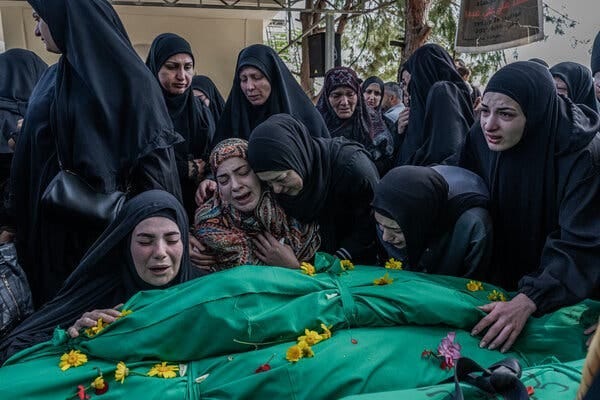
On May 10th Israeli air strikes in southern Lebanon killed (without warning) eight members of one family: a married couple, three of their children, a six-month-old grandchild, the father’s brother and a grandmother. Evacuation orders were afterwards issued.
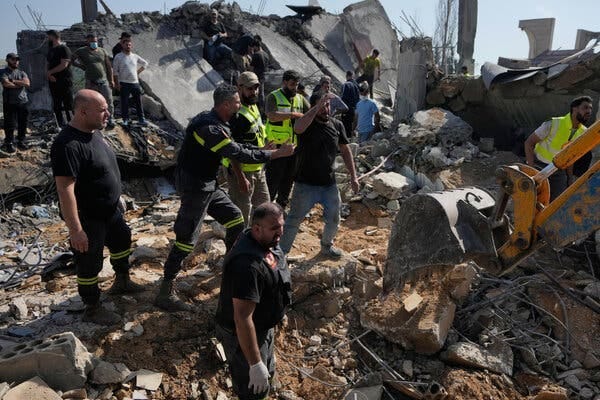
“They are hitting a lot today,” the resident of a town just south Saksakiyah told The New York Times. “So many people are getting killed for no reason.”

CovertAction Magazine is made possible by subscriptions, orders and donations from readers like you.
Blow the Whistle on U.S. Imperialism

Click the whistle and donate
When you donate to CovertAction Magazine, you are supporting investigative journalism. Your contributions go directly to supporting the development, production, editing, and dissemination of the Magazine.
CovertAction Magazine does not receive corporate or government sponsorship. Yet, we hold a steadfast commitment to providing compensation for writers, editorial and technical support. Your support helps facilitate this compensation as well as increase the caliber of this work.
Please make a donation by clicking on the donate logo above and enter the amount and your credit or debit card information.
CovertAction Institute, Inc. (CAI) is a 501(c)(3) non-profit organization and your gift is tax-deductible for federal income purposes. CAI’s tax-exempt ID number is 87-2461683.
We sincerely thank you for your support.
Disclaimer: The contents of this article are the sole responsibility of the author(s). CovertAction Institute, Inc. (CAI), including its Board of Directors (BD), Editorial Board (EB), Advisory Board (AB), staff, volunteers and its projects (including CovertAction Magazine) are not responsible for any inaccurate or incorrect statement in this article. This article also does not necessarily represent the views the BD, the EB, the AB, staff, volunteers, or any members of its projects.
Differing viewpoints: CAM publishes articles with differing viewpoints in an effort to nurture vibrant debate and thoughtful critical analysis. Feel free to comment on the articles in the comment section and/or send your letters to the Editors, which we will publish in the Letters column.
Copyrighted Material: This web site may contain copyrighted material the use of which has not always been specifically authorized by the copyright owner. As a not-for-profit charitable organization incorporated in the State of New York, we are making such material available in an effort to advance the understanding of humanity’s problems and hopefully to help find solutions for those problems. We believe this constitutes a ‘fair use’ of any such copyrighted material as provided for in section 107 of the US Copyright Law. You can read more about ‘fair use’ and US Copyright Law at the Legal Information Institute of Cornell Law School.
Republishing: CovertAction Magazine (CAM) grants permission to cross-post CAM articles on not-for-profit community internet sites as long as the source is acknowledged together with a hyperlink to the original CovertAction Magazine article. Also, kindly let us know at info@CovertActionMagazine.com. For publication of CAM articles in print or other forms including commercial internet sites, contact: info@CovertActionMagazine.com.
By using this site, you agree to these terms above.
About the Author

Charlotte Dennett Is a former Middle East reporter, investigative journalist and attorney.
Her latest book, just out in paperback, is Follow the Pipelines: Uncovering the Mystery of a Lost Spy and the Deadly Politics of the Great Game for Oil.
Her previous books are, with Gerard Colby, Thy Will be Done. The Conquest of the Amazon: Nelson Rockefeller and Evangelism in the Age of Oil. and The People v Bush: One Lawyer’s Campaign to Bring the President to Justice.
Charlotte can be reached at chardennettlaw@gmail.com.

When thousands of families wake up to find their homes flooded, and fields they eagerly awaited to harvest are transformed into mud- and waterlogged expanses, and farmers find themselves facing a lost season, evaporated labor, and livelihoods swept away by the flood, the discussion is no longer merely about a natural disaster, but about weighty political and administrative responsibilities that demand accountability.
What the Raqqa and Deir ez-Zor governorates witnessed in recent days represents one of the most severe disasters to strike the region in years. Thousands of hectares of farmland were submerged, dozens of villages suffered extensive damage, and thousands of families were forced to flee in search of safety, amidst heartbreaking scenes that encapsulate the extent of the suffering endured by the inhabitants of the Syrian Jazeera region.
The Responsibility Before the Flood
The Turkish authorities bear a significant share of the responsibility for this tragedy. According to Syrian officials, Ankara opened the gates of the Atatürk Dam and several other dams on the Euphrates River after water levels rose, without notifying the relevant Syrian authorities beforehand and without giving them sufficient time to take the necessary measures to protect residents, property, and agricultural lands.
When the water surged forth in enormous quantities, estimated at approximately 2,000 cubic meters per second, the residents of Raqqa and Deir ez-Zor found themselves facing a sudden flood that swept through villages, towns, and fields, leaving behind heartbreaking scenes of destruction and displacement.
The Absent Warning and the Delayed Response
Conversely, the responsibility of the authorities in Damascus is evident. Disasters demand constant preparedness, emergency plans, and the immediate mobilization of relevant agencies. The residents of the region were expecting swift action, clear warnings, and preventative measures to minimize losses. They expected officials to be present among them from the very first moments of the disaster, because those affected need someone to confront the crisis with them on the ground, not belated statements and pronouncements that only come after the fact.
A Suspicious Coincidence: Floods, Protests, and Wheat
The timing of this disaster raises many questions. The floods coincided with a wave of public anger following the announcement of wheat prices that displeased farmers across the Syrian Jazeera region, as the prices fell below production costs, leading to widespread feelings of injustice and loss.
Demonstrations erupted, angry chants rose, and protests spread with unprecedented speed. Squares filled with slogans demanding the dismissal of the governor and the minister, and others calling for the downfall of the regime. Given this confluence, questions abound regarding the circumstances and the need for a full and transparent investigation.
What comes after the floods? Compensation and accountability, or a repeat of the tragedy?
The people of Raqqa and Deir ez-Zor have the full right to demand a transparent investigation that reveals the details of what happened. They also have the right to demand compensation from the Turkish side for the damages if its responsibility for exacerbating the disaster is proven. Furthermore, they have the right to demand that the relevant authorities compensate those affected, provide relief to the victims, and utilize all available resources to restore life to the flood-stricken areas.
Water Recedes, Questions Flow
The Euphrates River may recede from the fields and villages in a few days or weeks. But the questions left by this flood will continue to resonate in people’s minds for a long time.
This disaster exposes a series of accumulated failures: in managing transboundary water resources, in coordination and early warning systems, and in preparing to confront dangers that threaten people’s lives and livelihoods.
In the shelters, where schools and tents have become spaces of heavy waiting and deferred hopes, thousands of families continue to search for one answer: Why did the people alone pay the price?
In a moment where pain intertwines with anger, the victims’ right to hold accountable all those found negligent, regardless of their position or status, becomes paramount. They demand, without delay, the full truth be revealed to the public and that those affected receive compensation commensurate with the magnitude of their losses.
If justice is ever to prevail, no official—Turkish or Syrian—whose negligence contributed to this catastrophe and its resulting deaths and losses will escape historical accountability.
But until that day arrives, the harshest truth remains: the victims possess nothing but their tears and their voices, and we possess nothing but our words… perhaps a single word will document a crime or prevent a soul from drowning in the coming flood.
A report issued by the US Inspector General for Operation Inherent Resolve warns of serious security repercussions following the escape of thousands of ISIS mercenaries and their families from camps and prisons in northeastern Syria.
The report states that between 15,000 and 20,000 people suspected of having ties to ISIS disappeared or escaped after the collapse of the detention system in early 2026, a consequence of attacks by the Syrian Interim Government and the security vacuum in Rojava.
It notes that the number of detainees in al-Hol camp has dwindled from approximately 23,400 to fewer than 1,500, following smuggling operations and mass escapes involving foreign women and children.
The report also mentions the escape of approximately 1,500 prisoners from al-Shaddadi prison during the Syrian Interim Government’s attacks on Rojava, warning that the resulting security vacuum has strengthened ISIS cells’ ability to reorganize.
https://hawarnews.com/en/tens-of-thousands-of-isis-mercenaries-disappear-in-syria
Read this and remember that Putler is to blame for this, because he and Erdogan agreed to betray Syria at the BRICS in Kazan 2024.
And remember, remember, that without Assad and the Alawites obeying Putler, this would not have been possible.
So remember just one thing: One Shiite is not worth crying over, and as many Russians as NATO kills, they are far too few.
December 2024 would be justly repaid if all Alawites (including the Assad family and Jamil and Suhail al Hassan) were forcibly mobilized by the Russians and sent to the front lines to die fighting the Ukrainian Nazis.
The traitors who remained in Syria and signed a reconciliation with HTS should be forcibly mobilized by HTS and sent to fight against Hezbollah, and Hezbollah should kill at least a thousand of them every day.
So that cemeteries should be increased in the traitorous Latakia and Tartus.
Most people in the world including most Jewish people are not aware that there was also a Jewish Nakba in which 850,000 Jews were expelled from Arab countries. Even myself I only found out about it a few years ago.
https://blogs.timesofisrael.com/the-departure-and-expulsion-memorial-the-jewish-nakba-memorial/
and the wonderful state of Khazaria.
Israel is imaginary by the Roman emperors, but Khazaria was and therefore we should return the Jews their Crimea and Kiev too.
SO that we would no longer hunt and terrorize lower-intelligent people in the desert.