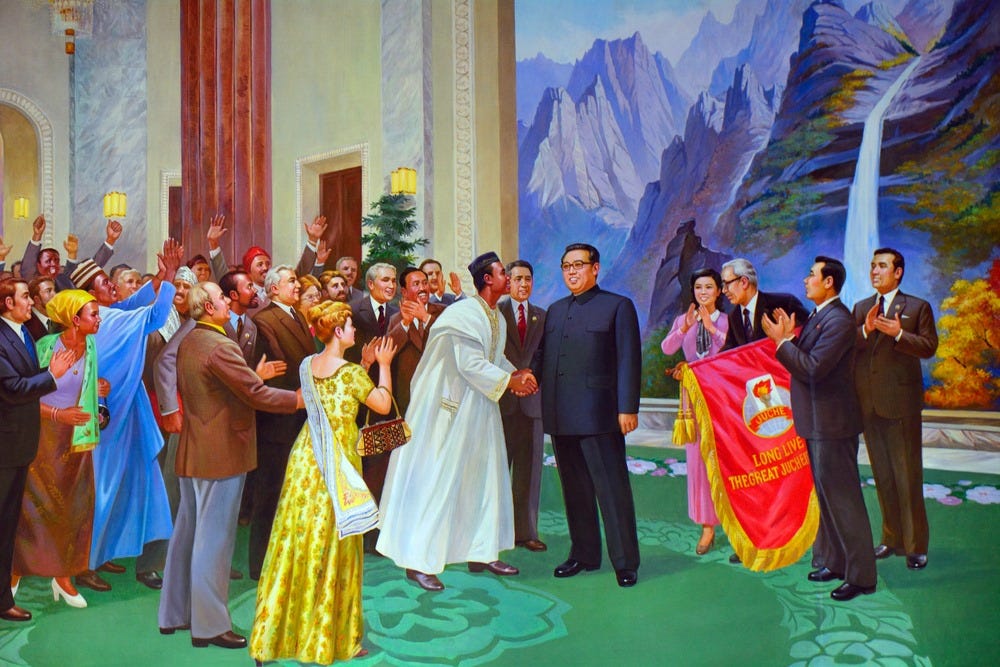
North Korea’s historic achievements have been airbrushed amidst a relentless CIA-State Department-media demonization campaign lending support to regime-change efforts
North Korea is not a country that most people would invoke favorably in polite company.
A relentless CIA-State Department-led demonization campaign over 70+ years has engrained the public with the perception that North Korea is an oppressive place with a threatening nuclear program ruled by a buffoonish family dictatorship.
Even normally astute political analysts attuned to the government’s use of the media and educational system to “manufacture consent” with the political status quo, have called North Korea “one of the most horrible countries in the world,” with “nothing good to say about it.”
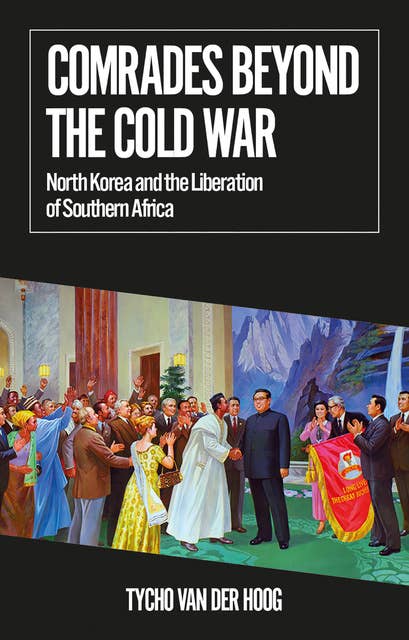
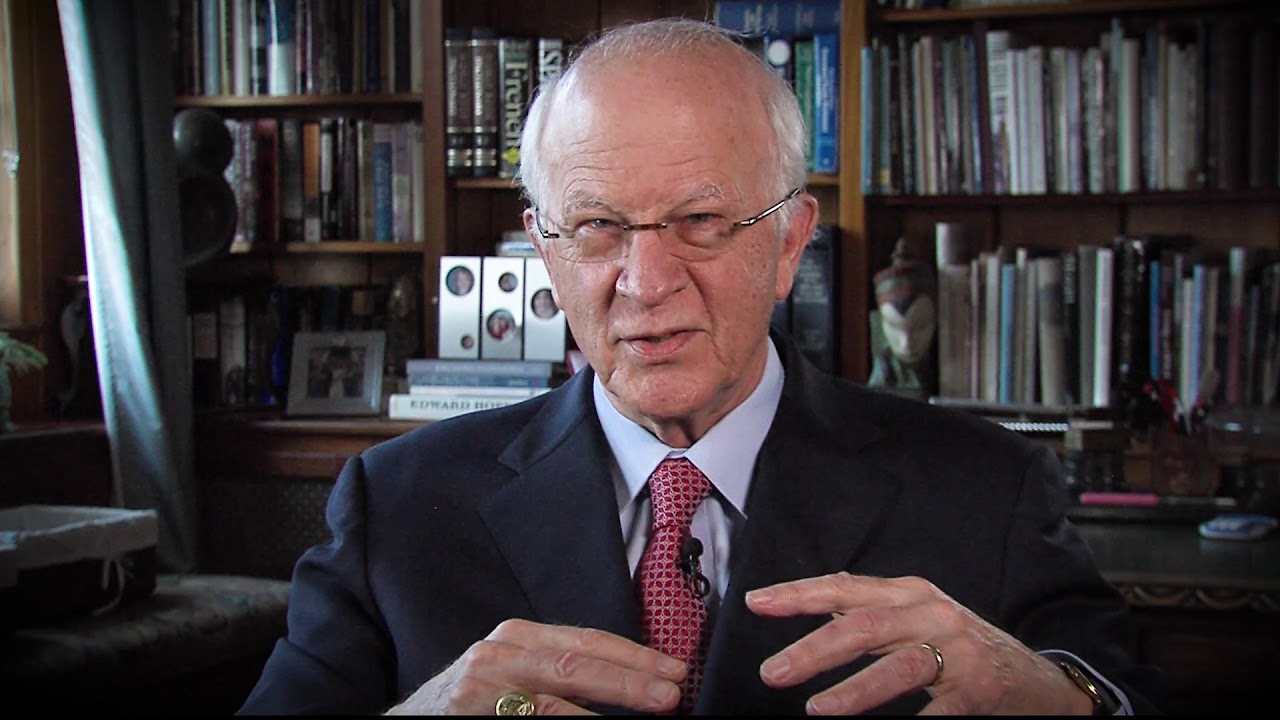
Tycho van der Hoog’s book, Comrades Beyond the Cold War: North Korea and the Liberation of Southern Africa (London: Hurst & Co., 2025), shows this latter viewpoint to be wrong-headed and that there are actually many good things to say about North Korea.
Among them is the important contributions made by North Korea to post-colonial African development and to the success of African liberation movements in the 1960s and 1970s that the U.S. government and CIA worked to suppress in collaboration with Apartheid South Africa.
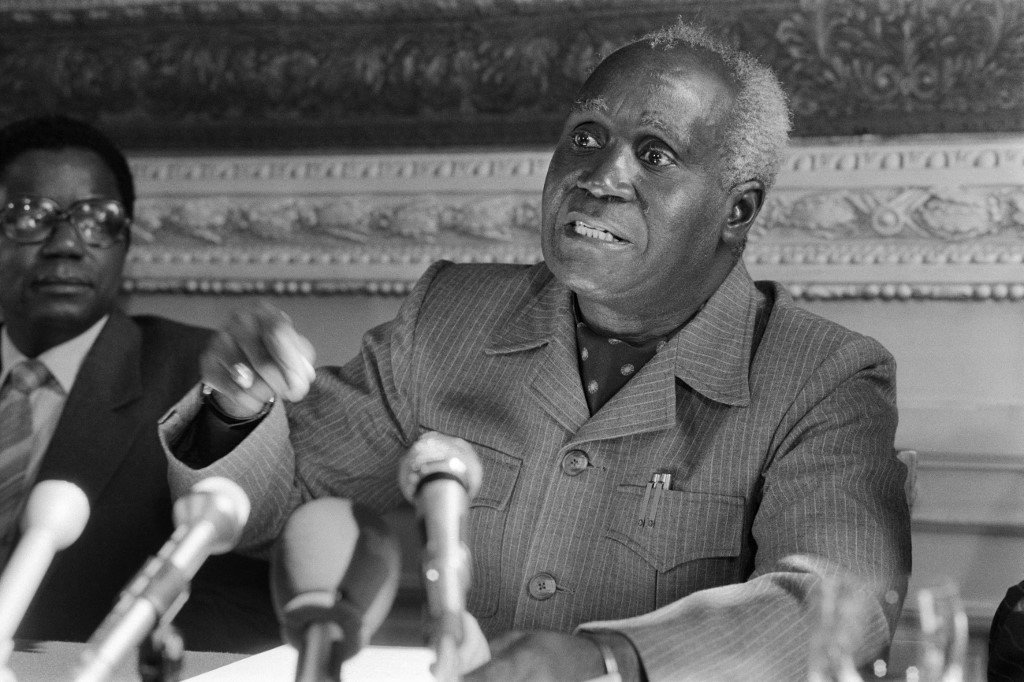
Van der Hoog notes that North Korea (Democratic People’s Republic of Korea-DPRK) offered military assistance and training to left-wing liberation movements, often through the so-called frontline states—Zambia and Tanzania—whose progressive governments (led by Kenneth Kaunda and Julius Nyerere, respectively) hosted exile revolutionary leaders and military training camps.
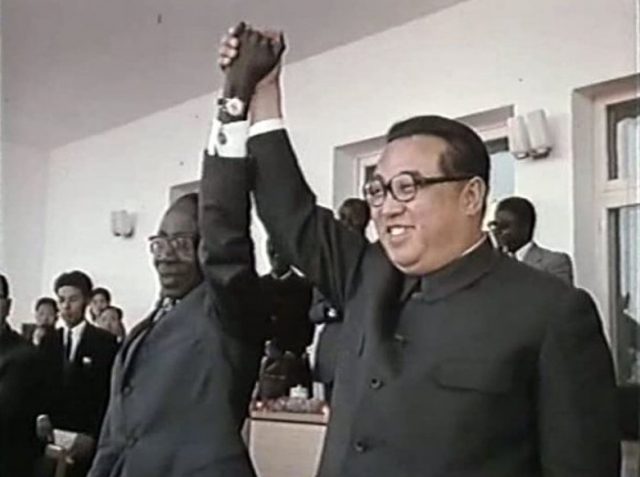
Kaunda, who ruled Zambia from its independence in 1964 until 1991, had forged a particularly close relationship with North Korean leader Kim Il-Sung because of a perceived compatibility between his governing philosophy—Zambian humanism—and the North Korean Juche philosophy emphasizing self-reliance and the building of an independent economy free from Western exploitation that provided excellent public services.
In 1982, as a symbol of their friendship, Kaunda belted a rendition of the Zambian liberation song “Tiyende Pamodzi” at Kim Il-Sung’s birthday celebration in Pyongyang.
Kaunda had for years been on the CIA’s hit list and was the target of a failed 1981 CIA-backed coup fomented by South African intermediaries.[1]
Kaunda’s nationalization of Zambia’s copper industry placed him at odds with corporate interests the CIA fronted for who have been able to take over the industry following privatization policies enacted by Kaunda’s right-wing successors (Frederick Chiluba, Hakainde Hichilema).
Kim Il-Sung had similarly alarmed U.S. corporate interests and the CIA by enacting a broad nationalization policy in the late 1940s in tune with the socialist model of governance.[2]
Along with Kaunda, Kim forged intimate personal relations with Julius Nyerere, Tanzania’s president from 1964 to 1985, whose Ujamaa philosophy embraced collectivist ideals that had been advanced in the North Korean revolution.
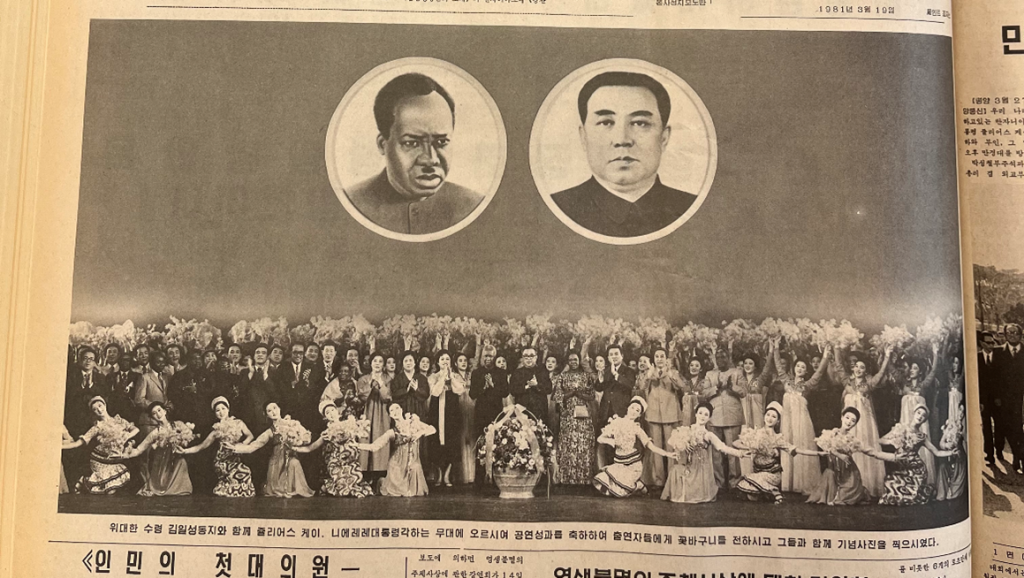
Nyerere, a Pan-Africanist and anti-imperialist like Kim, was targeted by the CIA in a regime-change operation around the time of independence that resulted in the severing of connections between Tanzania and Zanzibar and removal of leftist Zanzibar leader Abdulrahman Babu.
In the 1970s, the DPRK stationed six intelligence officers in Tanzania and built a huge embassy in the capital of Dar es Salaam, which had been transformed under Nyerere’s rule into what Agostinho Neto, leader of the leftist People’s Movement for the Liberation of Angola (MPLA), called “one of the heroic capitals of African resistance to colonial and racist rule.”
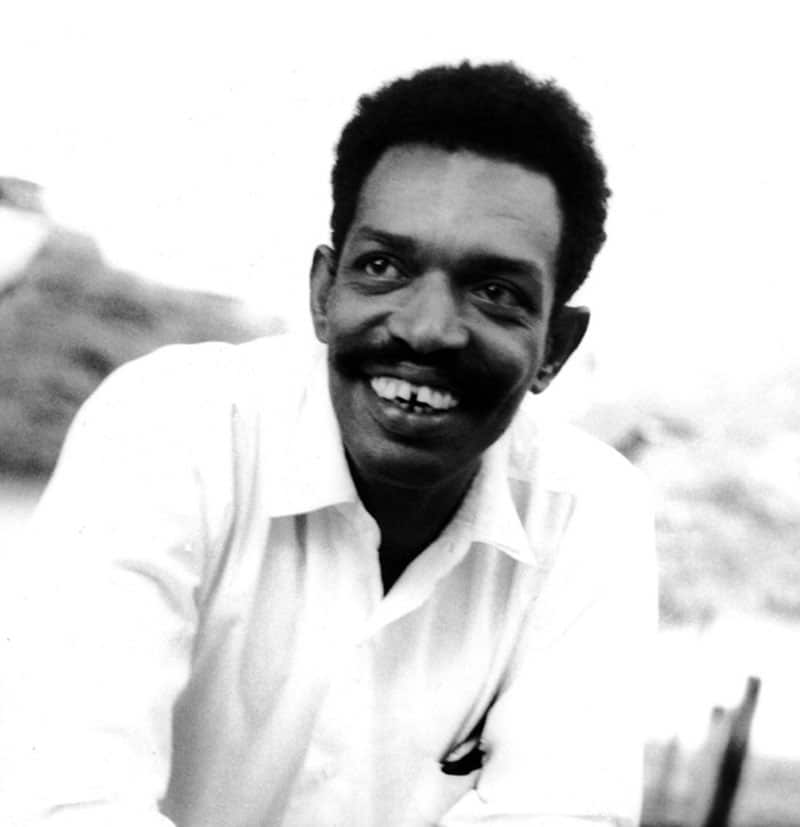
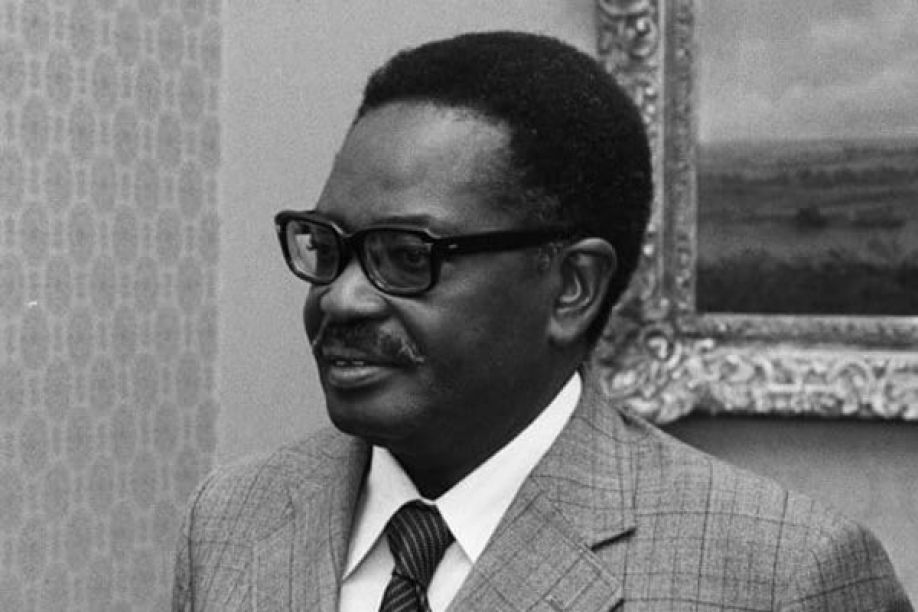
In 1983, the DPRK signed a military agreement with the MPLA—which was also supported by Cuba—by which it agreed to finance military training camps 150 kilometers from the capital of Luanda, where 1,000 to 3,000 North Korean advisers were permanently stationed until 1988.
The latter provided training in sniper skills, hit-and-run techniques and combat operations.
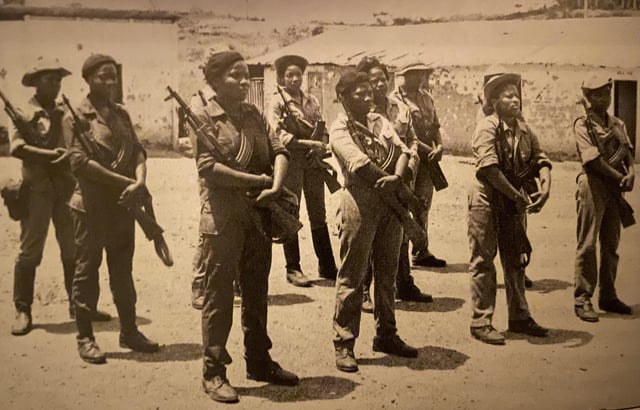
In the 1960s and early 1970s, the MPLA had led the liberation struggle against Portugal, which attacked the Angolan population with U.S. bombs and napalm.
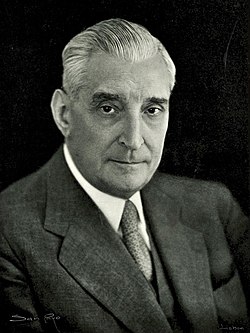
In April 1961, President John F. Kennedy temporarily cut back on military aid to Portugal—then ruled by fascist António Salazar—but back-tracked out of fear of losing the Azores air bases, a major transportation hub for the U.S. military.[3]
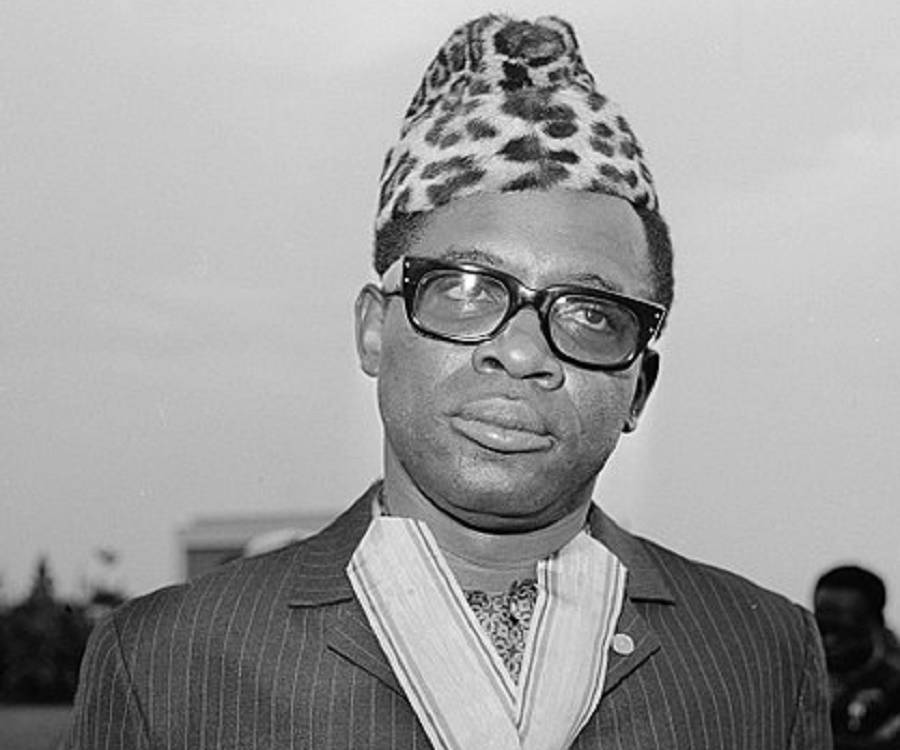
The CIA in the early 1960s began funneling arms to the National Liberation Front of Angola (FNLA), a rightist rival to the MPLA whose leader, Holden Roberto, was the brother-in-law of Congolese dictator Joseph Mobutu, who had been installed in power in a CIA coup.[4]
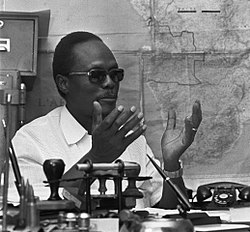
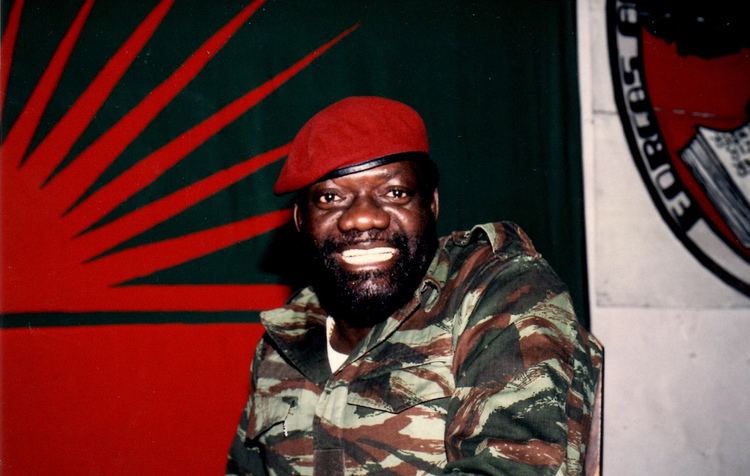
The CIA subsequently shifted to providing arms, mercenaries, advisers and money to another of MPLA’s rivals, UNITA, which was known as “Apartheid’s Contras” because of their backing from South Africa’s Apartheid regime and involvement in terrorist activities.[5]
Even the State Department characterized UNITA leader Jonas Savimbi, who had collaborated with the Portuguese, as a “monster.”[6]
CIA whistleblower John Stockwell wrote in his 1978 book, In Search of Enemies, that the CIA’s close collaboration with the South African intelligence services against the MPLA and other regional liberation movements stemmed from a mutually violent antipathy towards communism.[7]
Gulf Oil, Texaco, Boeing and Arthur D. Little also had major ongoing projects in Angola.[8]
In the 1960s, South Africa had assisted the CIA in suppressing a left-wing revolt in the Congo led by supporters of murdered Prime Minister Patrice Lumumba by developing a mercenary army, which Ghanaian leader Kwame Nkrumah compared to the Ku Klux Klan.[9]
Stockwell described Angola as a Vietnam-type morass orchestrated by Henry Kissinger. North Korea and Cuba were clearly on the right side of history, and the U.S. and South Africa the wrong side.[10]
Further Help During a Time of Need
North Korea was also on the right side of history when it gave military support to FRELIMO (Frente de Libertação de Moçambique), the dominant left-wing revolutionary party in Mozambique which had led the fight against Portuguese colonialism and fought in the 1980s against RENAMO (Mozambican National Resistance), a right-wing terrorist organization backed by South Africa, the Reagan administration and CIA.
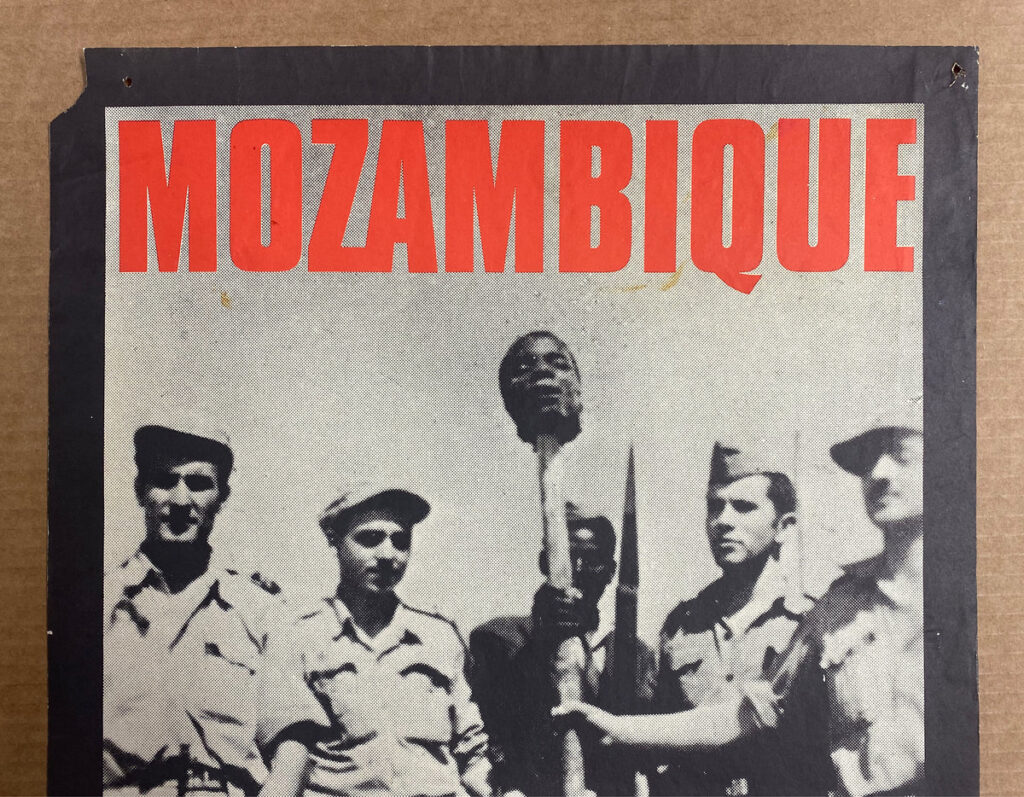
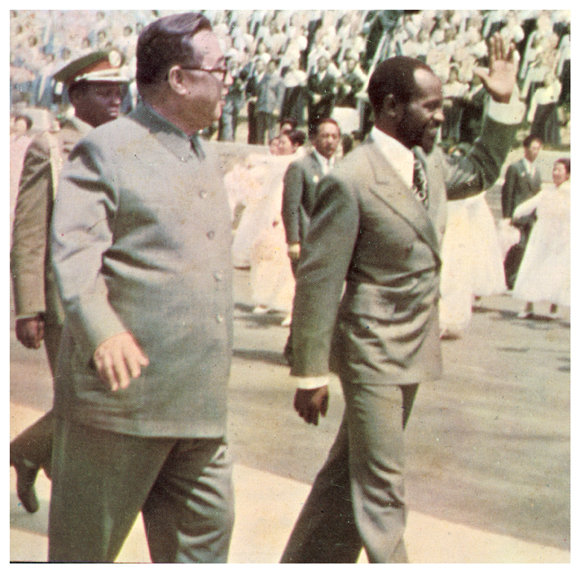
Kim Il-Sung was close to FRELIMO leader Samora Machel, a Pan-African giant and socialist who died in a suspicious plane crash in 1986 widely thought to be carried out by South Africa.
In the early 1980s, the Mozambican government had accused the CIA of running a spy network out of the U.S. embassy to gather information on Machel and other FRELIMO leaders so they could be assassinated.
The former research head of Mozambique’s Foreign Ministry publicly admitted that the CIA had paid him $300 per month to spy for the U.S., and an Air Force captain, Joao Goncalvez, said he learned the U.S. was planning a coup in Mozambique at that time with the help of South Africa.[11]
In Namibia, the DPRK supported the South West Africa People’s Organization (SWAPO) in its revolutionary struggle against South African occupation, which lasted from 1915 to 1990.
Assistant Secretary of State for African Affairs Chester A. Crocker, a key proponent of the Reagan administration’s support for South Africa and zealous champion of Jonas Savimbi in Angola, had strong intelligence ties and major investments in South African gold mining companies.[12]
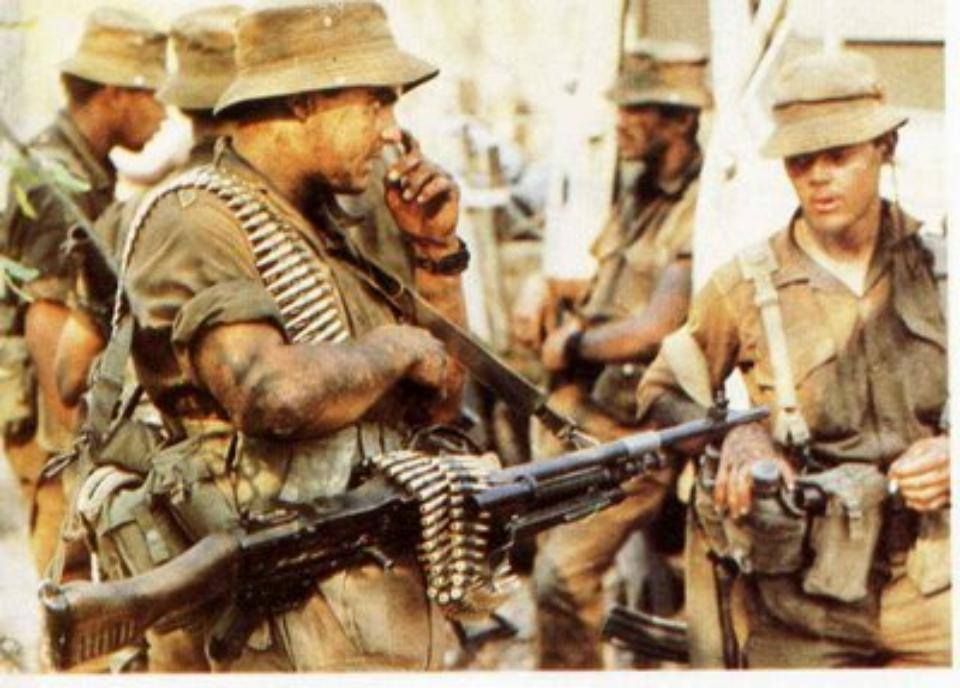
Coveting South African minerals, the Reagan administration and CIA presented SWAPO—like other African liberation movements—as Soviet and Cuban proxies and warned that its empowerment would threaten South Africa’s hold on the strategic Walvis Bay.[13]
While the CIA assisted South African security forces implicated in torture and other atrocities,[14] North Korean Special Forces provided weapons to SWAPO guerrillas and provided training to them in military facilities in Pyongyang where thousands of African freedom fighters went.
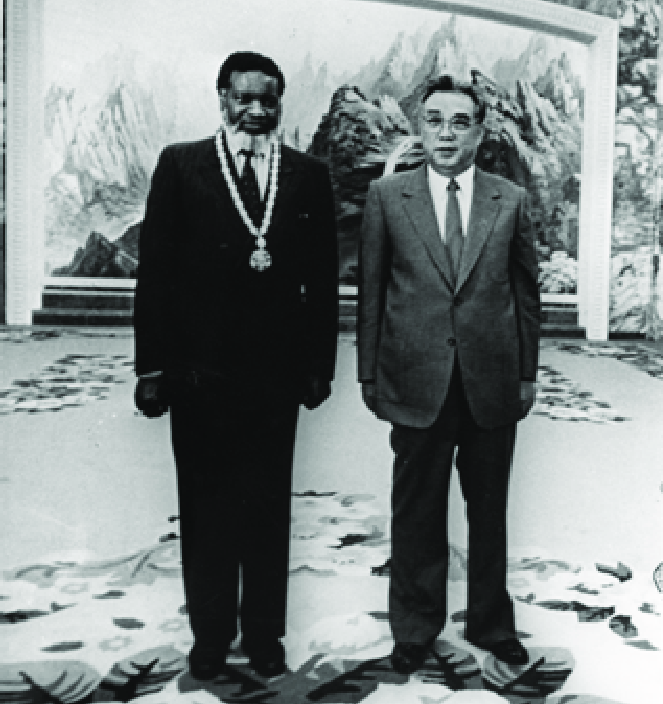
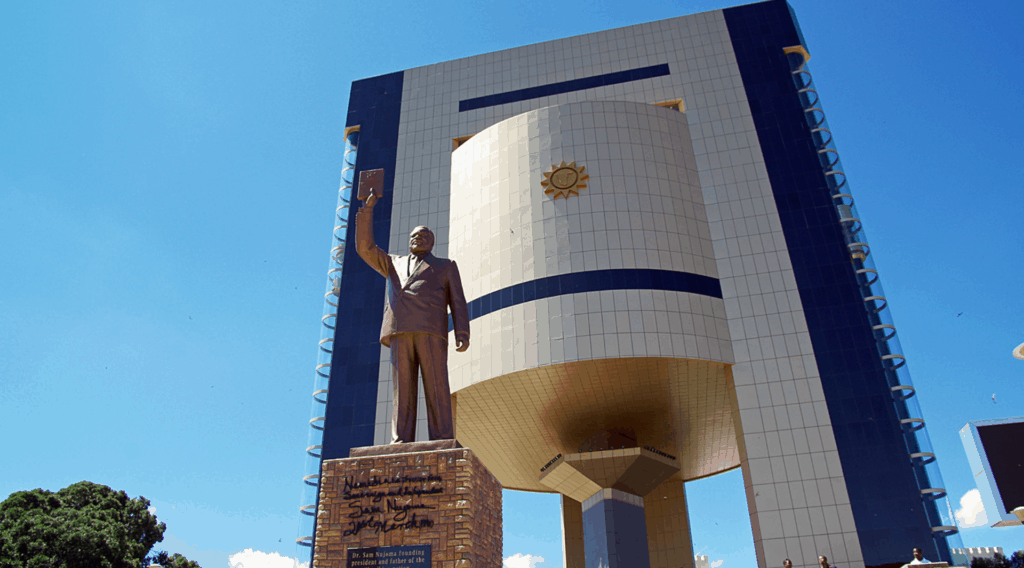
SWAPO leader Sam Nujoma was so grateful for North Korean support during Namibia’s liberation struggle that, during a 1986 banquet in Pyongyang in front of Kim Il-Sung, he cited the material assistance of North Korea as the reason why SWAPO was able to “maintain the banner of the struggle higher and inflict casualties on the South African racist troops.”
American diplomatic files indicate that, between April and August 1965, 15 Zimbabwean revolutionaries were trained in the use of explosives, weaponry tactics and intelligence in Pyongyang by North Korean Special Forces.
The Zimbabwean revolutionaries were fighting against the racist Ian Smith-led white settler regime that was supported by South Africa and the U.S., which failed to enforce sanctions it had imposed and backed South African military-terrorist operations. Further, the CIA aided in the recruitment of mercenaries who fought in the South Rhodesian army.[15]
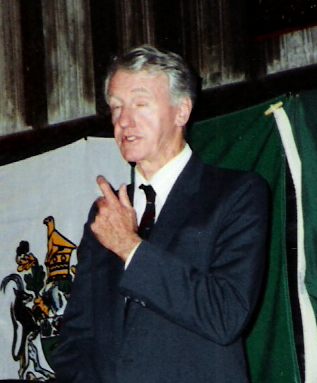
Pyongyang continued to support Zimbabwean African National Union (ZANU) and Zimbabwean African Patriotic Union (ZAPU) forces through the long guerrilla struggle in the 1970s.
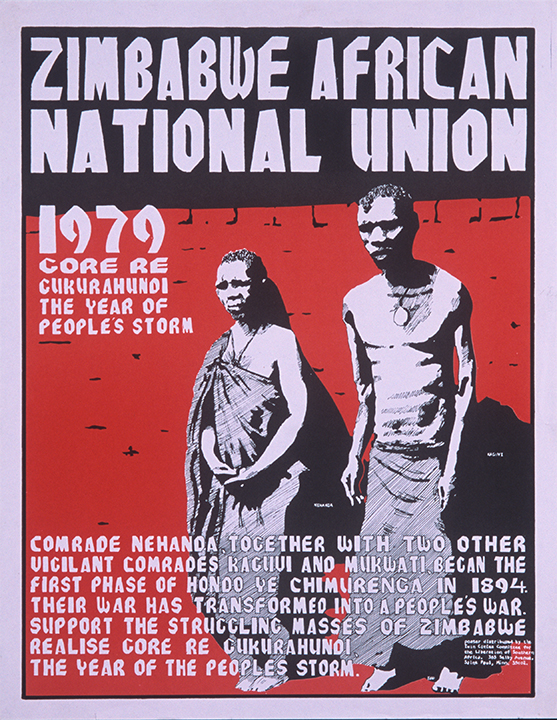
ZANU leader Robert Mugabe first visited Pyongyang in 1978 where he requested and was granted further military support, some of it channeled through Mozambique where ZANU fighters were based.
North Korea’s military assistance continued after Zimbabwe won its independence in 1980 under Mugabe’s leadership.
On his second visit to Pyongyang in 1980, Mugabe attended the Sixth Congress of the Workers’ Party of Korea as a guest of honor. Mugabe thanked Kim Il-Sung and the people of North Korea for their selfless help during the fight against colonialism, saying that “the Workers’ Party of Korea experienced the struggle of the people of Zimbabwe as its own.”
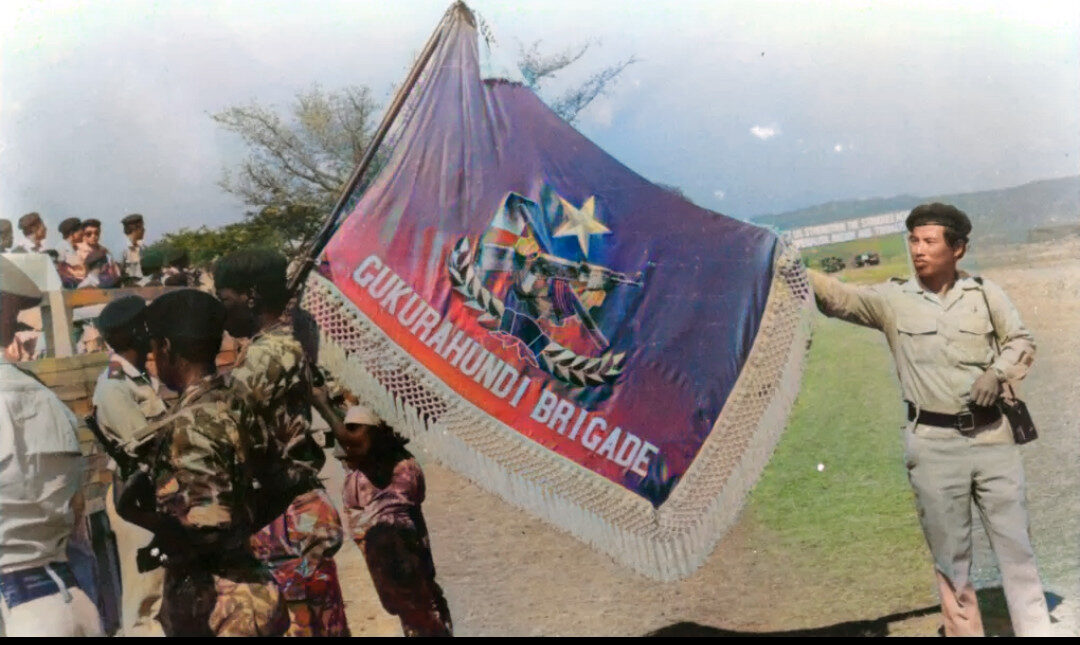
In August 1981, 103 military instructors from North Korea arrived from Zimbabwe to train the 5th Brigade of the Zimbabwean army, which was deployed by Mugabe in Matabeleland to wipe out the rival ZAPU in what is known as the Gukurahundi.
The latter episode shows the moral ambiguity of North Korean military training programs, which were not purely heroic. Nevertheless overall, North Korea’s role in Africa’s liberation from Apartheid rule, colonialism and neo-colonialism is a positive one that contrasts markedly with the CIA’s dubious support for colonialism, Apartheid and right-wing terrorist groups in Africa.
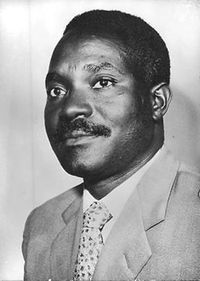
In the 1980s, the eminent Zambian politician Alexander Grey Zulu lauded North Korea’s government for its “invaluable aid to the oppressed people in South Africa,” and thanked DPRK leaders for “its help during a time of need when North Korea provided a near base to freedom fighters.”
Development Aid
Besides military support, van der Hoog chronicles how North Korea provided extensive development assistance to post-colonial African states that brought significant benefits to the local population.
Kim Il-Sung and the DPRK leadership had been convinced that South-South cooperation would lead to the establishment of a new international economic order.
The pinnacle of North Korean development aid to Africa occurred in the 1980s, when at least 20 African states benefited.
Among the examples that van der Hoog discusses are a) Lesotho, where North Korea rebuilt a national stadium, ran vegetable farms and helped bolster the country’s maize production and irrigation systems; b) the Seychelles, a country that had led the struggle to demilitarize the Indian Ocean and whose president survived several CIA-South African coup attempts,[16] where North Korea donated thousands of tons of cement for housing projects, tractors for agricultural development and supplied rice at a reduced price; and c) Angola, where North Korea constructed a major dam, ran an irrigation project and aided in the production of cotton.
Similar assistance was provided to Zimbabwe, Guinea, Ghana, Zambia and Tanzania, where the DPRK sent technical advisers who helped construct new parks, gardens and playgrounds for children and to run hydro-power stations, among other things.
Van der Hoog wrote that Julius Nyerere’s home village became a particular “hot-spot” for North Korean agricultural experts and town planners as the DPRK provided Tanzania with hundreds of thousands of dollars’ worth of building materials and set up an agricultural science institute that showcased North Korea’s Juche, or self-reliant agricultural system.
North Korean support for Tanzanian development came at a time of U.S. economic warfare that was designed to undermine support for Nyerere and Tanzania’s socialist experiment.[17]
North Korea As a Developmental Model
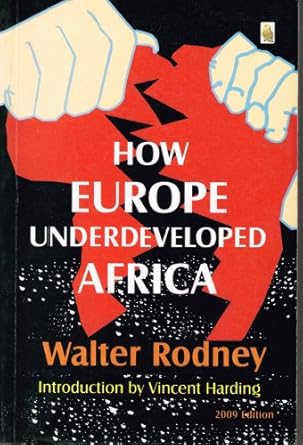
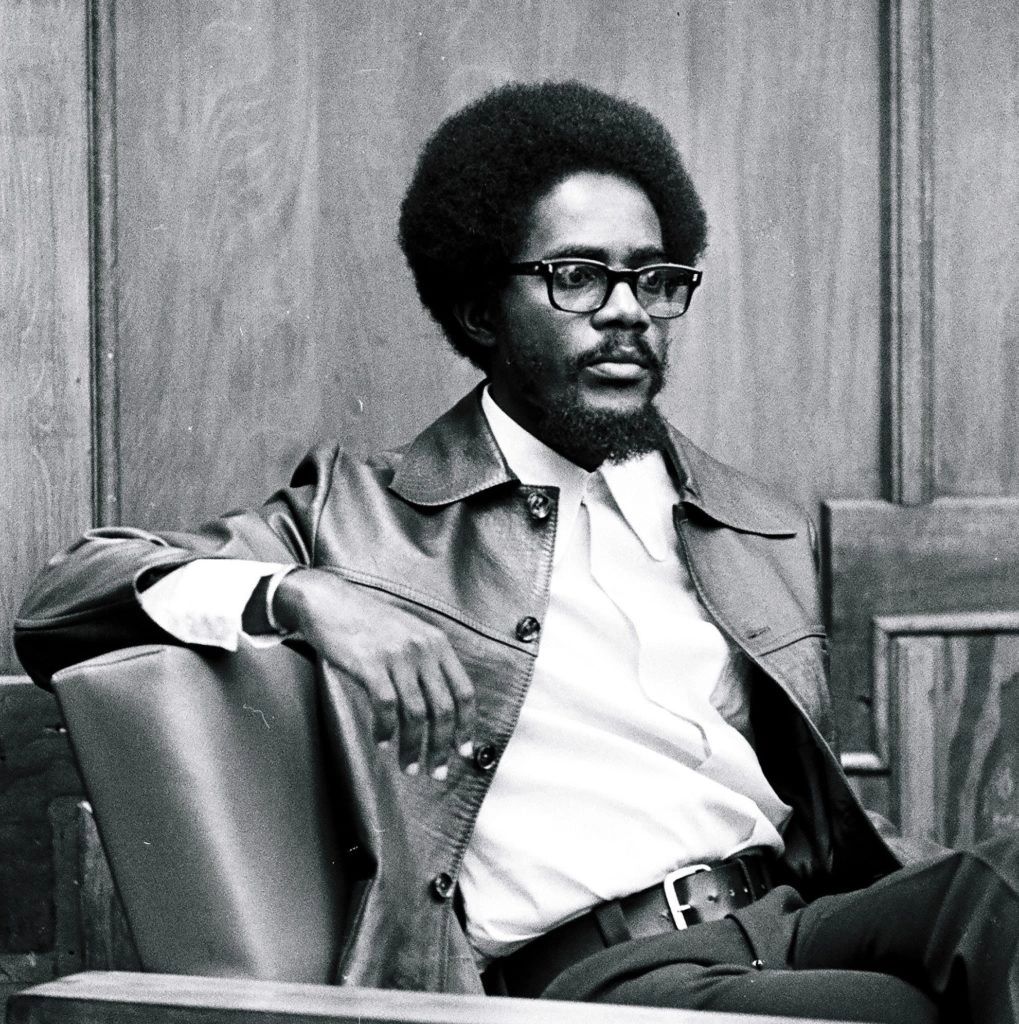
Walter Rodney, Guyanese author of the anti-imperialist classic How Europe Underdeveloped Africa, hailed North Korea as a development model for Africa, citing its miraculous recovery from the Korean War and establishment of a self-reliant economy based on the country’s Juche philosophy emphasizing independence from foreign influence and Western-based corporations.
African post-colonial leaders who embraced a socialist philosophy, such as Kenneth Kaunda, Kwame Nkrumah of Ghana and Julius Nyerere, were trying to build a similar kind of independent economy in their own countries.
North Korea disseminated the writings and speeches of Kim Il-Sung throughout Africa, setting up political education institutes and Juche centers, which promoted the Juche concept in Africa.
The first of the Juche schools was set up in Mali in 1969 and, by the 1980s, more than 30 African countries hosted a Juche school. Among them was Zimbabwe, where Robert Mugabe opened a Juche school at the University of Zimbabwe in 1981 following his second visit to Pyongyang and, thereafter, made Juche central to his development strategy for Zimbabwe.[18]
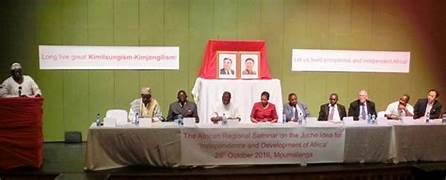
The Juche ideals meshed with Pan-African ideals espoused by leaders like Mugabe, Nyerere and Kaunda, who sought African unity and autonomy from the West.
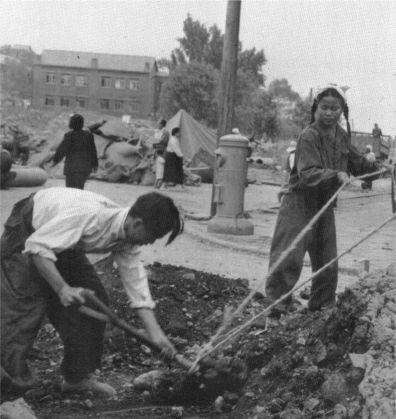
North Korea was widely viewed as both economically and morally superior to South Korea because it had stood up to Western aggression in the Korean War when it was nearly destroyed, and rebuilt its economy quickly and independently thereafter. (South Korea was viewed as a U.S. puppet state occupied by U.S. troops and run by a right-wing dictatorship.)
North Korean art is organized around a teleological idea of “a mythic historic destiny” that creates a direct link between anti-colonial struggle and modern politics, which continues to resonate with Africans who see history similarly.
Kim Il-Sung claimed that his grandfather led the resistance against American invaders in 1866, a courageous feat that was connected to the guerrilla fight against Japanese colonization in the 1930s and the “Victorious Fatherland Liberation War” against American imperialism in the 1950s.
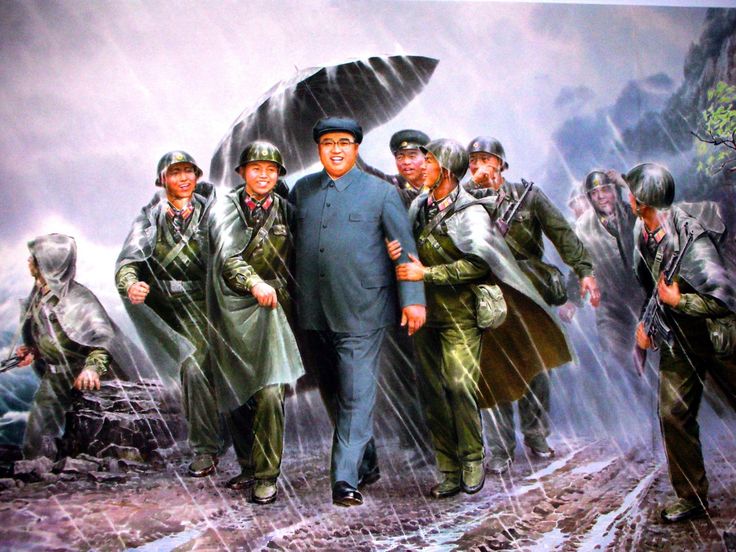
Kim Il-Sung bolstered his anti-imperialist credentials through his hosting of a Non-Aligned Movement summit in Pyongyang in 1987 and by joining the anti-imperialist Afro-Asian People’s Solidarity Organization, where he was celebrated for his achievements in transforming a backward colonial society into a “dignified, independent and sovereign nation.”
Part of the key to that transformation was the successful industrialization of North Korea’s economy, at the same time that the DPRK tried to establish a fair wage structure while providing free education and health care to North Koreans.
Additionally, the DPRK adopted an expansive land-reform program that equalized wealth in the countryside and resulted in food self-sufficiency, and did not lead to much violence.[19]
In 1965, Cambridge economist Joan Robinson wrote an article lauding North Korea’s tremendous economic growth, stating that “all the economic miracles of the postwar world are put in the shade by [North Korea’s] achievements.”
Some 13 years later, the CIA reported that North Korean grain production had grown at a more rapid pace than South Korea’s due to its advances in agriculture under a collectivized system.
Post-Cold War
North Korea’s economic success earned it great admiration in Africa and other developing world countries during much of the Cold War.
Things changed in the 1980s and 1990s, when North Korea’s economy contracted due to the collapse of the Soviet Union and other Eastern Bloc countries, which were its major trading partners, and a period of famine and drought.
U.S. and Western economic warfare and sanctions then began to take its toll and caused further economic distress, which was then used for propaganda purposes by the U.S. to denigrate North Korea and its economic system.
On the negative side is North Korea’s lack of political or press freedom, channeling a huge amount of money into the military, and imprisonment of dissidents, it is alleged, in harsh labor camps. It should be acknowledged though that the state of siege upon which North Korea has been placed for over 70 years and massive devastation heaped upon it in the Korean War helped shape the country’s political evolution.
By the 1990s, North Korea no longer had the excess capital to finance development projects in Africa or provide military assistance to left-wing governments as it had before.
Nevertheless, van der Hoog points out that the DPRK revitalized arms sales programs to Africa in the 21st century as a means of gaining hard currency, and is revitalizing some of its development projects.
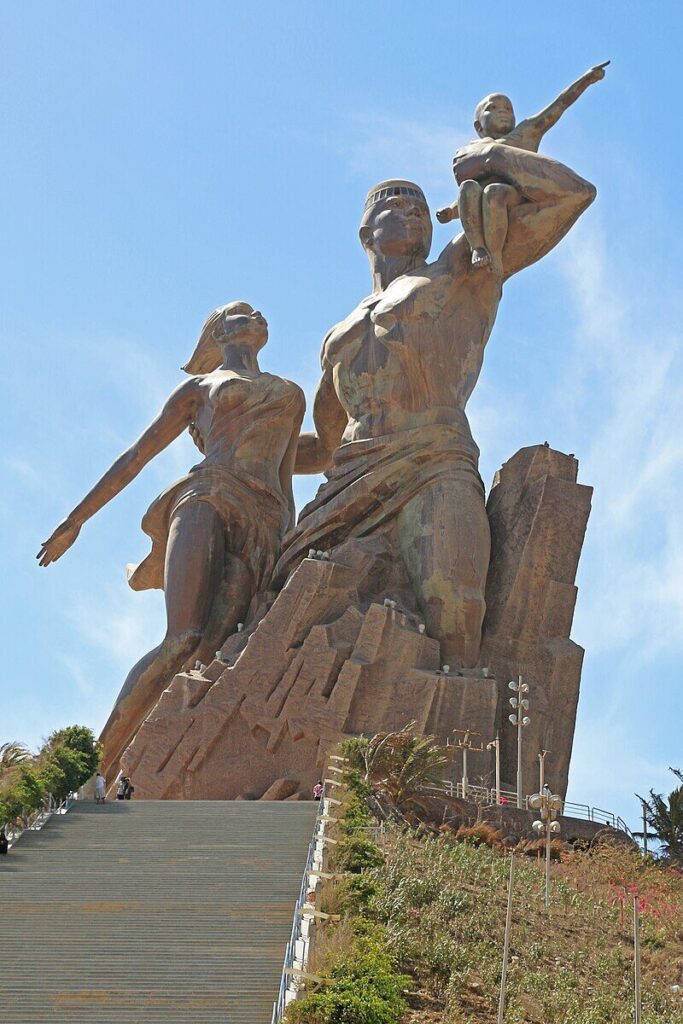
Additionally, it has been involved in the construction of monuments and museums in African capitals that celebrate local resistance to colonialism and liberation from Apartheid.
On June 7, The Wall Street Journal amazingly characterized North Korea as the world’s “most surprising economic success story,” portending well for the future.
The Juche ideal remains attractive in certain parts of Africa, where North Korea is viewed far more positively than in the West as a proudly defiant country with a practical and humane governing ideal.
“Zambia: CIA Targets Kaunda,” The Guardian (New York), October 28, 1981. Zambian Foreign Ministry official Walter Kayi Lumbwe was accused of treason and two U.S. embassy officials, John Finney and Michael O’Brien, were expelled from Zambia at this time after being accused of “activities inimical to the security of the [Zambian] state,” having been linked with a “CIA examination of the possibility of an alternative leadership in the country.” Lumbwe, after his arrest, admitted to being recruited by the CIA. The CIA’s presence in Zambia and efforts to coopt liberation movements based there and undermine Kaunda’s government is detailed in Robert Molteno, “The CIA and Studies on Guerrilla Warfare in Southern Africa,” CovertAction Information Bulletin, 4 (April-May 1979), 18-23. See also Sean Gervasi, “U.S. and South Africa Foment Terrorist Wars,” CovertAction Information Bulletin, 22 (Fall 1984), 38. According to African sources reported on by Gervasi, CIA Director William Casey flew to Lusaka and threatened sanctions against Zambia if any CIA role in the coup were exposed. ↑
See Charles K. Armstrong, The North Korean Revolution, 1945-1950 (Ithaca, NY: Cornell University Press, 2004). ↑
John Stockwell, In Search of Enemies: A CIA Story (New York: W.W. Norton, 1978), 51. ↑
Ironically, North Korea for a period also supported the FNLA, particularly against the Portuguese, in part because they were backed by the People’s Republic of China (PRC), whereas the Soviet Union supported the MPLA. North Korea switched, however, as van der Hoog shows, to supporting the MPLA in Angola. ↑
William Minter, Apartheid’s Contras: An Inquiry into the Roots of War in Angola and Mozambique (BookSurge Publishing, 2008). On the Angolan conflict, see also Piero Gleijeses, Conflicting Missions: Havana, Washington, and Africa, 1959-1976 (Chapel Hill: University of North Carolina Press, 2003); Stockwell, In Search of Enemies, 162. Some of the CIA mercenaries were trained at the Jonestown facility in Guyana set up by religious cult leader Jim Jones, who was outed as a CIA agent in Brazil. South African intelligence agent Gordon Winter said that UNITA was controlled by the CIA. ↑
Louis Wolf, “UNITA’s Savimbi Seeks U.S. Understanding—Again,” CovertAction Information Bulletin, 7, (December 1979-January 1980), 25, 26, details the fawning U.S. media coverage of Savimbi and his being feted in Washington. When Savimbi made overtures for a peace agreement with the MPLA, the CIA admonished him that the U.S. did not want any “soft allies.” Stockwell, In Search of Enemies, 193. In a massive propaganda campaign, the CIA planted stories in the media suggesting that Cuban troops had committed atrocities in Angola and were raping Ovimbundu girls, which was untrue. Caryle Murphy, a Washington Post stringer based in Luanda, told Stockwell that the Cuban soldiers had universally fallen in love with Angola and were well behaved. The only atrocity he could document was one where Cubans were executed by UNITA soldiers. (Stockwell, In Search of Enemies, 195) ↑
Stockwell, In Search of Enemies, 187; “United States Assists South Africa in Surveillance,” CovertAction Information Bulletin, 6 (October 1979), 32; Bill Schaap, “The CIA and BOSS,” CovertAction Information Bulletin, 18 (Winter 1983), 52, 53. Stockwell noted that CIA officers tended to admire their South African counterparts because they were “bluff, aggressive men without guile” who operated “efficiently.” The CIA had more than three dozen deep-cover CIA agents in South Africa during the early 1980s, and helped South Africa to evade U.S. and UN arms embargoes. ↑
“Stockwell Scores Savimbi,” CovertAction Information Bulletin, 7 (December 1979-January 1980), 27. ↑
Stockwell, In Search of Enemies, 188; Gleijeses, Conflicting Missions. In the 1970s, South Afrrica’s Security Bureau began hiring “CIA trained anti-Castro fanatics” to carry out contract killings of anti-apartheid activists and leftists. Schaap, “The CIA and BOSS,” 54. ↑
Stockwell, In Search of Enemies. Stockwell suggests that the CIA managed the war from Langley and in advanced bases inside Angola and Kinshasa. ↑
Charles Mitchell, “Mozambique claims CIA planned assassinations, coup,” United Press International, March 16, 1981. Four CIA employees were expelled from the country, including CIA Station Chief Frederick Lee Wettering, and two CIA wives. “The Faces of Evil,” CovertAction Information Bulletin, 13 (July-August 1981), 28. The article discusses how the CIA operatives who were expelled had shared information on the location of African National Congress (ANC) activists in Mozambique whose homes were violently raided and subsequently killed in what is known as the Matola Massacre. ↑
Ellen Ray and Bill Schaap, “Crocker and the CIA” in “The Namibia ‘Solution’: The Future of Southern African” CovertAction Information Bulletin, 13 (July-August 1981), 13; R.M., “Reagan and Africa: The Empire Strikes Back,” CovertAction Information Bulletin, 13 (July-August 1981), 34-36. ↑
Ray and Schaap, “The Namibia ‘Solution’: The Future of Southern African,” 4-15. The CIA supplied South Africa with weapons illegally through private airlines such as Globe Aero Ltd. of Lock Haven, Pennsylvania, a suspected CIA proprietary company. Louis Wolf, “Globe Aero, Ltd.: Merchants of Counter-Insurgency,” CovertAction Information Bulletin, 13 (July-August 1981), 18, 19. ↑
Clarence Lusane, “The U.S. Connection: South African Torture,” CovertAction Information Bulletin, 18 (Winter 1983), 55. ↑
Anton Ferreira and Jonathan Bloch, “CIA in Zimbabwe,” CovertAction Information Bulletin, 8 (March-April 1980), 26, 27; Gervasi, “U.S. and South Africa Foment Terrorist Wars.” U.S. companies acted as middlemen in arms shipments to the Southern Rhodesian army from Israel. ↑
Ellen Ray, “Seychelles Beats Back Mercenaries,” CovertAction Information Bulletin, 16 (March 1982), 4, 5, 6. Seychelles President France-Albert René expelled from the Seychelles 120 American civilians employed at a satellite tracking station in Mahé. ↑
Gervasi, “U.S. and South Africa Foment Terrorist Wars.” ↑
South African journalist and historian R. W. Johnson reported that the only book in President Mugabe’s office was Juche! The speeches and writings of Kim Il Sung. When I visited Zambia in 2007, Kim Il Sung’s writings were also prevalent in many libraries that hadn’t ordered recent new books since neoliberalism took over the country in 1991. ↑
Robert Mugabe stated at a press conference in 1980: “After the withdrawal of the Japanese, the DPRK faced the need to redistribute the land. But it did much more than that. Despite a population of seventeen million and a territory that is more than 85% mountainous, it has produced a surplus of food on an arable land of 250 million hectares. Zimbabwe has a lot to learn from the DPRK.” Van der Hoog emphasizes in his book North Korea’s negative influence on liberation movements in Africa in pushing them toward authoritarian policies when they took power. These authoritarian policies, however, were also a product of the legacy of European colonialism. ↑
CovertAction Magazine is made possible by subscriptions, orders and donations from readers like you.
Blow the Whistle on U.S. Imperialism
Click the whistle and donate
When you donate to CovertAction Magazine, you are supporting investigative journalism. Your contributions go directly to supporting the development, production, editing, and dissemination of the Magazine.
CovertAction Magazine does not receive corporate or government sponsorship. Yet, we hold a steadfast commitment to providing compensation for writers, editorial and technical support. Your support helps facilitate this compensation as well as increase the caliber of this work.
Please make a donation by clicking on the donate logo above and enter the amount and your credit or debit card information.
CovertAction Institute, Inc. (CAI) is a 501(c)(3) non-profit organization and your gift is tax-deductible for federal income purposes. CAI’s tax-exempt ID number is 87-2461683.
We sincerely thank you for your support.
Disclaimer: The contents of this article are the sole responsibility of the author(s). CovertAction Institute, Inc. (CAI), including its Board of Directors (BD), Editorial Board (EB), Advisory Board (AB), staff, volunteers and its projects (including CovertAction Magazine) are not responsible for any inaccurate or incorrect statement in this article. This article also does not necessarily represent the views the BD, the EB, the AB, staff, volunteers, or any members of its projects.
Differing viewpoints: CAM publishes articles with differing viewpoints in an effort to nurture vibrant debate and thoughtful critical analysis. Feel free to comment on the articles in the comment section and/or send your letters to the Editors, which we will publish in the Letters column.
Copyrighted Material: This web site may contain copyrighted material the use of which has not always been specifically authorized by the copyright owner. As a not-for-profit charitable organization incorporated in the State of New York, we are making such material available in an effort to advance the understanding of humanity’s problems and hopefully to help find solutions for those problems. We believe this constitutes a ‘fair use’ of any such copyrighted material as provided for in section 107 of the US Copyright Law. You can read more about ‘fair use’ and US Copyright Law at the Legal Information Institute of Cornell Law School.
Republishing: CovertAction Magazine (CAM) grants permission to cross-post CAM articles on not-for-profit community internet sites as long as the source is acknowledged together with a hyperlink to the original CovertAction Magazine article. Also, kindly let us know at info@CovertActionMagazine.com. For publication of CAM articles in print or other forms including commercial internet sites, contact: info@CovertActionMagazine.com.
By using this site, you agree to these terms above.
About the Author
Jeremy Kuzmarov holds a Ph.D. in American history from Brandeis University and has taught at numerous colleges across the United States. He is regularly sought out as an expert on U.S. history and politics and co-hosts a radio show on New York Public Radio and on Progressive Radio News Network called “Uncontrolled Opposition.”
He is Managing Editor of CovertAction Magazine and is the author of eight books, including Obama’s Unending Wars (Clarity Press, 2019), The Russians Are Coming, Again, with John Marciano (Monthly Review Press, 2018), Warmonger. How Clinton’s Malign Foreign Policy Launched the U.S. Trajectory From Bush II to Biden (Clarity Press, 2023); with Dan Kovalik, Syria: Anatomy of Regime Change (Baraka Books, 2025), and Political Assassinations in America: The Intricate Nexus of Deep State Crime (Clarity Press, 2026).
Besides these books, Kuzmarov has published hundreds of articles and contributed to numerous edited volumes, including one in the prestigious Oxford History of Counterinsurgency .
He can be reached at jkuzmarov2@gmail.com and found on substack here.

Here is a good article about the prison camps in North Korea.
https://www.journalofdemocracy.org/articles/review-essay-a-voice-from-the-north-korean-gulag/
Here is a good article on the catastrophe that took place in North Korea.
https://fertilizer.cropgpt.ai/case-studies/north-korea
Most of the comments in this article are very true and factual, but there are some misleading claims as outlined below:
1) Peaceful Land Reform: The claim that the land-reform program “did not lead to much violence” is historically false. Wealthy landowners and political dissidents were purged, executed, or forcibly relocated in a highly violent and authoritarian process of agrarian collectivization. 2) Food Self-Sufficiency: State-controlled collectivized agriculture eventually proved inefficient and rigid. It led to systemic soil degradation and over-reliance on chemical fertilizers, leaving the state unable to feed its population without foreign aid when the Soviet subsidies dried up 3)The Role of Sanctions: The text claims U.S. and Western sanctions are the primary driver of economic distress. While sanctions do limit global trade, economists attribute North Korea’s economic collapse and persistent poverty to chronic state mismanagement, extreme isolationism, and the disproportionate channeling of resources into its military.
In short, while early postwar North Korea experienced rapid reconstruction and garnered genuine admiration from some Western intellectuals, this early success was ultimately unsustainable. It collapsed due to systemic flaws and the withdrawal of foreign support, resulting in one of the most closed and repressive societies in the modern world