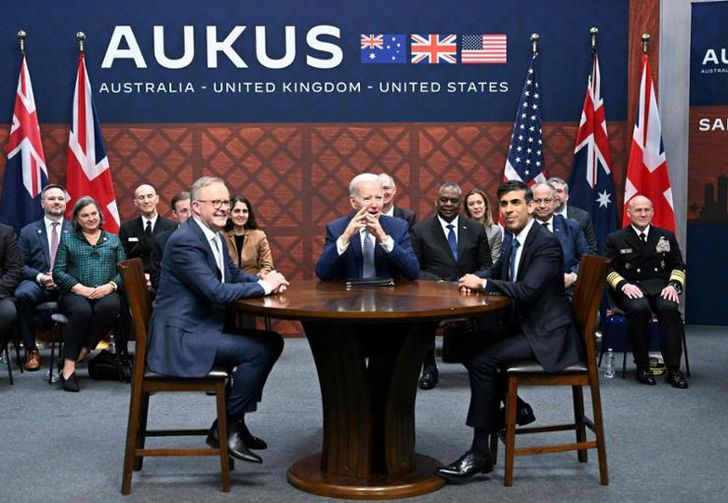
AUKUS, an acronym for Australia, United Kingdom and the United States, is a trilateral military partnership established in 2021. Its primary publicized goal is “to promote a free, open, and secure Indo-Pacific region by enhancing collective deterrence and accelerating the joint development of advanced military technologies.”[1]
Former Malaysia Prime Minister Ismail Sabri Yaakob said he had raised concerns about the project with Australian Prime Minister Scott Morrison (2018-2022), and warned that the nuclear submarine project might heighten military tensions in Asia. He urged all parties to avoid any provocation, as well as an arms race in the region. “At the same time, it will provoke other powers to take more aggressive action in this region, especially in the South China Sea,”[2]
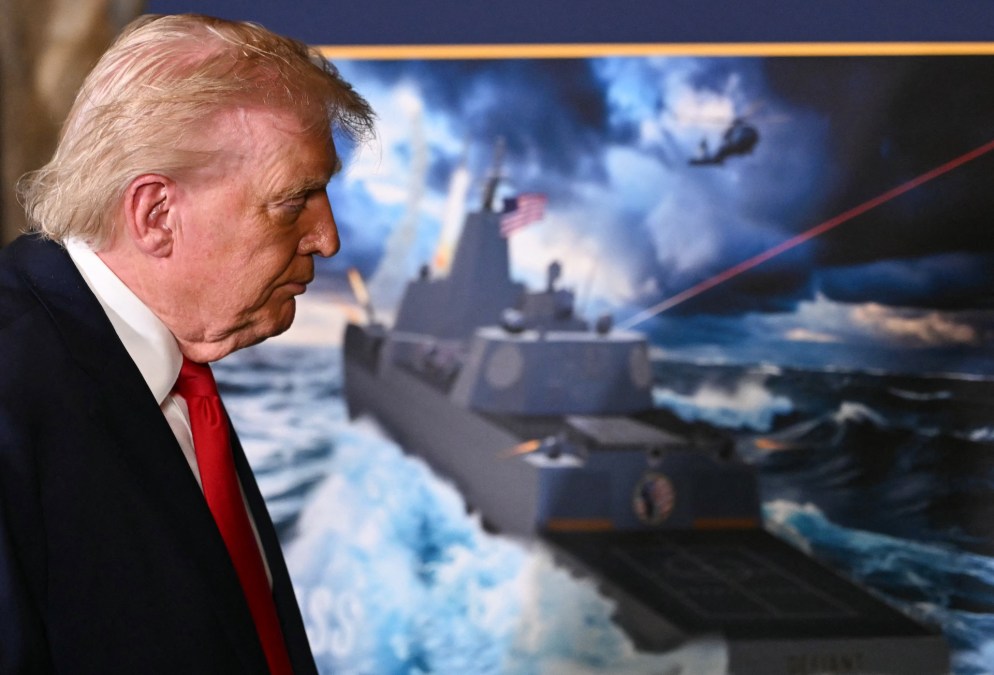
While President Trump officially endorsed the AUKUS nuclear-powered submarine deal, stating that the U.S. is going “full steam ahead” with the trilateral defense agreement, he also announced plans for the so-called Golden Fleet of battleships last December. He said the “Trump-class” ships would be “the fastest, the biggest, and by far 100 times more powerful than any battleship ever built.” The U.S. Navy’s latest shipbuilding roadmap, released last month, lays out plans to acquire 15 Trump-class battleships by 2055. The first, to be named “Defiant,” would be delivered in 2036.[3] Now Australia is concerned that Trump’s ships are going to obstruct the timely manufacture of AUKUS submarines.
AUKUS will bring nuclear-powered submarine capabilities to the South Pacific through a phased “Optimal Pathway” that provides Australia with nuclear-powered submarines (SSNs) and trains the Royal Australian Navy to operate them.
The pact ensures Australia becomes only the second country to receive top-tier U.S. and UK nuclear-propulsion technology.[4]
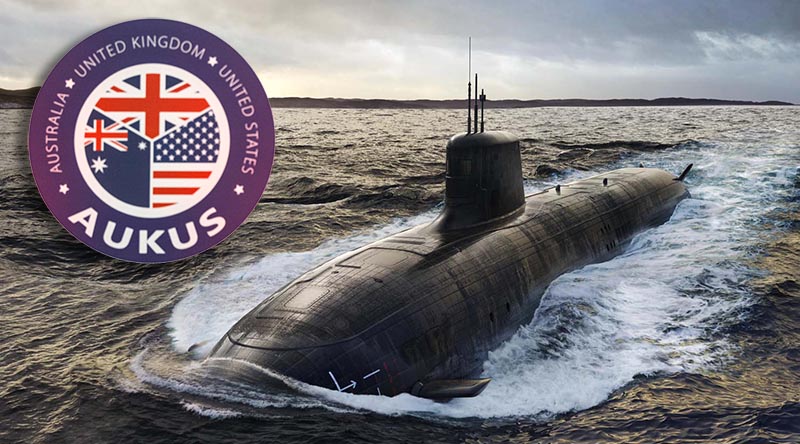
Under the AUKUS defense pact, the United States is sharing its heavily guarded nuclear-powered submarine technology with Australia and the UK. Notably, prior to AUKUS, the U.S. had not shared this sensitive nuclear-propulsion technology with any ally since its landmark 1958 Mutual Defense Agreement with the United Kingdom.[5]
Thousands of Australian personnel are embedding with U.S. and UK naval forces to master nuclear stewardship, while Australia undergoes a massive industrial expansion—including building new shipyards in South Australia.
The Nuclear Nonproliferation Treaty allows non-nuclear-weapon states to produce the highly enriched uranium for naval reactor fuel. Nevertheless, the agreement to transfer U.S. or UK nuclear-submarine technology, including possibly highly enriched uranium, has been described as an act of nuclear proliferation, and has been criticized by scholars and politicians.

James M. Acton, a British academic at the Carnegie Endowment for International Peace, wrote that “the nonproliferation implications of the AUKUS submarine deal are both negative and serious. For Australia to operate nuclear-powered submarines, it will have to become the first non-nuclear-weapon state to exercise a loophole that allows it to remove nuclear material from the inspection system of the International Atomic Energy Agency.…I am concerned that this removal will set a damaging precedent. In the future, would-be proliferators could use naval reactor programs as cover for the development of nuclear weapons.”[6]
Concerns have been raised that, by enabling a country without nuclear weapons to obtain nuclear-powered submarines and the technology for enriching uranium for naval reactors, AUKUS may lead to further arms proliferation if other countries follow Australia’s example.
This is especially since the nuclear-powered submarine technology carries no requirement of regular international inspections, yet has the capacity of producing nuclear weapons.
The AUKUS Plan
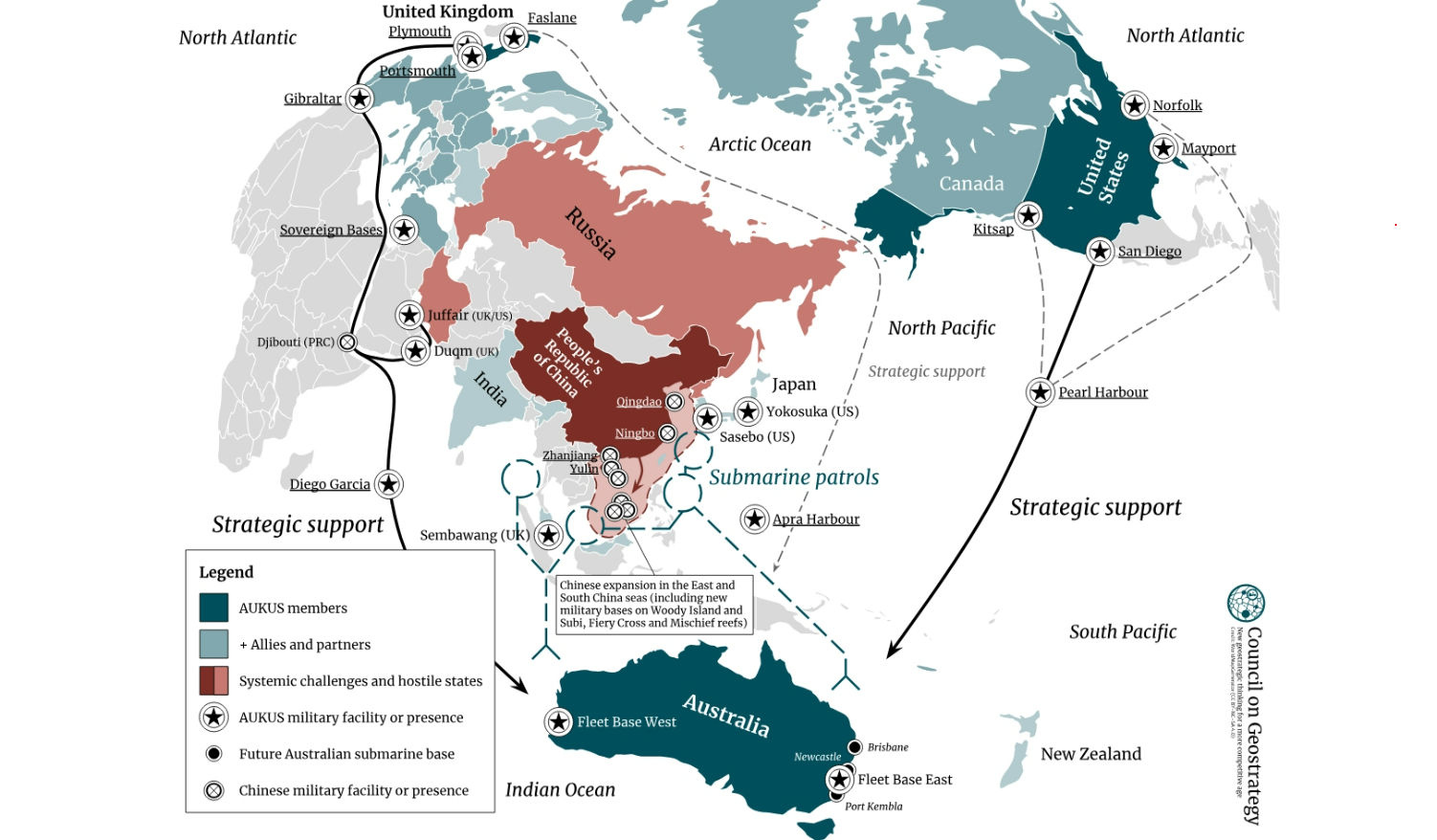
The AUKUS partnership is divided into two main work streams: Pillar 1 entails the rotational deployment of nuclear-powered submarines by the U.S. and UK through the HMAS Stirling naval base in Western Australia starting in 2027.
Also under Pillar 1, Australia will acquire conventionally armed, nuclear-powered submarines to modernize its naval capabilities.
This involves purchasing up to five U.S. Virginia-class submarines in the 2030s, followed by the future delivery of a newly designed AUKUS-class submarine.
All three nations are investing heavily to expand their respective submarine-manufacturing capacities to ensure smooth supply chains and long-term sustainment.[7] Total long-term costs for the submarine enterprise are forecast to range between Aus$71 billion and Aus$96 billion through 2036, with overall projections extending well past US$300 billion by 2055.[8]
Pillar 2 entails collaboration on six technology and capability areas: artificial intelligence, autonomous systems, quantum technologies, cyber capabilities, hypersonic missiles, and electronic warfare and will foster deep integration of military science and industrial bases.[9]
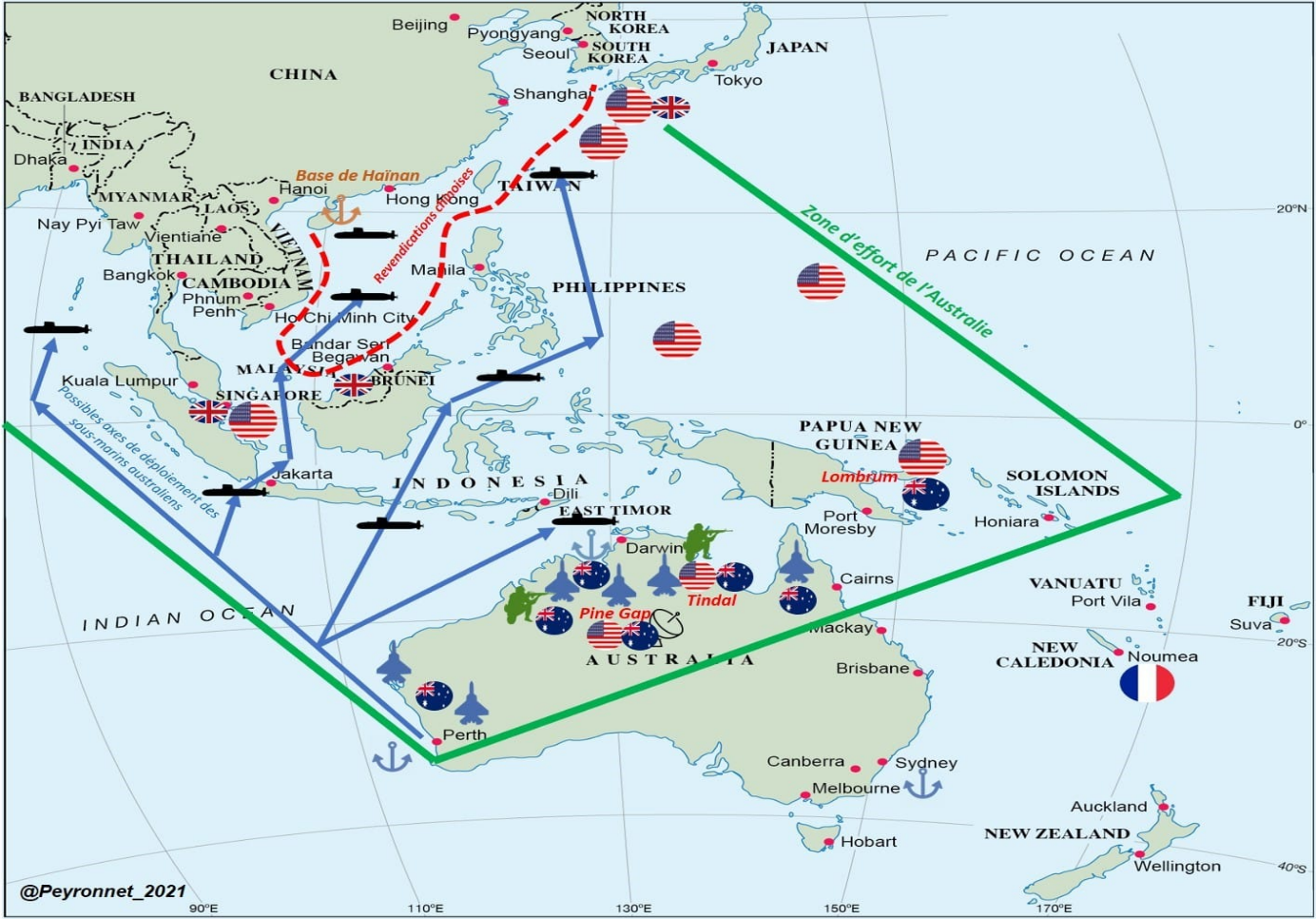
Arnaud Peyronnet, FMES associate member of the Strategic Monitoring Centre for the Mediterranean and the Middle East (OS2MO), stated on September 17, 2021, that Australia had officially moved beyond the status of an ally of the United States to that of a strategic partner, through the creation of the AUKUS security pact.
The AUKUS strategic agreement is the conclusion of a process of transformation of Australia’s strategic vision, which is as of now staked solely on that of the U.S. in order to stem Chinese military activity in the Western Pacific. This new alignment is accompanied by the surrender of any autonomy in the matter of purchasing military equipment, with Canberra from now on relying on U.S. and British military products and services.
The pact also allows the UK to re-establish itself in the Pacific, for the long term and in line with its post-Brexit strategy of a Global Britain. Finally, it confirms Britain’s alignment with the U.S.’s strategy regarding China.
If this alignment means a huge loss of strategic autonomy for both countries, it establishes a new relationship between the power blocs in the Western Pacific, as part of the great-power competition in the ongoing strategic rivalry among major global states—primarily the United States, China and Russia—as they compete for military, economic and technological supremacy.
It makes Australia a powerful back-up of the U.S. throughout Southeast Asia with non-aligned states in the region (Malaysia and Indonesia) which could become the theater for competition between the power blocs. AUKUS establishes the Western Pacific as the new geopolitical center of gravity for the next few decades.[10]
Cause of Both Previous World Wars: Surrender of Independent Foreign Policy
The loss of strategic autonomy—specifically the surrender of independent foreign policy to rigid alliance obligations and military timetables—was a defining cause of World War I. It meant that great powers could not independently de-escalate once an initial crisis began.
The loss of strategic autonomy—the ability to act independently in foreign and military policy without relying on foreign powers—was a central catalyst for World War II as well. It created a volatile dynamic where rising powers sought to forcefully reclaim their sovereignty, while European democracies ultimately lost their independence to stop fascist aggression.
Companies Financially Benefiting from AUKUS
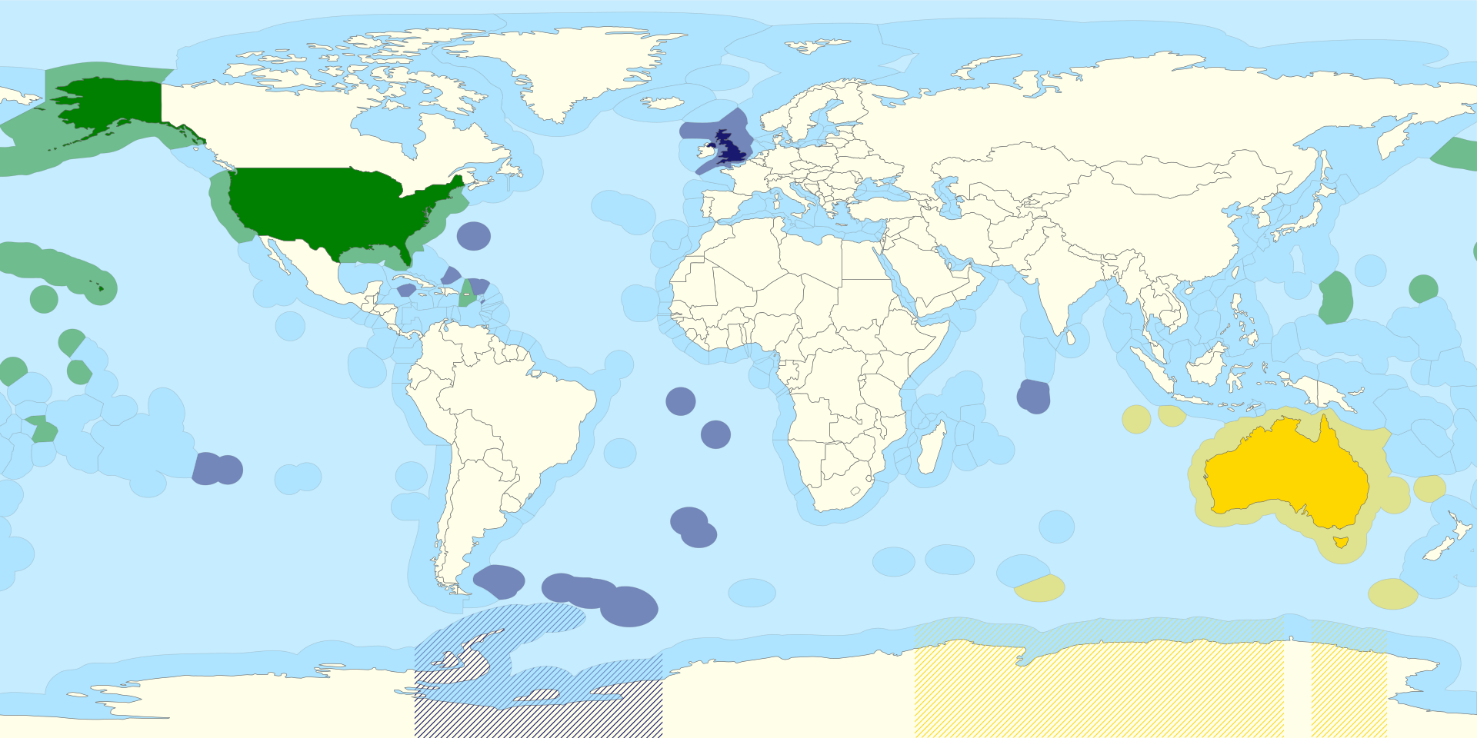
The companies benefiting most from the AUKUS program are major military contractors, nuclear component suppliers, and precision-engineering firms acting as primary builders or authorized suppliers across the U.S., UK and Australia.[11]
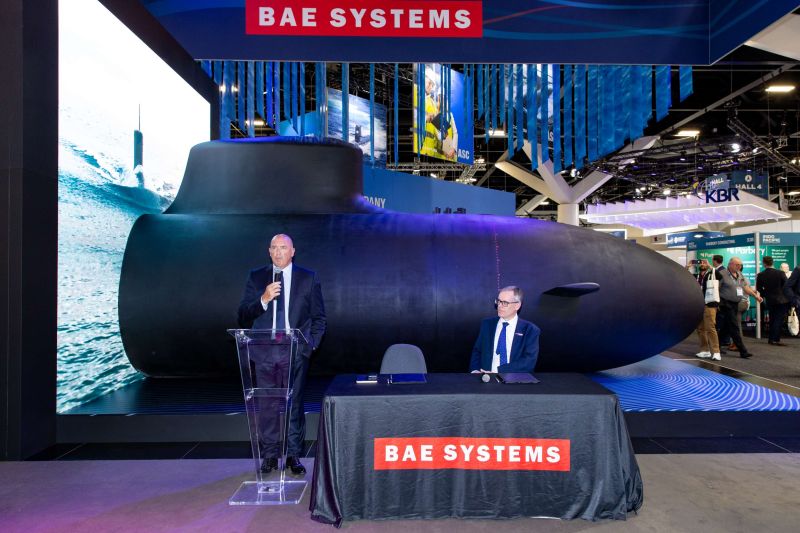
- BAE Systems: The anchor of the trilateral agreement, BAE Systems is co-designing the new SSN[12]-AUKUS submarines in the UK and will lead their construction in Adelaide, Australia, alongside ASC Pty Ltd.[13] According to the BAE Systems website, at the Indo Pacific 2025 International Maritime Exposition, four companies—BAE Systems, Raytheon Australia, General Dynamics Mission Systems, and Thales—proposed to lead the design and lay the foundations for manufacture and integration of combat systems for SSN-AUKUS under agreements to be negotiated with the Commonwealth of Australia and the UK.
- Huntington Ingalls Industries (HII): As one of only two builders of U.S. nuclear submarines, HII is deeply involved through the AUSSQ program, integrating and qualifying Australian suppliers into its nuclear and aircraft carrier supply chains.[14]
- Babcock International: Babcock secured a massive role in the trilateral enterprise, providing critical sustainment services for UK submarines at HMAS Stirling in Western Australia.[15]
- Rolls-Royce: It was awarded generational contracts to design and build the nuclear reactors for the SSN-AUKUS fleet. The company’s Derby facility in the UK is seeing massive expansion to meet this demand.[16]
- Thales: The company was appointed as the primary sonar design authority and integrator for SSN-AUKUS, providing advanced sonar and combat systems.
- General Dynamics Mission Systems and Raytheon Australia: These key contractors are providing and integrating combat control systems across the U.S. and Australian fleets.[17]
- VEEM and MacTaggart Scott Australia: These precision manufacturers qualify for U.S./UK supply chains.
- Hofmann, Levett, and Century Engineering: These three companies are advancing through certification for specialized components.[18]
Australia’s Choice: “Guns over Butter”
A 2025 article in The Guardian stated that AUKUS “is estimated to cost up to $368 billion over 30 years, although the deal could become even more costly should Donald Trump renegotiate terms to meet his ‘America first’ agenda.”[19]
The current deal, struck in 2021, includes the purchase of three American-made nuclear-powered submarines, the construction of five Australian-made ones, as well as sustaining the vessels and associated infrastructure. Such a price tag leaves less money to address societal priorities, such as investing in regional diplomacy and accelerating the renewable energy transition.[20]
Sam Roggeveen, director of the Lowy Institute’s International Security Program, says there are cheaper ways to replicate submarine capabilities, which are ultimately designed to sink ships and destroy other submarines. These include investing in airborne capabilities, more missiles, maritime patrol aircraft and naval mines.[21]
“The uncertainty that Aukus introduces is that we are buying submarines that actually have the capabilities to fire Tomahawk cruise missiles on to an enemy land mass,” says Roggeveen. “That is an offensive capability that’s ultimately destabilizing. We should be focusing on defensive capabilities only.”[22]
Saul Eslake, an independent economist, says higher defense spending is coming at a time of substantially higher demands on the public purse across a range of areas, from aged care, to disability services and childcare. At some point, Australians will need to grapple with how to pay for this extra spending on U.S. military products.[23]
As part of the agreement, Australia has already committed billions of dollars to help build up the manufacturing capacity of the U.S. and UK. The financial cost of the nuclear-powered submarine program is so high that Marcus Hellyer, from Strategic Analysis Australia, has described it as the country’s “fourth service,” sitting alongside the navy, army and air force.
Hellyer says the heavy investment in traditional assets, including submarines, leaves Australia with a limited ability to invest in emerging defense technologies. “We don’t have a lot of flexibility because so much of our investment budget is tied up,” he says. “Unfortunately, it’s tied up in things that won’t be delivered for a decade or more.”[24]



How U.S. “Democracy” Actually Works
Meanwhile in the U.S. Congress, Congressman Bill Huizenga (R-MI) introduced H.R. 9517 on June 29, 2026, “to amend the Arms Export Control Act to modify a limitation relating to export and transfers of defense articles and services under the AUKUS partnership, and for other purposes.” Huizenga has actively championed legislation to streamline defense trade and authorize the sale of Virginia-class submarines to Australia, linking regional manufacturers to massive military scale-ups.[25]

Businesses in Huizenga’s district (Michigan’s 4th Congressional District) will benefit from AUKUS contracts by securing direct access to a rapidly expanding, multibillion-dollar maritime supply chain.
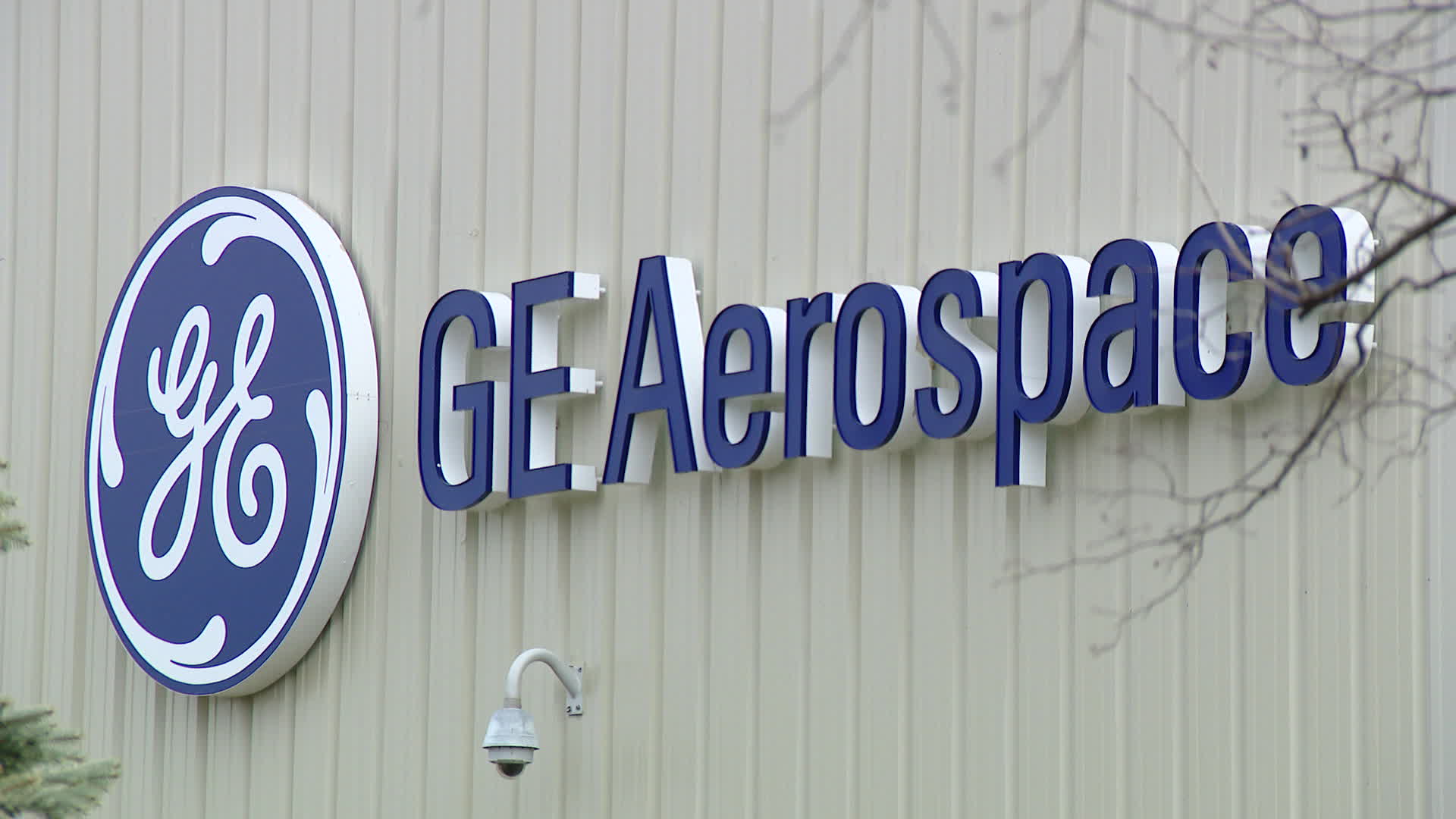
Karman Space & Defense and GE Aerospace are major military and aerospace contractors located in Huizenga’s district.
Karman Space & Defense operates facilities in the region that manufacture critical components for missile systems and defense programs.
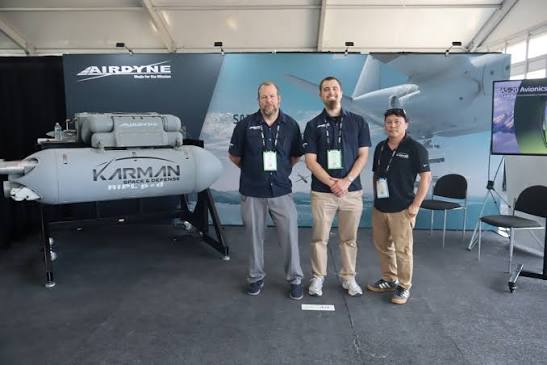
Additionally, GE Aerospace invested $70 million in western Michigan in advanced manufacturing to support national security aerospace production.[26]
The district is also home to key Department of War operational hubs where numerous contracting and technology support firms assist the U.S. military.
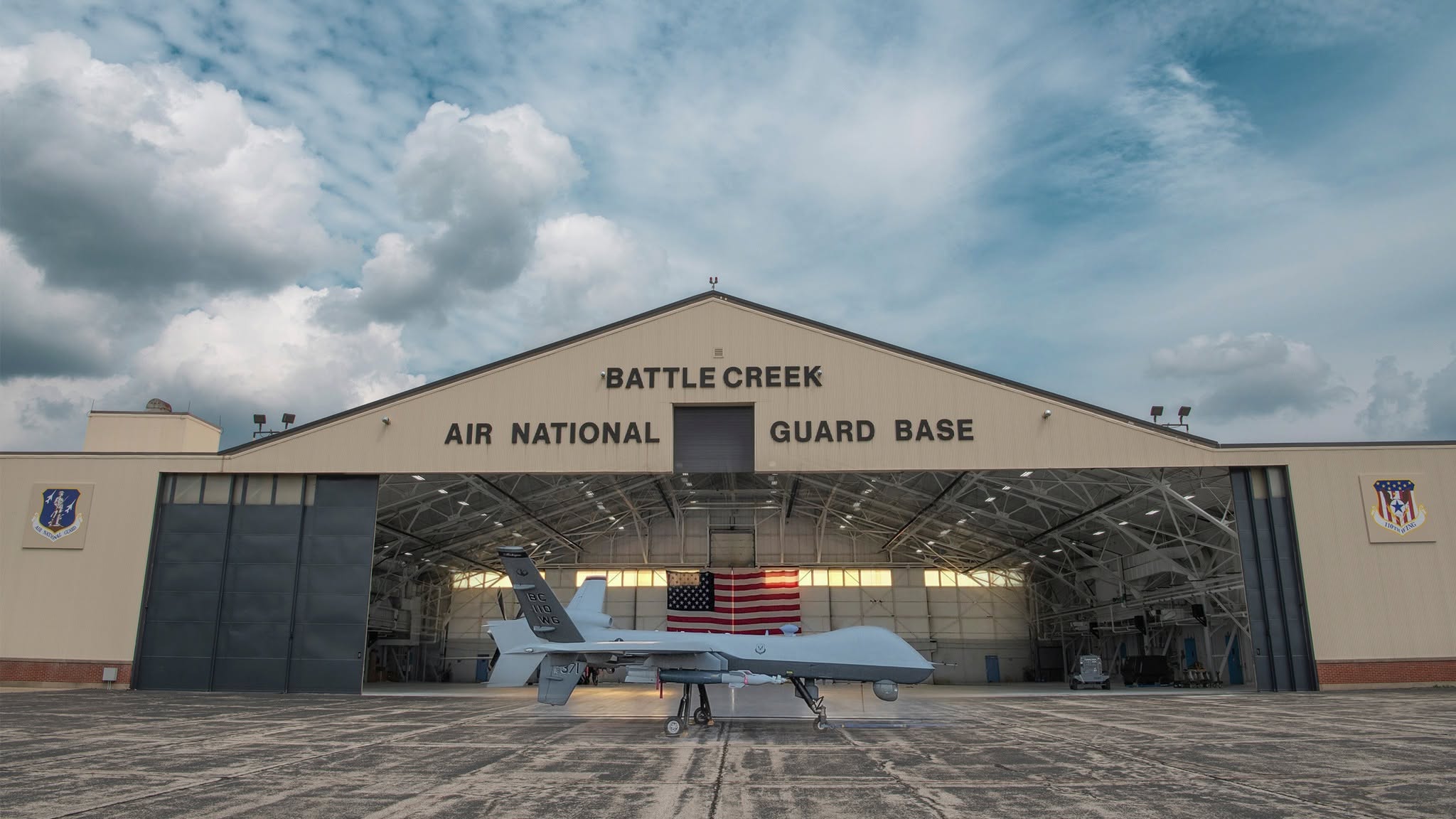
The Battle Creek Air National Guard Base (110th Wing) hosts cybersecurity operations and MQ-9 Reaper drone missions. Major contractors like Leidos and Northrop Grumman operate in and around this Battle Creek hub to support Department of War logistics and aerospace initiatives.
Militarization of Young Americans with “Boot Camp” Vocational Training
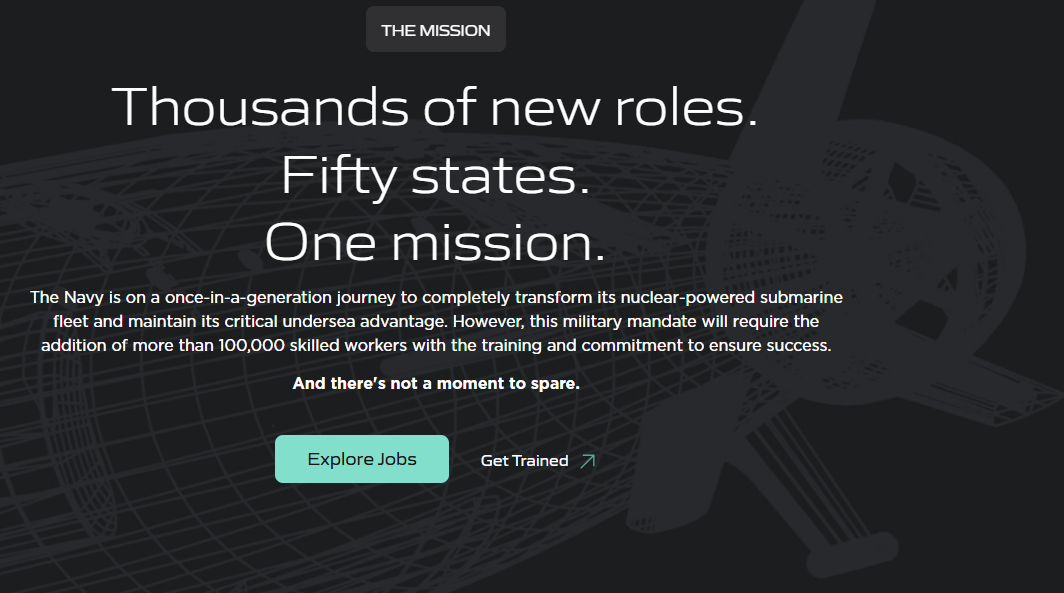
The Department of the Navy now has a website to entice young Americans away from traditional universities (which have become prohibitively expensive and leave young people strapped with massive debt) to opt instead for community college “Boot Camp” vocational training under the Department of the Navy (where anything beyond technical education is eschewed).
Thousands of government-sponsored programs around the U.S. are offering accelerated, short-term “Boot Camp” training in precision machining and other military-related skills at local community colleges around the U.S. Certificates in Computer Numberical Control (CNC) operation, welding, micro soldering, even social media influencers (for $50K/yr.) are being offered to young people, so they can “buy a nice truck” as Rear Admiral Scott Pappano (Program Executive Officer for Strategic Submarines) said during one of his meetings with students at Nashua Community College in 2024[27]—confirming that the way to induce workers to forget they are feeding an industry dedicated to murder and destruction is to offer them a material reward.
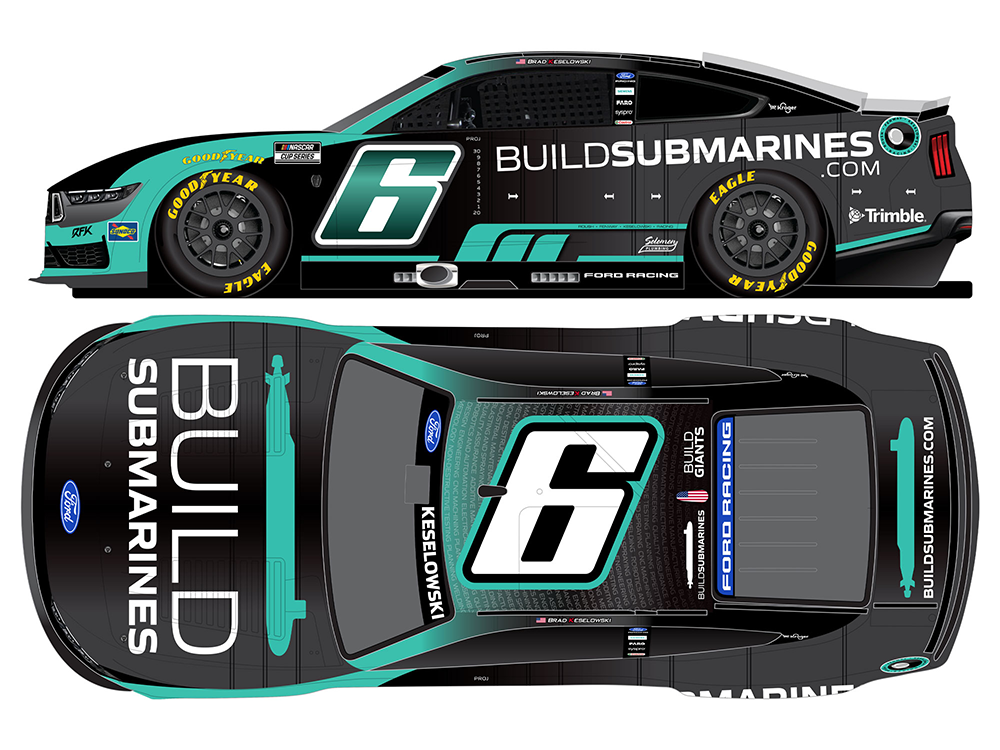
BuildSubmarines.com is a major workforce recruitment hub designed to connect job seekers and students with companies manufacturing the U.S. Navy’s next-generation submarine fleet.
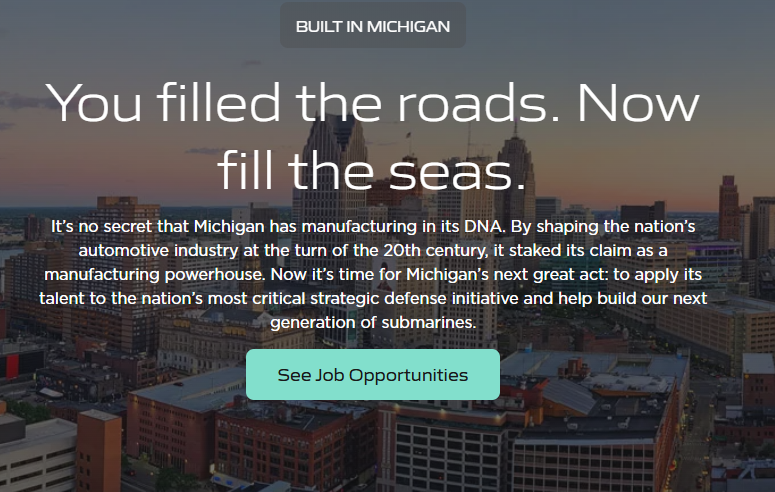
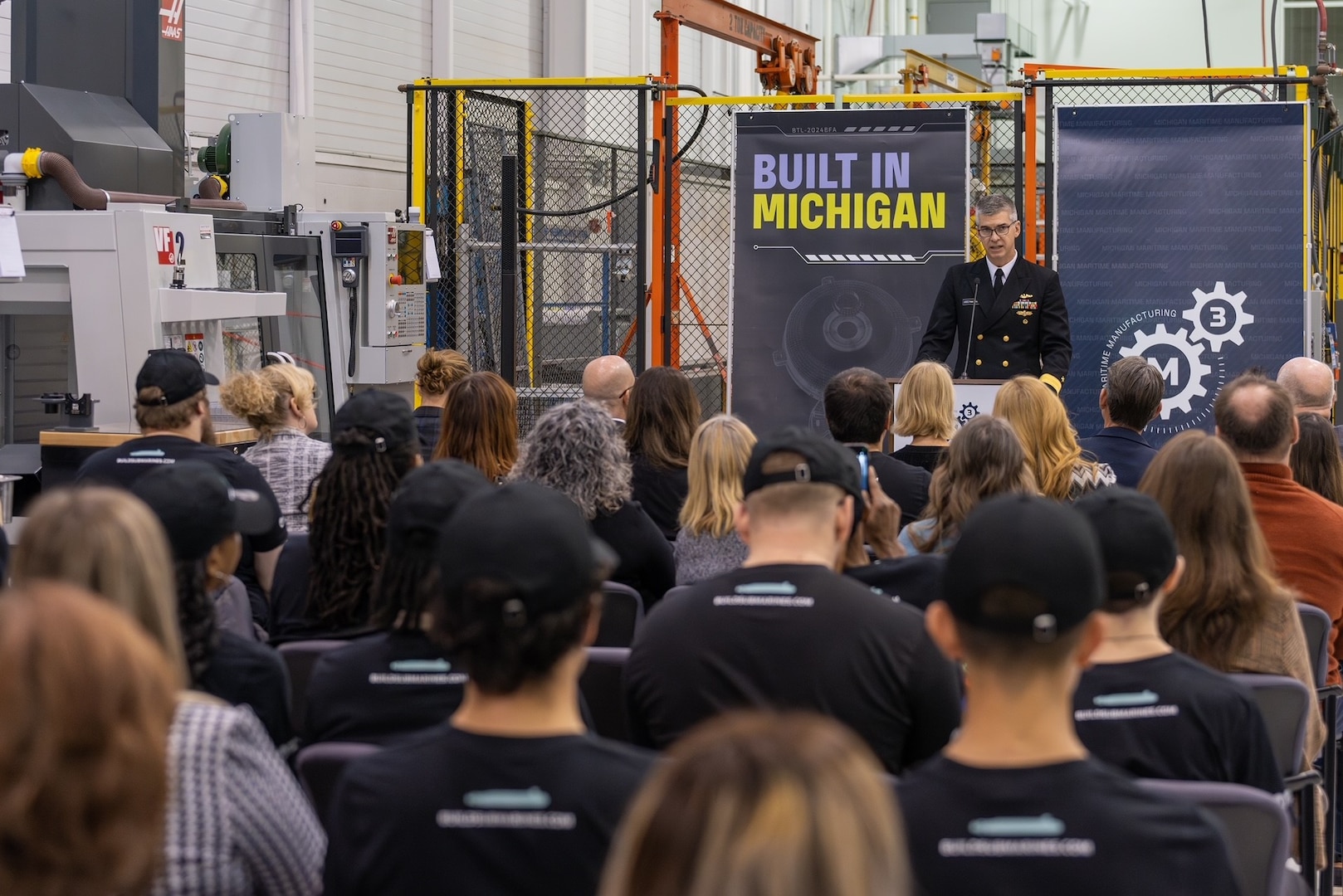
Michigan Maritime Manufacturing (M³) Initiative, backed by a $50+ million federal and state taxpayer-funded investment, is offering accelerated training pipelines for maritime welding and advanced CNC machining that operate directly through hubs like Macomb Community College and partner institutions across the state.
More than 175 defense and supply chain firms in the Greater Detroit area—and hundreds more statewide—are actively expanding their operations to build components for Virginia and Columbia-class submarines.[28]
CNC machines have revolutionized and completely decentralized military contracting, making it possible for a small business to purchase CNC machines, put them in any local warehouse and begin producing Patriot missile wings, propeller shafts, valve systems, radar arrays, specially milled casings to house and protect sensitive radar hardware and signal/surveillance equipment from the elements, and the list is nearly endless of parts and pieces needed by larger military contractors.
While it is not just Michigan military contractors that will benefit, Michigan’s industrial base has over 400 businesses already supplying the U.S. naval submarine fleet. Huizenga’s district, known for its strong manufacturing and metallurgical footprint, supplies components ranging from hard-to-get specialty alloys and metals to custom mechanical parts like pumps and valves.[29]
Under the second pillar of the AUKUS agreement, the U.S. is jointly developing hypersonic missiles, quantum computing, and autonomous systems with allied partners. Michigan’s innovative tech and advanced manufacturing companies are positioned to secure R&D and production contracts for these cutting-edge capabilities.[30]
Congressman Huizenga also introduced and helped advance legislation like H.R. 3068, removing regulatory red tape to facilitate arms exports for military contractors. By waving licensing barriers, local suppliers can trade and collaborate directly with Australia and the UK far more easily.[31]
Benefits for the U.S.
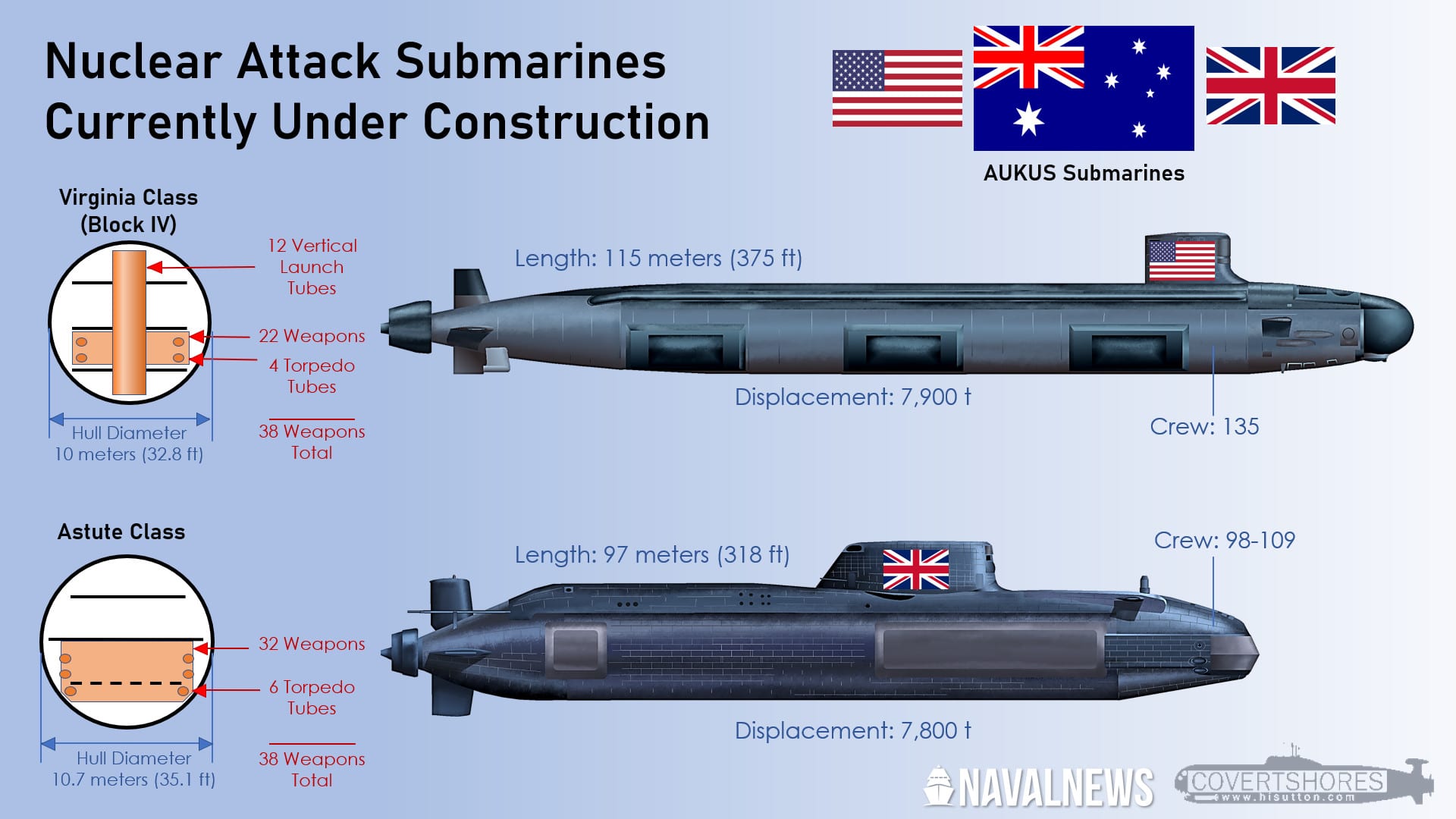
Compared to the diesel-electric submarines Australia was co-developing with France—until the U.S. urged Australia to sign the AUKUS agreement and cancel its contracts in favor of contracts with U.S. military firms—nuclear submarines are quieter, faster, more survivable and have nearly limitless endurance. This will allow the U.S. to deploy Australia’s future submarine fleet to distant Indo-Pacific locations for much longer periods of time, including to geopolitical hotspots like the South China Sea and parts of the Japanese archipelago.
The U.S.’s Virginia-class submarine will provide Australia with a major increase in submarine-based strike power, given that these vessels can carry up to 40 Tomahawk land-attack missiles. This will be a paradigm shift for the Australian military long-range strike capabilities, enabling Australia to independently and collectively thwart Chinese forces across a range of regional scenarios—in response to orders from the U.S.
Operating U.S. submarines out of Australia will significantly shorten their transit times to Western Pacific flashpoints from Guam, Hawaii or the continental U.S. Increasing the tempo of U.S. nuclear-powered submarine operations and maintenance out of Western Australia would allow Australia to develop the technical know-how and skills needed to run a fleet of nuclear-powered submarines, particularly if Australian submariners and engineers are embedded on U.S. submarines, as takes place between U.S. and UK submariners.
Establishing a Southern Hemisphere industrial base to construct and maintain nuclear-powered submarines in Australia will enable the U.S. to undertake greater presence of its nuclear-powered submarine fleet in the Indo-Pacific. This operational advantage will make Australia a valuable hub for the U.S.’s Indo-Pacific maritime and submarine operations and potentially open a gateway for more expansive U.S.-Australian posture arrangements in the region and beyond.
China’s Reaction
While the U.S. government cited rising concerns over China’s military modernization and coercive statecraft as reasons for the AUKUS military agreement, it can be argued that the Trump administration is being accused of the same.
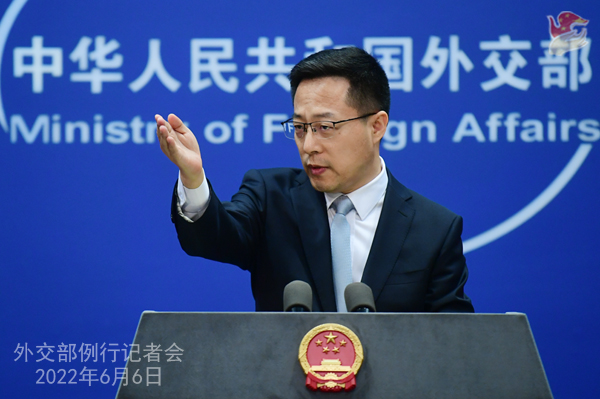
The spokesperson of the People’s Republic of China (PRC) Foreign Affairs Ministry, Zhao Lijian, said: “The nuclear submarine cooperation between the U.S., the UK, and Australia has seriously undermined regional peace and stability, intensified the arms race and undermined international non-proliferation efforts.” Zhao also said: “The three countries should discard the Cold War zero-sum mentality and narrow geopolitical perspective.” Spokesperson Hua Chunying said: “China is firmly opposed to the U.S., the UK and Australia’s malicious exploitation of loopholes in the Nuclear Non-Proliferation Treaty and the International Atomic Energy Agency safeguards mechanism.”
Victor Gao—former interpreter for Deng Xiaoping and Vice President of a Beijing think tank, the Center for China and Globalization—considered the move to be a violation of international law and warned that Australia’s moves toward nuclear-powered submarines would lead to the country “being targeted with nuclear weapons,” in a future nuclear war.[32]

AUKUS Secretly Canceled French Submarine Contract
The French government received official notification from Australia that the Attack-class submarine project was to be canceled only a few hours before it was publicly announced.
Le Monde reported that the original cost of the project in 2016 was €35 billion, of which €8 billion (A$12 billion) was to go to French companies. The project was reportedly going to employ 4,000 people in France over six years at Naval Group and its 200 subcontractors.
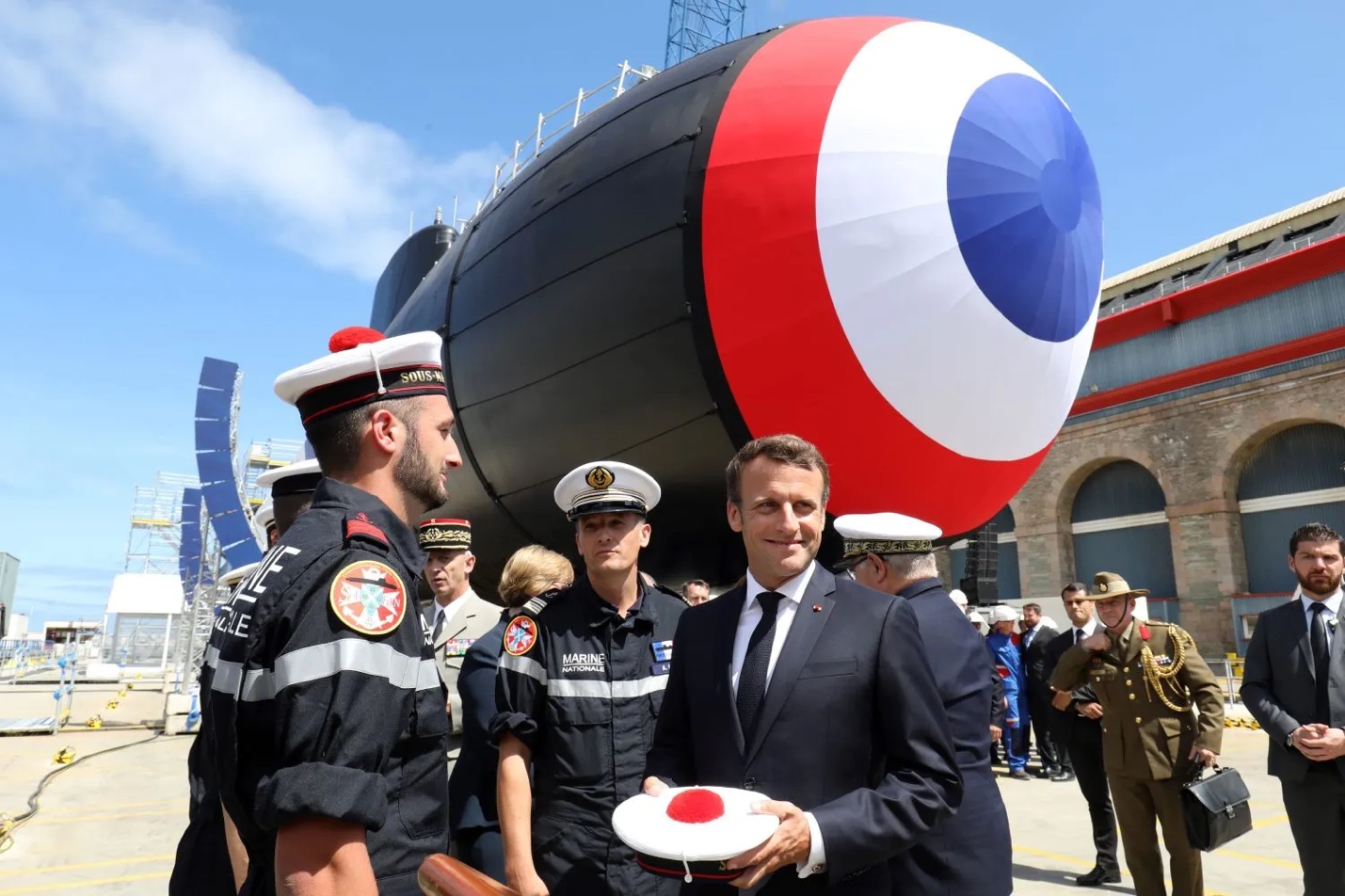
The French government was angered by both the cancelation of the Attackclass submarine project and not being made aware of the negotiations that led to the AUKUS agreement.
Jean-Yves Paul Le Drian, former French Minister of Defense, stated in a radio interview that the contract termination was a “stab in the back.”

On September 17, 2021, France recalled its ambassadors from Australia and the U.S., Jean-Pierre Thébault and Philippe Étienne respectively. Despite tensions in the past, France had never before withdrawn its ambassador to the U.S. After a call between the French and U.S. presidents, the French ambassador returned to the U.S. two weeks later.
Russia’s Reaction
Russia strongly opposes the AUKUS pact, viewing it as an aggressive U.S.-led bloc aimed at expanding Western military dominance in the Asia-Pacific and fueling a regional arms race. Moscow also considers the trilateral security agreement a severe challenge to the global nuclear non-proliferation regime.[33]
Unfortunately, Russia’s view is an entirely reasonable and resonant one, which captures exactly what the AUKUS pact is really all about.

Prime Minister of Australia; President of the United States of America; Prime Minister of the United Kingdom (March 14, 2023). “Joint Leaders Statement on AUKUS.” Prime Minister of Australia (Press release). ↑
https://www.abc.net.au/news/2021-09-19/malaysia-indonesia-criticise-australian-submarine-about-face/100474056 ↑
https://www.abc.net.au/news/2026-06-06/trumps-battleship-plan-poses-new-risk-to-aukus-committee-fears/105765176 ↑
https://www.cfr.org/articles/aukus-explained-how-will-trilateral-pact-shape-indo-pacific-security ↑
https://fsi.stanford.edu/news/defense-aukus ↑
James M. Acton, “Why the AUKUS Submarine Deal Is Bad for Nonproliferation—And What to Do About It,” Carnegie Endowment for International Peace, September 21, 2021. ↑
https://www.bbc.com/news/articles/cgr589k5yleo ↑
https://breakingdefense.com/2026/05/australia-unveils-45-2-billion-defense-budget-with-ramp-up-in-aukus-spending/ ↑
https://www.war.gov/Spotlights/AUKUS/ ↑
https://fmes-france.org/the-aukus-security-pact-aligning-australias-strategy-with-americas-geopolitical-vision/ ↑
Industry leaders unite to deliver combat system capability for SSN-AUKUS, https://www.baesystems.com/en-aus/article/industry-leaders-unite-to-deliver-combat-system-capability-for-ssn-aukus ↑
Submersible Ship Nuclear (or Submarine Ship Nuclear). It is the standard naval classification used by the U.S. Navy and NATO to designate a conventionally armed, nuclear-powered attack submarine. ↑
Ibid. ↑
Ibid.; “$19 Million to Help More Aussie Businesses Join US Submarine Supply Chain,” Huntington Ingalls Industries (HII) Newsroom, October 17, 2025. https://www.hii.com/news/19-million-to-help-more-aussie-businesses-join-us-submarine-supply-chain ↑
https://www.minister.defence.gov.au/media-releases/2026-04-10/supporting-australian-industry-join-uk-submarine-supply-chains ↑
Alice Nason, “The overlooked outcome: AUKUS and the Australia-UK partnership,” July 16, 2024, https://www.ussc.edu.au/the-overlooked-outcome-aukus-and-the-australia-uk-partnership ↑
“Industry leaders unite to deliver combat system capability for SSN-AUKUS,” November 5, 2025, https://www.baesystems.com/en-aus/article/industry-leaders-unite-to-deliver-combat-system-capability-for-ssn-aukus to deliver combat system capability for SSN-AUKUS ↑
“Industry leaders unite to deliver combat system capability for SSN-AUKUS.” ↑
Jonathan Barrett and Patrick Commins, “Aukus will cost Australia $368bn. What if there was a better, cheaper defence strategy?” The Guardian, June 14, 2025, https://www.theguardian.com/world/2025/jun/15/aukus-will-cost-australia-368bn-what-if-there-was-a-better-cheaper-defence-strategy ↑
Idem. ↑
Idem. ↑
Idem. ↑
Idem. ↑
Idem. ↑
https://huizenga.house.gov/news/documentsingle.aspx?DocumentID=402686 ↑
https://huizenga.house.gov/news/documentsingle.aspx?DocumentID=404015&ref=newsletters.qs.com ↑
The author was one of the graduates. ↑
https://www.buildsubmarines.com/michigan ↑
https://www.defensenews.com/naval/2023/03/15/how-the-us-plans-to-expand-its-submarine-industrial-base-for-aukus/ ↑
https://www.congress.gov/crs-product/IF12113 ↑
https://huizenga.house.gov/news/documentsingle.aspx?DocumentID=404071 ↑
https://www.bbc.com/news/world-58582573 ↑
https://www.aljazeera.com/news/2021/10/1/russia-says-aukus-pact-threatens-nuclear-non-proliferation-regime ↑
CovertAction Magazine is made possible by subscriptions, orders and donations from readers like you.
Blow the Whistle on U.S. Imperialism

Click the whistle and donate
When you donate to CovertAction Magazine, you are supporting investigative journalism. Your contributions go directly to supporting the development, production, editing, and dissemination of the Magazine.
CovertAction Magazine does not receive corporate or government sponsorship. Yet, we hold a steadfast commitment to providing compensation for writers, editorial and technical support. Your support helps facilitate this compensation as well as increase the caliber of this work.
Please make a donation by clicking on the donate logo above and enter the amount and your credit or debit card information.
CovertAction Institute, Inc. (CAI) is a 501(c)(3) non-profit organization and your gift is tax-deductible for federal income purposes. CAI’s tax-exempt ID number is 87-2461683.
We sincerely thank you for your support.
Disclaimer: The contents of this article are the sole responsibility of the author(s). CovertAction Institute, Inc. (CAI), including its Board of Directors (BD), Editorial Board (EB), Advisory Board (AB), staff, volunteers and its projects (including CovertAction Magazine) are not responsible for any inaccurate or incorrect statement in this article. This article also does not necessarily represent the views the BD, the EB, the AB, staff, volunteers, or any members of its projects.
Differing viewpoints: CAM publishes articles with differing viewpoints in an effort to nurture vibrant debate and thoughtful critical analysis. Feel free to comment on the articles in the comment section and/or send your letters to the Editors, which we will publish in the Letters column.
Copyrighted Material: This web site may contain copyrighted material the use of which has not always been specifically authorized by the copyright owner. As a not-for-profit charitable organization incorporated in the State of New York, we are making such material available in an effort to advance the understanding of humanity’s problems and hopefully to help find solutions for those problems. We believe this constitutes a ‘fair use’ of any such copyrighted material as provided for in section 107 of the US Copyright Law. You can read more about ‘fair use’ and US Copyright Law at the Legal Information Institute of Cornell Law School.
Republishing: CovertAction Magazine (CAM) grants permission to cross-post CAM articles on not-for-profit community internet sites as long as the source is acknowledged together with a hyperlink to the original CovertAction Magazine article. Also, kindly let us know at info@CovertActionMagazine.com. For publication of CAM articles in print or other forms including commercial internet sites, contact: info@CovertActionMagazine.com.
By using this site, you agree to these terms above.
About the Author

Gabriela Gavrilov’s most recent work is U.S.-Russian Commercial Relations 1763-1933: Origins of Russophobia (Atlantic, 2025). She is also author of the historical novel series Fire on the Steppe 1905-1918 (Kleio, 2020).
Gabriela can be reached at ggavrilov100@yahoo.com.



This is an excellent well written article. Almost everything is factually correct. This writer rarely expresses her opinion. On rare occasions where the writer expresses an opinion, it appears as if the writer has a strong pro China, pro Russia bias and will rarely say anything negative about China or Russia.