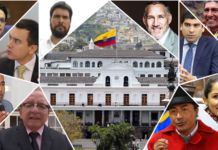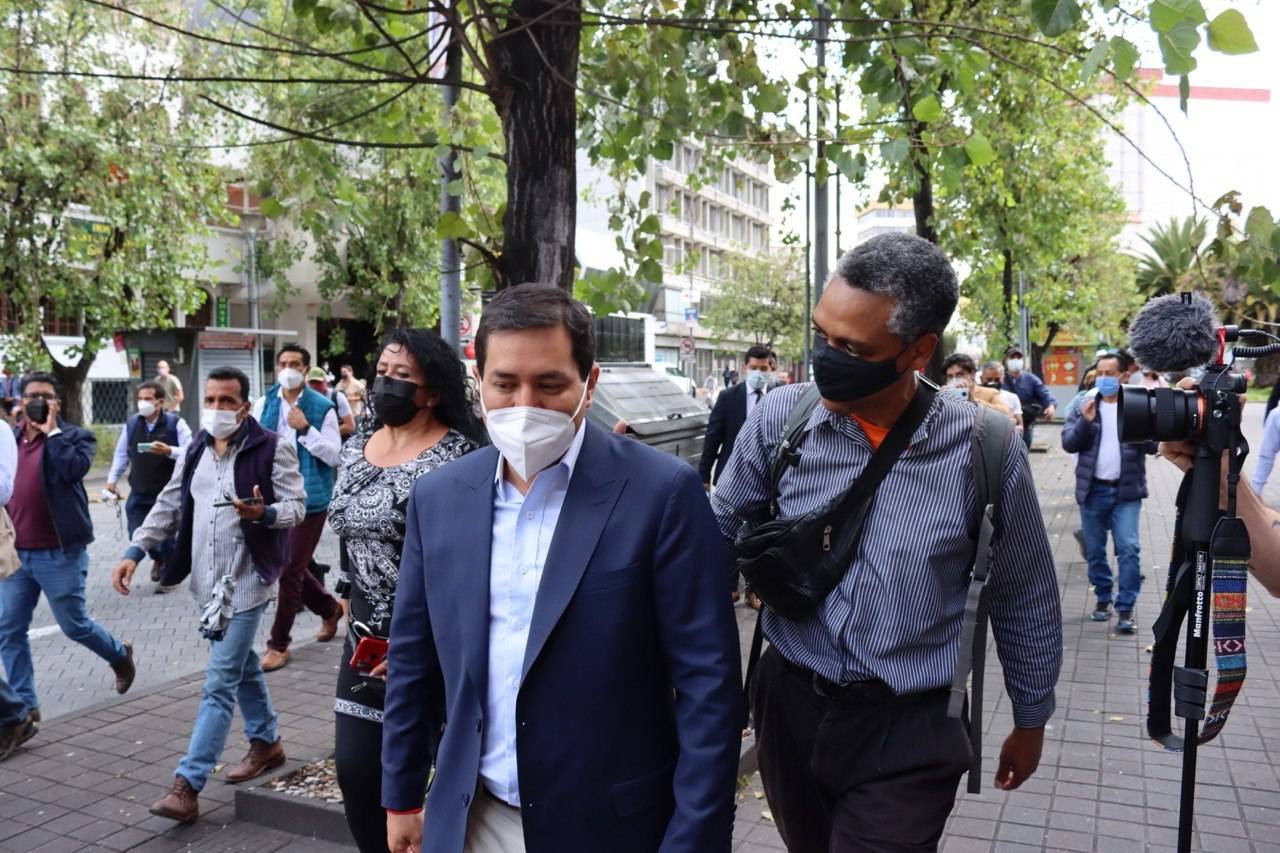
With and sometimes without one raggedy, expired Telesur press pass and a handful of inside contacts, Esteban Carrillo and I repeatedly penetrated Ecuador’s presidential candidate Andrés Arauz’s security detail.
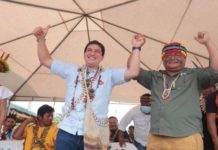
A protégé of former Ecuadorian president Rafael Correa, Arauz won the 2021 first-round vote by more than 13 percentage points over his top rival, right-wing banker Guillermo Lasso. Over the course of five months during the general election campaign, we gave everybody—from Arauz’s personal bodyguards to military soldiers and their checkpoints—the slip, attending press conferences, political rallies, and other events where he and his vice-presidential running mate, Carlos Rabascall, appeared and gave public statements.
We were in good. Too good. In broad daylight we literally bumped shoulders with both candidates at polling station entrances or after they had cast their ballots on first and second round election days. On two separate occasions, without being frisked, i even interviewed Arauz, the country’s leading presidential candidate.
“Arauz’s security detail is weak,” I wondered aloud. “Yeah,” Esteban replied on cue, “it’s almost like they want something to happen to him.”
And that something was not mere hypothesis. Notwithstanding backing from right-wing U.S. lobbyists, another presidential candidate, Yaku Pérez (Pachakutik Party), an “eco-socialist” implant subverting the climate-conscious and Indigenous vote, would eventually make his intentions clear, calling for an Ecuadorian military intervention, as well as requesting a purge of electoral authorities and nullification of the first-round electoral results on February 7th.
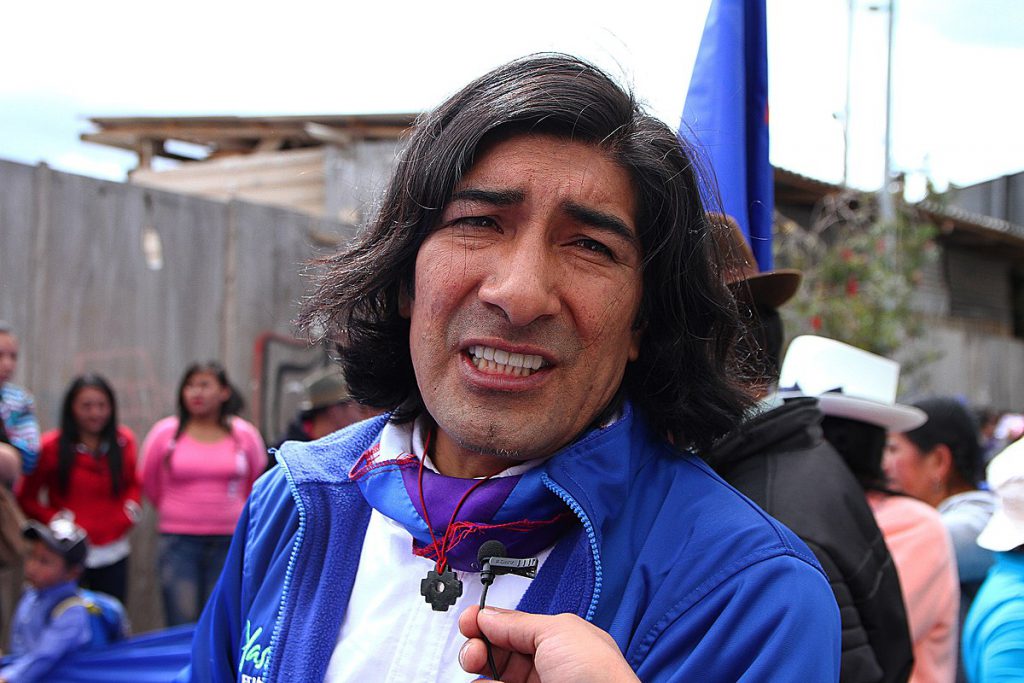
“Soldiers from the Armed Forces should intervene in the polls to give clarity to the elections, thus avoiding a return of Correismo [government policies promoted by Correa],” Pérez posted on Facebook. His support was for an earlier declaration made by Simón Espinosa Cordero, a former Catholic priest turned conservative media columnist and member of Ecuador’s Anti-Corruption Commission.
Michael Fitzpatrick, the then-U.S. ambassador to Ecuador, proved less conspicuous, apart from circulating within Carondelet Presidential Palace with such frequency that people began speculating whether he had a working diplomatic office on the premises.
Instructions of all sorts Fitzpatrick relayed to the then-president of Ecuador, Lenin Moreno, and his top government officials, all designed to debilitate Arauz’s chance at the presidency. At a confidential meeting held on the Galapagos Islands between Ecuadorian and U.S. government officials prior to the second-round run-off election, Fitzpatrick presented Moreno with a classified U.S. intelligence report that gave Arauz a 20-point lead over Lasso.
Also present at the meeting were Ecuador’s vice president, María Alejandra Muñoz, and the Secretary of the Presidency, Jorge Wated Reshuan, as well as senior U.S. military commanders. It concluded with a mutual agreement to oust Ecuador’s Minister of Foreign Affairs, Luis Gallegos, for his opposition to Moreno and Fitzpatrick’s demand to cause a diplomatic row with Argentina, then led by President Alberto Fernández.
In addition, at the request of several U.S. representatives, including then-Senators Marco Rubio and Robert “Bob” Menendez, Moreno was asked to sack Reshuan for failing to implement all measures aimed at linking Correa and Arauz to the National Liberation Army (ELN) in Colombia, thus, in their assessment, allowing Arauz’s victory in the first-round vote.

In no time flat, Quito had gone from traitorous political vibes to a presidential tinderbox campaign. Esteban and I were in the thick of it. That being the case, we took basic security measures to keep doing what we were doing without strangers rolling up on us as we had done to Arauz.
Coverage
While coordinating and deploying diversion tactics, at times scoring interviews with Correa’s then defense attorney, Fausto Jarrín (he now serves as a government adviser to current President Daniel Noboa), assembly-member candidate Jhajaira Urresta, and loads of working-class people on the streets, a rather cartoonish character from the Global North came knocking.
On more than one occasion, Jacobin magazine’s international editor contacted us as Ecuador’s first-round vote neared. Traveling all the way from New York City at the height of the Covid-19 pandemic, perceptible in this report by several individuals masked up in their KN95 and N95 respirators, or my very own makeshift let’s hold up Banco Pichincha mask, this bloke said that he was coming to Quito “2 weeks prior to the election to improve the coverage on the ground.” Riding his high horse, he went on to suggest a media collaboration and sharing of content, taking added privilege to address us as “comrades,” though I had never previously met or interacted with this guy.
“Comrades”?
Here we are, busting our chops on the ground, probably more than we should, taking calculated and un-calculated risks, just for me to turn around and give Jacobin’s international editor the scoop? If he were swooping in like Batman to “improve” the magazine’s coverage, then why contact us?
As far as I knew, he was nowhere on the scene two years back when I reported on the ground about the Indigenous-led protests against austerity measures. As tear gas, rubber and live bullets rained down upon men, women and children, at least 11 people were killed. One of the victims was a Kichwa father, leaving behind a widow and daughter, each of whom I knew personally.
Despite the importance of elections, his and anybody else’s right to travel to Ecuador to provide coverage in this case, I was not obligated to give him the time of day. And, after performing routine checks, asking media industry associates about this person, I concluded that my first impression was 100% spot on. So we, or at least I, moved on.
Lawfare at Play
Our proximity to Arauz stemmed from a handful of contacts Esteban maintained inside his campaign team. One such individual was Orlando Pérez. Back then he was the director of Telesur English and one of, if not the big shot progressive/leftist media personalities in Ecuador. However, wanting to put me on the back foot over some unfortunate, and I mean very unfortunate, office drama of which he was not initially part, someone should interview him about what that was all about, how did it go and end. Nevertheless, Esteban’s tactful communication with Orlando and others provided us with priceless inroads at different campaign events.
During Moreno’s presidency an engraved plaque detailing charges brought against Correa was erected on the exterior of Carondelet presidential palace in the Plaza Grande, the historic center of Quito. Part of a lawfare campaign, it was the ultimate betrayal by the head of state, Correa’s successor no less and former vice president during his second term in office. Judicial cases against Correa were restricted to internal Ecuadorian affairs, however.
Egged on to detain and extradite him from Belgium where he was granted political asylum and lives today, Interpol has refused to act on Ecuador’s request. In this context, Correa remains, theoretically, safe but not sound considering his obvious social media addiction, so much so that he puts U.S. President Donald Trump’s post totals to shame.
Also, meetings held throughout March 2021 between public and private media executives and members of the Communications Secretariat (SECOM) developed a mostly uncontested narrative stoking public fear that, if Arauz, the former Minister of Knowledge and Human Talent during Correa’s administration, became president, he would transform Ecuador into the Andean version of Venezuela or Cuba.
It is Jorge Glas, however, Correa’s vice president (2013-2017), who endures the greatest injustice. Initially imprisoned for five years on unsubstantiated corruption charges, he was eventually released in 2022, expected, by some, to be the 2023 presidential candidate representing the progressive/left-wing/pink-tide Citizens’ Revolution Party.
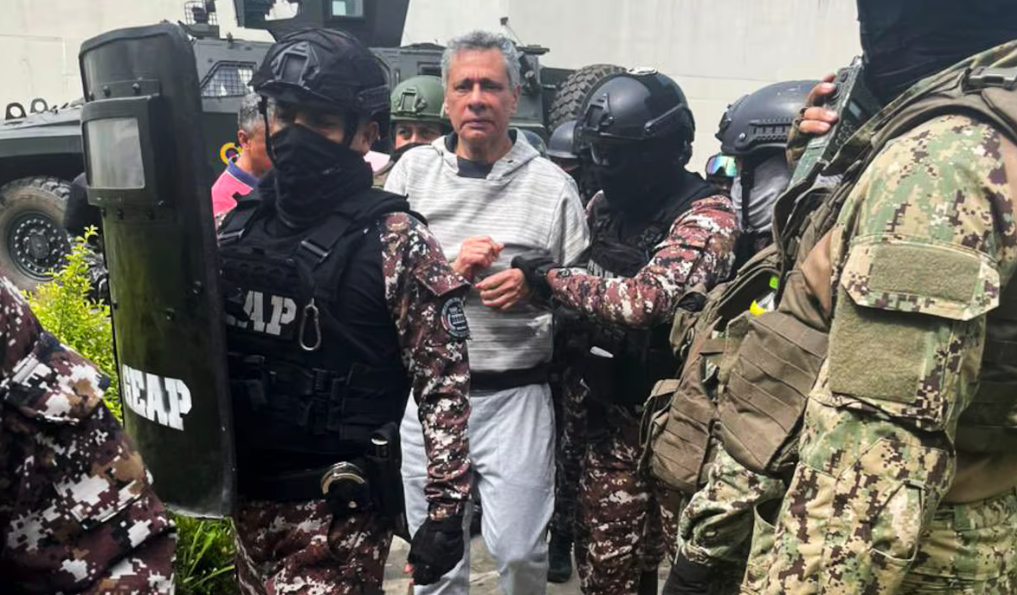
However, with the case resurrected when interim president, Danial Noboa, took office in 2023, Glas sought refuge in the Mexican Embassy in Quito. Days later he was granted political asylum. However, before issuing a salvoconducto (safe passage) to depart the country, Ecuadorian soldiers and police officers, playing double jeopardy, stormed the embassy to detain him again. In the process they would grapple with and point a gun at Roberto Canseco, the Mexican embassy’s deputy chief of mission.
Back on the Election Trail
On the eve of the decisive second-round presidential election vote, Colombia’s attorney general, Francisco Barbosa, flew to Quito to deliver a dossier to his counterpart, Diana Salazar. It contained what Barbosa claimed to be proof of the ELN’s financial support for Arauz’s campaign, adding that the presidential hopeful’s name appeared on the personal computer of (alias) Uriel, commander of the ELN’s Western War Front.
Taking into account inconsistencies regarding communication dates, the allegation meant that Arauz had maintained contact with the rebel leader after he succumbed in combat during a military operation in October 2020. That month, former Colombian President Iván Duque stated at a press conference that the “terrorist” guerrilla leader, Uriel, had been “taken down” in a “meticulous operation of shared intelligence by the national army of Colombia and the national police.”
The contracting of 250,000 bot-operated X (formerly Twitter) accounts also ensured the constant buzz of Arauz and Correa’s links to the guerrillas.
Letter
Per my instruction, Esteban, our social media specialist, ignored Jacobin’s international editor’s request to collaborate. The most obvious hint, however—no response to his query—flew over his head. What I could not fault was his persistence. With more messages arriving in our inbox, Esteban’s edginess started to spill over.
Appealing to good manners, he told me that we should answer. Unmannerly and terse, and in no uncertain terms, I let him know that I could care less about this guy or Jacobin. This was necessary to gauge whether my colleague was shilling up, dreamy-eyed as to how we, or he, might benefit by just meeting this guy.
The incident came around the same time we attended an Arauz rally where we bumped into Ben Norton, a co-founder and former editor/writer at The Grayzone, and founder and editor-in-chief of the Geopolitical Economy Report. Honestly, Esteban had to explain who he was, as I had no idea. A few nights later we all went out for piping-hot canelazos on the rooftop of the Secret Garden hostel in Quito’s San Blas neighborhood.
While Esteban and I put two or three in our tanks, I cannot recall if Ben accepted or declined, preferring a carbonated or natural fruit drink. In either case, he was cordial and understanding of Ecuador’s dire political straits. That night at Secret Garden deserves its own treatment, but I digress.
Finally, taking to better manners and to ice this irritating issue brewing between Jacobin’s international editor and us, I referred the issue back to the editor. More trap than test, I wrote a response and clicked the send button in his X direct messenger:
Greetings Denis Rogatyuk (Jacobin writer),
I hope this message finds you and yours well. Also, I’m pleased to inform you that our group discussion concerning the collaboration opportunity concluded with the following:
There are a number of ongoing issues that concern us about how local, community media outlets have been displaced by larger-sized media corporations. A similar framework applies to medium and small-sized alternatives, non-profits yet well-funded and headquartered in the global north.
Our concerns, which pre-date the COVID-19 global pandemic, have only mushroomed during this public health, social, and economic crisis. Lockdown and quarantine measures the world over have proven, without a shadow of a doubt, that small, locally-based media outlets will have no option other than to revive, taking on an even more critical role for the sake of informing our neighbors, family and friends in close proximity and the world beyond. This is the genesis, the driving force behind our work at Ecuador on Q. Our mandate doesn’t include having to relocate any of our reporters or media makers for any length of time to New York City, Moscow, Johannesburg, Tokyo, Berlin, Rio de Janeiro or anywhere else outside Ecuador to “improve” coverage. Our colleagues and collaborators lived through and performed on-the-ground reporting during the 2019 nationwide protests in Ecuador and long before. We live in Ecuador and our reporting reflects that.
Our position, however, doesn’t imply reticence to any and all ideas of collaborations. Far from it. We welcome the opportunity and challenge for both parties. While media outlets from across the political spectrum and in different parts of the world will suddenly tune their attention to events in Ecuador, about two weeks prior to the presidential election, our mandate extends beyond this framework. Therefore, in order to help balance this equation we pose the following:
Ecuador on Q is not in competition with The Jacobins or El Ciudadano. Our scope of reporting is limited to our locale—Ecuador. That said, we welcome collaboration requests consistent with our editorial line. However, disparities remain in terms of media resources and access to those resources, structuring, visibility, and so forth. Our most valued asset is human resources, the ability to listen to our community and utilize our media skills to provide them with a platform to voice their opinions. Also, as media production is not rocket-science and taking into account our own shortcomings, we also plan to develop workshops to help inculcate our community members with media fundamentals and tricks of the trade so they can develop their own critical coverage.
So, in order for us and our community to benefit from any collaboration involving larger, better-resourced media outlets requires a subscription to one of our media kit package deals. This would afford us some of the resources to provide honorariums for: the development of our website; working writers and staff members; research; on-the-ground and investigative reporting; travel; food; and other essentials of the trade. At the same time, our package will help your media outlet economize production costs by using local experts based in Ecuador. Contracting our on-the-ground colleagues—interpreters, translators, videographers, sound engineers, local guides, etc—means economizing on your travel and hospitality expenses as an entire team from abroad will not have to come to Ecuador.
This, to the best of our understanding, presents a win-win situation for all parties involved. Still, we remain open to alternative ideas and suggestions that include a framework based on parity. Feel free to send us your plan and we’ll analyse it with care. We hope you share our concerns in regard to equitable media collaborations and look forward to your thoughts.
In the meantime, please send us your email address and we will send you our available media kit packages. Thank you so much for your understanding.
Kindly
EonQ
Five years later and no response yet.
Circling the wagon on this affair didn’t signal an end to sporadic run-ins with big shot, Big Apple- based media houses. What took me aback, despite setting aside butter up attempts similar to Rogatyuk, was the very space and environment in which this outlet unexpectedly popped up, smack in the middle of Arauz’s second-round presidential election campaign closing event.
Expected during Arauz’s visit to the Big Apple while on the campaign trail was his appearance on Democracy Now. This “audience-funded journalism” bonanza is also supported by private foundations, including over the years by the Park Foundation, Ford Foundation, Lannan Foundation, and J.M. Kaplan Fund, contributions made to equip their state-of-the-art studios and over $37 million (USD) in net assets.
Either there’s a new lightness and levity to the whole “independent…news” sector or, somewhere down the line, the dice got overloaded against the very term itself. On the opposite end of the spectrum, our work operated on the basis of an idea and unconventional reporting techniques. Mint Press published one of our articles. Esteban and I also applied for a Pulitzer Center Grant, which was rejected. Nevertheless, with the same amount or even more goodwill, we carried our mission through until Arauz, willy-nilly, conceded victory to Lasso. Such distinctions, and there are many others doing this work to choose from, might be of latter day interest to independent journalists putting in work on shoestring budgets and net assets.
Swamped by foreign foundation money, Christian missionaries, and NGOs from its eastern Amazon region through the Andean heights to its lowland Pacific coast, the compendium of locaized uplift projects and improvement programs contrast tremendously to the dire straits the country finds itself in as a whole. “I work for an NGOO” one young lady at an Arauz rally tells me, “but a good one.” Years later, in this case an American NGO founder not far removed from college graduation in the US, speaks about how (Noboa’s) militarization of Pacific coast regions was necessary to help bring “stability” before going on to condemn Correa and his policies. Again, located two presidencies (Lenin Moreno and Guillermo Lasso) before Noboa even took office, Correa is the uncontested poster-child for all things wrong in Ecuador.
While in New York City, not only was Arauz interviewed by Amy Goodman, the first presidential candidate that I know of to do so, but he also took time to thank voters in the US for their support. The presidential candidate also convened with foreign investors to assure that their financial interests would remain safe and secure if he, a Correa-protégé, were elected.
Around this time Esteban and I had arranged a meeting with the head of Arauz’s presidential campaign communication department. The idea at hand was to discuss ways of leveraging and incorporating our on-the-ground, English-language reports to help bolster their messaging. Arriving a few minutes before talks were to start, we’d wait in their headquarters lounge for well over two-hours before my patience ended. I upped and left. Esteban remained for another hour or two before the meeting even began. Later that night he called to told me that although he spoke with the media coordinator, he had no time for our suggestions went nowhere.
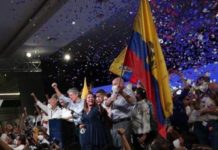
Back at Arauz’s closing rally, a kaleidoscope of clips from the campaign were payed on a large screen for the crowd of supporters. Exhausted, Don Medardo Y Sus Players performance of Solo Tú and other popular songs at the event provided me with a much needed diversion. As acknowledgement for what we’d done with virtually nothing, not even a snippet of our Ecuador- on-Q (EonQ) reporting was displayed. Instead, the sole clip showcasing Arauz’s English-speaking skills—as if that mattered apart from calming the nerves of US investors—was an outtake of the Citizen’s Revolution presidential candidate smiling from ear to ear as he chatted with Amy Goodman in her New York studios. The crowd, thousands in attendance, erupted in applause.
Conclusion
Despite winning the first-round election but failing to obtain at least 50% of the votes, Arauz went on to lose the decisive second-round runoff. The final results transpired in no small measure to the consorted transnational media campaign aimed at securing Lasso’s win. The left decried electoral rigging. The Citizens’ Revolution Party and Arauz himself conceded with minimal dispute. I brought my reporting on the country’s politics to a close. Little has changed during this five-year hiatus. Luisa González, another Correa protégé, represented the Citizens’ Revolution Party during the 2023 and 2025 presidential elections. On both occasions she lost to the current president, Daniel Noboa.
Ecuador remains on the same, if not worse, political trajectory and media brainwash job. Accusations mount of CIA boat strikes off the Ecuadorian and Galapagos coast, the main opposition political party, Revolución Ciudadana (Citizen’s Revolution), and two others were suspended by the National Electoral Council, and at least 22 Marshall Law decrees have been enacted. Bearing no positive results to date, last year, Noboa enlisted Erik Prince and what some call his private mercenary army, Blackwater, in a “war” on crime that seemingly knows no end.
In 2025, with a homicide rate of 51 per 100,000 residents, Ecuador has gone from one of the safest countries in South America to being its most dangerous in less than a decade.
“We are at war and we are fighting against people who are heavily armed, organised, with domestic and international financial backing and a structure of terror and criminality that reaches far beyond Ecuador’s borders,” Noboa said at the time. This was before reports of cocaine shipments in banana shipment containers operated by Noboa Trading, part of his family’s Noboa Corporation.
In terms of governance, all problems and mishaps, even bad weather some might argue, continue to be attributed to Correa. With no reckoning extending beyond the confines and limitations of the traditional progressive, left-wing political leadership class, their outlook and notions remain rooted in a return to the days of “Mashi” (Correa’s nickname in Kichwa means “Friend”). Their biggest accomplishment, if it can be called that, since he left office is transforming the former
head of state into something of a social media pink tide star.
Giving the benefit of the doubt, maybe they have offered their very best. They have shown up and they have given it a go. However, as time goes by, whatever collective energy and unified force does emerge to put an end to not only the present-day conundrum of right-wing, neo-liberal subservient government(s) but earnestly embark on a path of comprehensively dealing with an ongoing, 500+-year project of colonialism across the board, won’t be them. A lasting dilemma for Ecuador, as well as Peru and Bolivia, if I have learned nothing else, this is the lesson I take with me after having lived in Quito for more than seven years. And may that energy and force come sooner rather than later.

CovertAction Magazine is made possible by subscriptions, orders and donations from readers like you.
Blow the Whistle on U.S. Imperialism

Click the whistle and donate
When you donate to CovertAction Magazine, you are supporting investigative journalism. Your contributions go directly to supporting the development, production, editing, and dissemination of the Magazine.
CovertAction Magazine does not receive corporate or government sponsorship. Yet, we hold a steadfast commitment to providing compensation for writers, editorial and technical support. Your support helps facilitate this compensation as well as increase the caliber of this work.
Please make a donation by clicking on the donate logo above and enter the amount and your credit or debit card information.
CovertAction Institute, Inc. (CAI) is a 501(c)(3) non-profit organization and your gift is tax-deductible for federal income purposes. CAI’s tax-exempt ID number is 87-2461683.
We sincerely thank you for your support.
Disclaimer: The contents of this article are the sole responsibility of the author(s). CovertAction Institute, Inc. (CAI), including its Board of Directors (BD), Editorial Board (EB), Advisory Board (AB), staff, volunteers and its projects (including CovertAction Magazine) are not responsible for any inaccurate or incorrect statement in this article. This article also does not necessarily represent the views the BD, the EB, the AB, staff, volunteers, or any members of its projects.
Differing viewpoints: CAM publishes articles with differing viewpoints in an effort to nurture vibrant debate and thoughtful critical analysis. Feel free to comment on the articles in the comment section and/or send your letters to the Editors, which we will publish in the Letters column.
Copyrighted Material: This web site may contain copyrighted material the use of which has not always been specifically authorized by the copyright owner. As a not-for-profit charitable organization incorporated in the State of New York, we are making such material available in an effort to advance the understanding of humanity’s problems and hopefully to help find solutions for those problems. We believe this constitutes a ‘fair use’ of any such copyrighted material as provided for in section 107 of the US Copyright Law. You can read more about ‘fair use’ and US Copyright Law at the Legal Information Institute of Cornell Law School.
Republishing: CovertAction Magazine (CAM) grants permission to cross-post CAM articles on not-for-profit community internet sites as long as the source is acknowledged together with a hyperlink to the original CovertAction Magazine article. Also, kindly let us know at info@CovertActionMagazine.com. For publication of CAM articles in print or other forms including commercial internet sites, contact: info@CovertActionMagazine.com.
By using this site, you agree to these terms above.
About the Author
A former editor-at-large for African Stream and ex-staff writer at Telesur, Julian Cola is publishing a memoir of intimate, community-inspired stories titled “Proibidão (Big Prohibited): Off-Grid Correspondence From Brazil & Ecuador.”
The pre-launch is in December 2025. It includes media beefs and, having taught in the teaching-English-industrial-complex, the book discusses linguistic soft-power in the region and creative ways of dealing with it as mentioned in the essay, Listening To 2Pac In The Andes (Kawsachun News).
For more information contact: traducoessemfronteiras@protonmail.com