Tag: Bolivia

On October 19, Bolivia will have a new president—and he will be from the right. It is confirmed that the country is about to make a sharp ideological turn since the Movement for Socialism (MAS) came to power in January 2006.
Broadly speaking, Bolivia has...

President Luis Arce came to power in late 2020 with a leftist discourse and as the chosen successor to Evo Morales.
Five years later, he ends his term without the possibility of running for re-election (he stepped down after polling at just 1%) and with hundreds of political prisoners—all of...

Venezuela has itself experienced multiple U.S.-backed coup attempts
On June 27, 2024, the Venezuelan government condemned the failed military coup attempt that sought to unseat Bolivia’s left-wing government.
Venezuela’s government has itself survived repeated coup attempts backed by the United States since the country’s Bolivarian Revolution in the late 1990s.
The...

On August 6 we celebrated 197 years of independence here in Bolivia. We listened intently to the speech by President Luis Arce delivered in Sucre, the capital city in Bolivia’s Chiquisaca department. Among other issues, he spoke about the current military conflict in Ukraine and the need for peace...

In interview with British journalist, Morales says the U.S. uses NATO to provoke wars and sell weapons. U.S./UK-backed coup against him in 2019 was undertaken for lithium and because his government advanced an alternative economic model to the neoliberal “Washington Consensus”
In an interview with British journalist Matt Kennard at...

After Rodriguez ordered Che be shot, his hands were chopped off and shipped to Langley, but not before he stole the Rolex from Che’s corpse that was meant for the son of one of his compatriots in Bolivia
On September 16, 2021, Florida Governor Ron DeSantis awarded the Governor’s Medal...

Plan follows precedent of 1970s state-sponsored assassination campaign targeting leftists.
Operation Condor was a U.S.-directed secret intelligence program in the 1970s and early ’80s in six South American U.S.-backed dictatorships—Chile, Argentina, Brazil, Bolivia, Uruguay and Paraguay—that resulted in the torture and “disappearance” of thousands of people.
The victims included dissidents and...

As a warning to potential coup planners in other Latin American countries, the new government of President Luis Arce—elected in a landslide in October—will not adopt a “forgive and forget” attitude toward former dictator Jeanine Áñez and her key cabinet ministers.
On the contrary: Barely ten days after the election...

The stakes are both high, and the danger of violence or voter fraud stark, as Bolivians go to the polls this Sunday, October 18, to elect their next president.
Bolivia has experienced pronounced social unrest and economic retrogression since the November 2019 coup d’état which brought down Socialist President Evo...
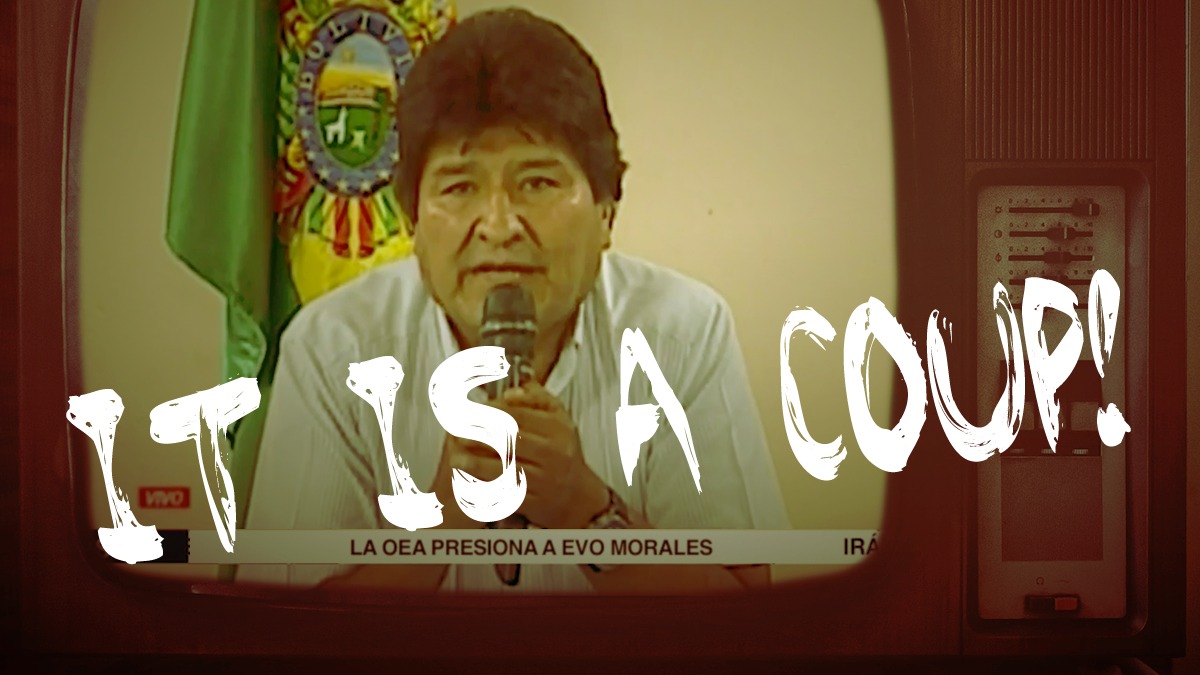
We, allied anti-imperialist organizations and individuals across the world, condemn the rightwing coup against indigenous president Evo Morales that forced him and other members of the Bolivian government to resign. This coup is being undertaken to inflict the worst kind of violence upon class-conscious, indigenous revolutionaries who, under...

 Radhika Desai is a Professor of Political Studies at the University of Manitoba, Winnepeg, Canada, Director of its Geopolitical Economy Research Group, and Convenor of the International Manifesto Group. Ms. Desai is an author of multiple books, including Geopolitical Economy(2013) and her most recent Capitalism, Coronavirus and War(2022). Ms. Desai hosts a fortnightly show, Geopolitical Economy Hour on the Geopolitical Economy Report website.
 Yan Pan is a Chinese PhD researcher at LUT University, Finland. Her work examines the political economy of China’s technological and industrial development, with a particular focus on the industrialization and governance of neurotechnology in China. Her research concerns industrial policy models for future industries in Chinese and Global South contexts. Prior to her PhD, she researched educational reforms and structural change in labor demand in China.
 Ken Hammond is professor emeritus of East Asian and Global History at New Mexico State University. He has lived and worked in China from time to time since 1982. A lifelong political activist, he is a member of the Party for Socialism and Liberation.