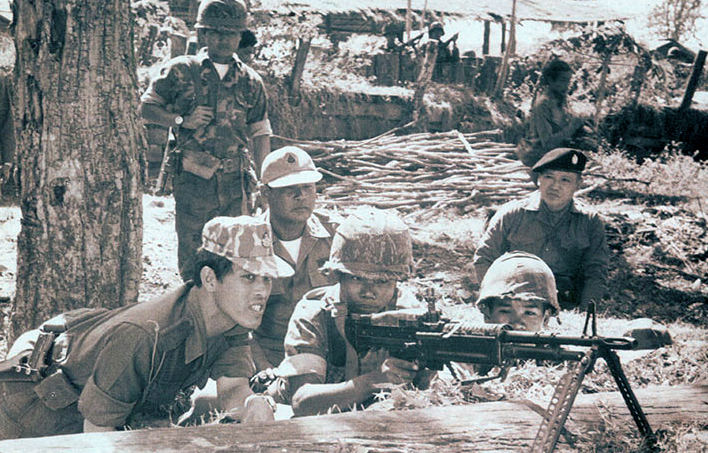
The Thai Border Patrol Police was created by the CIA
[This article continues CAM’s investigation into the nefarious activities of the CIA during the Cold War.—Editors]
In an April 28 interview with The Washington Post, Thai Foreign Minister Sihasak Phuangketkeow expressed his opposition to the war in Iran and noted Thailand’s strengthening ties with Russia and China, a departure from the past 75 years when Thailand existed firmly within the U.S. political orbit. [1]
While the conventional view is that Thailand benefited significantly from alliance with the U.S., often overlooked is the strong-armed methods adopted by the U.S. and hidden coercive role of the CIA, which contributed to Thailand’s evolution into an authoritarian state marred by vast social inequalities and the proliferation of sex-trafficking networks.
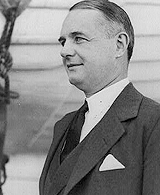
A pivotal turning point in modern Thai history occurred in August 1953 when William “Wild Bill” Donovan, former head of the Office of Strategic Services (OSS-World War II-era spy agency) and one of the founders of the CIA, arrived in Thailand as the new U.S. ambassador.
Donovan brought with him a group of OSS veterans to plan and carry out covert operations.
The Eisenhower administration at the time was dealing with the fallout of the “loss of China”—the victory of the Maoist forces in China’s civil war over the U.S.-backed Chiang Kai-shek.
This was in addition to the stalemate in the Korean War, where the People’s Republic of China (PRC) had helped the Democratic People’s Republic of Korea (DPRK) to survive after a joint U.S.-Republic of Korea (ROK) offensive and massive bombing operation.
Donovan’s appointment signaled a more aggressive anti-communist policy in Thailand that was designed to transform the country into an “anti-communist bastion.”[2]
The underlying goal was to help sustain U.S. hegemonic power in Southeast Asia, a region rich in mineral wealth that was long viewed as key to global domination.[3]
China’s People’s Daily warned in the early 1960s that U.S. imperialism would “use Thailand as a springboard to attack China” and that it intended to set up a nuclear bomber base in Thailand for attacks against China.[4]
Thailand additionally was thought to be a promising avenue of American corporate investment, with nearly 100 U.S. companies operating there by 1965.[5]
During his tenure as ambassador from September 1953 to August 1954, Donovan had personal charge of CIA agents who were involved in building up a specialized counterinsurgency force known as the Border Patrol Police (BPP).[6]
The BPP had been formed as an offshoot of a paramilitary police force and was established and coordinated by CIA operatives who began arriving in Thailand in 1950.
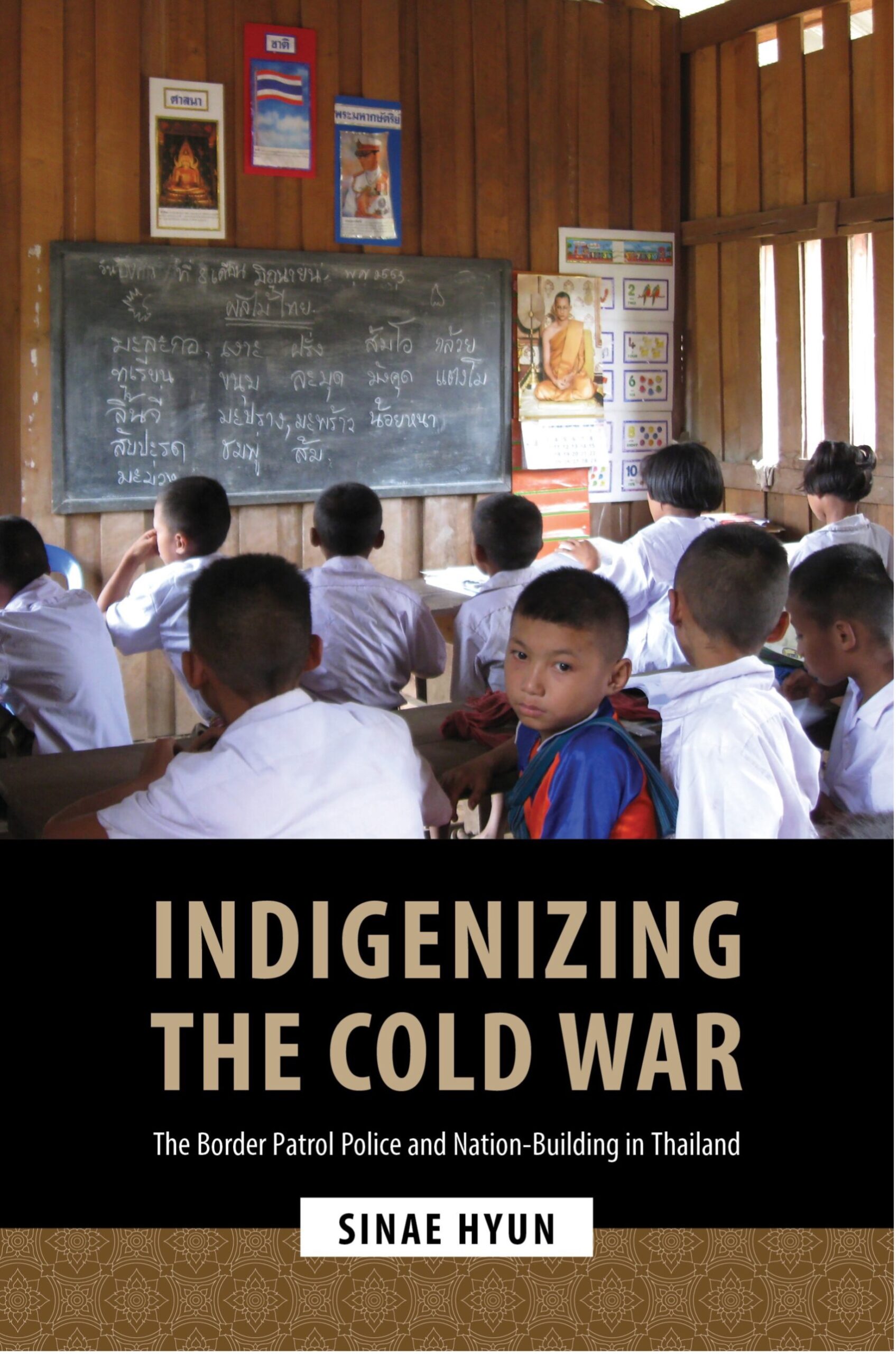
Sinae Hyun is a professor in the Institute for East Asian Studies at Sogang University in South Korea who has written a new history of the BPP, Indigenizing the Cold War: The Border Patrol Police and Nation-Building in Thailand, that is based on her Ph.D. dissertation at the University of Wisconsin, Madison.[7]
Hyun states emphatically that the BPP was “initiated, designed and trained directly by the United States,” and that the BPP was “expected to specifically target communist infiltrators and agitators, regardless of their nationality and ethnicity, at the border and in rural areas.”[8]
This focus led to the BPP’s involvement in invasive surveillance, mass roundups, and scorched-earth campaigns that resulted in the destruction of villages.
During Donovan’s tenure as ambassador, he and the CIA drew close to Thai police chief Phao Siyanon, a key power broker in Thailand known for his control of the regional narcotics trade and brutal suppression of leftist opposition movements.
In 1947, Phao had taken part in a coup d’état that ended the last of Pridi Phanomyong‘s attempts to create democracy and establish an economy independent of foreign control, restoring disgraced Field Marshal Plaek Phibunsongkhram to power.
Characterized by Free Thai leader Seni Pramoj as “the worst man” in the history of Thailand and by New York Times publisher C.L. Sulzberger as a “superlative crook,” Phao was linked to the murders of the chief of detectives and four Cabinet ministers who were accused of supporting an abortive coup against Phibun in 1949.
A specialized anti-communist police unit trained and equipped by the CIA under Phao’s direction arrested critics of Thailand’s right-wing government, including intellectuals.
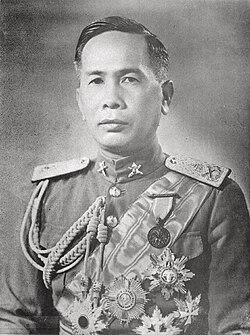
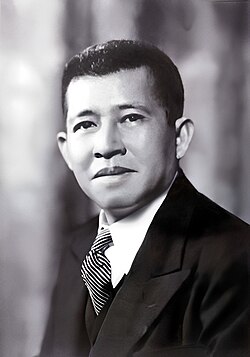
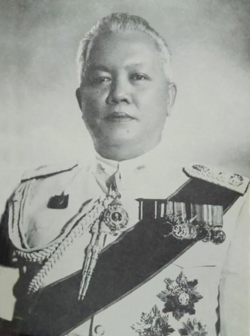
Thailand’s most prominent left-wing leader, Nai Tiang Sirikhand, a Free Thai leader in World War II who then served in the National Assembly but was accused of defecting to the communists, was strangled to death by Phao’s forces during a police interrogation.[9]
Along with an authoritarian police state, Thailand was transformed under General Phao’s direction into “the greatest source of illicit opium in the world,” according to a report by Garland Williams, an officer with the U.S. Federal Bureau of Narcotics (FBN).[10]
When in 1955 CIA Station chief Justin O’Donnell bluntly criticized Phao’s involvement in the opium trade, he was swiftly removed from his post by CIA headquarters.[11]
Beginning in the late 1940s, the CIA had begun equipping the BPP under the cover of a private corporation, Sea Supply, that had been set up by Lieutenant Colonel Willis Bird, Deputy Director of OSS Operations in China, and by Colonel Paul Helliwell, head of OSS special intelligence in China and the CIA’s liaison with organized crime.[12]
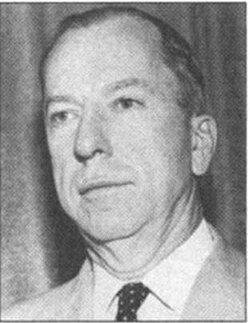
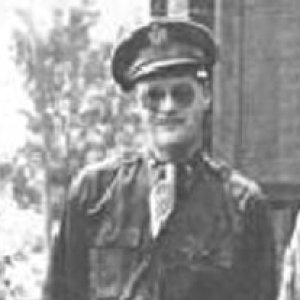
Financing for Sea Supply derived from a CIA black fund obtained from stolen Japanese gold and other treasures that were obtained at the end of World War II. (Helliwell laundering the gold in CIA-linked banks he helped set up).[13]
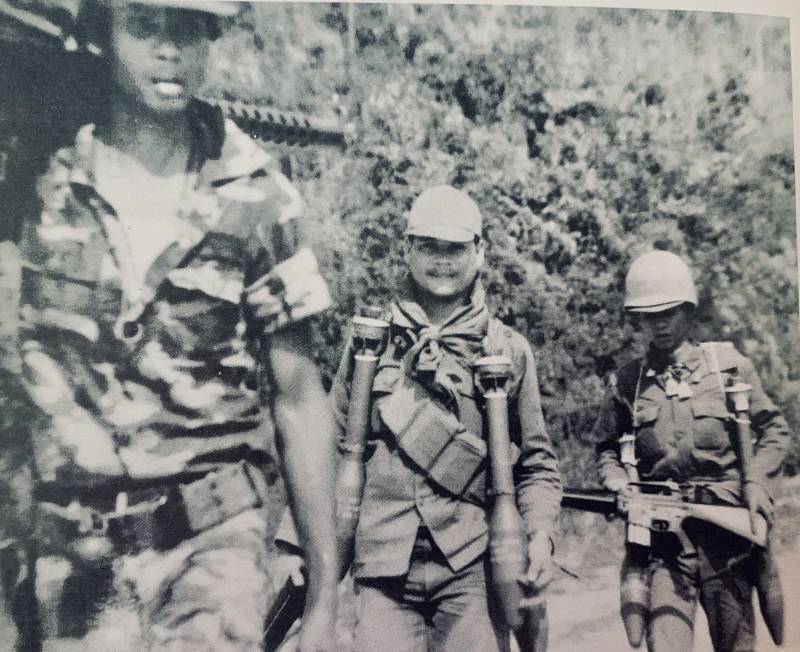
The weapons provided by Sea Supply included aircraft, bazookas, grenades and land mines.[14] Training was provided in parachuting, guerrilla warfare tactics, jungle survival, dynamiting, sabotage, intelligence gathering, and shooting.[15]
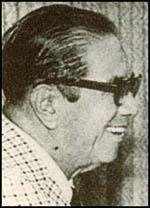
Married to the sister of a key figure in the Free Thai Movement which fought against Japan in World War II, Bird set up a secret group of Thai military and political figures known as the Naresuan Committee which included Phao, future Prime Minister Thanom Kittikachorn and, of course, “Wild Bill” Donovan.[16]
The Naresuan group was concerned with the growing influence of the Chinese Communist Party (CCP) and Vietminh (communists who fought against French colonialism and later the Americans in Vietnam) along Thailand’s northern border region, where the BPP operated.
The BPP was established as the genesis of a stay-behind clandestine anti-communist army that could be mobilized in the event of a Chinese invasion of Thailand or used for penetration operations into China.[17]
Under the cover of Sea Supply, Bird and Helliwell established a paratrooper training camp in Lopburi for the BPP and one of its offshoots, the Police Aerial Reinforcement Unit (PARU), which specialized in parachuting behind enemy lines and jungle warfare, and came to play a pivotal role in the CIA’s secret war in Laos.[18]
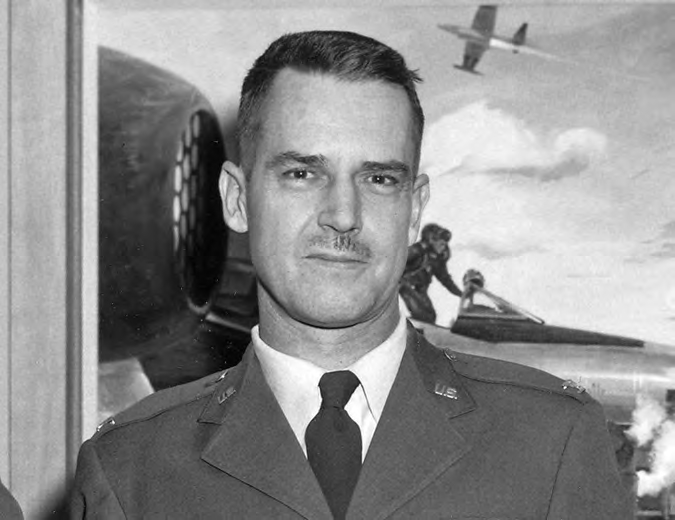
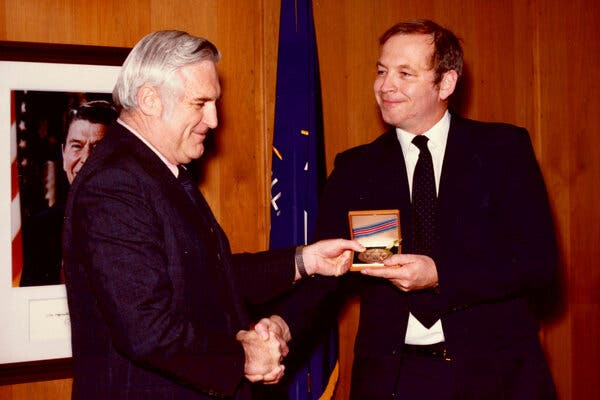
A key person running the Lopburi camp was Bill Lair, a CIA operative from Texas who was awarded the Intelligence Medal of Merit by CIA Director Allen Dulles.
Lair’s extreme anti-communism was apparent at the end of World War II when he refused to participate in the famous Elbe River linkup of U.S. and Soviet troops and, instead, expressed belief that the American army should have continued the war and defeated the communists.[19]
Lair was assisted at Lodpuri by other CIA operatives including:
- Jeffrey Cheek, who graduated Texas A&M University with Lair and went on to initiate CIA covert operations in Laos in 1955;
- Sherman “Pete” Joost, a Princeton graduate who had trained Kachin fighters during World War II and coordinated Guomindang fighters in Burma to carry out subversion operations in Communist China (Operation Paper);
- Ray Babineaux, who later served under cover as a Michigan State University professor training South Vietnam’s secret police;
- Walter P. Kuzmak, Sea Supply’s manager and an OSS veteran who had parachuted into Eastern Europe at the end of World War II to recruit Red Army defectors from Ukraine;
- Anthony Poshepny, the prototype for Lieutenant Kurtz in Francis Ford Coppola’s film Apocalypse Now as a CIA agent who went rogue;
- Jack Shirley, who served n the secret war in Laos and organized penetration operations into China among former Guomindang soldiers in Taiwan;
- Gordon Young, who was born into a missionary family in China and organized Lahu tribesmen in Yunnan and was involved in creating the CIA’s Hmong clandestine army in Laos with his brother William[20];
- Tom Fosmire, a former Sergeant in the 82nd Airborne Division who inserted agents into North Korea during the Korean War and, with Anthony Poshepny, went on to try and destabilize the socialist Sukarno government in Indonesia, to train Hmong insurgents in Laos, and to support anti-communist resistance forces in Tibet.[21]
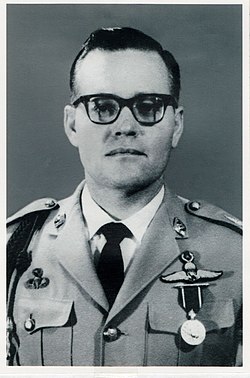
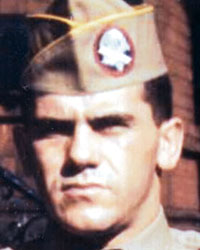
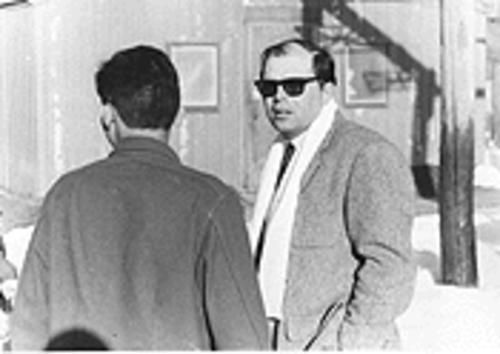
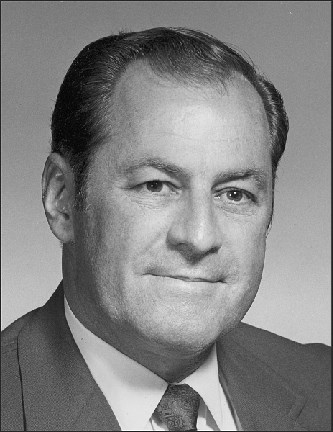
Phao helped Lair and the other CIA operatives open an additional training camp at an old Imperial Japanese training camp in Hua Hin, 230 kilometers south of Bangkok.[22]
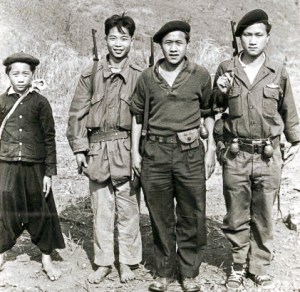
Beginning in the mid 1950s, the CIA began arranging for U.S. proxy forces in Laos, Cambodia and South Vietnam to receive training from the BPP in basic intelligence, sabotage tactics, and unconventional warfare at Hua Hin and Lodpuri.[23]
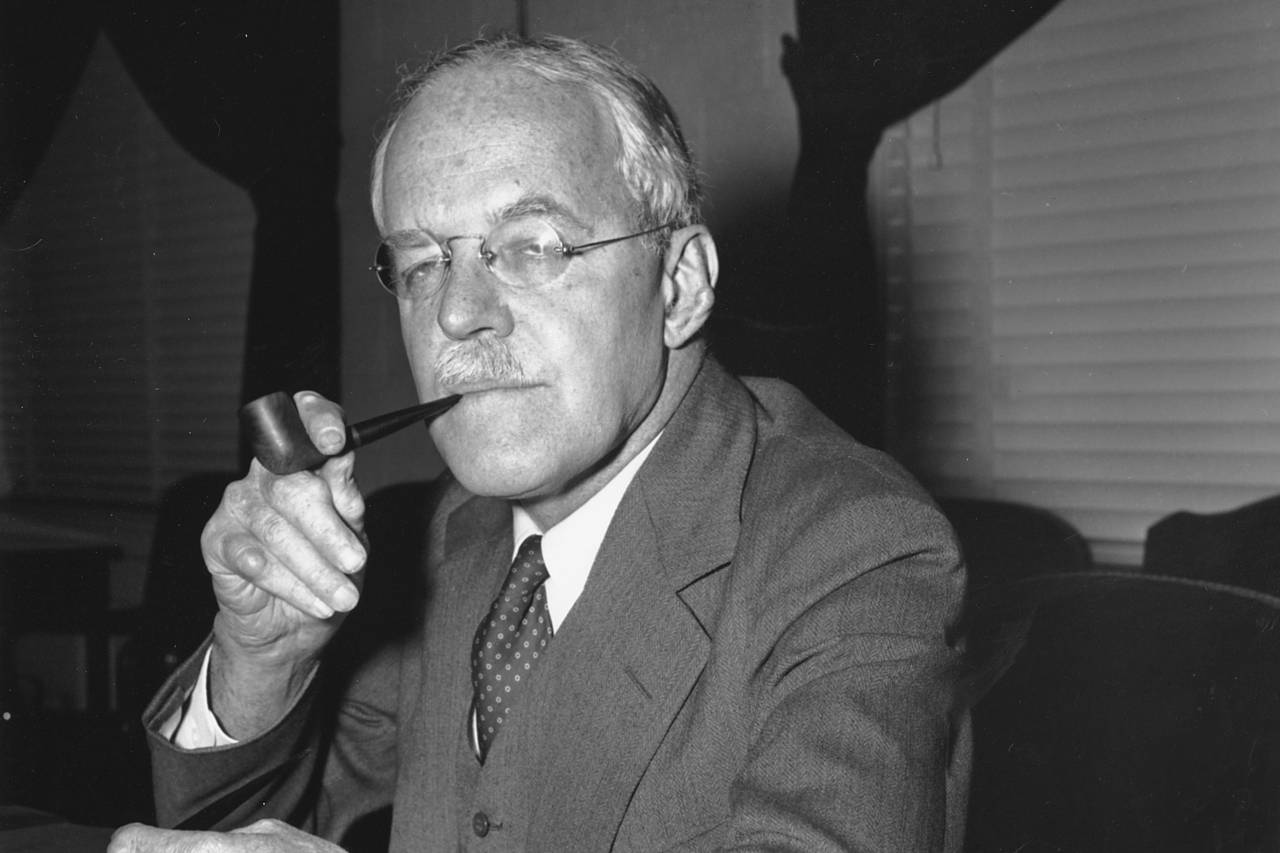
In 1956, Allen Dulles made a special visit with a group of military officers and Sea Supply managers to Hua Hin to inspect PARU’s training progress.[24]
Civic Action and Covert Action
The CIA placed a key emphasis on helping the BPP to carry out civic action programs like building schools and medical clinics for highland ethnic minorities in the border region who were deemed susceptible to communist influence.[25]
This was a way to win “hearts and minds,” help integrate the hill tribes into the Thai state, and gain intelligence on the communists by establishing close relations with local villagers and youth.[26]
Hyun writes that a key objective of the CIA in mobilizing the highland minorities in northern Thailand was to “obtain intelligence about the Chinese communist infiltration and to identify areas for future operations behind the Chinese enemy lines.”[27]
The CIA at the time had been organizing commando missions into China through Taiwan and northern Burma, in the latter case, using exiled Guomindang drug runners.[28]
In 1970, the Thai government made an agreement to allow the Gumindang drug runners to stay in Thailad where they were protected by BPP platoons who became integrated with them.[29]
PARU was mobilized under Operation Romeo to support anti-communist movements in China, along with Indonesia, Vietnam, Laos and Cambodia with the Civil Air Transport (CAT-aka Air America), owned by the CIA.[30]
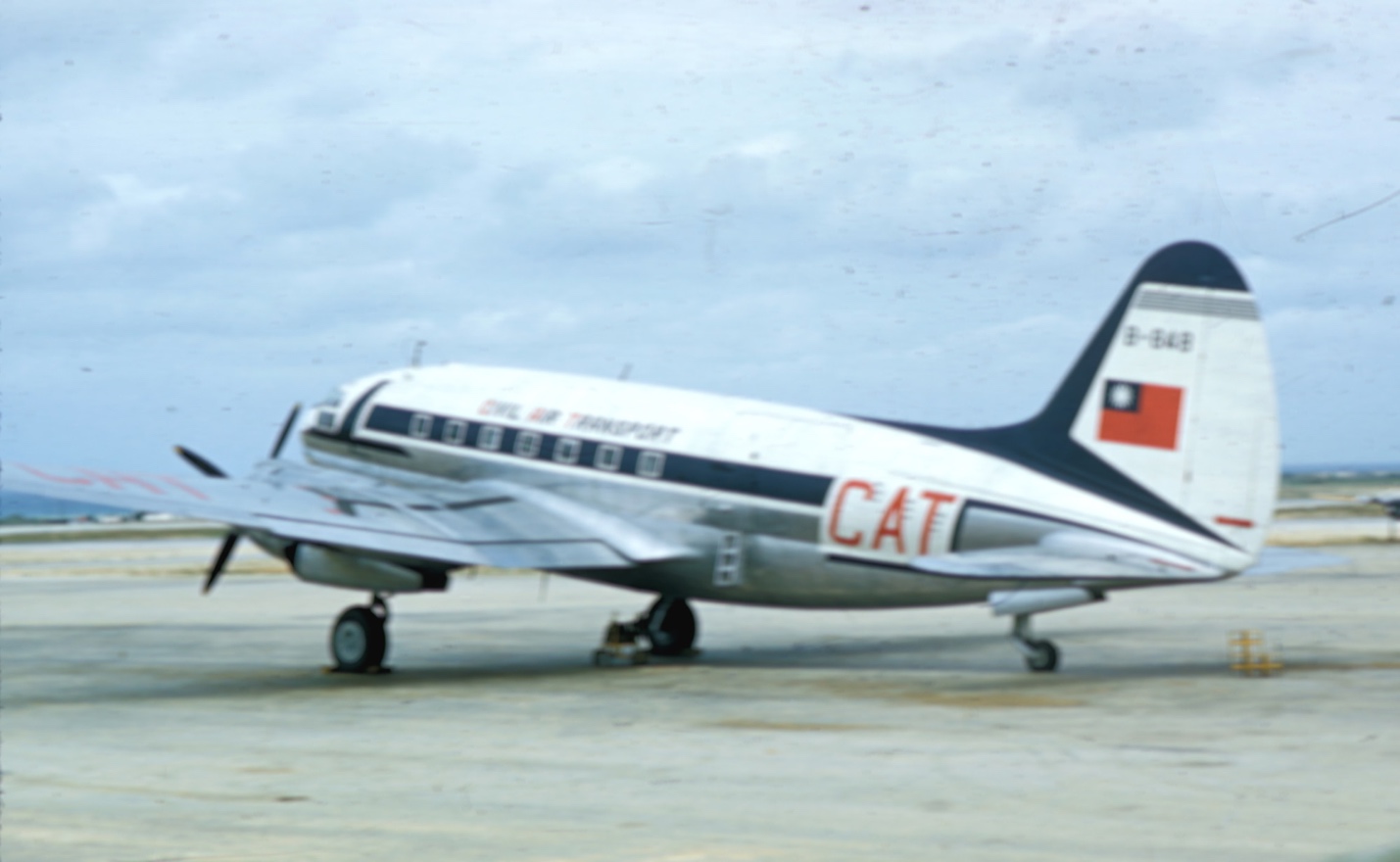
Australian academic Desmond Ball wrote that PARU was used by the CIA “for odd jobs in several of its ventures elsewhere in Asia—for example in 1958, PARU riggers helped make weapons drops to anti-government rebels in Indonesia and in 1959, they packed pallets destined for anti-Chinese guerrillas in Tibet.”[31]
Hoodlums Take Over
In the early 1960s, CIA training of the BPP and PARU began to be carried out under the cover of USAID’s Office of Public Safety (OPS). The OPS’s director in Thailand for a period, Jeter Williamson, was a former Greensboro, North Carolina police officer who went to provide security assistance to the Saudi Royal family after a stint with the Phoenix Program in Vietnam.[32]
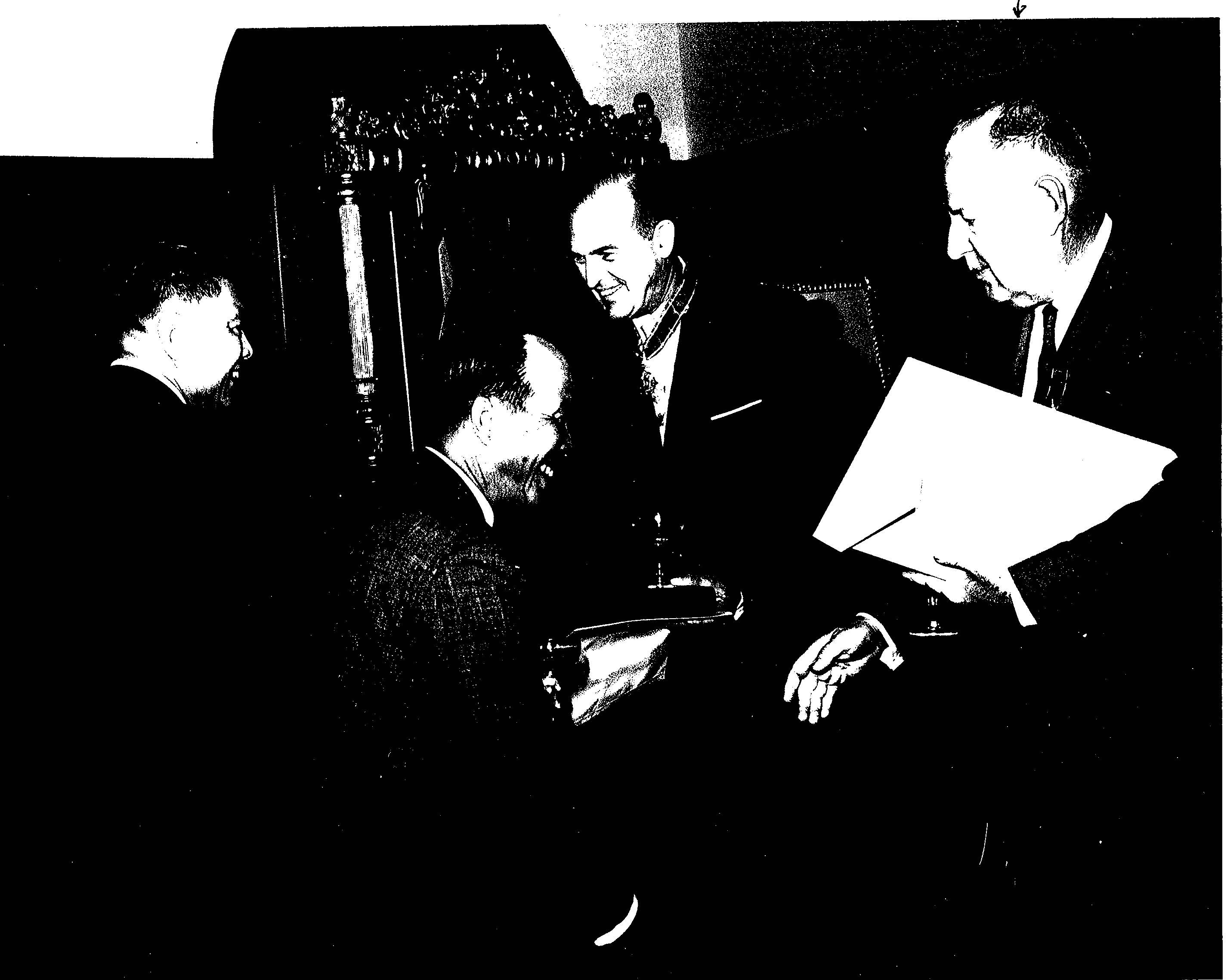
Another OPS officer in Thailand, Laurent Maubert St. Georges, served in the late 1970s as CIA Station Chief in Khartoum; while William E. Hanscom, who trained PARU units in airborne activity, demolition and guerrilla warfare, had been a jump-master in the Korean War who was recruited into the CIA’s paramilitary section at that time.[33]
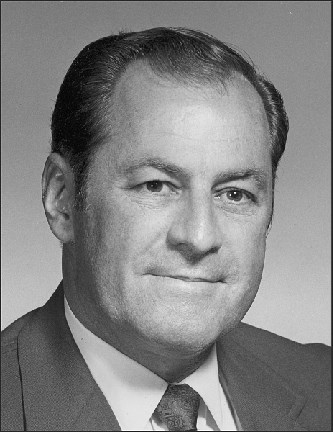
CIA officer Gordon Young, who came from a missionary family and learned the local languages and customs, complained that from 1962 onwards “a new breed of paramilitary hoodlums” began to take over the CIA’s advisory role with the BPP, “soldiers of fortune in civilian clothes” and “professional warriors looking for another war and ignoring the fact that wise strategy is better than brute force.”[34]
The wise strategy that Young had in mind still, however, fit with a dubious tradition of Western powers recruiting and training local proxy forces often drawn from minority groups, to advance their own geo-strategic agenda and without regard for the local impact.
Young said that most CIA advisers “cared little about the people they were dealing with and few of them had the sort of experience, compassion or language critical to the work. They were adventurers first, and wanted to be able to get back into another hot war.”
Dirty War Against the Communists and Red Hmong
The CIA’s investment in the BPP resulted, in part, because the highland minorities were major opium traders, and the CIA wanted to profit from the drug trade instead of the communists.[35]
The hill tribes were recruited into the BPP to carry out counterinsurgency operations targeting the “Red Hmong,” a faction of the Hmong minority group that had migrated from China, who joined the Thai Communist Party because it intended to end lowlander discrimination against the Hmong and make the Hmong equal in status and power.[36]
By the mid-1960s, the Red Hmong began engaging in armed struggle with the People’s Liberation Army of Thailand (PLAT) after their houses were burned and villages ransacked by the BPP.[37]
Desmond Ball points out that BPP troopers often “lacked discipline, abused village women, drank too much whiskey and behaved ill-mannerdly.” Additionally, they “enjoyed illegal opium and smuggling trades, squeezed bribes out of villagers or used villagers for forced labor activities that dramatically conflicted with civic action concepts.”[38]
In retaliation for atrocities directed agains them, the Red Hmong would burn down BPP schools where teachers spied on and tried to indoctrinate students, and attacked the CIA sponsored BPP training camps. The BPP in turn would call in army air strikes or napalm attacks and burn more of their villages.[39]
Royalist Patron
The BPP’s close relationship to the CIA was matched by its closeness to the Thai monarchy.[40]
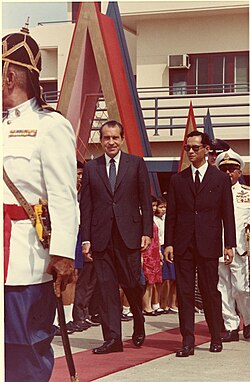
An ardent anti-communist, Thai King Bhumibol (1946-2016) frequently attended police ceremonies with Phao and visited PARU’s training camp, which was conveniently located across from the King’s palace.
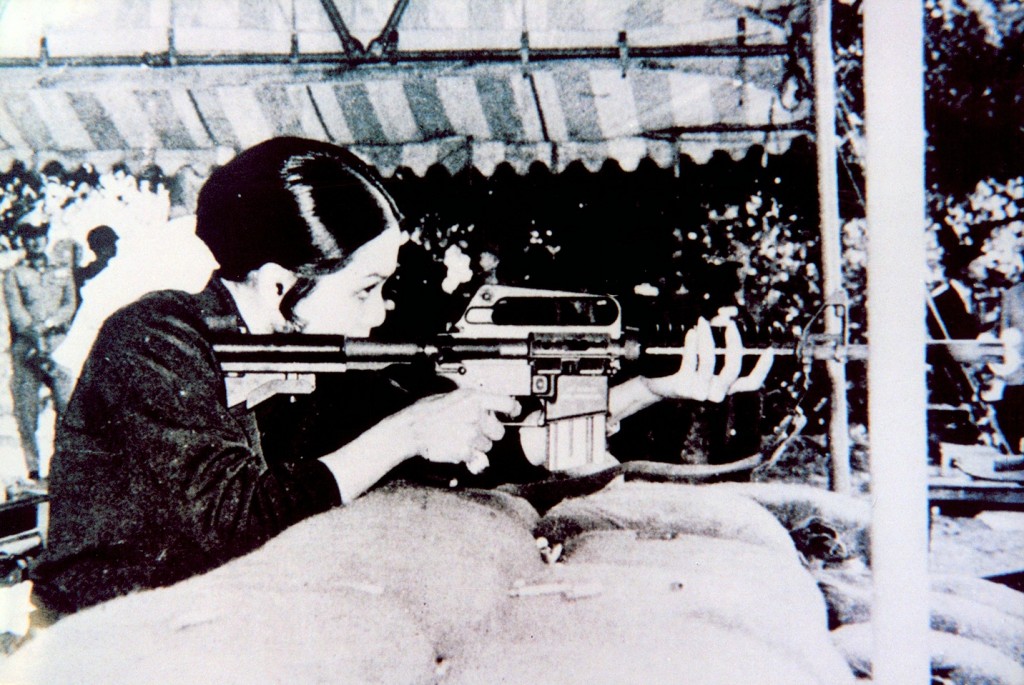
The King, a close friend of Bill Lair who sailed boats with him, received instruction at the PARU camps in shooting, which he did for sport, and donated light aircraft to PARU for use in special operations. PARU, in turn, served as the King’s secret service.[41]
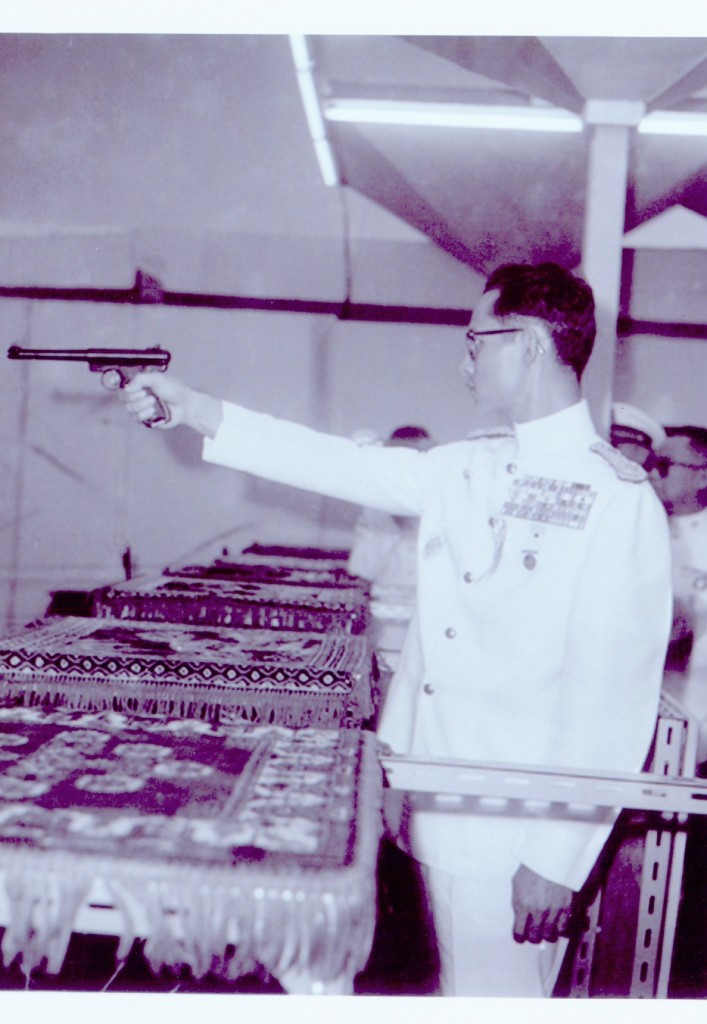
King Bhumibol and his wife supported rural development projects and BPP schools, largely as a way of burnishing their public image.[42] In total, the Royal family donated almost 16 million baht between 1962 and 2006 that was used to build 198 BPP schools.[43]
When the Princess Mother Srinagarindra traveled to the remote border regions, she flew on a CIA helicopter.[44]
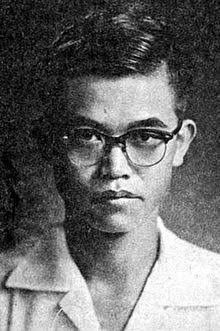
Jit Phumisak, a pre-eminent Thai radical, referred to King Bhumibol as “the big land lord of saktina [feudalist system],” which the BPP and CIA worked in Thailand to help uphold.[45]
Considered the “Che Guevara” of Thailand, Phumisak joined the Communist Party in the jungles of the Phu Phan mountains in Sakon Nakhon province, where he was hunted by the BPP and imprisoned for six years before he was executed in 1965.
Base for U.S. Aggression in Indochina
The suppression of leftist groups in Thailand gained added importance to the U.S. as the Indochina Wars escalated. Between 1957 and 1973, the U.S. government spent more than $91 million to improve the Thai National police and more than 620 advisers to work with it.[46]
In 1957, Phao was unseated in a coup by Field Marshal Sarit Thanarat who looted Thailand’s coffers of three billion baht (roughly $90 million) during his tenure as prime minister (1957-1963).[47]
The Eisenhower and Kennedy administrations valued Sarit for his fervent anti-communism and as a military modernizer—though he suspended the constitution, dissolved parliament, banned political parties, and consolidated all power to himself.
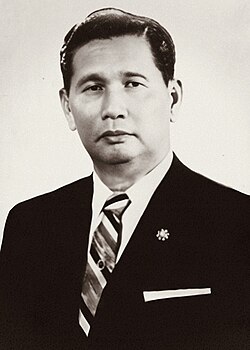
Sarit’s successor, Thanom Kittikachorn (1963-1973), was also valued by the U.S. government for his anti-communism and because he continued Sarit’s expansion of the network of U.S. military bases in Thailand that was used for bombing operations in Indochina and as a launching pad for covert operations.
The Thai Communist Party characterized Thanom as a “running dog of the Americans” who “supported the rich people and landowners against the poor peasants.”[48]
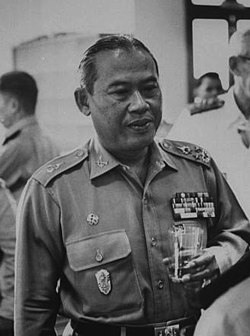
Hyun notes that American forces were distributed among four major air bases in northeast Thailand—Udon Thani, Nakhon Phanom, Ubon Ratchathani, and Nakhon Ratchasima (Korat).
The Ramasuan complex posessed the largest and most sophisticated U.S. electronics-intelligence installation outside the U.S. and West Germany.[49]
At the dawn of the Vietnam War, air bases in Nakhon Savan (Takhli), Udon Thani and Nakhon Phanom provinces had “hundreds of helicopters, light planes and bombers that carried CIA and U.S. military forces and millions of bombs from Thailand to Laos and Vietnam.”[50]
By 1966, Thailand housed 35,000 U.S. troops, some stationed at a B-52 bomber base that was constructed under Thanom’s rule at Sattahip (U-Tapao Air Base).[51]
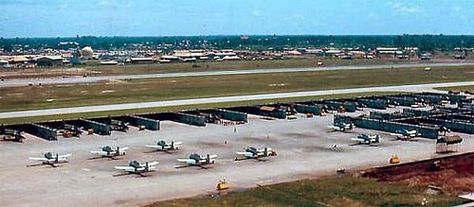
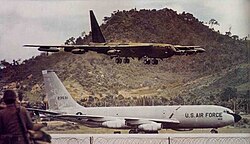
A number of the U.S. bases were located in Northern Thailand, whose protection from insurgents underlay the huge investment in BPP civic action and counterinsurgency training and operations.[52]
In 1974, BPP troopers planted land mines and massaced villagers who tried to obstruct the building of a dam outside Udan Thani City that was designed to supply water to U.S. military bases. This horrific incident underscored the BPP’s support for U.S. imperialism throughout the Cold War.[53]
Covert Action in Laos
In 1960, Sarit gave the CIA permission to mobilize PARU for its secret action in Laos so long as it helped the Lao army under General Phoumi Nosavan who was Sarit’s cousin.[54]
General Phoumi was a favorite of the CIA who was installed in a 1960 coup after the left-wing Pathet Lao had won elections but were driven underground.[55]
Due to the weakness of the Royal Lao Army (RLA), which was entirely financed by the U.S., the CIA created a clandestine army among right-wing Hmong to fight the Pathet Lao.
Bill Lair was a key figure working through PARU to recruit Hmong chieftain Vang Pao as the head of the CIA’s secret army. Vang Pao was known for adopting brutal methods and profiting from the regional drug trade.
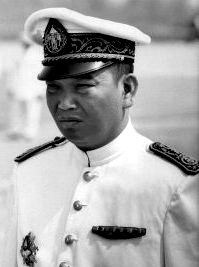
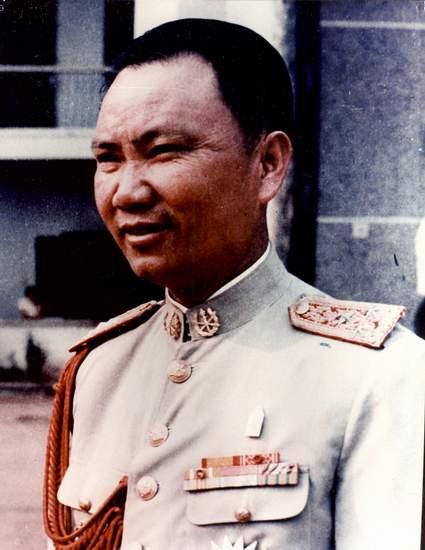
The deployment of PARU forces in Thailand in assistance of the Hmong was in violation of the 1954 and 1962 Geneva Agreements, which outlawed foreign intervention in Laos.[56] The CIA took pains as such to disguise the PARU forces and have them operate under civilian cover.[57]
One of the leaders of the PARU operational team in Laos said that communications training with the American radio and code systems, patrol duties in the remotest parts of Thai border areas, and the building of a border information center helped PARU to “readily carry out the CIA’s covert action in Laos.”[58]
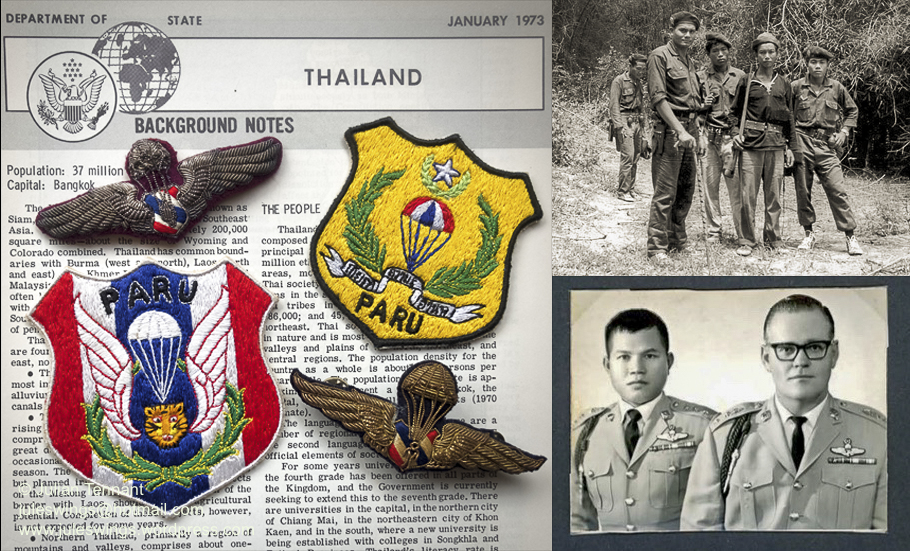
Lair and PARU commander Pranet Ritluechai organized PARU operational teams in Laos to collect intelligence, assist the Lao army on the battlefield and help organize Hmong battalions along with Kha, Thai Dam and Lao Theung counterparts to fight the Pathet Lao.[59]
Many Hmong soldiers went to Hua Hin and other PARU and BPP training camps during the secret war to refine their jungle fighting skills and receive more weapons from the CIA.[60]
In a July 1961 memo to General Maxwell Taylor, CIA operative Edward Lansdale wrote that “99 PARU personnel have been introduced covertly to assist the Meo [Hmong] in operations in Laos.” Lansdale added that combat reports of these operations “have included exceptionally heroic and meritorious actions by PARU personnel. The PARU teams have provided timely intelligence and have worked effectively with local tribes.”[61]
One notable activity of the BPP in supporting the secret war was to open up a radio station in Long Chen to disseminate propaganda.[62] The station’s director, Manas Khantatatbumroong, was assigned to work with CIA adviser Edward Johnson to set up the United Lao Ethnic Radio Station, which broadcast propaganda in three languages—Lao, Hmong and Lao Theung.[63]
With its expertise in rural development, the BPP further played a vital role in building airstrips in remote villages that allowed for Air America to land there and supply the Hmong with weapons and food aid—and also to carry out opium (Air America gained the nickname “Air Opium”).[64]
The brutality of PARU forces was evident when they beheaded a Lao general who betrayed them and then brought his severed head back to Hua Hin to “let all PARU know that we revenged the evil that betrayed us.”[65]
Hyun suggests that approximately 40,000 Thai soldiers fought in the Laos secret war, with many carrying out bombing missions flying Lao Air Force planes.[66] Some 2,482 Thai men were killed.[67]
When PARU soldiers returned to Thailand, they could not even receive any official compensation because their actions had been top secret.[68]
Thammasat Massacre and the CIA’s Ugly Imprint on Thailand
When students and civil activists toppled the military government and sent Thanom Kittikachorn into exile in 1973, PARU considered this to be a victory of communism in disguise as democratization.
Many of the student leaders of that era had condemned PARU for its involvement on the wrong side of the secret war in Laos and Indochina Wars, which yielded vast death and destruction.[69] The Thai monarchy was condemned for similar reasons.
On October 6, 1976, BPP and PARU troops and their auxiliaries—fascistic groups that emerged out of counterinsurgency organizations set up and funded by the U.S.—massacred student protesters at Thammasat University in Bangkok.[70]
Prior to the massacre, thousands of leftists, including students, workers and others, had been holding ongoing demonstrations against the return of Thanom Kittikachorn to Thailand. Students had also demanded the withdrawal of all U.S troops from Thailand.[71]
Official reports state that 46 were killed and 167 were wounded at Thammasat University, while unofficial reports state that more than 100 demonstrators were killed.[72]
The deaths were caused by the “BPP force from Hua Hin” firing upon unarmed civilians after surrounding the university.[73]
One set of authors reported that the carnage caused by the BPP was “almost unbelievable. Some students were burned alive or lynched from nearby trees; others were simply shot at point-blank range, some on the university grounds, others as they attempted to flee the campus or swim to safety [on the Chao Pya River located next to the campus].”[74]
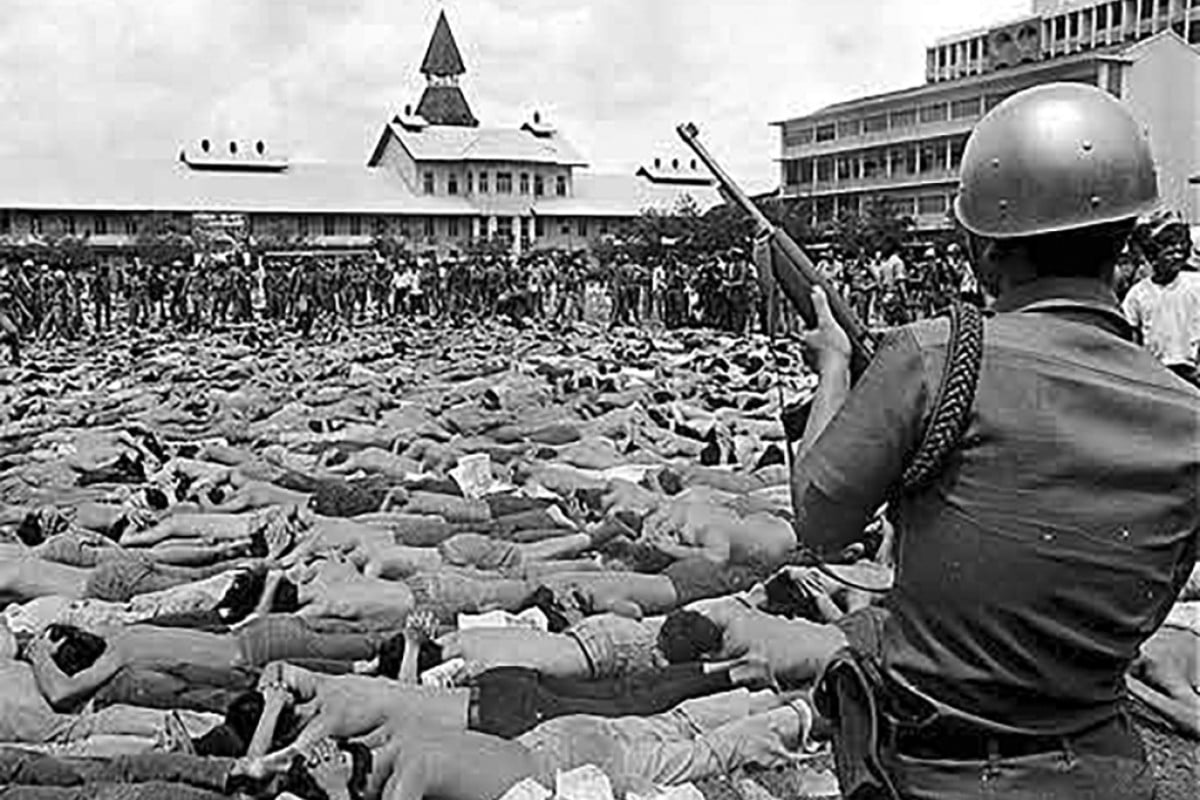
The Thammasat massacre underscores the pernicious influence in Thailand of the CIA, which had established the Hua Hin camp, created the BPP and supplied it with some of the weapons, notably M-16 rifles, that were used to mow down the protesters.[75]
U.S. sales of military equipment in Thailand in 1976 totaled $89.6 million, more than Thailand had purchased in the previous 25 years combined.[76]
The CIA’s negative influence extended to its role in shaping the fervent anti-communist climate by which the BPP, PARU and other conservative forces in Thailand viewed liberal and left-wing viewpoints as being signs of communist infiltration and subversion.[77]
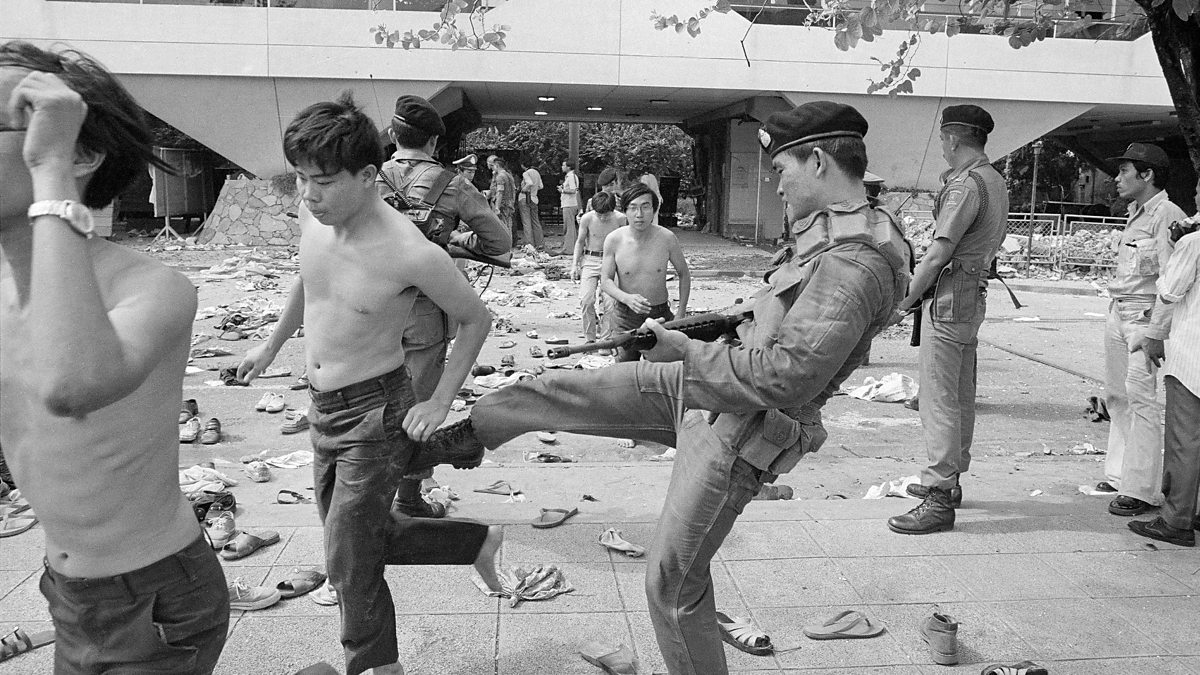
The influx of U.S. aid—totaling $2 billion from 1949 to 1969—and luxury goods on an artificial economic base had generally fueled inflation and corruption in Thailand. In 1973 it was reported that there were 400,000 drug addicts, 300,000 prostitutes and 55,000 children under five who died of malnutrition as a third of the population lived in “absolute poverty.”[78]
Hyun emphasizes how the Thai Royal Family saw an opportunity to utilize the security infrastructure created by the CIA to help to consolidate its authority. She sees the monarchy as the ultimate victor of the Cold War in Thailand, which set back democracy.[79]
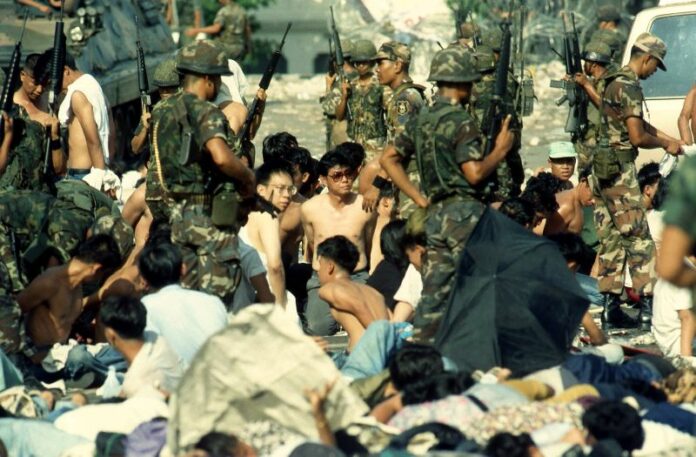
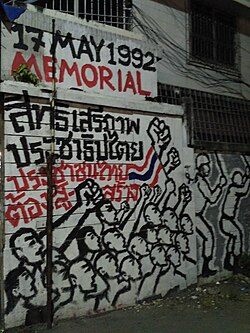
In the May 1992 “Black May” attacks on pro-demcracy demonsrators, the BPP caused 52 deaths and hundreds of casualties.[80]
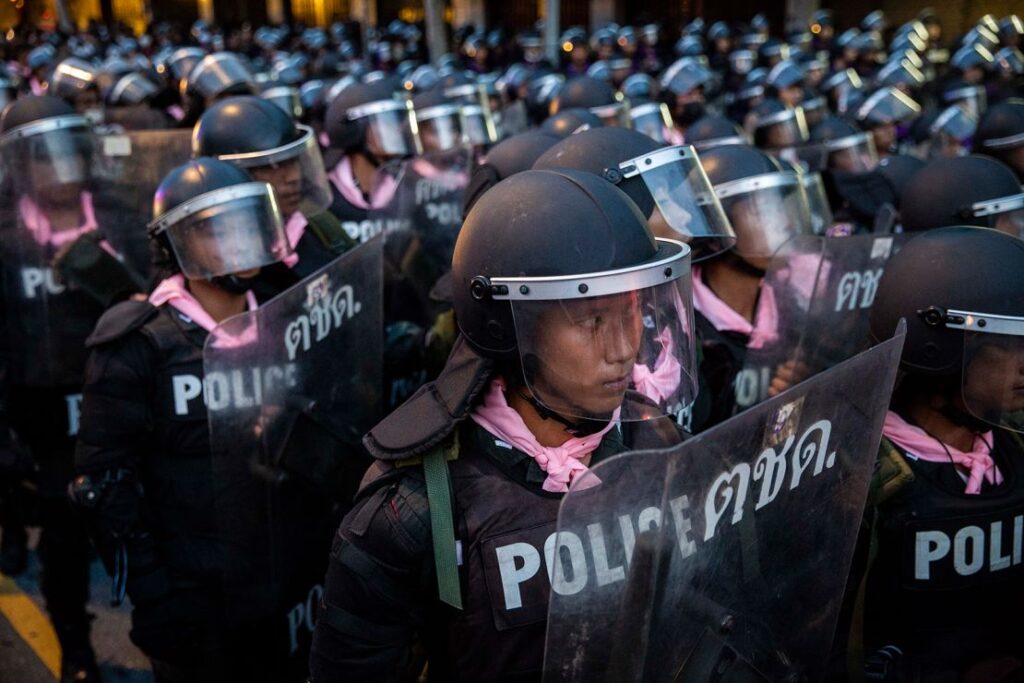
Eighteen years later, in October 2020, the BPP sprayed chemical-laced water on protesters in Bangkok who had gathered to demand the redrafting of the constitution, the resignation of Prime Minister Prayut Chan-o-cha, and reform of the monarchy.[81]
Hyun wrote that, while this latest generation of protesters may not have known a lot about the 1976 Thamassat University massacre—which had been suppressed—or about the traumatic experience of their parents’ generation during the Cold War, they recognized that the BPP was “not on the side of the people who desire change in Thailand.”[82]
Donovan and the CIA people probably thought they were undertaking a heroic project to save the Thai people from communism when it created and trained the BPP at Hua Hin in the 1950s.
In reality, they left an ugly legacy of violence, hatred and political reaction that has persisted into the 21st century—fitting a pattern of U.S. foreign policy intervention writ large.

Journalist Brian Berletic has pointed out that since 2001, the U.S. has sought to politically capture Thailand through U.S. backed billionaire Thaksin Shinawatra and Thanathorn Juangroongruangkit, another billionaire. During his tenure as Thai Prime-Minister from 2001 to 2006, Shinawatra privatized Thai state owned enterprises before selling them off to U.S. investors, sent Thai troops to participate in the U.S. occupation of Iraq, and hosted CIA secret detention camps. ↑
Thailand became part of an anti-communist alliance named the Southeast Asia Treaty Organization (SEATO) with the Philippines, Australia and Pakistan. ↑
See https://peacehistory-usfp.org/1898-1899/. ↑
Quoted in Bob Bergin, “Defeating an Insurgency—The Thai Effort Against the Communist Party of Thailand, 1965-ca. 1982,” Studies in Intelligence, June 2016, 27. ↑
Banning Garrett quoting Chase Manhattan Bank in “Thailand: The Next “Domino?” in Two, Three,…Many Vietnams: A Radical Reader on the Wars in Southeast Asia and the Conflicts at Home, editors of Ramparts Magazine, with Banning Garrett (San Francisco: Canfield Press, 1971), 118. The companies included Disney, Coca-Cola, Esso Standard Oil, IT & T and Chase Manhattan Bank. American companies invested in the extraction of raw materials—mostly tin—and in light manufacturing. ↑
Sinae Hyun, Indigenizing the Cold War: The Border Patrol Police and Nation-Building in Thailand (Honolulu: University of Hawaii Press, 2023), 23. ↑
One of Hyun’s Ph.D. supervisors, Alfred W. McCoy, has written important histories of the Philippines constabulary that was created by U.S. imperial rule in the Philippines, and of the CIA’s support for the narcotics traffic in Southeast Asia during the Indochina Wars. Desmond Ball, Tor Chor Bor: Thailand’s Border Patrol Police (BPP): Volume 1, History, Organisation, Equipment, and Personnel (Bangkok: White Lotus Press, 2013) is another detailed study.Hyun, Indigenizing the Cold War, 27. ↑
Noam Chomsky and Edward S. Herman, The Political Economy of Human Rights: The Washington Connection and Third World Fascism (Boston: South End Press, 1979), 221. ↑
Jeremy Kuzmarov, Modernizing Repression: Police Training and Nation-Building in the American Century (Amherst, MA: University of Massachusetts Press, 2012), 107, 108. For detailed discussion of Thai politics in this period, see Daniel Fineman, A Special Relationship: The United States and Military Government in Thailand, 1947-1958 (Honolulu: University of Hawaii Press, 1997). ↑
Ball, Tor Chor Bor, 69. O’Donnell ws replaced by John Limond Hart, a former CIA station chief in South Korea who was involved in covert intrigues in Italy during the late 1940s and went on to serve as CIA station chief in South Vietnam from 1966-1968. ↑
Kuzmarov, Modernizing Repression, 106, 107; Hyun, Indigenizing the Cold War, 28. ↑
See Sterling and Peggy Seagrave, Gold Warriors: America’s Secret Recovery of Yamashita’s Gold (London: Verso, 2003). ↑
Hyun, Indigenizing the Cold War, 72, 84. ↑
Hyun, Indigenizing the Cold War, 31, 84, 85. ↑
Hyun, Indigenizing the Cold War, 28. In 1951, Bird assisted Phao in putting down an officers coup against Phibun, who was taken hostage for a period on a Navy ship. Ball, Tor Chor Bor, 72. ↑
Ball, Tor Chor Dor, 63. ↑
Hyun, Indigenizing the Cold War, 30. ↑
On the Elbe River linkup, see Jeremy Kuzmarov, “Remember the Oath of the Elbe,” The Progressive, November 28, 2018. Born in Hilton, Oklahoma, Lair had a geology degree from Texas A&M University and served in a combat unit in Normandy in World War II. ↑
Young had unusual respect for the northern hill tribes the CIA worked with and became disillusioned by U.S. police training programs in Thailand and in the Far East. This was in part because under the tour system, CIA advisers did not develop local language schools or abililty to understand the local people they were trying to recruit/exploit. Young’s book on the hill tribes and memoir is a valuable resource. Gordon’s younger brother Bill began carrying out a special CIA mission in Laos with a band of multiethnic Thai agents beginning in 1958. See Sinae Hyun, “Disenchanted: Thailand’s indigenisation of the American Cold War, seen through the experience of Gordon Young,” Journal of Southeast Asian Studies, 54, 1 (February 2023).Hyun, Indigenizing the Cold War, 85. Another CIA operative was named Richard Van Winkle although this is probably a pseudonym. Joost was believed to have been implicated in the death of a Civil Air Transport employee, a Mr. Kilham, though the circumstances were covered up. ↑
Hyun, Indigenizing the Cold War, 31. ↑
Hyun, Indigenizing the Cold War, 34. ↑
Hyun, Indigenizing the Cold War, 35. Alfred Ulmer Jr., CIA officer in charge of Far Eastern operations was part of Dulles’ group that visited Hua Hin. ↑
Hyun, Indigenizing the Cold War, 33, 62. ↑
Kuzmarov, Modernizing Repression, 110. A CIA adviser stated that “schoolchildren at the BPP schools” were among “the best sources of information around.” Another wrote to the U.S. ambassador that “students tell their teachers when their relatives are making trips to Burma to contest the communists.” Some of the school-teachers in the BPP were assigned to command paramilitary units. ↑
Hyun, Indigenizing the Cold War, 40. The hill tribes had their own grievances against the Chinese. ↑
See Alfred W. McCoy, The Politics of Heroin: CIA Complicity in the Global Drug Trade, rev ed. (New York: Lawrence Hill Books, 2003); ↑
Ball, Tor Chor Dor, 151. ↑
Hyun, Indigenizing the Cold War, 98. ↑
Ball, Tor Chor Dor, 88. ↑
Ball, Tor Chor Dor, 92; Kuzmarov, Modernizing Repression. ↑
“Naming Names Africa,” Covert Action Information Bulletin, 4 (April-May 1979), 31, 32; Daniel P. Sullivan, The Murder of the Real Jack Ryan: Piecing Together the Life and Death of a CIA Operator (Omaha, Nebraska, 2020), 263, 264. Born in Minnesota, Hanscom had been a Marine Corps Raider in World War II who took part in a legendary 1942 commando raid at Makin Island. He was awarded the bronze star in the Korean War and thereafter trained Pakistani troops in Rawalpindi out of an American base. Arriving in Thailand in 1958, Hanscom tried to model the BPP after the U.S. Army airborne and provided first-hand instruction in the field, serving often as a “wind dummy” who tested wind conditions for jumps. In the 1960, Hanscom went to work for the OPS in Vietnam where he was involved with the Phoenix program. ↑
Ball, Tor Chor Dor, 96. The Thai found the concept of having American advisers condescending. Harvey E. Gutman, assistant director of the USOM to Thailand (1968-70) stated: “the Thai hated the term ‘advisor’ as they felt it put them on an inferior student level. The police were especially sensitive. The colonel in charge of liaison with USAID… complained that he was being ‘advised’ by a former [American] police sergeant, ‘a high school graduate,’ he said with contempt. In Hyun, “Disenchanted: Thailand’s indigenisation of the American Cold War, seen through the experience of Gordon Young.” ↑
McCoy, The Politics of Heroin. The CIA’s recruitment of tribal minorities in Thailand fit with a strategy of traditional colonial powers who recruited minority groups as sacrificial lambs. ↑
Ian G. Baird, “Becoming Marxist: Ethnic Hmong in the Communist Party of Thailand,” in Matthew Galway and Marc H. Opper, Eds., Experiments with Marxism-Leninism in Cold War Southeast Asia (Canberra: Australian National University Press, 2022), 306. Red Hmong leader Jong Teng was, ironically, related to Vang Pao, the head of the CIA’s clandestine army in Laos. He went for political training in Maoist China. Baird’s account lays out the Hmong’s grievances that included BPP operatives killing their chickens and pigs for food along with abuse of Hmong girls and young women. ↑
Baird, “Becoming Marxist,” 300, 307. The BPP additionally fired indiscriminately at civilians and abducted Hmong village elders. The Hmong were drawn into the Thai Communist Party (CPT), which offered them protection from the BPP and other oppressive Thai security agencies financed by the U.S. ↑
Ball, Tor Chor Dor, 141. Ball details an incident in December 1967 where BPP troopers raped a number of village girls after getting drunk on rice wine in Ban Nan Sa in the Nan Province. Alfred W. McCoy in another study detailed gross injustices meted out by the BPP to local villagers, including their forced displacement, which created the conditions for the outbreak of a violent insurgency. See McCoy, “Subcontracting Counterinsurgency: Academics in Thailand, 1954-1970” in Bulletin of Concerned Asian Scholars, February 1971, 56-70. ↑
McCoy, “Subcontracting Counterinsurgency: Academics in Thailand, 1954-1970;” Banning Garrett, “The Dominoization of Thailand” in Ramparts, November 1970, 10; Ball, Tor Chor Dor, 143. The BPP was involved in the suppression of a separate communist and Muslim separatist rebellion in Southern Thailand. ↑
The USAID Office of Public Safety’s 1974 termination report expressed enthusiasm at the Thai Royal Family’s excellent relationship with the BPP. Hyun, Indigenizing the Cold War, 81. ↑
Hyun, Indigenizing the Cold War, 35, 108. Prince Vajiralongkorn also visited Hua Hin in 1965 and insisted on jumping from an airplane like a real PARU paratrooper. ↑
Hyun, Indigenizing the Cold War, 47. ↑
Hyun, Indigenizing the Cold War, 142. ↑
Hyun, Indigenizing the Cold War, 146. ↑
Hyun, Indigenizing the Cold War, 44. ↑
Hyun, Indigenizing the Cold War, 53. ↑
Kuzmarov, Modernizing Repression, 111. ↑
Ralph McGehee, Deadly Deceits: My 25 Years in the CIA (New York: Ocean Press, 1999), 112. ↑
Chomsky and Herman, The Political Economy of Human Rights, 226. ↑
Hyun, Indigenizing the Cold War, 96. ↑
Hyun, Indigenizing the Cold War, 96. ↑
McCoy, “Subcontracting Counterinsurgency: Academics in Thailand, 1954-1970.” ↑
Ball, Tor Chor Dor, 143. ↑
Hyun, Indigenizing the Cold War, 97. ↑
See Laos: War and Revolution, ed. Alfred W. McCoy and Nina Adams (New York: Harper & Row, 1970). ↑
Hyun, Indigenizing the Cold War, 98. ↑
Idem. ↑
Idem. ↑
Hyun, Indigenizing the Cold War, 98, 99. ↑
Hyun, Indigenizing the Cold War, 100. ↑
Hyun, Indigenizing the Cold War, 102. Lansdale went to Thailand to help organize the hill tribes and BPP. ↑
Hyun, Indigenizing the Cold War, 102. ↑
Idem. Johnson was a Sorbonne-educated linguist. ↑
Hyun, Indigenizing the Cold War, 102. ↑
Hyun, Indigenizing the Cold War, 104. The active commander of the camp refused to allow the PARU men to bring the head in so the PARU troops went into the jungle and burned it. ↑
Hyun, Indigenizing the Cold War, 105. ↑
Hyun, Indigenizing the Cold War, 106. ↑
Hyun, Indigenizing the Cold War, 107. ↑
Hyun, Indigenizing the Cold War, 108, 109. Laos was the most heavily bombed country in history during the secret war. See Fred Branfman, Voices from the Plain of Jars: Life Under an Air War, rev ed. (Madison, WI: University of Wisconsin Press, 2013). ↑
Hyun, Indigenizing the Cold War, 110, 126; Chomsky and Herman, The Political Economy of Human Rights, 227. The auxiliaries included the right-wing paramilitary Red Gaurs who had fought alongside the Hmong under CIA direction in the secret war in Laos. Ball, Tor Chor Dor, 159. A key commander of the BPP during the student massacre, Vithoon Yasawasdi, was a Laos war veteran. ↑
Hyun, Indigenizing the Cold War, 133. The Thai monarchy supported the return of Thanom. ↑
Hundreds of students were also arrested and carted away in a convoy of buses that were stoned by rightist vigilantes. ↑
Hyun, Indigenizing the Cold War, 124. ↑
David Morell and Chai-Anan Samudavanija. Political Conflict in Thailand: Reform, Reaction, Revolution (Cambridge, MA: Oelgeschlager, Gunn & Hain, 1981), 275. Also quoted in Bergin, “Defeating an Insurgency—The Thai Effort Against the Communist Party of Thailand, 1965-ca. 1982,” 30. The Thammasat protest had started after two students were hung protesting Thanom’s return to Thailand. ↑
Hyun, Indigenizing the Cold War, 134. ↑
Chomsky and Herman, The Political Economy of Human Rights, 227. ↑
Political scientist Thomas Lobe, who conducted research about the CIA in Thailand and BPP, noted in 1977 that the U.S. government’s aid and assistance in developing the Thai police and military “played a significant role in the buildup for the 1976 coup.” Lobe further argued that the U.S. government’s consistent application of certain kinds of foreign assistance over years created “the pre-conditions, the infrastructure and the readiness for a more coercive, repressive, and vehemently anti-communist set of political-military leaders.” Hyun, Indigenizing the Cold War, 134. ↑
Chomsky and Herman, The Political Econoy of Human Rights, 218-230; Noam Chomsky and Edward S. Herman, The Political Economy of Human Rights II: After the Cataclysm: Postwar Indochina and the Reconstrction of Imperial Ideology (Boston: South End Press, 1979), xv. The data comes from a World Bank report. ↑
Hyun calls the monarch-based rule in Thailand at best a “semi-democracy,” which “denies a leadership role for the politicians elected by the people.” Hyun, Indigenizing the Cold War, 166. ↑
Ball, Tor Chor Dor, 163. ↑
Hyun, Indigenizing the Cold War, 169. ↑
Hyun, Indigenizing the Cold War, 170. ↑
CovertAction Magazine is made possible by subscriptions, orders and donations from readers like you.
Blow the Whistle on U.S. Imperialism

Click the whistle and donate
When you donate to CovertAction Magazine, you are supporting investigative journalism. Your contributions go directly to supporting the development, production, editing, and dissemination of the Magazine.
CovertAction Magazine does not receive corporate or government sponsorship. Yet, we hold a steadfast commitment to providing compensation for writers, editorial and technical support. Your support helps facilitate this compensation as well as increase the caliber of this work.
Please make a donation by clicking on the donate logo above and enter the amount and your credit or debit card information.
CovertAction Institute, Inc. (CAI) is a 501(c)(3) non-profit organization and your gift is tax-deductible for federal income purposes. CAI’s tax-exempt ID number is 87-2461683.
We sincerely thank you for your support.
Disclaimer: The contents of this article are the sole responsibility of the author(s). CovertAction Institute, Inc. (CAI), including its Board of Directors (BD), Editorial Board (EB), Advisory Board (AB), staff, volunteers and its projects (including CovertAction Magazine) are not responsible for any inaccurate or incorrect statement in this article. This article also does not necessarily represent the views the BD, the EB, the AB, staff, volunteers, or any members of its projects.
Differing viewpoints: CAM publishes articles with differing viewpoints in an effort to nurture vibrant debate and thoughtful critical analysis. Feel free to comment on the articles in the comment section and/or send your letters to the Editors, which we will publish in the Letters column.
Copyrighted Material: This web site may contain copyrighted material the use of which has not always been specifically authorized by the copyright owner. As a not-for-profit charitable organization incorporated in the State of New York, we are making such material available in an effort to advance the understanding of humanity’s problems and hopefully to help find solutions for those problems. We believe this constitutes a ‘fair use’ of any such copyrighted material as provided for in section 107 of the US Copyright Law. You can read more about ‘fair use’ and US Copyright Law at the Legal Information Institute of Cornell Law School.
Republishing: CovertAction Magazine (CAM) grants permission to cross-post CAM articles on not-for-profit community internet sites as long as the source is acknowledged together with a hyperlink to the original CovertAction Magazine article. Also, kindly let us know at info@CovertActionMagazine.com. For publication of CAM articles in print or other forms including commercial internet sites, contact: info@CovertActionMagazine.com.
By using this site, you agree to these terms above.
About the Author
Jeremy Kuzmarov holds a Ph.D. in American history from Brandeis University and has taught at numerous colleges across the United States. He is regularly sought out as an expert on U.S. history and politics and co-hosts a radio show on New York Public Radio and on Progressive Radio News Network called “Uncontrolled Opposition.”
He is Managing Editor of CovertAction Magazine and is the author of eight books, including Obama’s Unending Wars (Clarity Press, 2019), The Russians Are Coming, Again, with John Marciano (Monthly Review Press, 2018), Warmonger. How Clinton’s Malign Foreign Policy Launched the U.S. Trajectory From Bush II to Biden (Clarity Press, 2023); with Dan Kovalik, Syria: Anatomy of Regime Change (Baraka Books, 2025), and Political Assassinations in America: The Intricate Nexus of Deep State Crime (Clarity Press, 2026).
Besides these books, Kuzmarov has published hundreds of articles and contributed to numerous edited volumes, including one in the prestigious Oxford History of Counterinsurgency .
He can be reached at jkuzmarov2@gmail.com and found on substack here.