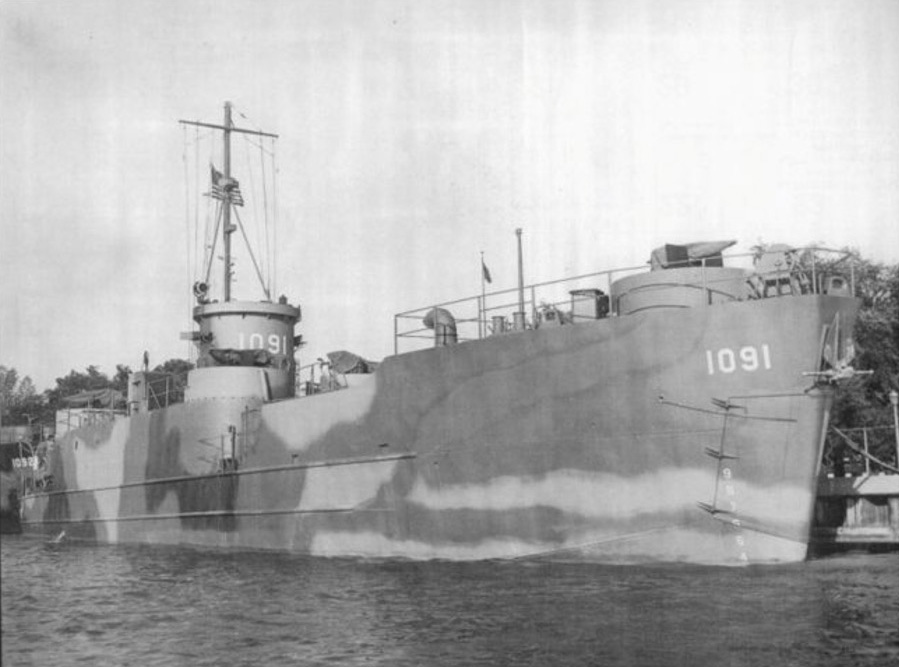
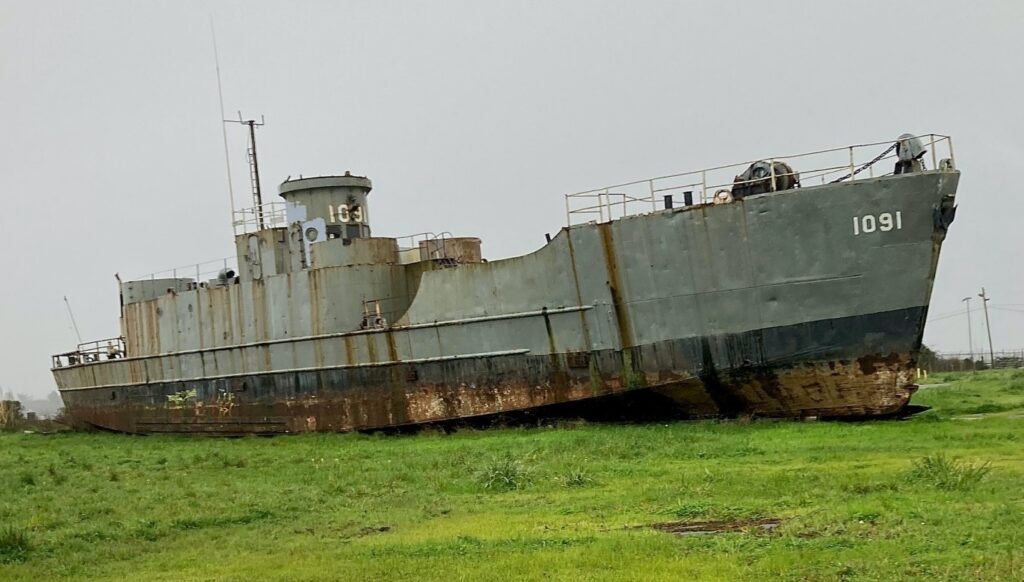
The notorious “Bubonic Plague Ship” of the U.S. Navy has been found beached in Northern California. LSIL 1091 laboratory vessel was used to breed dysentery and cholera epidemics among North Korean and Chinese POWs at the sprawling Koje Island Prison Camp during the Korean War.
[This article is part of CAM’s efforts to spotlight the U.S. military and CIA’s use of biological warfare during the Korean War, which has now been definitively confirmed by the CIA’s own documents.—Editors]
Samoa, California, is remote even by the local standards of Humboldt County. A few hearty souls live on this sandbar, huddled in the lee of its dunes in quaint hand-built seaside homes reminiscent of the “drop city” camps of the 1960s.
This spit of heaved up sand dune runs north to south to create the natural estuary of Humboldt Bay and the safe harbor of the Gold Rush city of Eureka. From the windward side of Samoa, only a hundred yards away, the Pacific Ocean, North America’s deepest and widest moat, stretches 5,000 miles (8,000 km) across unbroken sea to the rugged and rocky islands of Japan.
Considerable local history has accrued to this remote outpost of California civilization including the Trinity gold rush, horrific Indian massacres, the expulsion of the Chinese, the glory days of the Redwood Empire, the once thriving salmon industry, and the short-lived but flourishing ship-building industry. Rolled out of the water on redwood logs and under the shadow of the vast depot of the Samoa Smokehouse sits the rusted, beached hulk of the most unheralded naval vessel in all American history. This craft is LSIL 1091.
Originally classified as a Landing Craft Infantry (Large) LCI(L), 1091 is an ugly duckling even as gray World War II steel-clad warships go. It is flat-bottomed and square-hulled. Steel plates run up the ship’s sides to enclose the mid-ship house with its two forward cannon turrets, and two aft machine gun turrets. There is a forepeak house for repairs and ramp stowage at the bow, and there are open fore and aft decks, but there are no outside passageways, no masts, no lifeboats, and few portholes to clutter the severity of its profile. It is a military product of form follows function.
This particular landing craft design is attributed to Winston Churchill, and it is a foreboding war engine. Its purpose was to transport and rapidly discharge an invading amphibious force of 200 marines equipped with guns, ammunition and rations sufficient to establish a beachhead. The flat bottom allowed the LCI to run ashore in shallow water. An innovative hatch in the ship’s bow swung open at the waterline. From this maw slid a 40 ft. (12 m.) ramp like an extending tongue to grapple onto the beach. When the ship grounded the entire deployment of troops could charge onto the beach in a matter of minutes while covered by the ship’s cannons and machine guns. Half a dozen of these vessels launched against a fortified shoreline was a formidable manned amphibious assault.
Number LCI(L) 1091 was built late in the war (1944) by Defoe Shipbuilding Company of Bay City, Michigan. (The total production run of LCI (L) ships for World War II was 1098.) It was 158 feet (51 m) long and 23 feet (7.4 m) wide, with a 236-ton (214 mt) displacement when empty. It was propelled up to a sustained speed of 14 knots by two sets of four harnessed diesel engines driving twin propellers, and it carried a crew of 24 sailors with four commanding officers. It arrived in the Pacific Theater in time to participate in the assault on Okinawa Gunto (April-June 1945). When the Pacific War ended two months later in August 1945 with the unconditional surrender of Japan, 1091 was reassigned to Occupation mine sweeping duty at Kochi-Shikoku and Nagoya harbor.
Operation Crossroads
1091’s clandestine activities began the following year when the ship was assigned as a support vessel to Operation Crossroads of Joint Task Force 1. This project ushered in the resumption of U.S. atomic bomb tests following the obliteration of Hiroshima and Nagasaki. Under the command of Admiral William H.P. Blandy, the U.S. conducted two A-bomb tests, on June 30 and July 26, 1946, at Bikini Atoll in the Marshall Islands.
Test Abel (#4 atom bomb detonation) was a “fat man” replica dropped free fall to explode at 518 ft. (158 m.) above the water where a dozen decommissioned U.S., Japanese and German warships were anchored within the atoll lagoon. The purpose of the test was to address the Navy’s concern whether a large flotilla of warships was vulnerable to an A-bomb attack.
The Abel explosion created a fast-rising column of debris mushrooming into a cauliflower bloom high into the stratosphere. Remarkably, the heat vortex of the detonation sucked the radioactive fallout and debris into the atmosphere disbursing it to rain far and wide across the planet. Bikini Atoll was only lightly contaminated by Abel.
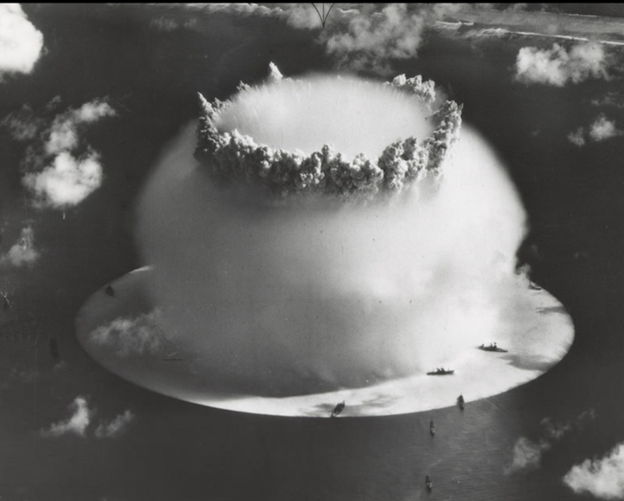
Test Baker (#5) was a different story. Baker was an underwater test. The bomb was suspended beneath a sacrificial ship LSM-60 at 90 ft. (27 m.) of depth midpoint between the lagoon floor and the surface. The concussion created a rapidly expanding gas bubble which hit the seafloor and the surface simultaneously and burst into the air. LSM-60 was vaporized; no part of LSM-60 was ever identified. The explosion created a rapidly expanding fireball of radioactive fallout and water vapor known as a Wilson hemisphere.
Simultaneously, a highly radioactive white “crack” spread across the water surface. A massive column of water geysered into the air, blasting the fireball and cracked asunder as it gushed dramatically upward into its cauliflower crown. The entire atoll was saturated in radioactive fallout.
In the succeeding three weeks it became apparent that the radioactive contamination of the damaged target vessels and shore infrastructure could not be scrubbed clean of toxic levels of radioactivity. The lagoon water was so defiled with radioactive elements that surviving reef fish glowed. Support vessels entering the lagoon after the detonation could not be scrubbed of radioactive toxicity and had to be scuttled at sea.
The Operation Crossroads health officer, Army Colonel Dr. Stafford Warren, who had been Chief of the Medical Section for the Manhattan Project, pulled the plug on the third planned Crossroads Test (#6) code named Charlie. Admiral Blandy was outraged, but ultimately acquiesced to science. Warren’s decision revealed a growing rift between the Departmens of War and Navy over control of the future deployment of the atom bomb.
The role that LCI(L) 1091 played in the Crossroads tests was support—a tender ship running errands, delivering mail, and shuttling cargo and personnel across an immense ocean. But Abel and Baker were hardly routine events; they were carefully planned actions which from our vantage of historical hindsight have pushed the human species ever closer toward mass extinction.
Drone Warfare
Following Crossroads, LCI(L) 1091 returned to Japan and the Occupation boat pool. In 1949 the craft was re-designated Landing Ship Infantry (Large) LSIL-1091. The ship was activated for Korea duty in General Douglas MacArthur’s call up for war, immediately following the North Korean invasion of the south in June 1950. This is when 1091 was quickly converted into the Navy’s smallest aircraft carrier. While much of 1091’s Korean service was clandestine and has been redacted in official Navy records, this mission was memorable and heroic in its way.
The aft deck of 1091 was outfitted with a catapult to launch reconnaissance drones. These drones were radio-controlled from the ship to circle inland, take photos of the city of Inchon with its troop deployments, fortifications, factories, rail lines, and harbor, then circle back to ditch into the sea where 1091 could retrieve it. Enemy positions could then be relayed to offshore gunboat artillery. 1091 gathered intelligence in the defense of the Pusan Perimeter and in preparations for the Inchon Landing. Drone aerial reconnaissance was part of Gen. MacArthur’s invasion toolkit.
1091 had plenty of hold space for drones and cargo where assault troops had previously been bunked. The vessel was quickly adapted to this new espionage role. Some background on drones is interesting. Austria had used unmanned hot air balloons to drop incendiary devices from above as far back as 1849.
The U.S. Army began funding drone research during World War I. In World War II, drones were used as decoys and for surveillance as radio controls improved and drones were able to penetrate deeper inland. Two drones had been sent into the mushroom cloud of A-bomb Baker with measuring devices and sample collectors, and the U.S. Army was already purchasing half a dozen drone models from as many suppliers. In Korea, drone warfare became operational. LSIL 1091 was at the cutting edge of this new warfare technology.
General Sams Acquires a Floating Medical Laboratory
With the success of the U.S./UN landing at Inchon and the ponderous triumphal march of X Corps on Seoul, the renamed LSIL 1091 returned to Japan from its second successful intelligence assignment. This is when the ship became available to General Crawford Sams. Sams was a battle-hardened medic from the Allied campaigns in North Africa and Europe when he joined General MacArthur’s command as theater surgeon in the Philippines in 1944.
MacArthur was planning his Pacific island-hopping campaign with the climax invasion of Japan, and Sams fit in well with MacArthur’s inner circle known as the “Luzon Gang.” During the post-war occupation of Japan, Sams became the top U.S. administrator of all social welfare services, including public education and health care in the Occupation government. He controlled the largest chunk of the Occupation budget and was given wide leeway by MacArthur on its allocation.
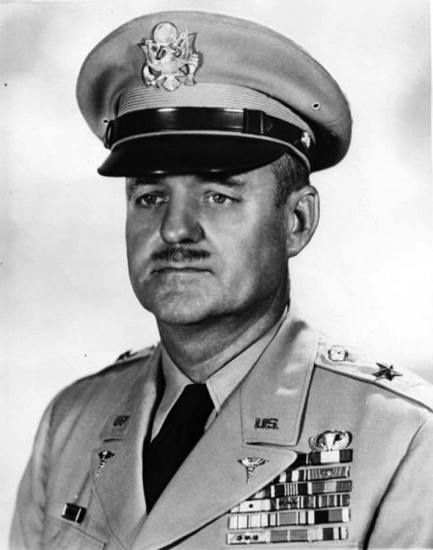
Sams already had a long and top-secret collaboration with both U.S. and Japanese biological warfare (BW) personnel before outfitting his own medical lab ship in 1951. Sams was MacArthur’s bagman in Japan. He brokered a ¥1 million (~$2,778) plea deal with General Shiro Ishii, Imperial Japan’s top bio-weaponeer and creator of the infamous Unit 731 death camp at Ping Fan near Harbin, China. Ishii threw a big party for his former staff and divvied up the loot. Sams became the patron and employer of many former Unit 731 doctors with well-paying medical jobs. In exchange for immunity from war crimes prosecution, Unit 731 staff went to work for the U.S.[1]
Sams allocated the budget for the new base hospital at Atsugi Air Base near Yokohama, which became the main hospital for the U.S. Occupation Army and its community. Clandestinely, the hospital included Unit 406, a full spectrum bioweapon laboratory and germ production factory attached at the rear.
The Army Corps of Engineers had rapidly built and staffed other BW labs with mass production plants at Ft. Detrick, Maryland, Vigo County, Indiana, Pine Bluff, Arkansas, and Horn Island, Mississippi, so the construction and outfitting of a BW factory had become routine and efficient. To this day the CIA continues to build and export bioweapons labs around the world, often disguised as chemical plants or agricultural research stations. A dozen such facilities were revealed in Ukraine in 2022.[2]
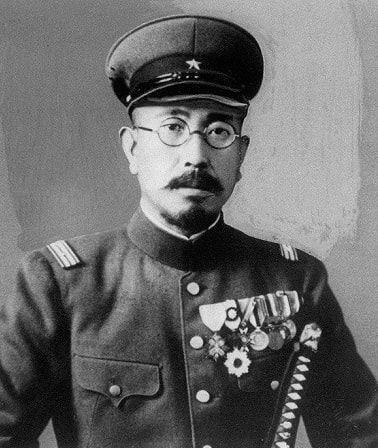
In addition to Unit 406, Sams upgraded Shiro Ishii’s personal BW production lab, Böeki kenkyû-shitzu (Tokyo Nutritional Research Center), located underground at the Army Medical College in Tokyo. The facility had survived the Tokyo bombing raids and was renamed J2C 406 as a subordinate entity to Unit 406. A third BW production facility engaged in mass insect breeding and bomb packaging was located at the Kyoto Imperial University. Unit 406 and J2C 406 were fully functional BW research and production plants by 1946 indicating the U.S. Army’s intent to weaponize and use germ warfare long before the Korean War broke out.[3]
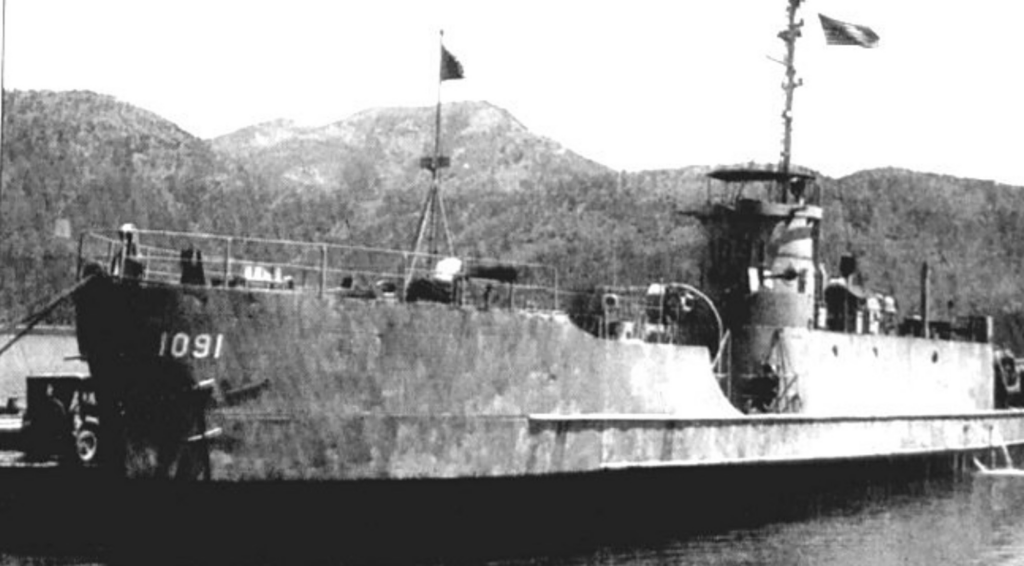
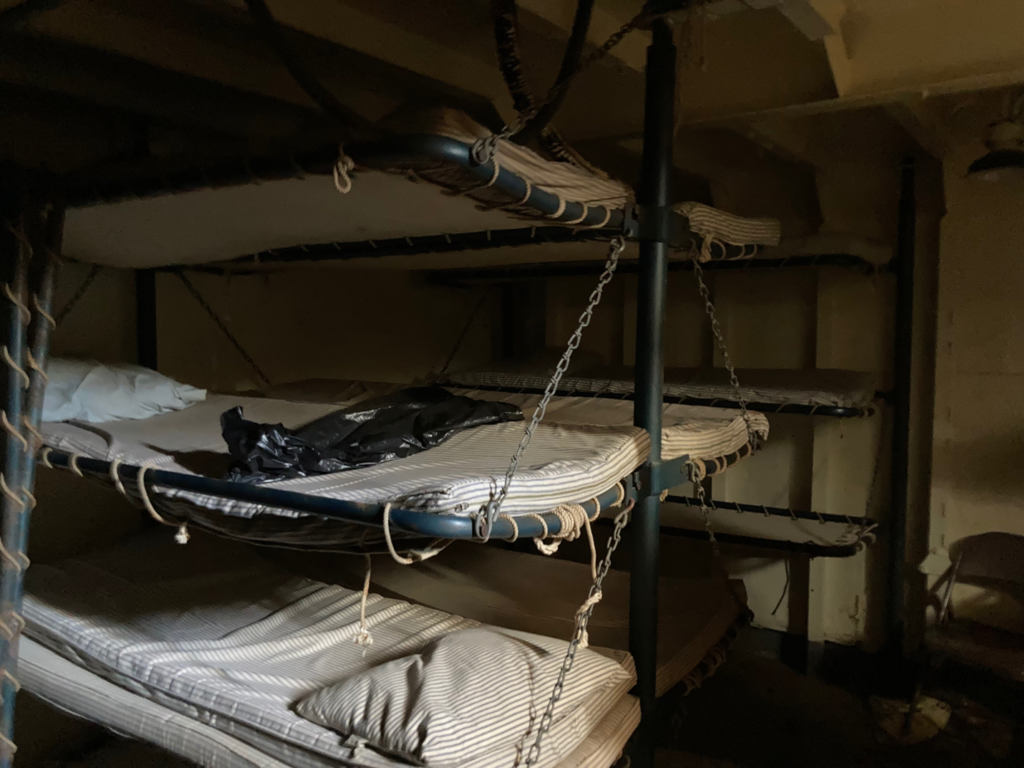
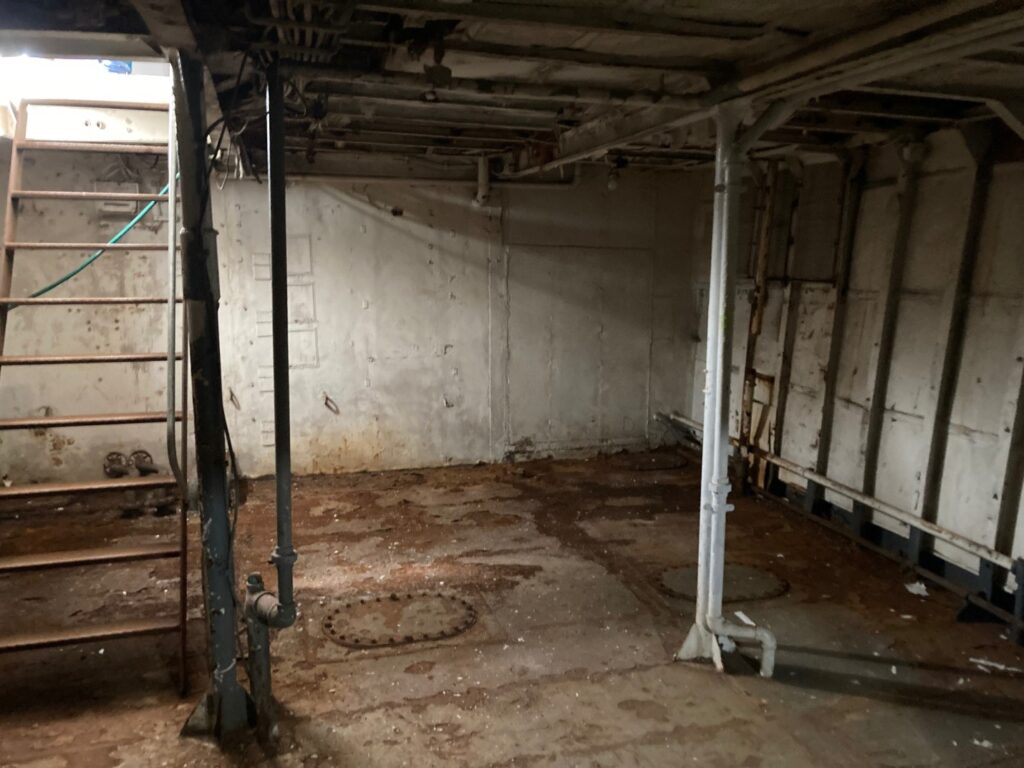
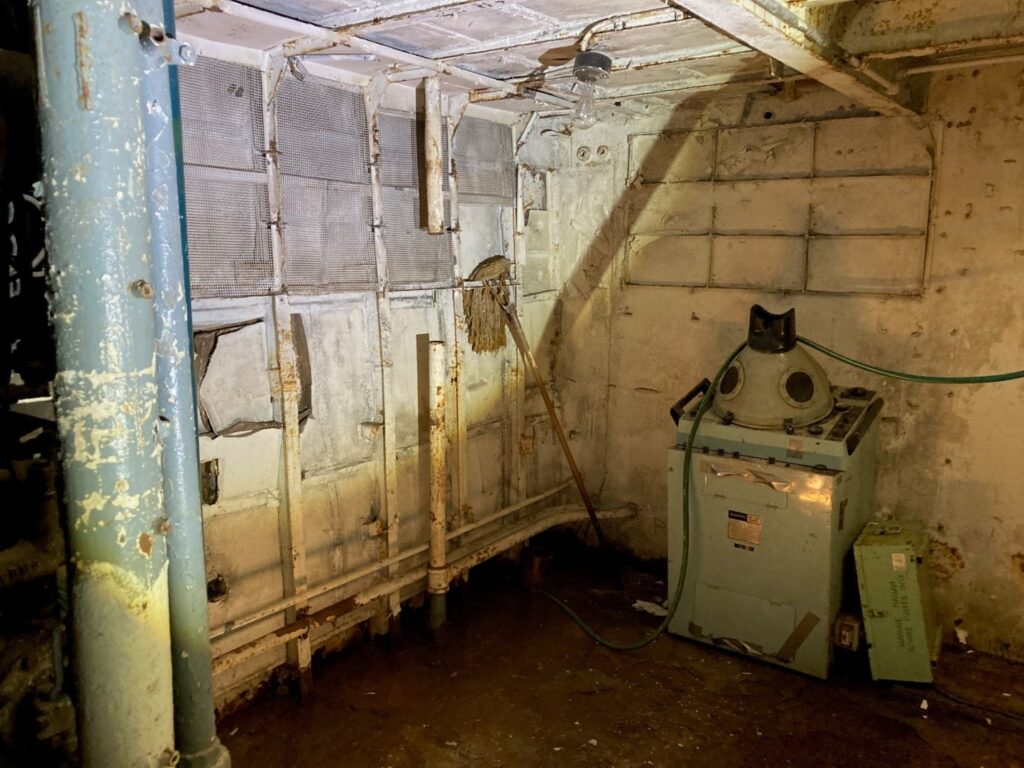
The conversion of LSIL 1091 into an “epidemic control” laboratory ship was its darkest espionage episode, but as a mechanical retrofit to the ship it was a simple modification. The ship had three holds—one forward, one aft and the midship hold where the medical lab was installed. Bulkhead partitions were added while the inside hull between the ship’s ribs held mesh cages housing lab mice. Benches and storage lockers were arranged as needed. The house with its living quarters was reached by an interior ladder. A locking hatch connected to the forward hold where patients or prisoners could be constrained on bunks.
Sams’ explanation (in his subsequent interviews) for converting LSIL 1091 into a medical laboratory ship was to provide epidemic prevention in the war zone. As theater surgeon, troop inoculation against disease was his responsibility and this mobile lab boat was needed; however, the opposite role of using the lab to breed and spread disease was also available, and these opposing tasks were not easily distinguishable, one from the other. The accusation of plague ship comes to us directly from Mao Zedong in his private correspondence with Joseph Stalin.[4]
Mao’s accusation gains credence when we discover that the two Japanese medical doctors sent on board to conduct inoculations of Korean and Chinese POWs at the Koje Island Prison Camp were none other than General Wakamatsu Jiro and General Kitano Masajo, Shiro Ishii’s top BW henchmen.[5]
Sams’ Shore Raid
Sams put his administrative duties at HQ on autopilot when the battle in Korea heated up. Sams loved the adrenalin of war, and though he was well into middle age he was not going to sit this one out pushing paper in Tokyo. When the Chinese People’s Volunteer Army (PVA) entered the war and routed the U.S./UN forces out of North Korea, Sams saw the opportunity for engagement using his lab ship behind enemy lines.
Neither the PVA nor the Korean People’s Army (KPA) had a navy to challenge this warship. Nor did they have much heavy artillery, so this permitted the low draft LSIL 1091 to anchor close into shore. From there it could send raiding parties out to the numerous inhabited coastal islands to grab locals back to the ship for interrogation and BW experimentation.[6]
On board Sams’ plague yacht on this initial foray up the east coast of North Korea to Wonsan were Ishii, Kitano and Wakamatsu.[7] Sams was being given a field demonstration of BW warfare by the three top BW experts of Japan! This modus operandi of kidnapping locals and injecting them with contagious disease was a continuation of Unit 731 methods well-developed at the Ping Fan death factory. Now it was being adapted to a mobile shipboard laboratory. The generals were talking shop; the BW war against the Chinese and Korean communists was a fully integrated U.S./Japan collaboration.
Sams’ most infamous combat role was a shore raid he launched from 1091 near the port of Wonsan on the east coast of North Korea in March 1951. Information had come to his attention describing a new disease which had broken out among Chinese PVA troops with symptoms resembling bubonic plague. Sams wanted to go ashore himself in North Korea to verify this intelligence, which if true would require the inoculation of the entire U.S./UN army in Korea at a huge cost and effort. Sams proposed to kidnap a sick PVA soldier from a communist field hospital, and to transport him back to the ship for testing.
This was a risky plan to obtain enemy medical intelligence. Sams was accompanied on this mission by the U.S. Navy’s top commando team of Lt. Eugene J. Clark, Commander Youn and Col. Ke. These three soldiers had clandestinely penetrated two islands at the mouth of Inchon harbor for a whole week to map the harbor and obtain critical tidal information on the eve of the invasion. They barely escaped on a sampan in a blaze of bullets.
The raiding party was launched from LSIL 1091 in a rubber dingy. After a couple of landing attempts were thwarted by communist gunfire from shore, Sams’ party moved to a further location and landed after dark. They proceeded to a village where three guards were killed, and a Korean medic was located who gave Sams a detailed account of the symptoms of the bubonic plague victims. Sams was able to make a remote assessment based on this intelligence and his own knowledge of disease pathology. This was not bubonic plague at all, Sams diagnosed, but hemorrhagic smallpox which in later stages displayed similar symptoms. The raiding party returned to 1091 without further incident and without need for a kidnapping victim, or a mass troop inoculation.[8]
This shore raid, while successful, was an exceedingly foolhardy mission for Sams to personally undertake. After all, he was one of MacArthur’s top generals at HQ and privy to all kinds of top-secret information, including the entire U.S. and Japanese BW programs. Most likely he did not mention his intent to personally participate in this shore raid. He would never have received permission, as he knew far too much and he was a couple of decades and more than several pounds beyond commando requirements. It would have been a political disaster for the U.S./UN had he been captured.
So why didn’t he just send Clark, Youn and Ke with instructions to bring back a sick or dead Chinese soldier? The most likely answer is that he was putting on a show for his three illustrious Japanese guests—Ishii, Kitano and Wakamatsu. The Army gave Sams a medal for this mission.
Koje Island Prison Camp
With its cover blown at Wonsan, Sams and Ishii returned to Tokyo, while Wakamatsu and Kitano continued on board back to their assignment at Koje Island. (Geoje-do) In short order, Koje Island had become a sprawling prison colony housing 170,000 POWs.[9] The prisoners were not a homogeneous group: There were the Chinese communist PVA soldiers, former Kuomintang soldiers who had been captured during the Chinese Civil War and pressed into the PVA; there were also North Korean KPA soldiers, and South Korean ROKA soldiers.
There were at least 80,000 homeless refugees from both North and South Korea who had been rounded up in the sweep. These prisoners were held at many locations across South Korea, and it became a logistical nightmare for the U.S./UN to feed and contain them as the harsh winter approached.
Island prisons offer obvious security advantages. Koje-do was the second largest island of South Korea with a population of more than 100,000 inhabitants. It was mountainous, irregular-shaped and close to Pusan Harbor. The prison was laid out along a valley sloping to the sea. The prison headquarters was built by the Army Corps of Engineers in December 1950. It was then connected up and down the valley by a complex of fenced-in city blocks which were partitioned into barbed-wire stockades. It began receiving prisoners in January 1951.
Very quickly the prison complex grew to become many dozens of such stockade/compounds each with its rows of streets, barracks, Quonset huts, tents and latrines. Each compound was intended for 700-1,200 prisoners but, because of the enormous number of POWs, the compounds were immediately overcrowded with 6,000-7,000 POWs in each compound. Streets were also fenced off to create more necessary enclosures.
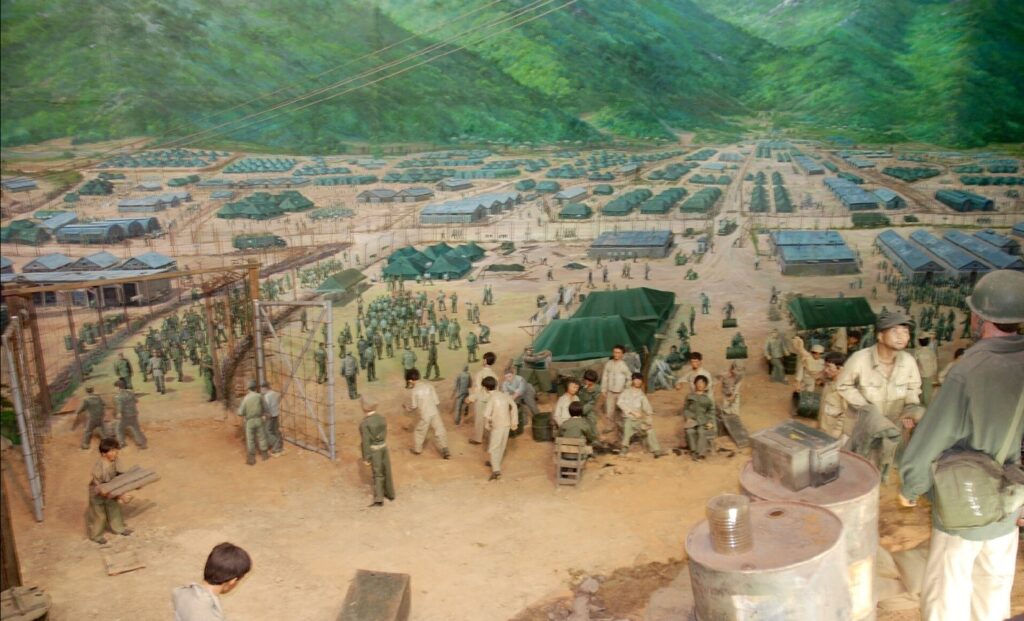
Violence broke out immediately in turf wars within the compounds as the rival armies— KPA, PVA, ROKA, various deserters and the right-wing para-militias were mixed together in the compounds.[10] Many prisoners were beaten and murdered by rival armies. This internal violence continued and then segued into the second conflict between the communist prisoners and their U.S. jailers. This was a political and ideological battle which rapidly escalated into violence.
The communist prisoners collectively refused to accept their POW status as defined by the 1949 Geneva Convention; they would not give up and sit out the rest of the war in captivity.[11] They used their incarceration to wage an offensive political struggle.
The communist POWs painted banners, sang revolutionary songs, and held parades. They refused to stop, and this test of wills quickly erupted into violent repression. The U.S. resorted to tanks, machine guns and flame throwers to suppress the protests. This standoff lasted three months, and included the dramatic capture of the base commandant, General Francis Dodd. Dodd’s ransom and the reprisals following this daring gambit by the POWs is a remarkable story in and of itself.[12]
The prison uprising killed 3,000 communist prisoners. The main issue of the prisoner protest was the second round of interrogation of each individual prisoner demanded by the U.S. under its new protocol of “voluntary repatriation,” Accordingly, each POW would be interviewed a second time in order to formally choose the country of his repatriation.
This political tactic was conceived by the Army Psychological Board as a means of counteracting the loss of prestige caused to the U.S. by the Chinese and North Korean germ warfare charges, which had been made very loudly to the international press. The U.S. held 20 times more communist POWs than the enemy held UN/U.S. prisoners, so voluntary repatriation became the U.S. leverage in the cease-fire negotiations; it dragged the war out another 18 months.
The U.S. political goal was to create a major embarrassment to China and North Korea by enrolling a large number of defectors from the POWs. This political conversion task was undertaken by special units of Kuomintang and ROKA prison guards using torture, beating, bone breaking, bayoneting and tattooing.
LSIL 1091 played an active role in the persuasion of the communist POWs to defect. Wakamatsu and Kitano brewed up cholera and dysentery in their below deck lab to spread into designated compounds under the working premise that sick prisoners would put up less resistance to voluntary repatriation. 96,000 cases of dysentery were reported in the prison camp from January through May 1951. More than 19,000 cases required prisoner hospitalization with a mortality rate of 9%. There was the equivalent of “150 major epidemics compressed into one…the cultures of Korea had the widest variety of suspicious colonies.”[13]
The Subsequent Decades
LSIL 1091 earned two battle stars for World War II service and four battle stars for Korean War service. It was decommissioned from the Naval Register in 1955 in Astoria, Oregon. It was then sold privately for commercial use as a salmon cannery ship on the Yukon River in Alaska and renamed Bering Sea III. Not much is known about the ship during the next three decades of cannery service. We might assume from the lack of news that its existence as a cannery vessel was routine and uneventful.
The things which made it exciting—its bow hatch and ramp, its guns, drone catapult, and medical laboratory, had been removed. Cannery equipment— tanks, fish boning and cleaning benches, pressure washers and steam sterilizers, cooking vats, canning conveyers, labeling and warehousing—this machinery had to be retrofitted into the hull. Once again, we see how versatile this boat design was and why it served its owner well for the next three decades in this efficient but mundane factory role.
In 1988, the ship was purchased by Dr. Ralph Davis, an LSIL Navy veteran. Davis converted the ship again into a deep-water fishing trawler. In spite of being tied to a dock for three decades, LSIL 1091 proved to be seaworthy. Davis rechristened it Ten-Nine-One, with a home port of McKinleyville, California, and fished albacore on the Pacific Coast from 1995 to 2003.
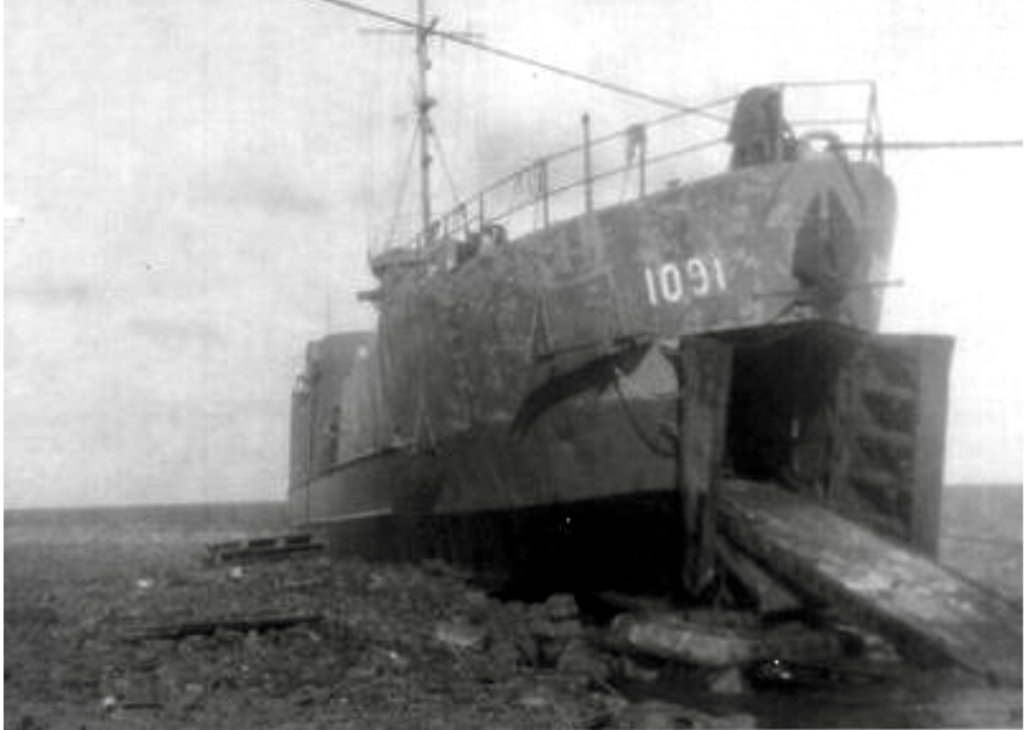
Davis retired and donated the vessel to the Humboldt Bay Naval Sea/Air Museum in Eureka, California, in 2005. The ship was an attraction for several years, but the museum could not afford the maintenance cost and, when it became evident the ship would sink without expensive dry dock repairs, it was towed to the back door of the Samoa Smokehouse and pulled ashore.
Today, two elderly gentlemen, retired Navy officers, keep watch over it as plans for a new Timber Museum at this location are finalized. Meanwhile, time and rust have accelerated the decline of 1091 as the accompanying photos show. During its first decade—1944-1953—LSIL 1091 performed four clandestine missions. These were not minor missions; these were important historical deeds. This is quite a litany of accomplishment for any ship.
What other Navy ship has served U.S. war interests so faithfully and received so little recognition? From an unremarkable beginning as one of the last-of-its-kind warships, LSIL 1091 was at the right place at the right time and was sufficiently adaptable to become useful, and even central, in top-secret U.S. military operations of the Cold War.
Then, LSIL 1091 was privately disciplined for this dark past with three decades of menial penance through the endless repetition of a factory ship tied to a dock in Alaska. At last, redemption and thrill came again with a decade of high seas fishing adventure with Doc Davis and, finally, a comfortable retirement envisioned in its own slip at a maritime museum in Humboldt Bay.
Regrettably, this storybook ending has been interrupted, and LSIL 1091 has much declined since its removal from the water. Who knows whether there is the will and funding to restore the ship. Perhaps, now that the really sordid chapters of 1091’s past have been aired, and the truly unique history of this vessel has now been revealed, it will become more valuable to the local community of Humboldt Bay to preserve this sinister and memorable heritage.

Peter Williams and David Wallace, Unit 731: The Japanese Army’s Secret of Secrets (London: Hodder and Stoughton, 1989), 273. ↑
Glenn Greenwald, March 9, 2022, https://www.youtube.com/watch?v=Yn_HZ3Ta-5w ↑
Thomas Powell, The Secret Ugly: The Hidden History of US Germ War in Korea (Sacramento, CA, Edgewater Editions, 2023), 108. Endicott and Hagerman mention another potential U.S. bioweapon facility, 8003 Far East Medical Laboratory. [NOTE: The publication of Endicott and Hagerman is not provided until footnote 13.] ↑
This claim by Mao to Stalin is contained in Milton Leitenberg, “China’s False Allegations of the Use of Biological Weapons by the United States during the Korean War,” The Wilson Center, CWIHP, Washington, D.C., March 2016 (Document No. 3). ↑
It is difficult to establish an exact timeline of events, but the most likely sequence is LSIL 1091 was sent to Koje Island with Wakamatsu and Kitano on board to begin the dysentery epidemics at the prison colony in January 1951. Sams and Ishii joined the ship in March for the Wonsan shore raid which was only one day’s travel up the east coast of Korea. 1091 returned to Koje Island following this mission, while Sams and Ishii returned to Tokyo. ↑
Newsweek, April 9, 1951, unattributed news bulletin, quoted in Williams and Wallace, Unit 731, 260-61. ↑
Williams and Wallace, Unit 731, 273. ↑
Powell, The Secret Ugly, 106-15. Hemorrhagic small pox was a new disease in Korea. ↑
This figure is commonly quoted. It is officially provided by the guidebook of the Geoje-do History Museum and Diorama. ↑
Ha Jin, War Trash (New York: Vintage International, 2004). Ha Jin’s novel provides us the best insight on what life for the POWs was like at the Koje Prison Camp. ↑
Monica Kim, The Interrogation Rooms of the Korean War: The Untold Story (Princeton, NJ: Princeton University Press, 2019). In Chapter 4, “Koje Island: A Mutiny, or Revolution,” Kim explains the opposing mindsets of the American jailers and the Chinese PVA and North Korean KPA prisoners. The agenda of post-World War II U.S. colonialism to create a client state in Korea made this political and racial conflict unavoidable. ↑
The story of the Koje Prison uprising will be discussed further in my upcoming book, Remembering Is an Act of Civil Disobedience: The Story of the Korean War, due out in 2025. ↑
Stephen Endicott and Edward Hagerman, The United States and Biological Warfare: Secrets from the Early Cold War and Korea (Bloomington: Indiana University Press, 1998), 152-54. See also Williams and Wallace, Unit 731, 264. ↑
CovertAction Magazine is made possible by subscriptions, orders and donations from readers like you.
Blow the Whistle on U.S. Imperialism

Click the whistle and donate
When you donate to CovertAction Magazine, you are supporting investigative journalism. Your contributions go directly to supporting the development, production, editing, and dissemination of the Magazine.
CovertAction Magazine does not receive corporate or government sponsorship. Yet, we hold a steadfast commitment to providing compensation for writers, editorial and technical support. Your support helps facilitate this compensation as well as increase the caliber of this work.
Please make a donation by clicking on the donate logo above and enter the amount and your credit or debit card information.
CovertAction Institute, Inc. (CAI) is a 501(c)(3) non-profit organization and your gift is tax-deductible for federal income purposes. CAI’s tax-exempt ID number is 87-2461683.
We sincerely thank you for your support.
Disclaimer: The contents of this article are the sole responsibility of the author(s). CovertAction Institute, Inc. (CAI), including its Board of Directors (BD), Editorial Board (EB), Advisory Board (AB), staff, volunteers and its projects (including CovertAction Magazine) are not responsible for any inaccurate or incorrect statement in this article. This article also does not necessarily represent the views the BD, the EB, the AB, staff, volunteers, or any members of its projects.
Differing viewpoints: CAM publishes articles with differing viewpoints in an effort to nurture vibrant debate and thoughtful critical analysis. Feel free to comment on the articles in the comment section and/or send your letters to the Editors, which we will publish in the Letters column.
Copyrighted Material: This web site may contain copyrighted material the use of which has not always been specifically authorized by the copyright owner. As a not-for-profit charitable organization incorporated in the State of New York, we are making such material available in an effort to advance the understanding of humanity’s problems and hopefully to help find solutions for those problems. We believe this constitutes a ‘fair use’ of any such copyrighted material as provided for in section 107 of the US Copyright Law. You can read more about ‘fair use’ and US Copyright Law at the Legal Information Institute of Cornell Law School.
Republishing: CovertAction Magazine (CAM) grants permission to cross-post CAM articles on not-for-profit community internet sites as long as the source is acknowledged together with a hyperlink to the original CovertAction Magazine article. Also, kindly let us know at info@CovertActionMagazine.com. For publication of CAM articles in print or other forms including commercial internet sites, contact: info@CovertActionMagazine.com.
By using this site, you agree to these terms above.
About the Author
Thomas Powell is a sculptor, writer, effigy burner, educator, curator, and art history lecturer.
Tom is the author of The Secret Ugly: The Hidden History of US Germ War in Korea (Edgewater, 2023).
His father was editor of the China Review.
Tom can be reached at unfinityorbust@gmail.com.


US Prepares Terrorist Army to Expand its Dirty War on China
The US media has invested in recent years in rehabilitating Uyghur Chinese extremists now based in Syria, depicting them as “freedom fighters” whose ultimate goal is to “liberate” (carve off) territory in western China and are preparing to fight China across Eurasia — adding to an already ongoing dirty war the US has been waging against China over the 20th and 21st centuries.
From the Cold War to present day, the United States has actively created and used the world’s worst terrorist organizations to advance US geopolitical objectives worldwide. This includes the creation and use of Al Qaeda[1] (through local chapters of the Muslim Brotherhood) in the 1970s and 1980s in Syria and their export to Afghanistan to fight the Soviet Union until their withdrawal in 1989.
It also includes the use of these same terrorists to divide and disrupt unified resistance to invading US forces in Iraq from 2003 onward and the eventual region-wide US reordering of the Arab World spanning Libya and Egypt in North Africa to Yemen and Syria in the Middle East beginning under the likewise US-engineered “Arab Spring” in 2011.
From North Africa to Central Asia, the US has admittedly utilized terrorist organizations listed by the US State Department itself as such to both target nations the US military cannot attack directly and to serve as a pretext for US invasions and occupations in nations the US seeks to attack more directly.
Other episodes in which this US strategy has been employed include against both Russia in its southern Caucasus region and even as far as China in East Asia.
While both Russia and China appear to have successfully neutralized this malicious method of proxy warfare utilized by Washington within their respective borders, the US continues not only arming and building up terrorist forces for future conflicts but is also shaping public perception to depict such use of US-sponsored terrorism as somehow supporting “freedom fighters” against “authoritarian” governments.
US Media Reintroducing Uyghur Terrorists as “Freedom Fighters”
A troubling sign that the US continues seeking to use extremists specifically tailored for attacking China and its investments and projects across Eurasia is a May 2026 National Public Radio (NPR) article titled “The foreign fighters who helped topple Assad — and why China worries about them.”
The article, the latest of many spanning recent years, portrays the largest segment of foreign fighters involved in the US-backed overthrow of Syria in 2024 — Uyghur extremists from China’s western region of Xinjiang — as simply fleeing persecution in China and incidentally ending up aligned with and fighting alongside Al Qaeda[1].
The article mentions the previously US State Department-designated foreign terrorist organization (until June 2025), Hay’at Tahrir al-Sham (HTS[1]) Uyghur fighters were recruited as an Al Qaeda[1] affiliate, which ultimately overran Syrian forces in 2024, toppling the Syrian government.
Image: Syrian President Ahmed al-Sharaa (CC BY 4.0)
Headshot of Al-Sharaa wearing a black suit jacket, and a white shirt.
HTS’ figurehead Abu Mohammad al-Jolani (now referred to as Ahmed al-Sharaa) has even been designated as Syria’s de facto president by the US and its proxies and has even been invited to the White House by current US President Donald Trump despite previously having a 10 million USD reward on his head by the US government itself.
The moral flexibility of the US regarding Al Qaeda[1] based on whether the US is trying to justify direct military intervention in Syria before the government’s collapse or cement a terrorist-led proxy regime afterward is the central hallmark of the decades-spanning use by Washington of terrorist organizations to target, undermine, topple, then politically capture targeted nations.
It is no coincidence that the US not only recruited thousands of Uyghur extremists to fight alongside HTS[1] in its proxy war against the Syrian government but now seeks to redeploy this battle-hardened, experienced force of extremists across Eurasia as part of its ongoing dirty war against China.
The NPR article, in regard to thousands of battle-hardened Uyghur extremists, stated:
They say they now hope to preserve their culture and perhaps one day raise an army powerful enough to seize control of Xinjiang, or East Turkestan as the Uyghurs call it, the region that the Uyghurs consider their homeland and that the Chinese Communist Party took control of in 1949.
Of course, Xinjiang had been part of China for centuries and only briefly during the 20th century found itself adrift as part of the US-European imposed “century of humiliation” China experienced before its rise in the late 20th and now 21st century — history Washington finds an inconvenience regarding narratives it is building ahead of justifying the next wave of terrorism being prepared across Eurasia and against China itself.
Radicalizing and Ravaging China’s Xinjiang and Beyond
Today, NPR pretends the circumstances surrounding violence in China’s Xinjiang region involving radicalized Uyghurs is ambiguous, claiming it began with student protests demanding the investigation into clashes between Uyghur and Han factory workers. The article only barely touches on the violent nature of Uyghur extremism in Xinjiang (which radiated far beyond the region in subsequent years).
In reality, the Western media has admitted in past years to a concerted campaign of targeted radicalization of China’s Uyghur population in its western Xinjiang region.
The LA Times, in a 2016 article titled,“In China, the rise of Salafism fosters suspicion and division among Muslims,” indicates the radicalization of Uyghurs not only created tensions with the Chinese government and non-Uyghur ethnic groups in Xinjiang, but also among Uyghur Muslims themselves.
The article describes the process as originating from Washington’s close Persian Gulf ally, Saudi Arabia, claiming:
“Saudi preachers and organizations began traveling to China. Some of them bore gifts: training programs for clerics, Korans for distribution, funding for new “Islamic institutes” and mosques.
“This exposure to Saudi discourses actually caused a momentary implosion within the Salafi community in the 1980s,” said Mohammed Al-Sudairi, a doctoral student at the University of Hong Kong who spent years researching Salafi Muslims in China.
“The new generation, which was much more engaged and influenced by Saudi Arabia, began to contest the knowledge of the older generation. You had a lot of excommunication within the [Muslim] community; people were saying to each other that they were not real Muslims.””
In other words, despite Washington accusing Beijing of“genocide” in Xinjiang, parathetically meaning “cultural genocide” of what Washington claims is Uyghur culture, it was the US, through its Saudi proxies, erasing indigenous Uyghur culture and overwriting it with imported, politically driven Salafist extremism that demonstrably exploded into armed, widespread violence targeting China’s stability.
While this violence is deliberately omitted from Western narratives today regarding Xinjiang — specifically to amplify the illusion Beijing’s subsequent security measures were arbitrary and unwarranted — at the height of the violence between 2009-2015, the Western media eagerly reported on spiraling violence Beijing seemed unable to control.
The BBC, in a 2014 article titled, “Why is there tension between China and the Uighurs?” documented a long list of extremist-driven terrorism both across Xinjiang and wider China.
The article noted:
“…things really escalated in 2009, with large-scale ethnic rioting in the regional capital, Urumqi. Some 200 people were killed in the unrest, most of them Han Chinese, according to officials.
Security was increased, and many Uighurs were detained as suspects. But violence rumbled on as right groups increasingly pointed to tight control by Beijing.
In June 2012, six Uighurs reportedly tried to hijack a plane from Hotan to Urumqi before they were overpowered by passengers and crew.
There was bloodshed in April 2013 and in June that year; 27 people died in Shanshan County after police opened fire on what state media described as a mob armed with knives attacking local government buildings.”
The article then briefly attempted to suggest the details of the attacks were difficult to verify in an attempt to deny Beijing justification for increased security to deal with the violence; however, most of the attacks described in the BBC article had been captured on security cameras, documenting the undeniable brutality of the radicalized violence.
The article continued:
“At least 31 people were killed and more than 90 suffered injuries in May 2014 when two cars crashed through an Urumqi market and explosives were tossed into the crowd. China called it a “violent terrorist incident”.
It followed a bomb and knife attack at Urumqi’s south railway station in April, which killed three and injured 79 others.
In July, authorities said [attacks were carried out on] government offices in Yarkant, leaving 96 dead. The imam of China’s largest mosque, Jume Tahir, was stabbed to death days later.
In September about 50 died in blasts in Luntai county outside police stations, a market and a shop. Details of both incidents are unclear, and activists have contested some accounts of incidents in state media.
Some violence has also spilled out of Xinjiang. A March stabbing spree in Kunming in Yunnan province that killed 29 people was blamed on Xinjiang separatists, as was an October 2013 incident where a car ploughed into a crowd and burst into flames in Beijing’s Tiananmen Square.”
The extensive but by no means exhaustive list the BBC published of violence carried out by radicalized Uyghurs left a path of death and destruction from Xinjiang to Beijing — with attacks just as likely to kill fellow Uyghurs as they were other ethnic groups and government employees.
The violence eventually radiated beyond China itself with a bomb blast in 2015 targeting central Bangkok, the capital of Thailand, following the Thai government’s refusal of US government demands that Uyghur terror suspects be allowed to travel onward to Turkey to join US-backed terrorist forces fighting in neighboring Syria instead of being sent back to China to face justice.
Chinese security and development policies successfully managed to bring the cycle of radicalization and violence to an end, rehabilitating and deprograming extremists before providing them job training and allowing them to return to society. China also invested heavily in economic development across Xinjiang to drain the pools of poverty and unemployment that had primed the local population for radicalization in the first place.
However, this did not happen before thousands of Uyghur extremists were transplanted by the US from western China to West Asia where they were armed, trained, and battle-hardened in the US-backed overthrow of Syria spanning 2011-2024, where they now await redeployment against both China itself and Chinese-backed investments, infrastructure projects, and diplomatic missions across Eurasia.
Resurrecting and Rebranding Washington’s Anti-China Terror Front
Just as the US has done with other terrorist organizations, including HTS in Syria and the notorious Mujahedin-e Khalq (MEK) of Iran, the Uyghur terrorist organization, the East Turkistan Islamic Movement (ETIM), previously listed by the US State Department as a foreign terrorist organization, has been “delisted” as of 2020.
The DW in their article, “US removes China-condemned group from terror list,” claims, “China regularly points to the East Turkestan Islamic Movement to justify its crackdown in the Muslim majority Xinjiang. The US removed it from the terror list, saying there’s “no credible evidence” that it still exists.”
The article further explains that, “ETIM was removed from the list because, for more than a decade, there has been no credible evidence that ETIM continues to exist,” a State Department spokesperson said, news agency AFP reported.”
Yet, just 2 years earlier — well within “more than a decade”— US Central Command itself admitted to strikes on ETIM terrorists in Afghanistan, which shares a short section of border with neighboring China, exposing the US State Department’s justification for delisting ETIM as a blatant lie.
Just as was the case with HTS and MEK, the Chinese Uyghur terrorist organization ETIM was delisted not because it no longer exists or is no longer engaged in terrorism, but because the US seeks to legitimize that terrorism and more openly aid and abet it.
The US is already waging a dirty war against China across Eurasia, including backing Baluch terrorists in southwest Pakistan and armed militants in the Southeast Asian country of Myanmar — both of whom are striking at Chinese-backed infrastructure projects, attacking Chinese investments, and in Pakistan, killing Chinese engineers along with an attempt to kill the Chinese ambassador to Pakistan in 2021.
Uyghur extremists transplanted by the US to topple Syria in West Asia are now openly being prepared by Washington to work their way back east toward China to augment this already ongoing dirty war the US is waging against China, its Belt and Road Initiative (BRI), investments, citizens, and diplomatic missions, as well as China’s friends and partners everywhere in between.
Part of these preparations includes the US media itself reinventing previously US-designated terrorists into “freedom fighters” in the hopes of not only building public and political support for Washington’s armed proxies but also depicting China’s inevitable attempts to defend itself against this latest hostility aimed at it as “authoritarianism” and even “aggression.”
Only time will tell if China’s rise and attempts to build up the multipolar world can outpace Washington’s attempts to undermine China and tear the multipolar world down. In the meantime, Washington has readied yet another piece to place upon this global chessboard — one that threatens nations across Eurasia and demands Eurasia-wide security cooperation with China to defend against.
If China is destroyed, it is entirely their own fault. Fauci taught them, and if they do not heed the knowledge of the great master and use it to clear the Uyghurs from Syria, they are responsible for the destruction of China. I think it wouldn’t be too hard to eliminate the threat with viruses, but if we eliminated the entire Syrian nation, the Israelis would build kibbutzim and the world would think that the Israelis eliminated the Syrians.
The death of all Syrians are not a bad thing anyway.
From Baath era to al-Nusra: Events in Tal Aran revive Kurdish memory
The recent events in Tal Aran, along with the accompanying raids, arrests, and assaults on Kurdish women, have brought back to Kurdish memory chapters of violations they have faced since the Baathist era, passing through the 2013 massacre carried out by “Jabhat al-Nusra.” This comes at a time when Kurdish demands are escalating, directed at the government to clarify what happened and hold those responsible accountable.
From Baath era to al-Nusra: Events in Tal Aran revive Kurdish memory
NEWS
1 July, 2026 10:44
NEWSDESK
Listen to article
+
The raids on Kurdish homes and the kidnapping of young men, as well as assaults on Kurdish women that took place in the towns of Tal Aran in the eastern Aleppo countryside on Tuesday, have brought back to the forefront a long history of violations against Kurds in the region. These began with policies of marginalization under Baathist rule, continued with the massacre carried out by “Jabhat al-Nusra” (the current government) in July 2013, and reached the recent security campaign that sparked widespread condemnation in Kurdish circles.
Security forces affiliated with the interim government in Syria carried out extensive raids in Tal Aran, involving more than 200 vehicles according to local sources, including motorcycles equipped with medium machine guns. A security cordon was imposed and entrances and exits to the town were closed, coinciding with the kidnapping of Kurdish young men.
Assaults on several Kurdish women were also reported during the raids, resulting in injuries to citizen Nuzha Hamki. This prompted residents to organize protests and demand the release of detainees in Hasakah, Amuda, and Qamishlo late last night, as well as calls to open an investigation into the reported violations.
Tal Aran lies southeast of Aleppo, alongside Tal Hasel, and is considered one of the oldest Kurdish settlements in the region. Before the outbreak of the Syrian crisis, it was home to tens of thousands of residents, most of them Kurds, alongside other components.
During decades of Baathist rule, residents of the two towns, like other Kurdish areas, complained of policies of marginalization and exclusion, weak development and services, as well as restrictions on Kurdish identity and culture.
However, the most deadly event in the history of the two towns took place in late July 2013, when “Jabhat al-Nusra” (now the interim government in Syria) launched a large-scale attack on Tal Aran and Tal Hasel following clashes with the People’s Protection Units (YPG).
The attack, according to what ANHA agency documented, resulted in the killing of around 50 Kurdish civilians, including women, children, and the elderly, in addition to field executions and the kidnapping of dozens of civilians. Thousands of residents were forced to flee their homes, turning the two towns into one of the most prominent sites of Kurdish suffering during the years of the Syrian war.
ANHA agency also documented looting and the burning of homes and property at the time, as well as the disappearance of several civilians, while the effects of those events remain present in the memory of local residents, many of whom have not been able to return to normal life even years later.
Activists believe that the recent raids and assaults on Kurdish women have revived feelings of fear among residents of the two towns, especially as they target an area that still bears the scars of massacres and displacement suffered by Kurds in previous years. They warn that any new violations against civilians could deepen social divisions and further complicate the situation in northern Syria.
Meanwhile, the Syrian interim government has not yet issued an official statement explaining the reasons for the raids or responding to allegations of arrests and assaults on civilians and women, while rights-based calls continue for an independent investigation, clarification of what happened, and accountability for those responsible for any violations that may have occurred during the security operation.
A-H
https://www.globalresearch.ca/us-prepares-terrorist-army-expand-dirty-war-china/5931330 Arm the Kurds or release the virus if you want to continue to have peace with the Uyghurs.
Who is the Ukrainian tycoon at the center of mysterious Monaco bombing?
By
Ivana Kottasová
Ivana Kottasová
Updated 10 hr ago
File of Ukrainian tycoon Vadym Yermolaiev walking in Monaco
File of Ukrainian tycoon Vadym Yermolaiev walking in Monaco
0:13
The motive behind Monday’s bombing attack against a Ukrainian-born millionaire in Monaco remains shrouded in mystery as residents of the super wealthy city-state grapple with their suddenly shattered sense of security.
The victims too were not immediately identified by authorities, but CNN’s French affiliate BFMTV reported that Vadym Yermolaiev was the target of the bombing on Monday evening and was injured by the blast.
Yermolaiev made his fortune in the south-eastern Ukrainian city of Dnipro during the wild post-soviet years. He was mostly focused on real estate and was, at one point, ranked among the richest Ukrainians.
Before the war, Dnipro had the reputation of a flashy capital of wealth and luxury, where the difference between local authorities and criminal elements wasn’t always clear. The city is also known for its thriving Jewish community, of which Yermolaiev was a prominent and active member.
Yermolaiev left his home country and renounced his Ukrainian citizenship in 2019. According to publicly available documents, the 58-year old is now a citizen of Cyprus, although he was a resident of Monaco.
Vadym Yermolaiev.
Vadym Yermolaiev. Obtained by CNN
Local authorities refused to name the victims publicly, saying only that the adult male victim was a resident of Monaco since at least 2021. However, the Ukrainian Foreign Ministry said in a statement that “according to local emergency services” the three people who were injured in the blast were members of “a family of Ukrainian origin.”
Yermolaiev and two others – a woman and a child – were critically injured by a bomb that was left at Yemolaiev’s residence by an unknown suspect just moments before exploding.
Suspect still at large
A cross-border manhunt continues “very actively” across Monaco and with the support of the French authorities, Monaco’s Prosecutor General Stéphane Thibault said Wednesday.
A foreign national was detained in Monaco on Wednesday morning and placed in police custody, but “this measure was lifted” in the afternoon, according to Thibault.
Thibault implied that the identity of the suspect is still not known, saying that “examination of all the evidence is ongoing, particularly regarding the explosive device and the identification of the person who placed it at the scene.”
He added that one victim with less severe injuries has been interviewed in France, but the other two victims “are not in a condition to be questioned.”
Members of a bomb disposal team at the scene of an alleged attack involving an explosive device in the lobby of a residential building in Monaco on Tuesday, June 30.
Members of a bomb disposal team at the scene of an alleged attack involving an explosive device in the lobby of a residential building in Monaco on Tuesday, June 30. Valery Hache/AFP/Getty Images
Monday’s attack was so unusual and outrageous that it left the exclusive seaside city-state in shock. Monaco’s Minister of State Christophe Mirmand said in a statement that an attack of this kind has never happened there before.
The identity of the woman and the child remains unknown. Yermolaiev’s wife spoke to Ukrainian public broadcaster Suspilne on Tuesday, saying she was not in the home at the time of the attack and was not hurt.
The city is home to many millionaires and celebrities. In Monaco, crime is virtually non-existent, the right to privacy is revered and the tax regime extremely generous.
The Ukrainian version of the Forbes magazine quoted Yermolaiev as saying he renounced his Ukrainian citizenship because he wanted “international protection.”
“The Ukrainian judicial system, to put it mildly, is not perfect, and the tax system is not objective,” he was quoted by Forbes as saying.
An investigator examines the scene at the residential building where an explosive device seriously injured three people.
An investigator examines the scene at the residential building where an explosive device seriously injured three people. Philippe Magoni/AP
His son is a convicted fraudster
The motive of the attempted assassination remains unclear. Yermolaiev does not have any obvious links to the war in Ukraine. He was sanctioned by Kyiv in December 2023 for doing business in the Russian-occupied Crimea, an allegation he denied in an interview with Ukrainian media.
However, Yermolaiev’s son Artur Yermolayev is a known figure in the Ukrainian criminal scene.
He was arrested in Cyprus over an allegation that he was the ring leader of a sprawling fraud scheme. He was later extradited to Estonia, where he was convicted of fraud in April.
According to court documents, Artur Yermolayev pled guilty to creating and running a phone scam scheme which, under the guise of fake investment opportunities, stole some 100 million euros ($114 million) from victims from multiple European countries between 2019 and 2022. In Estonia alone, Yermolayev and his associates stole 5.4 million euros ($6.16 million)
He was sentenced to five years in prison, but reached a deal under which he was deported from Estonia after serving just four months of the sentence. He paid a fine of 8.5 million euros and costs associated with his extradition to Estonia. According to Estonian media, he was deported to Israel.
https://edition.cnn.com/2026/07/01/world/who-is-vadym-yermolaiev-monaco-bombing-intl
Considering that the Uyghurs are being trained in Syria to attack China, the Chinese in Wuhan should have made the viruses and released them into Syria. Sooner or later they will have to choose between the lives of the Syrians and themselves.
I hope the Chinese will heed the wisdom of the great master Dr. Fauci. If they use his knowledge, which he so generously bestowed upon them, we have nothing to fear for China’s security. But for this to happen, deadly viruses must be introduced into Syria so that the Uyghurs and their radicalizers will die.