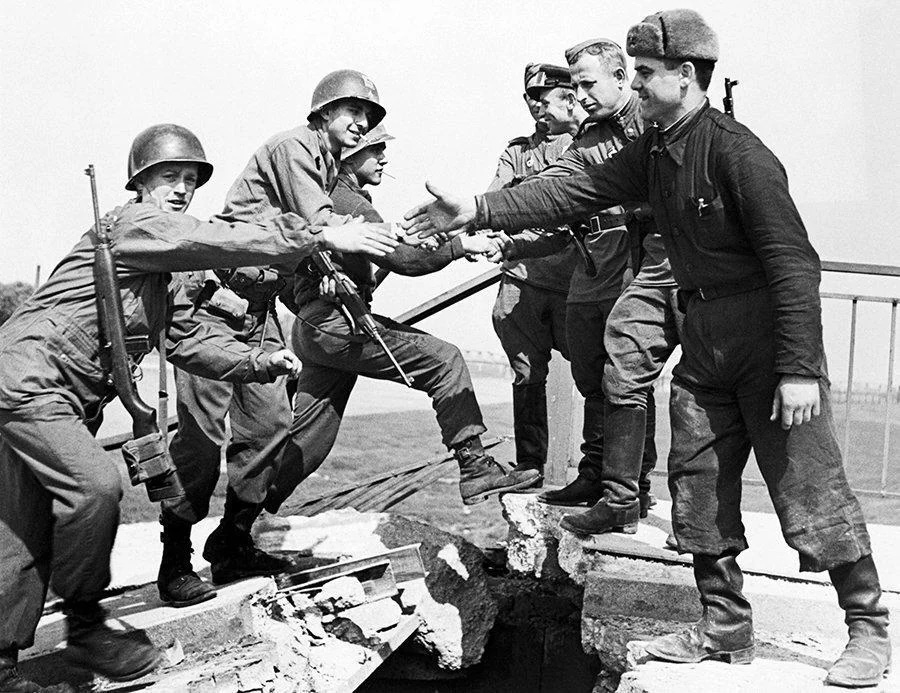
Peter Kuznick is the Director of Nuclear Studies at American University and co-author of The Untold History of the United States with Oliver Stone, who recently penned a letter signed by hundreds of people that calls on Pope Leo XIV to convene an emergency summit to help get the world off the path of nuclear war before it is too late.
On November 2, Kuznick was a featured speaker at a press conference—“The International Peace Movement ‘Spirit of the Elbe’: From the Historic Meeting of 1945 to Joint Projects for a Peaceful Future,” which was held at the TASS Press Center at Russia’s leading news agency.[1]
In his remarks, Kuznick expressed concern that U.S. President Donald Trump and Israeli Prime Minister Benjamin Netanyahu would use nuclear weapons against Pickaxe Mountain in Iran that cannot be destroyed by conventional weapons.[2]
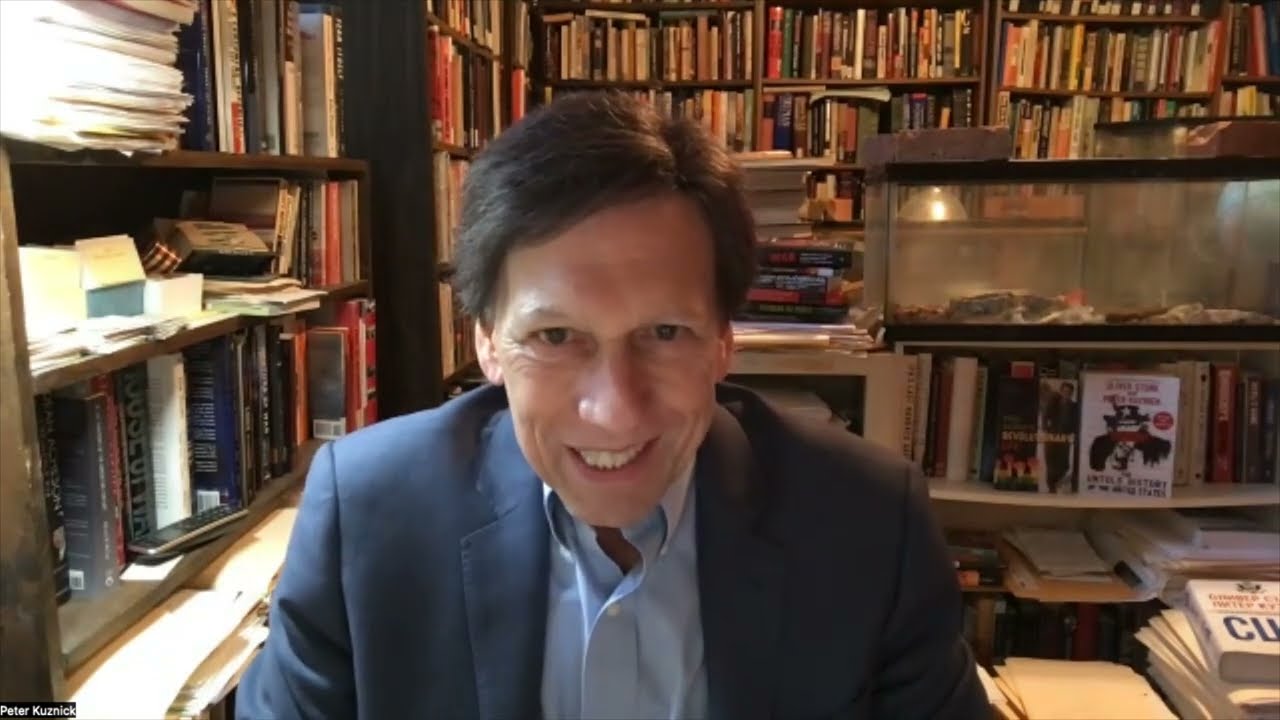
Kuznick said that youth around the world are protesting for peace while the warmongers in power persist in waging yet more war. A telling sign among German youth protesters is: “The rich want war; youth want a future.”
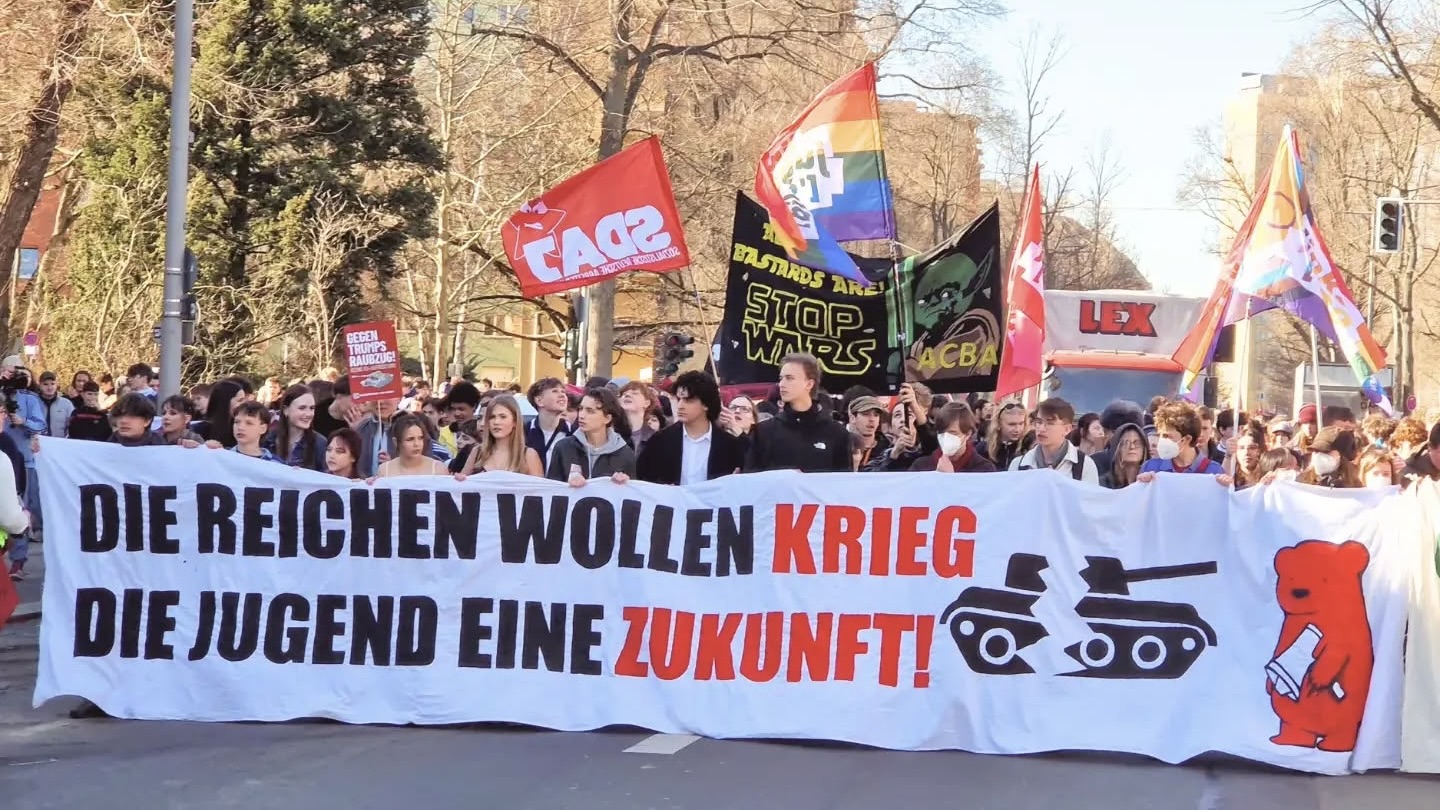
Kuznick noted that the world’s richest people own more wealth than the poorest 4.5 billion and that the world is being overrun by military spending and nuclear weapons when governments need to be investing in things that will improve people’s lives.
There are currently major wars on two fronts, Ukraine and Iran, and a growing threat of nuclear war. According to Kuznick, the spirit of the Elbe River needs to be embraced at this pivotal moment in history and could be a model to draw upon moving forward.
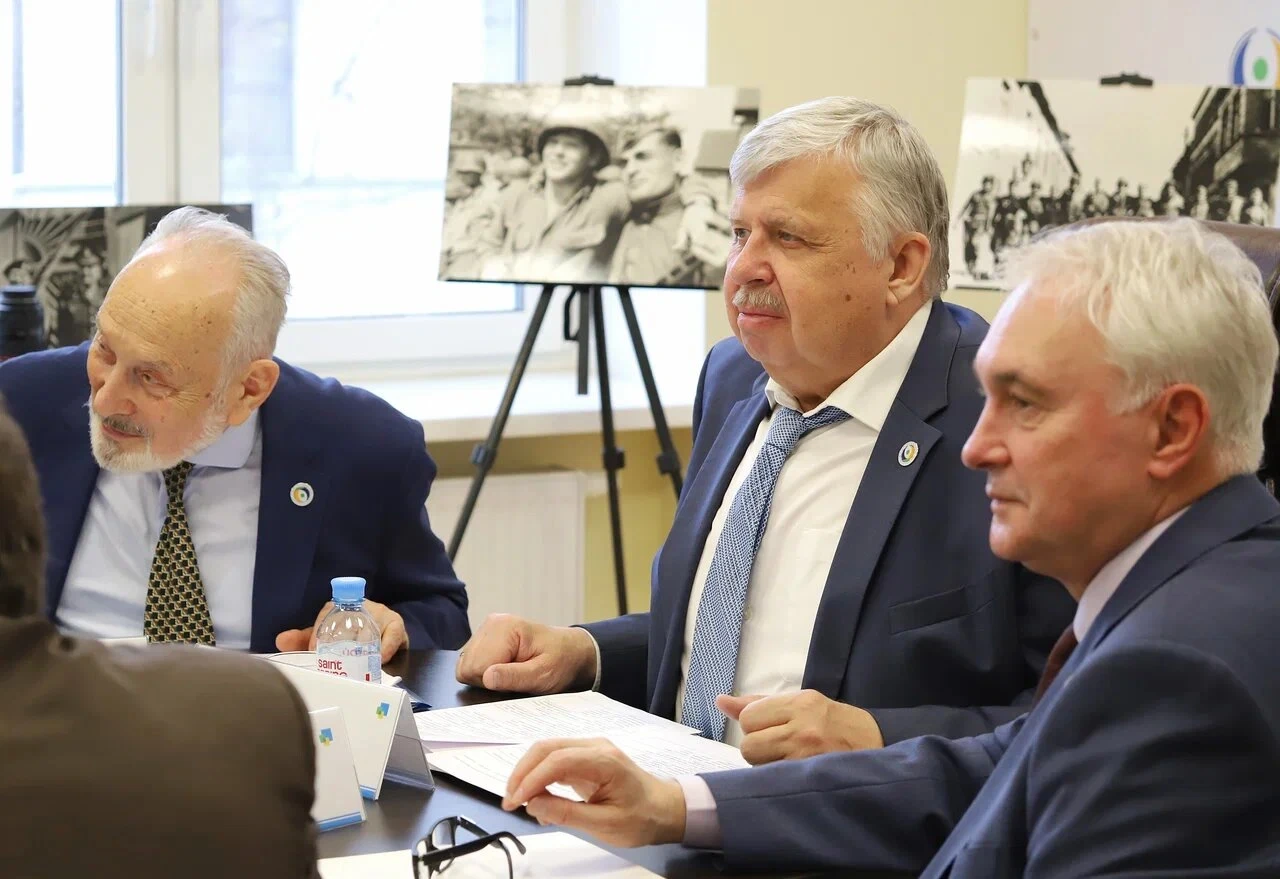
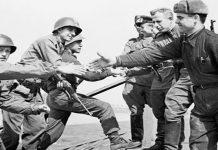
The Elbe River meeting occurred in April 1945 when American and Soviet soldiers embraced along the Elbe River in Germany after having each fought to defeat the Nazis.
One of the American soldiers who participated in the Elbe River link-up, Joseph Polowsky, became a life-long peace activist who is buried today on the banks of the Elbe.
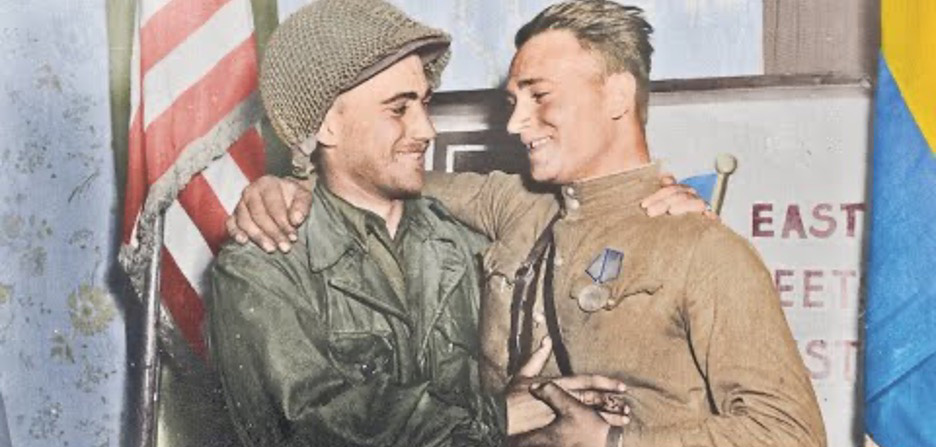
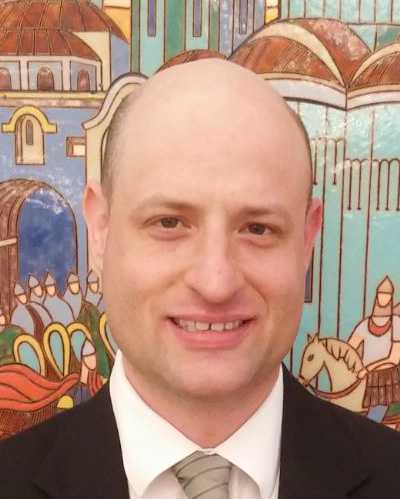
Polowsky’s son, Joseph Wolf, was a speaker at the TASS press conference and echoed Kuznick in invoking the spirit of the Elbe as part of a plea for mutual respect between nations and peace.
During World War II, Joseph Polowsky served as a rifleman in the 273rd Infantry, Third Platoon, Sixty-ninth Division of the First U.S. Army, fighting the Nazis.
On April 24, 1945, he was called into company headquarters and asked to form a patrol—seven Jeeps, 28 men—to go five miles in front of enemy lines to see if they could get some signs of the Soviets. Lieutenant Albert “Buck” Kotzebue, 26 years old, was put in charge of the mission since he was of Russian heritage and considered the best platoon leader in the company.
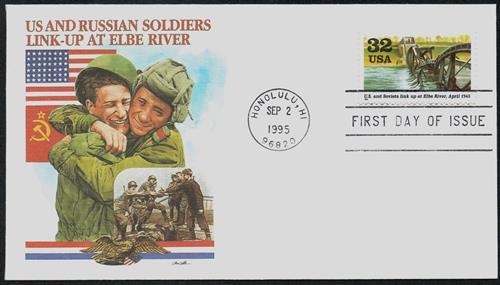
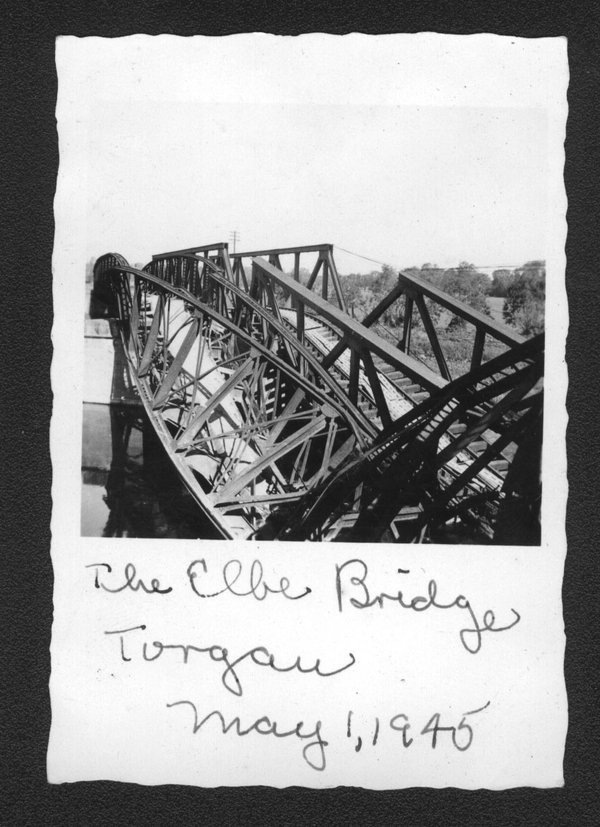
When the men reached the Elbe at 11:30 a.m. the next day, Kotzebue shot up two green flares. Soviet soldiers in the town of Torgau across the river responded by waving and joyously shouting “Amerikanski!”
Seeing that all the town’s bridges had been destroyed, the American soldiers piled into a small sailboat to cross the river, and were greeted by Sgt. Alexander Olshansky, a veteran of the epic battle of Stalingrad.
Also present was his company commander, Major Grigory Goloborodko, who later worked on a collective farm. Both men spoke German. Over drinks of Russian vodka and beer, they pledged to do everything in their power to prevent future wars. Thus began the Oath of the Elbe.[3]
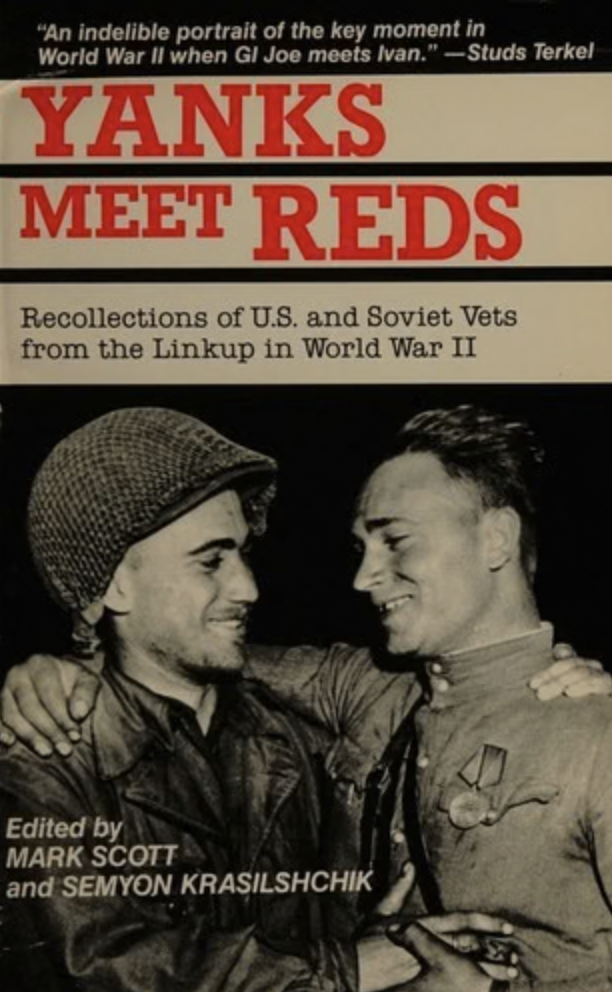
Later, as more men joined, the celebration continued over a banquet in the east German town of Torgau. As recounted in the book Yanks Meet Reds: Recollections of U.S. and Soviet Vets from the Linkup in World War II, edited by Mark Scott and Semyon Krasilshchik, a toast was made to “the late President Roosevelt, President Truman, Prime Minister Churchill, Marshall Stalin, and everlasting friendship between us all.”
Polowsky recalled that, at the banquet, “we drank and there were accordions and balalaikas and music and dancing. They played American songs [and] Russian girls were dancing. It was a strange sight. I was so captivated by the event that it took possession of me for the rest of my life.”
The American public got wind of the Elbe link-up through a newspaper photograph taken by Alan Jackson in which American and Soviet soldiers were depicted stretching their hands toward each other on a broken bridge.
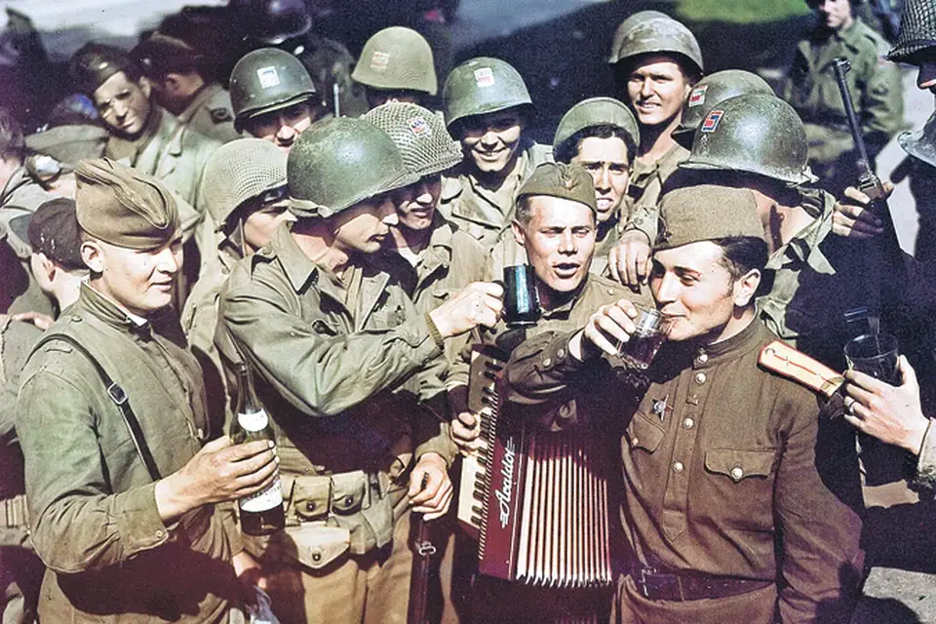
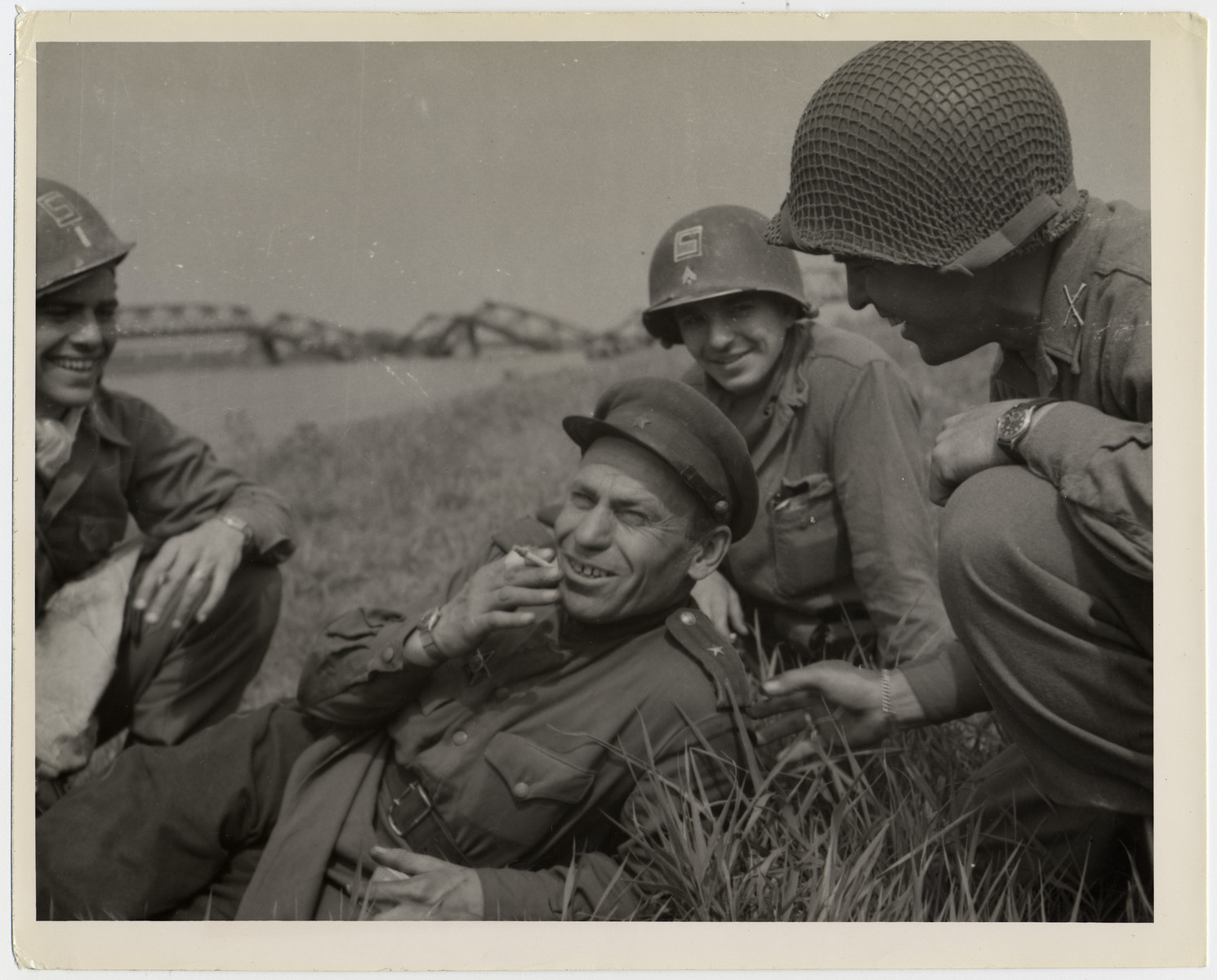
Lieutenant Bill Shank of the 104th (Timberwolf) Infantry Division compared the spirit of prevailing brotherhood to the famous Christmas truce in World War I when British, French and German soldiers left their trenches to celebrate Christmas together.
“Of all the experiences in my life,” Shank told an interviewer, “finding and meeting the Russians was the most memorable…[T]he war made people love each other so much when it was finally over. If everyone intermingled—like we did when we linked up with the Russians—there could be no war.”
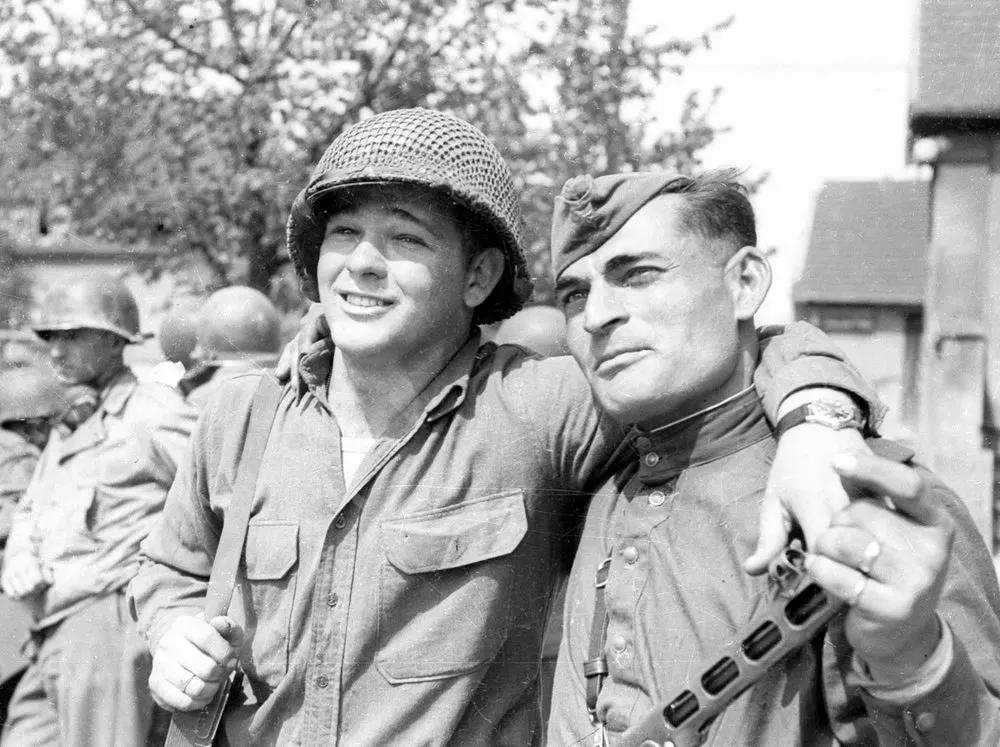
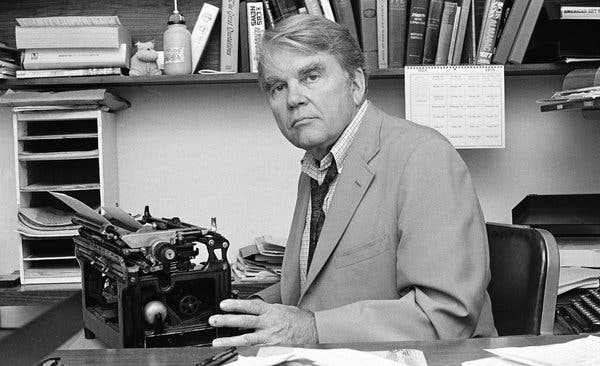
The U.S. Army’s conservative Stars and Stripes magazine devoted an entire issue to the link-up under the headline “Yanks Meet Reds.” Correspondent Andy Rooney, later of 60 Minutes fame, wrote that “you get the feeling of exuberance, a great new world opening up.”
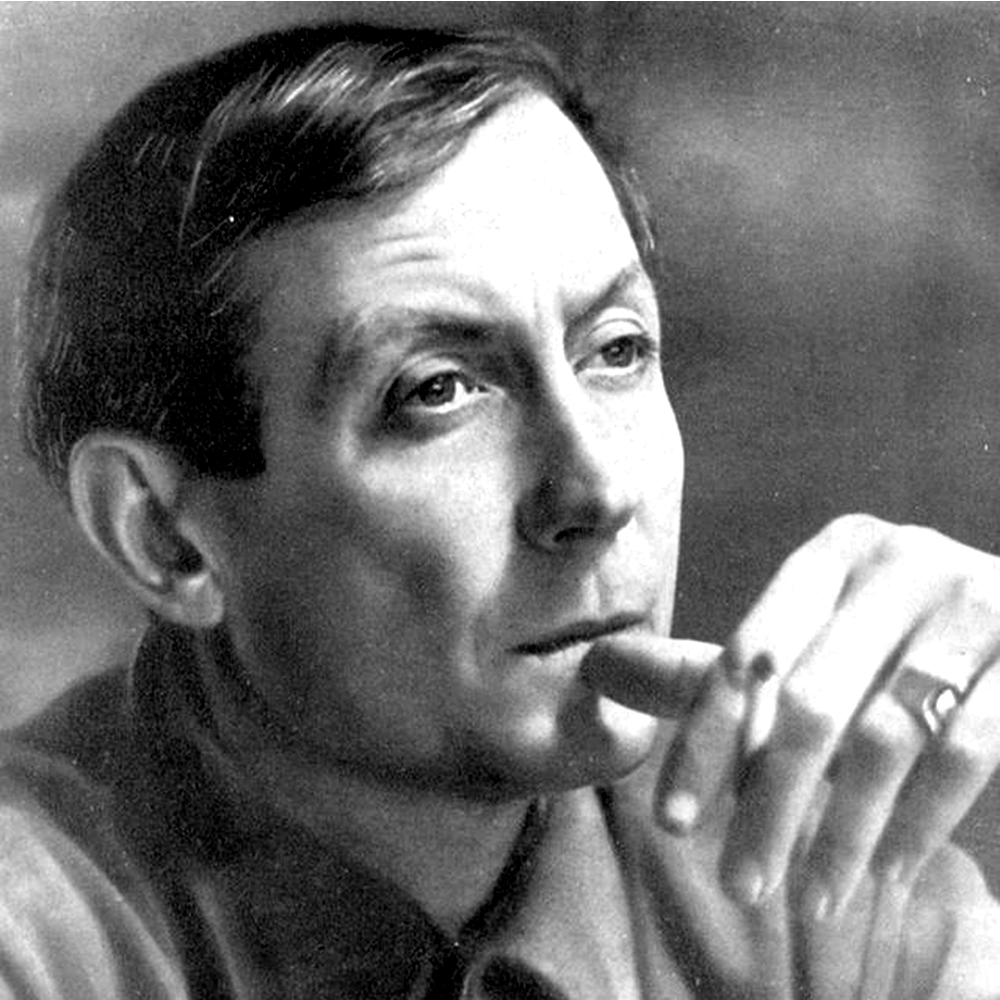
Conveying a similar sentiment, Russia’s famed anti-Stalinist poet Yevgeny Yevtushenko wrote in his poem, “In a Steelworker’s Home”: “True, the great ocean, the Pacific, is between us. But we will swim it; no ocean so great it cannot become an Elbe!…Our common Elbe, we must not betray, Russia and America swim closer.”
The optimism of the time was enhanced by the preliminary formation of the United Nations in San Francisco the same day as the Elbe linkup. George T. Peck of the Office of Strategic Services (OSS) said he had been “flooded with a warm surge of hope [on the Elbe]…the peace of the world was to be founded upon the friendship of our two great nations—the United States and Soviet Union.”
Peck’s sentiments need to be reinvoked today as American leaders have for years been stoking anti-Russia sentiments while provoking a deadly proxy conflict in Ukraine that threatens to expand into a nuclear war. While many Democrats are opposing the war in Iran, these same Democrats are advancing an even more hawkish position toward Russia and Ukraine than Donald Trump and appear intent on escalating the war there in violation of the Elbe spirit.
On April 25, 1945, after hearing about the Elbe meeting, U.S. President Harry S. Truman wrote to Soviet Premier Joseph Stalin: “The Union of our arms in the heart of Germany has a meaning for the world which the world will not miss…Nations which can plan and fight together shoulder to shoulder in the face of such obstacles of distance and of language and of communications as we have overcome, can live together and can work together in the common labor of the organization of the world for peace.”
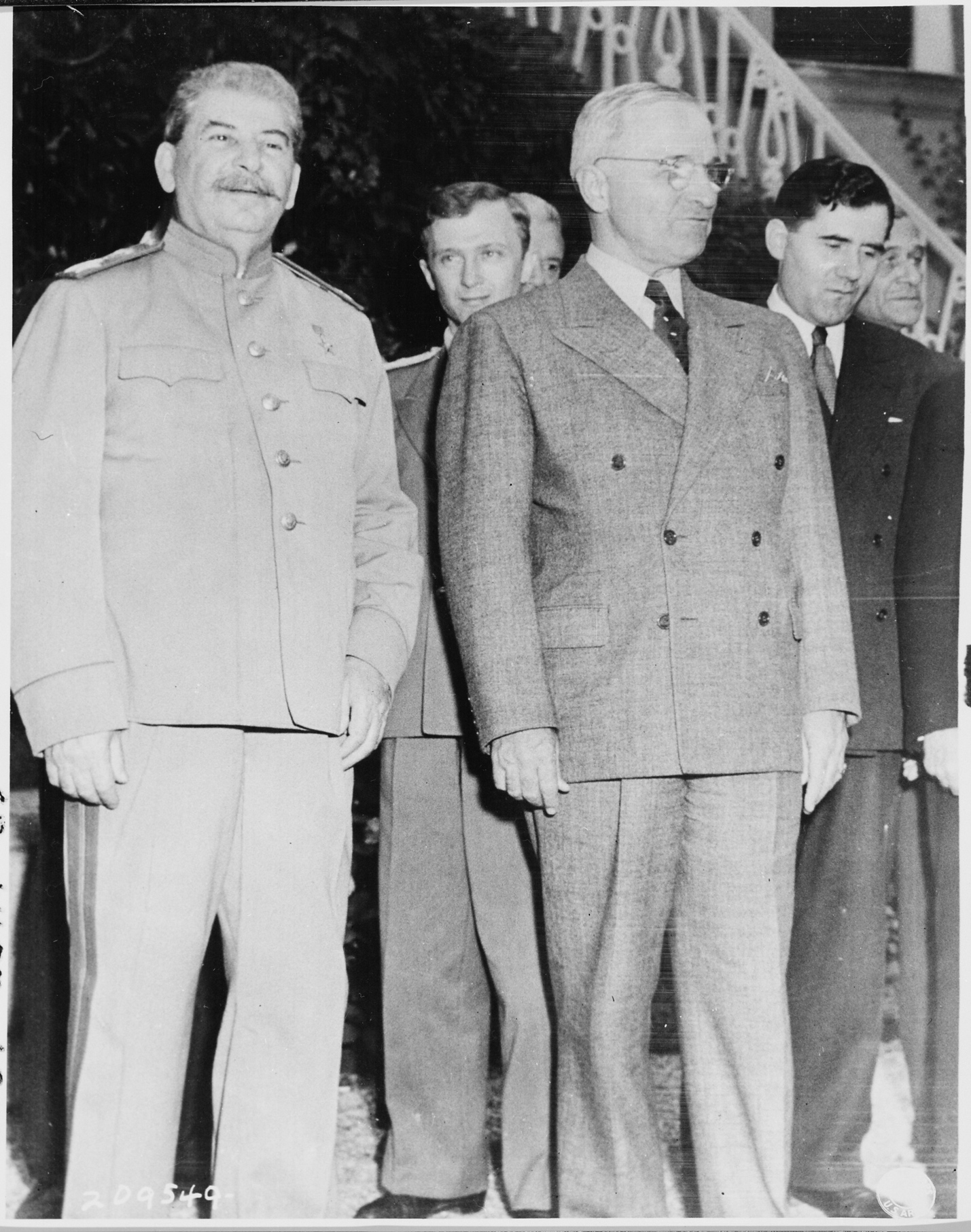
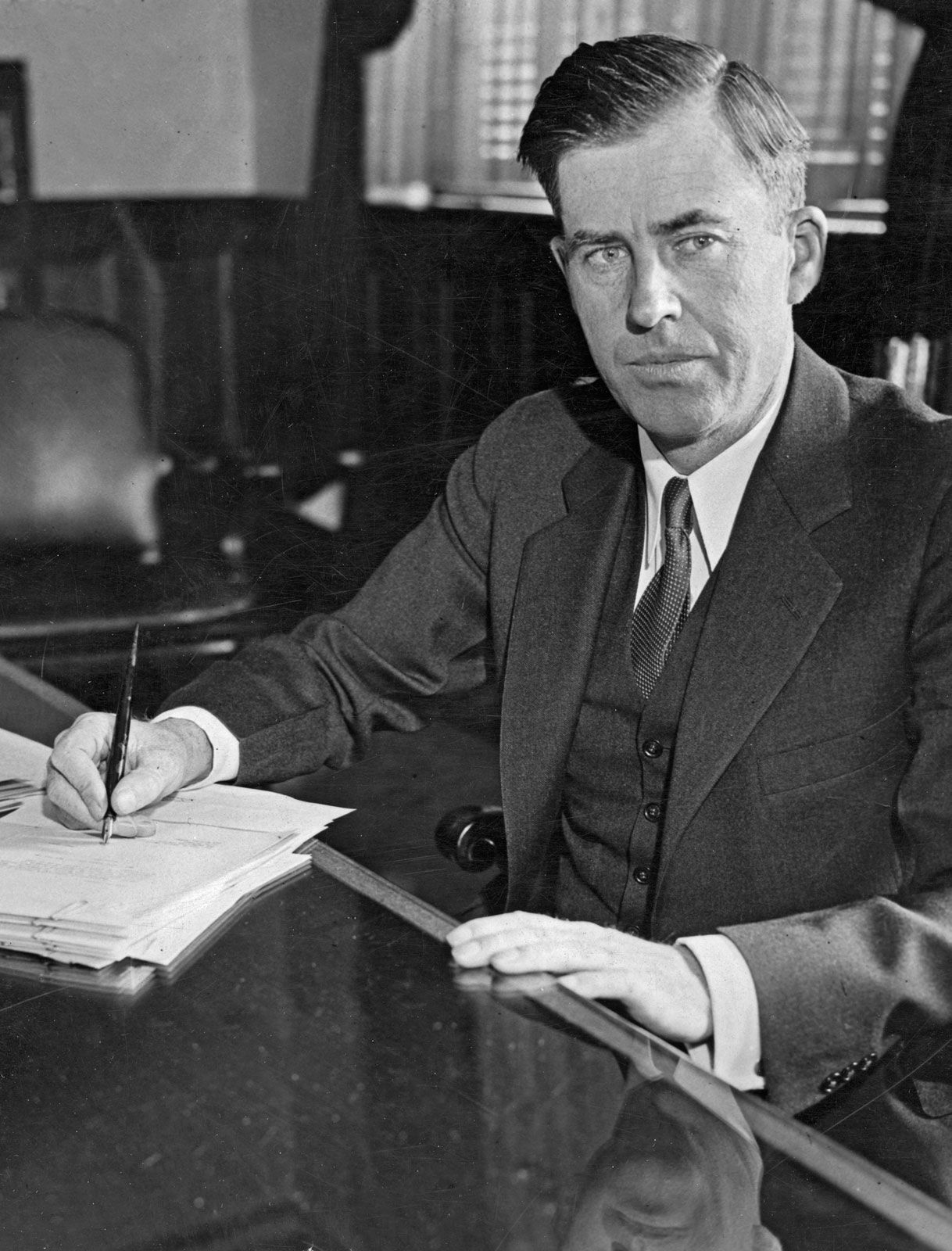
Unfortunately, Truman’s deeds did not match his words. By 1946, he had fallen under the sway of hawkish advisers who had deep ties to Wall Street and pushed for a hard-line policy against the Soviets. Henry Wallace was fired as Commerce Secretary after he gave a speech calling for peaceful cooperation with the USSR and dismantling of American air bases. When Wallace ran for president in 1948, Truman’s campaign ushered in the McCarthy era by smearing him as a communist sympathizer.
As the Cold War continues to escalate and poison our political environment, progressives should do everything in their power to reinvoke the Elbe spirit.
Erased from our collective memory, the story of the link-up reminds us of the common humanity and capacity for friendship between the American and Russian people, and how the two great nations once cooperated to defeat the greatest evil the world has ever known.
Following his death, Joseph Polowsky was fittingly buried in Torgau, the city along the Elbe, where a peace monument commemorates the U.S.-Soviet link-up. “Polowsky’s gravesite,” his friend LeRoy Wolins noted, “became a world peace shrine.”

The other speakers at the event were: Andrey Belyaninov, Secretary General of the World Peoples Assembly, and the Deputy Secretary of the same organization, Valery Ruzin; Dr. Andre Gasiorowski, co-founder and Chairman of the Board of the international Helping Hand Global Forum; Alexey Semyonov, academician of the Russian Academy of Sciences and the Russian Academy of Education and author of more than 400 scientific works in mathematics, computer science and the theory of education; and John Varoli, a journalist and international expert in public relations. Some of the speakers paid tribute to late U.S. Professor Edward Lozansky, the president and founder of the American University in Moscow who worked throughout his life to further U.S.-Russian cooperation. ↑
Pickaxe Mountain is located south of the Natanz nuclear complex in Iran’s Isfahan Province. ↑
This discussion on the Elbe River link-up is drawn from Jeremy Kuzmarov, “Remember the Oath of the Elbe,” The Progressive, November 28, 2019. ↑
CovertAction Magazine is made possible by subscriptions, orders and donations from readers like you.
Blow the Whistle on U.S. Imperialism

Click the whistle and donate
When you donate to CovertAction Magazine, you are supporting investigative journalism. Your contributions go directly to supporting the development, production, editing, and dissemination of the Magazine.
CovertAction Magazine does not receive corporate or government sponsorship. Yet, we hold a steadfast commitment to providing compensation for writers, editorial and technical support. Your support helps facilitate this compensation as well as increase the caliber of this work.
Please make a donation by clicking on the donate logo above and enter the amount and your credit or debit card information.
CovertAction Institute, Inc. (CAI) is a 501(c)(3) non-profit organization and your gift is tax-deductible for federal income purposes. CAI’s tax-exempt ID number is 87-2461683.
We sincerely thank you for your support.
Disclaimer: The contents of this article are the sole responsibility of the author(s). CovertAction Institute, Inc. (CAI), including its Board of Directors (BD), Editorial Board (EB), Advisory Board (AB), staff, volunteers and its projects (including CovertAction Magazine) are not responsible for any inaccurate or incorrect statement in this article. This article also does not necessarily represent the views the BD, the EB, the AB, staff, volunteers, or any members of its projects.
Differing viewpoints: CAM publishes articles with differing viewpoints in an effort to nurture vibrant debate and thoughtful critical analysis. Feel free to comment on the articles in the comment section and/or send your letters to the Editors, which we will publish in the Letters column.
Copyrighted Material: This web site may contain copyrighted material the use of which has not always been specifically authorized by the copyright owner. As a not-for-profit charitable organization incorporated in the State of New York, we are making such material available in an effort to advance the understanding of humanity’s problems and hopefully to help find solutions for those problems. We believe this constitutes a ‘fair use’ of any such copyrighted material as provided for in section 107 of the US Copyright Law. You can read more about ‘fair use’ and US Copyright Law at the Legal Information Institute of Cornell Law School.
Republishing: CovertAction Magazine (CAM) grants permission to cross-post CAM articles on not-for-profit community internet sites as long as the source is acknowledged together with a hyperlink to the original CovertAction Magazine article. Also, kindly let us know at info@CovertActionMagazine.com. For publication of CAM articles in print or other forms including commercial internet sites, contact: info@CovertActionMagazine.com.
By using this site, you agree to these terms above.
About the Author
Jeremy Kuzmarov holds a Ph.D. in American history from Brandeis University and has taught at numerous colleges across the United States. He is regularly sought out as an expert on U.S. history and politics and co-hosts a radio show on New York Public Radio and on Progressive Radio News Network called “Uncontrolled Opposition.”
He is Managing Editor of CovertAction Magazine and is the author of eight books, including Obama’s Unending Wars (Clarity Press, 2019), The Russians Are Coming, Again, with John Marciano (Monthly Review Press, 2018), Warmonger. How Clinton’s Malign Foreign Policy Launched the U.S. Trajectory From Bush II to Biden (Clarity Press, 2023); with Dan Kovalik, Syria: Anatomy of Regime Change (Baraka Books, 2025), and Political Assassinations in America: The Intricate Nexus of Deep State Crime (Clarity Press, 2026).
Besides these books, Kuzmarov has published hundreds of articles and contributed to numerous edited volumes, including one in the prestigious Oxford History of Counterinsurgency .
He can be reached at jkuzmarov2@gmail.com and found on substack here.


 Radhika Desai is a Professor of Political Studies at the University of Manitoba, Winnepeg, Canada, Director of its Geopolitical Economy Research Group, and Convenor of the International Manifesto Group. Ms. Desai is an author of multiple books, including Geopolitical Economy(2013) and her most recent Capitalism, Coronavirus and War(2022). Ms. Desai hosts a fortnightly show, Geopolitical Economy Hour on the Geopolitical Economy Report website.
 Yan Pan is a Chinese PhD researcher at LUT University, Finland. Her work examines the political economy of China’s technological and industrial development, with a particular focus on the industrialization and governance of neurotechnology in China. Her research concerns industrial policy models for future industries in Chinese and Global South contexts. Prior to her PhD, she researched educational reforms and structural change in labor demand in China.
 Ken Hammond is professor emeritus of East Asian and Global History at New Mexico State University. He has lived and worked in China from time to time since 1982. A lifelong political activist, he is a member of the Party for Socialism and Liberation.
