[Much excitement has accompanied the Trump administration’s release of declassified documents in the John F. Kennedy, Robert F. Kennedy and Martin Luther King, Jr., files. While these documents have not yielded any smoking guns, they do provide important documentation of CIA and other secretive government activities during the 1960s. CovertAction Magazine (CAM) has been busy rummaging through these documents and has been publishing some of the revealing ones.
The first document we published sheds light on some of the wide-ranging CIA covert operations in Vietnam, South America and Cuba during the early 1960s. The second detailed plots by CIA operative William Pawley to sabotage Cuba’s sugar supply with right-wing anti-Castro terrorists.
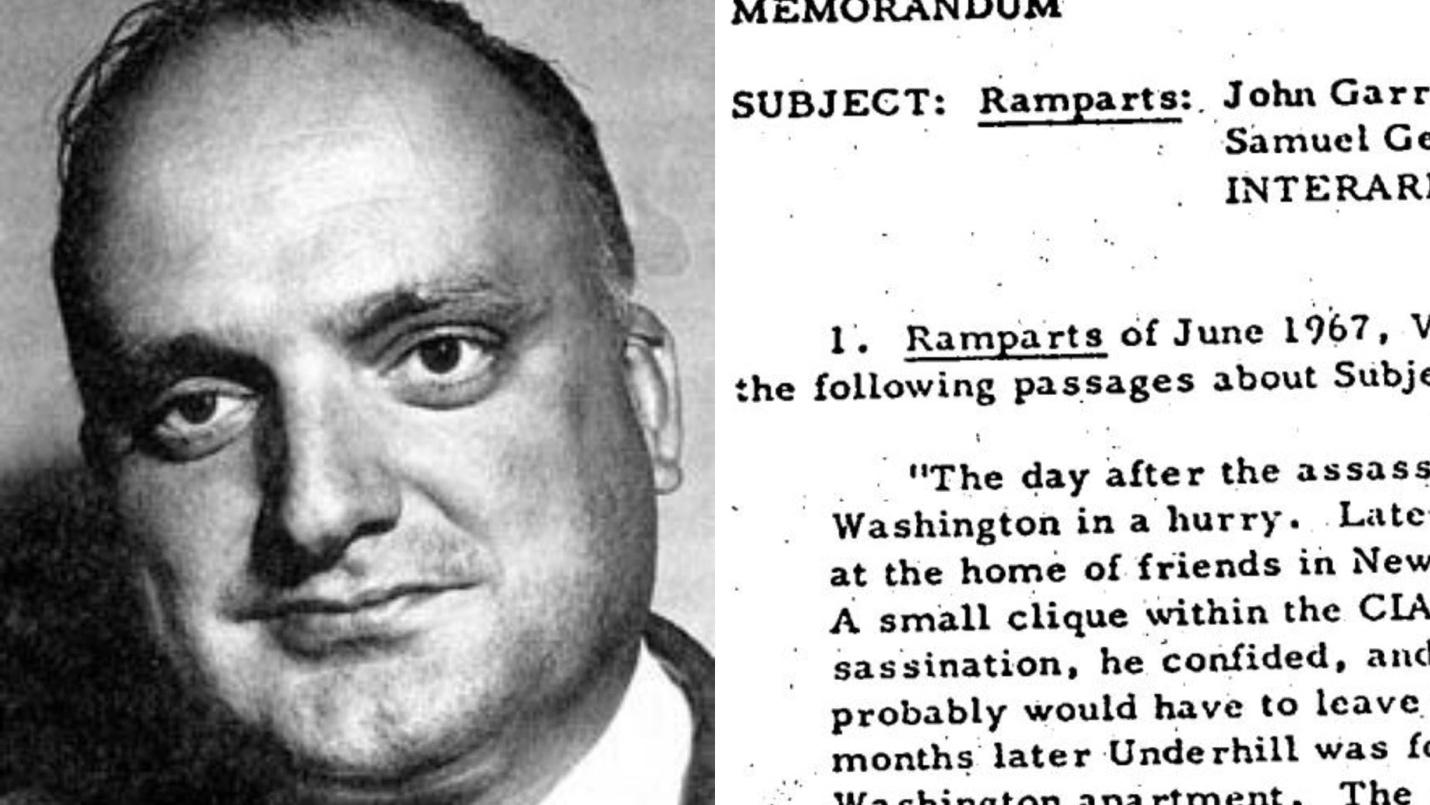
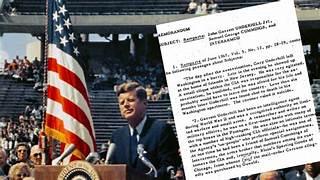
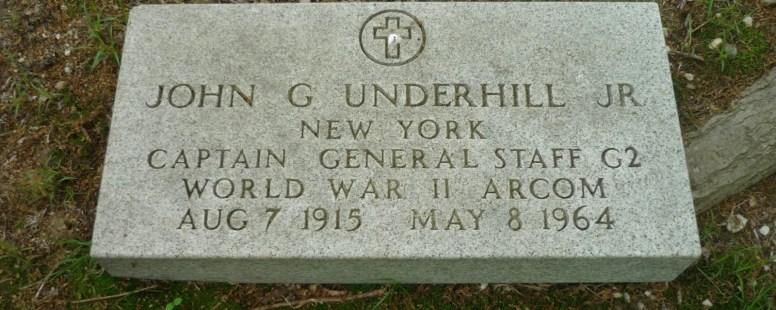
The document reproduced below provides a report on a Ramparts magazine article about John Garrett Underhill, Jr., an intelligence agent and military correspondent for Life magazine who was found at his Washington, D.C., home—with a bullet in his head behind his ear on May 8, 1964—after reporting that a CIA clique was behind the JFK assassination. Underhill’s body was found by Asher Byrnes of The New Republic who noted that Underhill was right-handed but was shot in the left side of his head. In an interview with Playboy magazine, New Orleans District Attorney Jim Garrison referred to Underhill as a CIA agent with valuable information pertaining to his investigation.
Pioneering JFK assassination researcher Penn Jones, Jr., wrote in Forgive My Grief (1966) that Underhill had stated that the CIA had Kennedy killed and that the most active group in the assassination was the Far Eastern branch of the CIA, which was unhappy with Kennedy’s looking into their activities, most notably a lucrative business they were running in guns, contraband, and drugs in the Far East.
This week marks the 63rd anniversary of the death of JFK. CAM is bringing you a week full of original articles on the JFK assassination.—Editors]
July 19, 1967
MEMORANDUM
SUBJECT: Ramparts: John Garrett UNDERHILL Jr:,
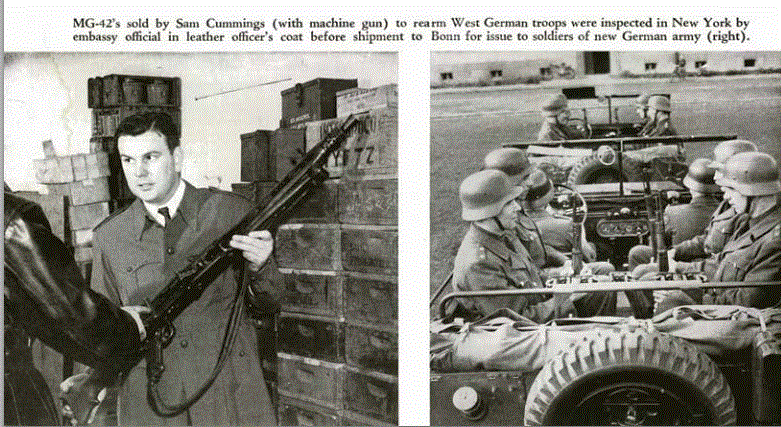
Samuel George CUMMINGS, and
INTERARMCO
1. Ramparts of June 1967, Vol. 5, No. 12, pp. 28-29, contains following passages about Subjects:
“The day after the assassination, Gary Underhill left Washington in a hurry. Late in the evening he showed up at the home of friends in New Jersey. He was very agitated. A small clique within the CIA was responsible for the assassination, he confided, and he was afraid for his life and probably would have to leave the country. Less than six months later Underhill was found shot to death in his Washington apartment. The coroner ruled it suicide.
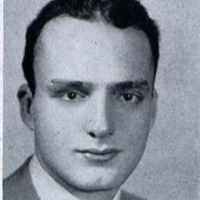
“J. Garrett Underhill had been an intelligence agent during World War II and was a recognized authority on limited warfare and small arms. A researcher and writer on military affairs, he was on a first-name basis with many of the top brass in the Pentagon. He was also on intimate terms with a number of high-ranking CIA officials–he was one of the Agency’s ‘un-people’ who perform special assignments. At one time he had been a friend of Samuel Cummings of Interarmco, the arms broker that numbers among its customers the CIA and, ironically, Klein’s Sporting Goods of Chicago, from whence [sic] the mail-order Carcano allegedly was purchased by Oswald.
* * *
2. A check of Agency records has yielded the following information about John Garrett UNDERHILL Jr.
* * *
d. Was a pictorial journalist for Life, 1938-1942.
e. Ordered to active duty with MIS, Washington, as a second lieutenant, on 8 July 1943. Served with MIS for 2-1/2 years, working on technical and photographic headings for MIS publications, evaluation of intelligence, and enemy uniforms, insignia, weapons, etc. On 9 October 1945 received a War Department staff citation for superior work in military intelligence. Left active duty in May 1946.
f. CIA memoranda of February and October 1949 show that there was interest by the New York office of OO, Contacts Division, in using Subject as a contact for foreign intelligence. Name checks were conducted with various military members of the intelligence community, but these yielded insufficient information, and 00 was advised that contact should be developed with caution, on a limited basis, and that Subject was not to receive information classified higher than confidential.
g. On 12 March 1957 national agency checks were again requested on Subject because of interest by the Office of Security.
h. A UP article of unknown date cites an article written by UNDERHILL for Esquire. The article described the U.S. Army as shockingly weak. The UP piece stated that UNDERHILL served in military intelligence in World War II and Korea. UNDERHILL said that he had served as a consultant [probably in 1956] to an Army coordinating group.
i. A report of 6 August 1954 from the Office of Security, Department of State, concerns contacts between UNDERHILL and one Herman AXELBANK, who was trying to sell photographs of Soviet military subjects. UNDERHILL reported these contacts to the FBI and to CIA. In November 1949 UNDERHILL visited Washington to call the attention of CIA to certain AXELBANK pictures and was advised that Colliers might be interested in some of them for an article on Russia. UNDERHILL discussed AXELBANK, with “Ricky” Haskins of CIA.
3. On the basis of the foregoing an inquiry was made of director, Domestic Contact Service, whose office provided the attached reply.
4. The following information about Samuel George CUMMINGS, 201-178343, was compiled from his 201 file and from information provided by the Office of Security and by C/CL/SPG.
a. His date and place of birth are 4 February 1927, Philadelphia.
b. He entered on duty with CIA as a staff employee in December 1950. He was then a GS-9 assigned to Ground Branch, Weapons and Equipment Division, OSI. In January 1952 he was transferred to the Office of Procurement and Supply. During 1952/1953 he travelled abroad extensively, buying foreign weapons.
c. He married a German national and consequently resigned in November 1953, when he became a career agent in Guatemala.
d. Cables of the 1951-1952 period state that CUMMINGS was then buying arms for CIA and that the arms were intended for resistance elements behind the Iron Curtain.
e. On 17 August 1954 CUMMINGS became the principal agent of the [redaction in document] International Armament Corporation and Interarmco Lt., both incorporated in Canada, Switzerland, and the U.S. CUMMINGS engaged in sharp practises in his conduct of business and was also extremely difficult to control.
* * *
j. On 4 January 1962 the Rome periodical Vie Nuove stated that CUMMINGS was hired by CIA as an expert in arms and ballistics.
k. In December 1962 the Office of Security recommended against his use by Domestic Contact Service as a source, and in December 1964 the CI Staff advised that it had no operational interest in Subject. (Comment: As was noted above, this statement is correct, because Subject’s activity is not directed by the Agency. He volunteers information.)
1. An Interagency Source Register memo to ACSI, dated 1 June 1965, stated that at that time there was “no record of a current operational interest in Subject.”
m. An Agency report of 24 February 1966 cited CUMMINGS as trying to procure military equipment from Communist Bloc countries on behalf of DIA.
n. Agency reports of February and May 1967 stated that CUMMINGS had been in close contact with the BND (West German foreign intelligence service) for a year or more, that he had been given requirements by the BND, and that these included lists of Soviet and Bloc arms for procurement. It was also reported that he showed a BND representative a copy of a purchase order for the procurement of a Soviet T-54 tank, the order having originated with DIA. BND officials have often stated that CUMMINGS is a CIA agent.
o. A form dated 1 June 1967 was directed to the Interagency Source Register by “DA”, presumably Department of the Army.
5. Agency records contain numerous references to INTERARMCO.
6. It is noted that UNDERHILL. CUMMINGS, and INTERARMCO have not appeared to date in any press or classified reports of the Garrison investigation in New Orleans, with the tenuous exception of the Ramparts article cited at the outset of this memorandum.
CovertAction Magazine is made possible by subscriptions, orders and donations from readers like you.
Blow the Whistle on U.S. Imperialism
Click the whistle and donate
When you donate to CovertAction Magazine, you are supporting investigative journalism. Your contributions go directly to supporting the development, production, editing, and dissemination of the Magazine.
CovertAction Magazine does not receive corporate or government sponsorship. Yet, we hold a steadfast commitment to providing compensation for writers, editorial and technical support. Your support helps facilitate this compensation as well as increase the caliber of this work.
Please make a donation by clicking on the donate logo above and enter the amount and your credit or debit card information.
CovertAction Institute, Inc. (CAI) is a 501(c)(3) non-profit organization and your gift is tax-deductible for federal income purposes. CAI’s tax-exempt ID number is 87-2461683.
We sincerely thank you for your support.
Disclaimer: The contents of this article are the sole responsibility of the author(s). CovertAction Institute, Inc. (CAI), including its Board of Directors (BD), Editorial Board (EB), Advisory Board (AB), staff, volunteers and its projects (including CovertAction Magazine) are not responsible for any inaccurate or incorrect statement in this article. This article also does not necessarily represent the views the BD, the EB, the AB, staff, volunteers, or any members of its projects.
Differing viewpoints: CAM publishes articles with differing viewpoints in an effort to nurture vibrant debate and thoughtful critical analysis. Feel free to comment on the articles in the comment section and/or send your letters to the Editors, which we will publish in the Letters column.
Copyrighted Material: This web site may contain copyrighted material the use of which has not always been specifically authorized by the copyright owner. As a not-for-profit charitable organization incorporated in the State of New York, we are making such material available in an effort to advance the understanding of humanity’s problems and hopefully to help find solutions for those problems. We believe this constitutes a ‘fair use’ of any such copyrighted material as provided for in section 107 of the US Copyright Law. You can read more about ‘fair use’ and US Copyright Law at the Legal Information Institute of Cornell Law School.
Republishing: CovertAction Magazine (CAM) grants permission to cross-post CAM articles on not-for-profit community internet sites as long as the source is acknowledged together with a hyperlink to the original CovertAction Magazine article. Also, kindly let us know at info@CovertActionMagazine.com. For publication of CAM articles in print or other forms including commercial internet sites, contact: info@CovertActionMagazine.com.
By using this site, you agree to these terms above.
About the Author
Chris Agee
Executive Editor
Jeremy Kuzmarov
Managing Editor


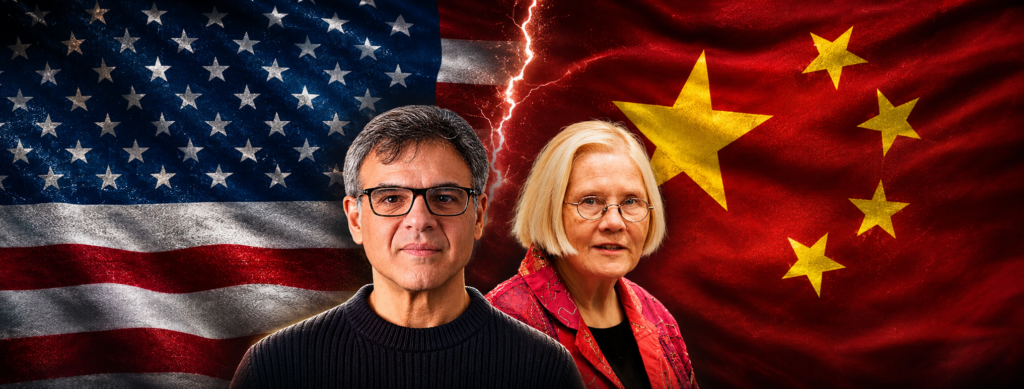
 Radhika Desai is a Professor of Political Studies at the University of Manitoba, Winnepeg, Canada, Director of its Geopolitical Economy Research Group, and Convenor of the International Manifesto Group. Ms. Desai is an author of multiple books, including Geopolitical Economy(2013) and her most recent Capitalism, Coronavirus and War(2022). Ms. Desai hosts a fortnightly show, Geopolitical Economy Hour on the Geopolitical Economy Report website.
 Yan Pan is a Chinese PhD researcher at LUT University, Finland. Her work examines the political economy of China’s technological and industrial development, with a particular focus on the industrialization and governance of neurotechnology in China. Her research concerns industrial policy models for future industries in Chinese and Global South contexts. Prior to her PhD, she researched educational reforms and structural change in labor demand in China.
 Ken Hammond is professor emeritus of East Asian and Global History at New Mexico State University. He has lived and worked in China from time to time since 1982. A lifelong political activist, he is a member of the Party for Socialism and Liberation.