On August 8, 1973, Kim Dae-jung, an opposition leader with the Korean New Democratic Party (KNDP), was kidnapped by the Korean Central Intelligence Agency (KCIA) from the 22nd floor of the Grand Palace Hotel in Tokyo and drugged while he was imprisoned.
The plot was to swiftly eliminate Kim, though...
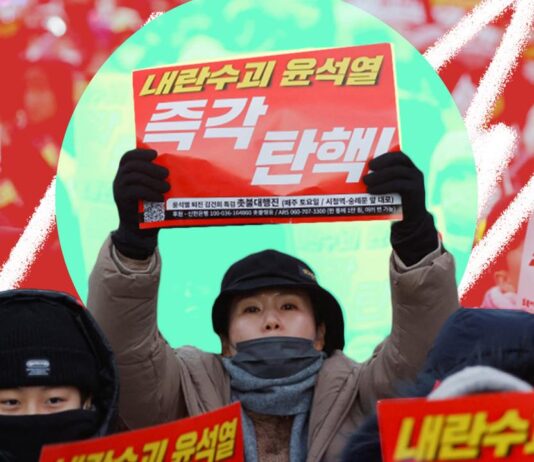
Calls for the resignation of South Korean President Yoon Suk Yeol have rung out from civil society and beyond after Yoon declared martial law on December 3rd. The Korean Confederation of Trade Unions (KCTU) called for strikes until Yoon steps down, and groups under and beyond that organization are heeding the call...
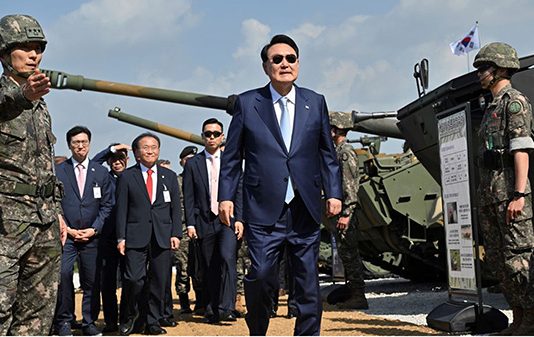
Exemplifies serious war crisis whose roots are being twisted in the U.S. media
In early April, the United States and South Korea conducted joint naval exercises in the Sea of Japan near the coast of Pohang, 262 kilometers southeast of Seoul.
The exercise—in which the U.S. dispatched an expeditionary sea base...
Part of mounting popular disaffection against South Korea’s conservative leader whom the RAND Corporation branded as a “perfect partner” for the U.S.
South Korea is hitting the headlines again but not for the reasons that its leaders would like.
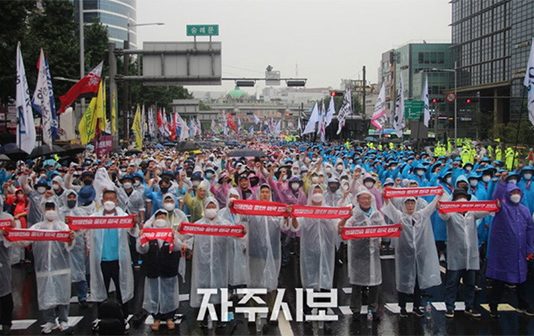
Protests have erupted in the wake of a new law supported...
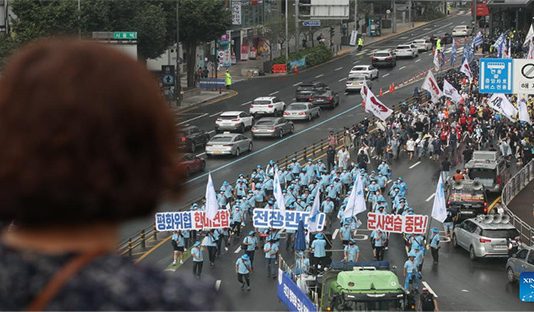
Protesters in Seoul demand withdrawal of U.S. troops from South Korea
During his trip to the Indo-Pacific in May, U.S. President Joe Biden made his first stop in South Korea where he hoped to inaugurate a new golden era of U.S.-South Korean relations.
South Korea’s newly elected President Yoon Suk-yeol was...


 Radhika Desai is a Professor of Political Studies at the University of Manitoba, Winnepeg, Canada, Director of its Geopolitical Economy Research Group, and Convenor of the International Manifesto Group. Ms. Desai is an author of multiple books, including Geopolitical Economy(2013) and her most recent Capitalism, Coronavirus and War(2022). Ms. Desai hosts a fortnightly show, Geopolitical Economy Hour on the Geopolitical Economy Report website.
 Yan Pan is a Chinese PhD researcher at LUT University, Finland. Her work examines the political economy of China’s technological and industrial development, with a particular focus on the industrialization and governance of neurotechnology in China. Her research concerns industrial policy models for future industries in Chinese and Global South contexts. Prior to her PhD, she researched educational reforms and structural change in labor demand in China.
 Ken Hammond is professor emeritus of East Asian and Global History at New Mexico State University. He has lived and worked in China from time to time since 1982. A lifelong political activist, he is a member of the Party for Socialism and Liberation.