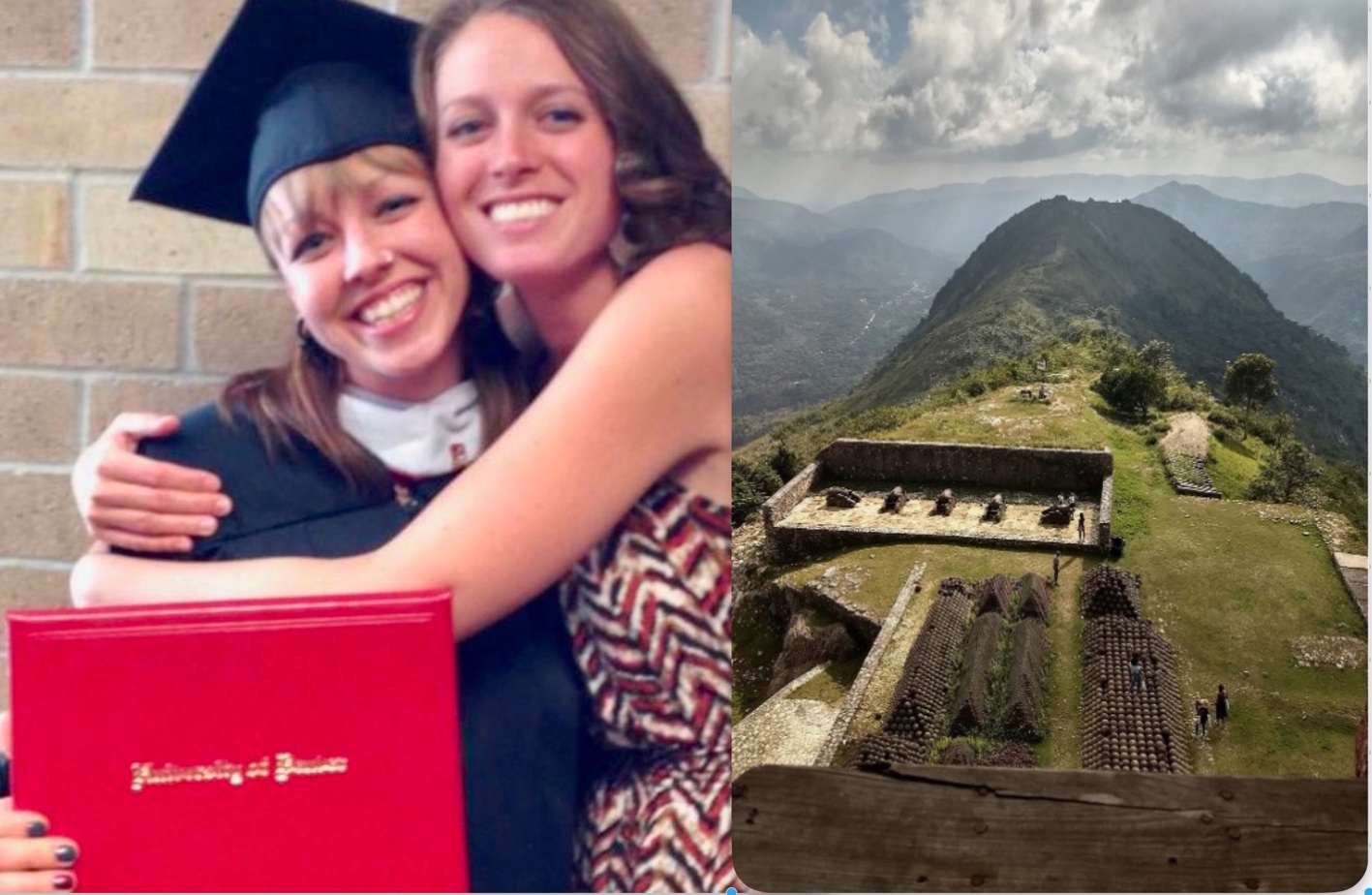
“…the real significance of this scandal for me…is the link to contemporary slavery and trafficking. I can’t say to what extent, but there is human trafficking happening through the Clinton’s [Caracol] Complex. And mining has always been historically linked to trafficking, slavery, and labor exploitation.”
— Monica Petersen, Research Fellow and Assistant to the Director at the Human Trafficking Center at the University of Denver, in January 2016 Facebook post (LINK) [Emphasis added.]
From Facebook posts, we know that University of Denver Human Trafficking Center Researcher Monica Petersen took a series of trips to Haiti in 2015 and 2016 to investigate human trafficking. We know that she went to talk to Haitian workers, or those very close to them, about working conditions at the Clinton Foundation-sponsored Caracol textile factory in northern Haiti. From a January 2016 Facebook post, we know that Monica Petersen received some kind of report about human trafficking allegedly happening at this Caracol textile factory.
Beyond this, we know almost nothing. Petersen officially passed away in Haiti in November 2016, but the circumstances of her death and events leading up to it remain unclear to this day. A single Washington Post article from December 2016, is the only article I could find about Monica Petersen’s death from any mainstream news agency for nearly a decade. The silence in the media about Petersen’s death in 2016 is both revealing and disturbing at the same time, potentially telling us a great deal about the true level of censorship we live with in our society. What really happened to Human Trafficking Center Researcher Monica Petersen? Was she correct in her statement before her death that human trafficking was occurring at the Clinton-sponsored Caracol textile factory in Haiti?
There is clearly an oddly limited “hodgepodge” of social media information regarding Petersen’s death. My search for answers about her death led me to look deeply into this “hodgepodge” of limited information. The result is this article. What I found, in my opinion, deepened the suspiciousness of Petersen’s death, and what her investigation in Haiti may have truly revealed.
The blatant media black-out and obfuscation of relevant, publicly available, information about Petersen’s death is striking. It is obvious from reading reporter Glenn Kessler’s single 2016 Post article that he misrepresented and omitted highly relevant Facebook posts about Petersen’s investigation into the Clinton-sponsored Caracol factory in Haiti. It is also worth mentioning that, when Hillary Clinton was Secretary of State, Kessler in his duties as a reporter frequently traveled with Clinton and “for several years wrote a blog about his experiences on those trips.”

In this article, I seek to expose the full scope of the publicly viewable, relevant social media posts that shine light on Petersen’s human-trafficking investigation and her death in Haiti. As can be clearly seen in these online postings, some of the key people involved in these communications were decidedly left-wing, social justice-oriented activists, not the sort of people you could label as right-wing, pro-Trump QAnon conspiracists.
Facebook posts about Monica Petersen’s death were shared predominately on right-wing, pro-Trump message boards and other social media sites after her death in November 2016. However, just because these messages were shared mostly on such sites does not change the content of the messages themselves, nor the background of the activists who posted the messages. The subsequent media silence about the circumstances of Petersen’s death may speak volumes about the level of criminality against the people of Haiti Monica Petersen was seeking to expose.
Background of Monica Petersen
According to her cv, Monica Petersen worked as a Research Fellow and Assistant to the Director of the Human Trafficking Center (HTC) at the University of Denver. Petersen officially passed away in Port-au-Prince, Haiti, on November 13, 2016. The Human Trafficking Center graduate program for which Petersen worked provided “the only two-year graduate level training program on forced labor and human trafficking in the U.S.”
Monica Petersen was born and raised in Ames, Iowa; her life growing up included active involvement with her local 4-H club, as well as many other school activities. Petersen received a bachelor’s degree in anthropology from Western State College of Colorado (now Western Colorado University). In 2014, Petersen received a master’s degree in international development with a concentration in human trafficking from the Josef Korbel School of International Studies at the University of Denver.
The Human Trafficking Center, the graduate program for which Monica Petersen would go on to work, was a part of the prestigious Josef Korbel School. Considering that Petersen’s master’s degree had a focus on human trafficking studies, it is safe to say that she must have taken many classes at the Human Trafficking Center and knew quite a bit about the graduate program, before going on to work directly for the HTC as a human trafficking researcher.
One important update: According to a post on the Human Trafficking Center’s Facebook page, the Human Trafficking Center permanently shut down at the University of Denver as of June 2021. Notably, according to the HTC’s post about its closing, there is a description of all the HTC’s academic accomplishments over a nearly 20-year period of operation at the University of Denver. However, there is no explanation for why the decision was made to shut down the HTC program other than that the University of Denver “decided to close” the program.
In addition to her close association with the Human Trafficking Center, Monica Petersen worked with other social justice-oriented and anti-human trafficking organizations during her life, including the Social Wellness Advocacy Network, the Colorado Human Trafficking Council, and the Laboratory to Combat Human Trafficking. She gave an academic presentation about women victims of human trafficking at the University of Nebraska-Lincoln. Petersen’s social media postings show that she had a significant academic history researching and combating human trafficking and was also involved in other forms of social justice activism, like advocating for the rights of sex workers.

In 2014, Petersen wrote a blog post for the Human Trafficking Center blog, titled “Root Causes and Contradictions of the Displaced Youth along the U.S./Mexico Border.” In the post, Petersen talked in detail about how “free trade” polices instituted in Central America, and throughout the world, have contributed enormously to increased inequality between the U.S. and Central America and other Third World countries, and greatly increased global poverty.
As Petersen wrote, this “breakdown” in society in Central America has allowed an illegal “informal” economy of gangs and crime to flourish and, horrifically, this has contributed greatly to increased child trafficking from Central American countries. Petersen clearly had a deep level of knowledge about economics and global politics, and their impact on criminal human trafficking activities throughout the world.
None of this background “fits” with the “QAnon narrative” described by the mainstream media. Before Petersen’s death, she appeared on a podcast about human trafficking and sex workers, hosted by Chris Sowa, titled “Fighting the Trafficking Narrative from Alaska to Rhode Island.” By all accounts, Monica Petersen was committed to investigating and reporting on human trafficking and other social injustices until the end of her life.
At the time of Petersen’s death in November 2016, the Director of the Human Trafficking Center at the University of Denver was Professor Claude d’Estrée. The 2016 Washington Post article about Petersen’s death quotes d’Estrée as follows: “[He] had employed Petersen until June [2016] as a researcher and as his assistant, after which she moved to Haiti. He said she had been teaching at [a] private pre-kindergarten-through-12 school, Union School Haiti, mainly to support herself, and had been exploring setting up a nongovernmental organization in Haiti. He said she committed suicide but the circumstances are not clear. D’Estrée said Petersen had gone to Haiti a number of times, but she was not there to research human trafficking and was not investigating the Clinton Foundation. He said she had been a ‘brilliant’ research fellow, working the past two years to produce a still unpublished article that critiqued a controversial book on the business of sex trafficking by Siddharth Kara.”
However, even within the 2016 Washington Post article, Monica Petersen’s own Facebook post contradicts d’Estrée’s claim that she was not in Haiti to investigate human trafficking. In the same article, Kessler directly references a group of four Facebook posts, both by and about Petersen, in the couple of years leading up to her death in Haiti in November 2016. One of these posts, from August 2015, is by Monica Petersen and states: “I’m down in Haiti for the next 3 wks doing fieldwork on human trafficking.”
It is true that Petersen took another trip to Haiti in 2016, so in fairness maybe d’Estrée is saying that Petersen was not investigating human trafficking on her particular trip to Haiti in late 2016, when she died there. Still, why was Professor d’Estrée not clear about this in Kessler’s article in The Washington Post? Why did d’Estrée not mention anything about what Monica Petersen was doing on her 2015 trip to Haiti, when she clearly was investigating human trafficking there?
However, this is just the beginning. What can be clearly seen in Kessler’s Washington Post article is that he obviously only references certain Facebook posts about Petersen, her time in Haiti, and her death. He clearly does not reference other Facebook posts that are publicly viewable on the internet about Monica Petersen. The specific posts that he omits just happen to relate to Petersen’s investigation into the Clinton-sponsored Caracol textile factory in Haiti, and how her death may possibly be related to this investigation.
Bill and Hillary Clinton and the Clinton Foundation were heavily involved in financing and otherwise supporting the construction and operation of the Caracol Industrial Park in northern Haiti, near the city of Cap-Haïtien. Caracol Industrial Park is a textile production factory that opened for business in 2012.
A well-known photo shows Bill and Hillary Clinton posing with a large group of Haitian workers and factory managers at the Caracol Industrial Park for its inauguration ceremony in October 2012. A 2015 report from Politico stated that the Clintons “were instrumental at nearly every step” in the creation of the Caracol Industrial Park.
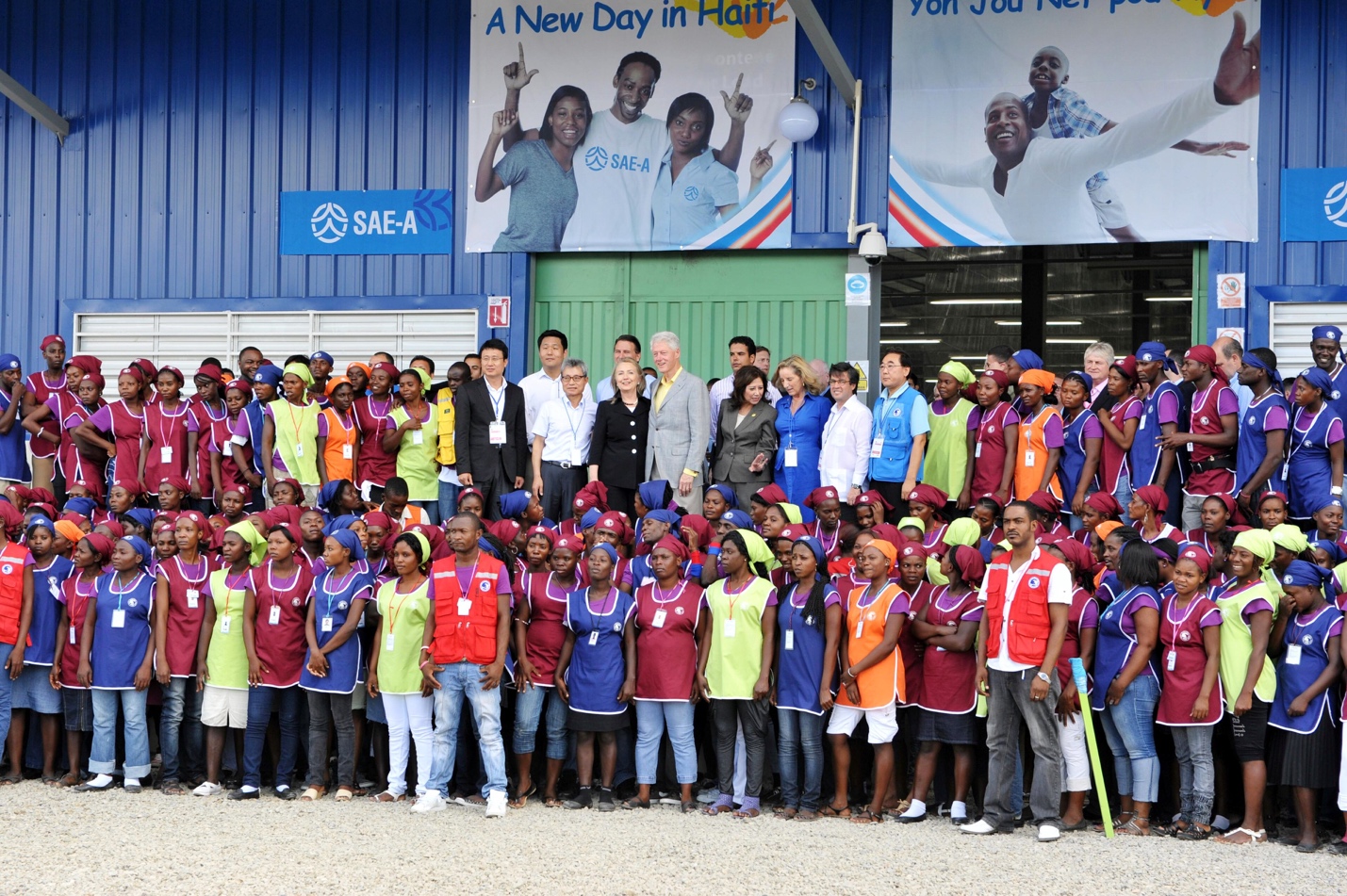
As the BBC reported in 2016, the main employer at the Caracol factory was the giant South Korean textile corporation, Sae-A Trading Co.
The Caracol textile factory produces clothes for U.S. big-box retailers like Walmart, Target and Old Navy. Perhaps not coincidentally, after Sae-A received its contract to start producing clothing at Caracol, it donated between $50,000 and $100,000 to the Clinton Foundation.
A major disappointment with the Caracol factory, at least one that is publicly known, is that the total number of jobs created at the factory has fallen far short of initial projections. Bill Clinton said that Caracol would create 100,000 jobs “in short order” but, as of 2019, Sae-A Trading employed only about 13,000 workers at the Caracol factory complex, most of whom were female textile workers.
By far the most significant of the Facebook posts that Kessler does not mention, is a January 4, 2016, post shared by Bella Robinson, a social justice activist from Rhode Island and friend of Monica Petersen. In that post, Robinson quotes Monica giving a “report” or “travel update” about her visit to Haiti. As shocking as it is to say, Robinson quotes her as stating the following about her visit in Haiti:
- She personally went to the Caracol Industrial Park in Haiti to investigate working conditions of the plant’s workers.
- She personally heard of and was possibly actively investigating claims of human trafficking happening at the Clinton Foundation-sponsored Caracol Industrial Park in Haiti.
Here is the Facebook post (archived link). In Robinson’s post quoting Petersen, the latter states: “Caracol is a garment exporting zone, a field site I visited in August to check out the conditions of the workers (conclusion: working conditions okay, working wages too low & below contracts & legal minimum wage in Haiti).”
Later on, toward the end of the same Facebook post, Petersen says the following: “…the real significance of this scandal for me…is the link to contemporary slavery and trafficking. I can’t say to what extent, but there is human trafficking happening through the Clinton’s Caraol [sic] Complex.” This post was clearly only shared by Bella Robinson to her own group of Facebook friends.
Again, the direct quote from Monica Petersen is: “I can’t say to what extent, but there is human trafficking happening through the Clinton’s [Caracol] Complex.” (Emphasis added.)
As obviously shocking as it is to see allegations of actual human trafficking occurring at a Clinton-sponsored textile sweatshop in Haiti, Kessler’s 2016 Washington Post article indeed confirms that Bella Robinson knew Monica Petersen. His article also confirms the authenticity of at least one Facebook post from Bella Robinson quoting Petersen’s own report about her trip to Haiti.
In Kessler’s Post article, Monica Petersen is named as an “acquaintance” of Robinson. Additionally, Kessler’s article states that “Bella Robinson, a sex worker and activist in Rhode Island in January [2016,] had posted a blog post that Petersen had shared on Facebook that had been critical of the Clinton Foundation’s work in Haiti.” Significantly, The Washington Post here acknowledges that Bella Robinson was sharing actual social media posts by Monica Petersen through her own Facebook posts.
Bella Robinson is a Rhode Island-based social justice activist, sex worker rights activist, and sex worker. She is the Executive Director of “COYOTE RI,” a support organization for current and former sex workers and trafficking victims. She is also a founding member of the “AMOR Network,” which describes itself as “an alliance of grassroots organizations, providing community support in Rhode Island and southern New England for victims of hate crimes and state-sponsored violence.”
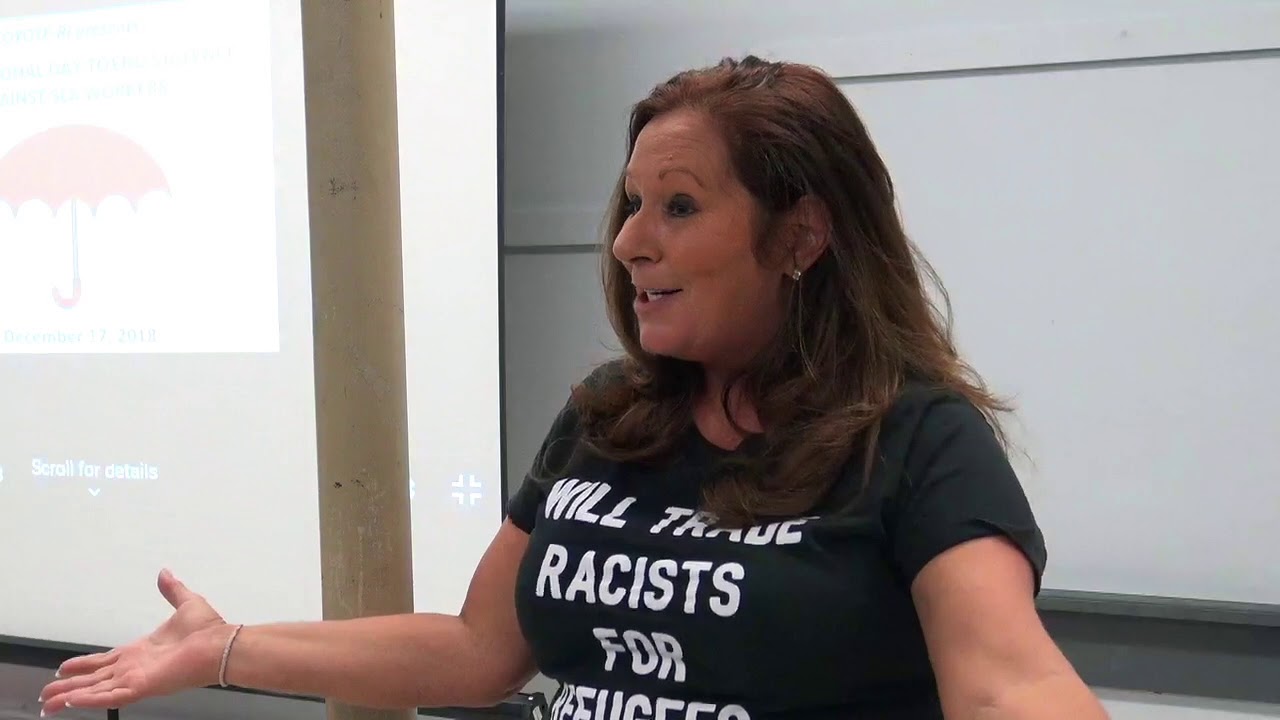
In addition, Robinson has a scholarly background investigating and writing about sex worker rights’ issues as well as sex trafficking. She and Elena Shih, Associate Professor of American Studies and Ethnic Studies at Brown University, co-wrote a research paper titled “Organizing under Criminalization: Policing and Sex Workers’ Rights in Rhode Island.”
In the paper, Robinson and Shih discuss the history of de-criminalization and re-criminalization of sex work in the state of Rhode Island, and the impact re-criminalization has had on the lives of sex workers in the state. Rhode Island de-criminalized prostitution for 30 years and re-criminalized it in 2009. Robinson and Professor Shih also have conducted research surveys where they interviewed sex workers in Rhode Island, and sex workers nation-wide, to try to better understand “the realities of consensual sex work and sex trafficking in the US.”
The nationwide survey Robinson and Shih conducted included interviews with 1,494 sex workers. Professor Shih herself teaches courses in human trafficking, labor migration and sex work, amongst many other subjects at Brown University. Shih also serves on the Board of Directors of Robinson’s “COYOTE RI” organization. Robinson clearly has a background both in researching and writing about the nature of sex trafficking and sex work at an academic level.
After Monica Petersen’s death in November 2016, many of Robinson’s Facebook posts concerning Petersen and her death in Haiti were shared or linked to across various right-wing, pro-Trump/QAnon message boards and websites. People critical of Robinson might try to say she is affiliated with the QAnon “movement” and, therefore, dismiss what she posted. However, Robinson’s background indicates a long involvement with left-leaning, social justice-oriented activism, amongst other information that does not suggest her being affiliated with the “QAnon crowd.”
It is difficult to dismiss Bella Robinson’s social media posts as yet another QAnon “rant.” The same can be said about Monica Petersen. Although she passed away in Haiti in 2016, obviously before the current “QAnon craze” took hold, she clearly had a well-established academic and activist background researching and investigating human trafficking. Again, none of this fits the “QAnon narrative” at all.
Despite this, the entire focus of Kessler’s Washington Post article (titled “‘Pizzagate’ rumors falsely link death of sex-worker advocate to nonexistent Clinton probe”) is a “debunking job” against the supposed conspiracy theories that Petersen’s death in Haiti had anything to do with the Clintons. In his Post article, Kessler states that, after Petersen’s death in November 2016, the blog post that Bella Robinson posted on Facebook quoting Monica Petersen the past January was shared in a Reddit discussion thread and went viral. Kessler states that, after the blog post went viral, “This then resulted in a flurry of ‘news stories’ falsely claiming that Petersen had written the blog post and was killed for investigating the Clintons.”
Kessler must have interviewed Bella Robinson for his 2016 Post article about Petersen’s death, since his article quotes her directly. He includes quotes from Robinson, where she responds to how her Facebook post quoting Petersen went viral after her death. Kessler quotes Robinson saying, “Some guy from Reddit found an old Facebook post on the Clintons and screen shot it and tagged it in this, and even after I confirmed that her death had nothing to do with the Clintons, he made up stories that the family couldn’t get answers.” Kessler quotes Robinson as saying that her comments “were taken out of context, and that she was actually trying to end the speculation.” Kessler further quotes Robinson as saying that “Monica Petersen’s death is a PRIVATE family matter and it had nothing to do with the Clinton scandal.”
As already stated, Kessler in his Washington Post article only refers to four specific Facebook posts concerning Monica Petersen’s trips to and death in Haiti, both by and about Petersen. Kessler does not include screenshots of these Facebook posts in his actual article. He does, however, link to screenshots of the four Facebook posts on a separate Imgur image-hosting website.
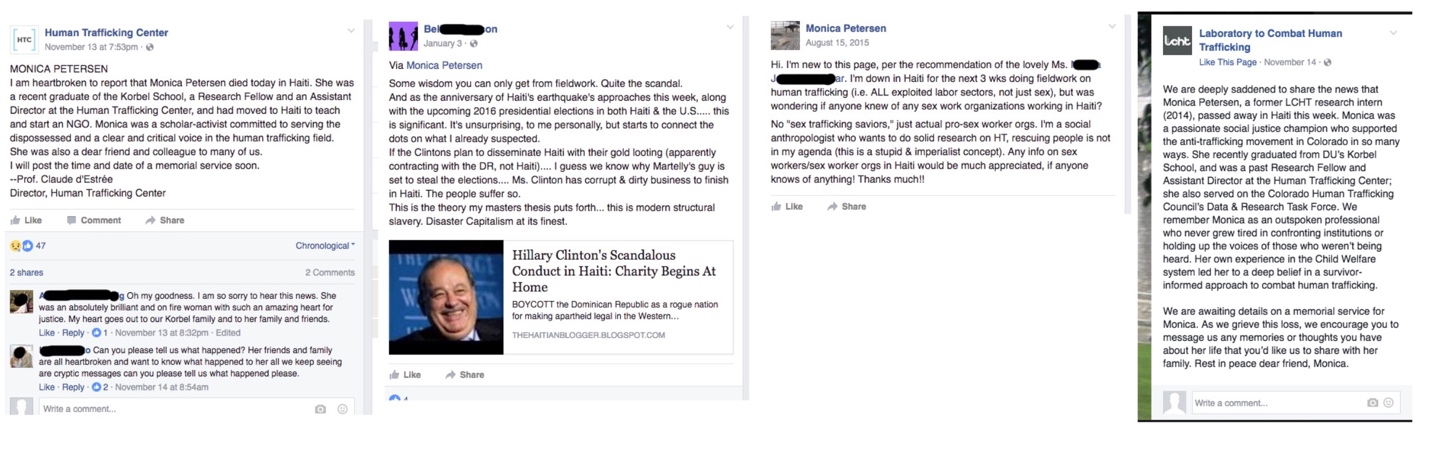
These four Facebook posts include posts from the University of Denver Human Trafficking Center, as well as the “Laboratory to Combat Human Trafficking,” one of the anti-human trafficking organizations with which Petersen worked. Both organizations posted on Facebook immediately after Petersen’s death on November 13, 2016, announcing her death in Haiti and lamenting her passing. Kessler also refers to an August 15, 2015, Facebook post by Monica Petersen herself, where she discusses her (then-ongoing) trip to Haiti in 2015. In the post, Petersen states: “I’m down in Haiti for the next 3 wks doing fieldwork on human trafficking (i.e. ALL exploited labor sectors, not just sex)…”
Finally, in his Washington Post article, Kessler also links to a January 3, 2016, Facebook post by Bella Robinson quoting Monica Petersen, posted about half a year later. In this post, Petersen is quoted discussing the then-upcoming presidential elections in Haiti and the U.S. In the same post, Petersen also alleges that the Clintons were involved in corrupt dealings in Haiti. She claims that the Clintons were allegedly engaged in a “gold looting” scheme in Haiti, and states that “Ms. Clinton has corrupt & dirty business to finish in Haiti. The people suffer so.”
Notably, Petersen claims in the same Facebook post that she gained this knowledge about these corruption scandals in Haiti through her own “fieldwork,” or in other words, through her own first-hand investigations in Haiti. Specifically, Petersen states in the beginning of the post, “Some wisdom you can only get from fieldwork.”
However, this is where things become far more disturbing. The next day, on January 4, 2016, Bella Robinson, in another Facebook post, she again directly quotes Petersen.
In this specific Facebook post, again posted by Robinson the very next day, Monica Petersen is quoted as clearly saying that “human trafficking” was allegedly occurring at the “Clinton’s” Caracol Industrial Park in Haiti. A screenshot of this specific January 2016 Facebook post must have been saved by other Facebook users from Robinson’s Facebook feed, since this post has been repeatedly archived and saved for view on the “Wayback Machine” online archiving website.
Screenshots of this Facebook post have been captured and saved 27 different times over multiple years on the “Wayback Machine” site. The first screenshot of this post was captured on November 22, 2016, shortly after Petersen’s death in Haiti just a week before. This Facebook post was publicly archived and viewable before Glenn Kessler’s article about Petersen’s death was published in The Washington Post the following month.
Conspicuously, Kessler does not refer to this Facebook post directly quoting Monica Petersen in his Washington Post article about her death.
Before quoting Petersen in this Facebook post, Bella Robinson begins by introducing her friend Petersen, stating “Back to Haiti and Clinton: My friend Monica Peterson [sic] reports…” Robinson then immediately goes on to quote Petersen giving an extended, “travel blog”-style narration describing in detail her trip to Haiti. Given that the previous day, Petersen was quoted in Robinson’s other Facebook post saying that she was doing investigative “fieldwork” in Haiti, we can plausibly deduce that, at the time of their postings in January 2016, Monica Petersen must have been back in Haiti on another personal trip.
Based on the available evidence here, it appears clear that Glenn Kessler chose to feature in his Washington Post article the Monica Petersen-related Facebook posts that do not contain any specific claims of human trafficking happening in Haiti. At the same time, Kessler blatantly ignores this January 2016 Facebook post quoting Petersen where, again, she clearly claims that “human trafficking” was allegedly happening at the “Clinton’s” Caracol Industrial Park in Haiti.
If you think this reeks of an obvious selective omission of information on Glenn Kessler’s part as a journalist, this is just the beginning. Just by doing a Google news search query on “Monica Petersen,” The Washington Post is the only major news outlet that covered her death when it actually occurred in 2016.
For the better part of a decade subsequent to her death, Kessler’s Post article was the only coverage of Petersen’s death in any major media outlet. Even the Denver Post, Petersen’s hometown paper at the time of her death, did not report about her passing. Looking at the absence of mainstream reporting about Petersen’s death, I cannot help but believe that there must be some type of “clamp-down” on information going on here.
Also strikingly, one thing should immediately be noted about Glenn Kessler’s past employment history: In his job duties as a journalist, as his Wikipedia page notes, he “traveled with three different Secretaries of State—Colin Powell, Condoleezza Rice, and Hillary Clinton—and for several years wrote a blog about his experiences on these trips.”
If this appears to reek more of conflict of interest, it gets even worse. I will return to Kessler’s Post article, but first it is important to do what Kessler and The Washington Post clearly did not: provide archived links and descriptions of all the Monica Petersen-related social media posts I could find on the internet that have information relevant to her death and time spent in Haiti.
I present these posts in chronological order, as best as I can discern it. From 2015 to roughly November 2016, both Bella Robinson posts and her quotes from Monica Petersen, as well as Facebook comments from Petersen’s friends shortly after her death, shed light on deeply troubling information about Petersen’s time in Haiti as well as her death there.
As will be clearly seen, Kessler’s December 2016 Washington Post article does not reference most of this highly relevant information that is publicly viewable. The fact that Kessler published his article in December 2016, after all these Facebook posts were publicly aavailable on social media, denies any excuse that he did not have access to this information.
Full disclosure: The author was able to locate these other Facebook posts by and about Monica Petersen by combing through old message boards and discussion threads on the Reddit website, as well as the now-defunct Voat website. On both sites, users have for years repeatedly posted links to archived snapshots of these Facebook posts, posts that Kessler quite conspicuously ignored.
Timeline of Monica Petersen-Related Facebook Posts
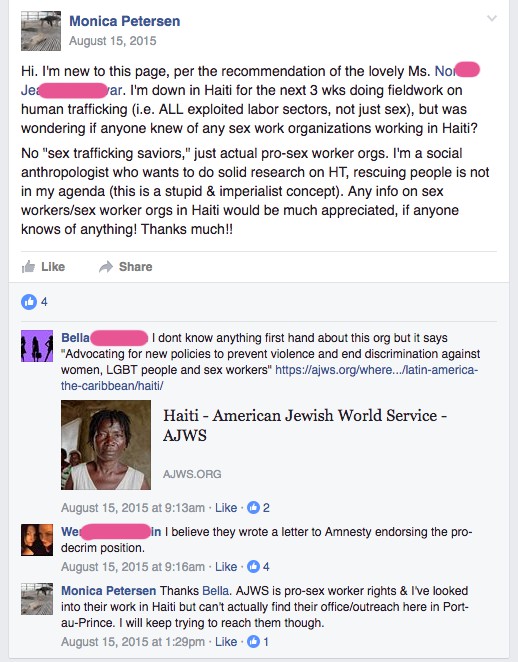
August 15, 2015, Post:
Personal Facebook post from Monica Petersen. Kessler references this post in his 2016 article. In this post, Petersen is asking some questions to an unknown Facebook page she recently joined. Petersen states that she is visiting Haiti “…for the next 3 wks doing fieldwork on human trafficking (i.e. ALL exploited labor sectors, not just sex).” She describes herself as a “social anthropologist who wants to do solid research on [human trafficking].”
Petersen says that, as part of her field research, she is seeking to work with sex-worker rights organizations in Haiti that are truly “pro-sex worker orgs,” and not what she considers to be “sex trafficking savior” organizations seeking to “rescue” sex workers. She goes on to say that “rescuing people” is a “stupid & imperialist concept.”
Bella Robinson responds to Petersen’s post, suggesting that she look into one such organization she might want to work with in Haiti, called the “American Jewish World Service.” Petersen then thanks Robinson on the message thread, saying that she was searching for that organization’s office or their representatives in Haiti while she was in Port-au-Prince, but that she could not find them and was trying to reach them.
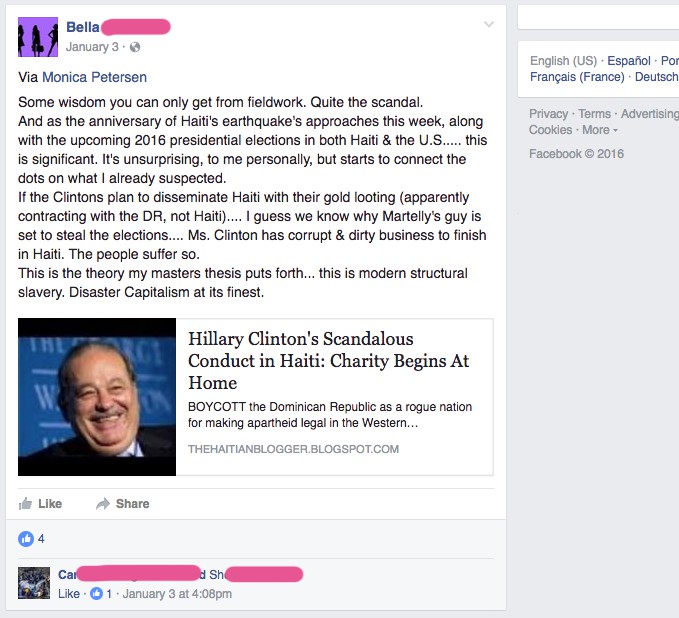
January 3, 2016, Post:
Kessler’s 2016 Washington Post article references this post and states that Robinson posted it in January 2016. Kessler does reference this post in his 2016 article. Robinson’s Facebook post quotes Monica Petersen giving a “travel report” from Haiti. In the post, Petersen discusses the Clintons’ alleged corruption in Haiti. Specifically, she states her belief that the Clintons planned to “loot” Haiti for gold, and work in conjunction with groups from the Dominican Republic to accomplish this purpose.
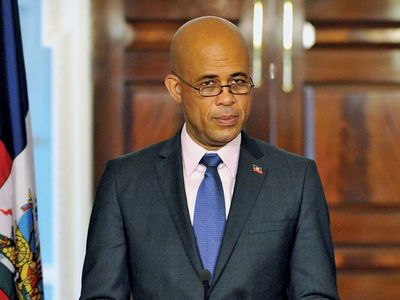
Petersen also speculates that a partner of then-Haitian President Michel Martelly (who she calls “Martelly’s guy”) is going to steal the upcoming 2016 Haitian presidential election. She also speculates that the Clintons’ alleged “gold looting” scheme in Haiti would somehow be responsible for corrupting and rigging this election.
Significantly, in this post, Petersen refers to her master’s thesis from the Human Trafficking Center at the University of Denver. Petersen says her master’s thesis focuses on researching “modern structural slavery” and “disaster capitalism.”
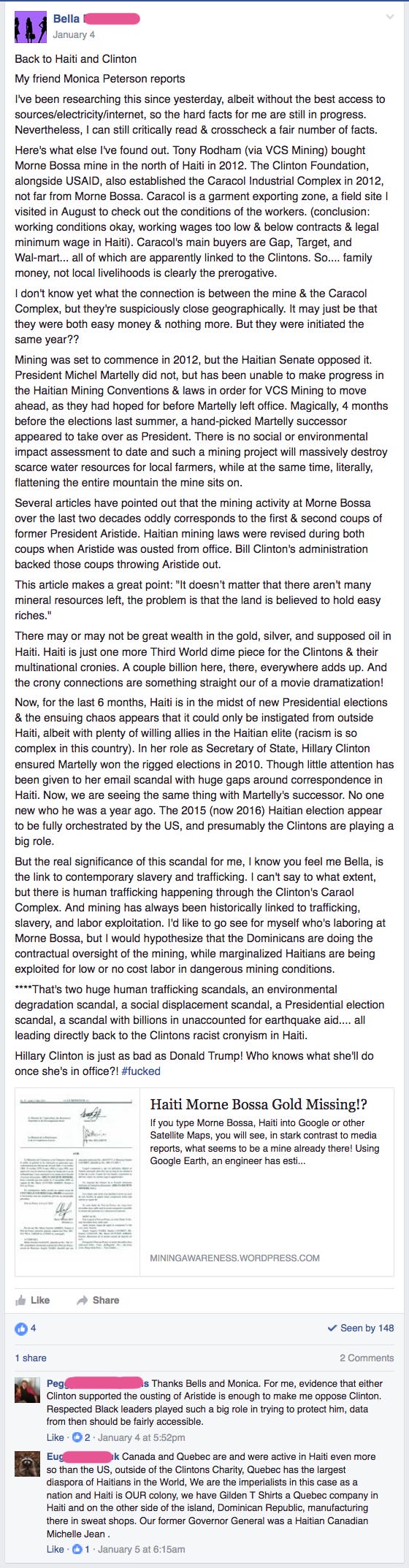
January 4, 2016, Post:
Bella Robinson’s Facebook post quoting Petersen’s “report” from Haiti. Glenn Kessler does not refer to this post in his 2016 Washington Post article. This is the specific post in which Petersen claims that human trafficking is happening through the “Clinton’s” Caracol Industrial Park. From the beginning of the post, it is clear Petersen is back in Haiti doing field work as on her previous 2015 trip. In her post, Petersen continues to describe her investigation into Clinton-related corruption in Haiti and discusses the Morne Bossa gold mine in the north of Haiti.
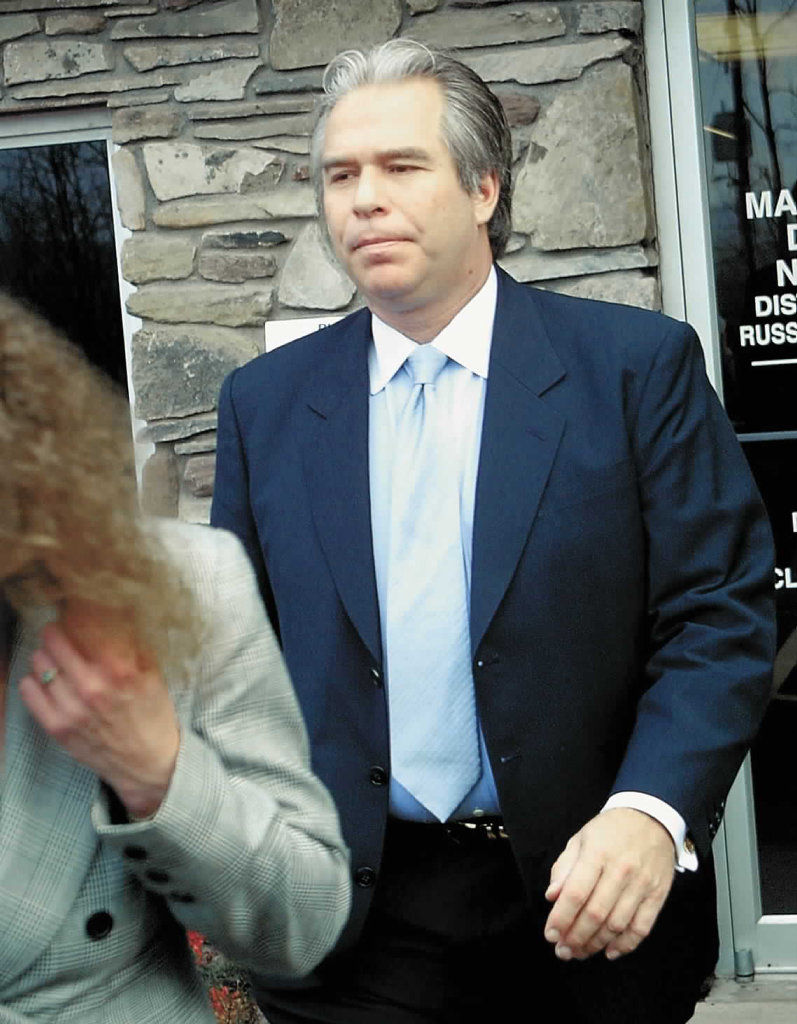
The North Carolina-based VCS mining company, on whose board Hillary Clinton’s brother Tony Rodham sat before he died, received the permit to mine gold at the Morne Bossa mine in 2012. In the Facebook post, Petersen describes how the Clintons may have allegedly worked with the presidential administration of Haiti’s Michel Martelly in a “crony” manner, to attempt to begin mining gold at Morne Bossa in 2012.
As Petersen also describes, the Clinton Foundation established the Caracol Industrial Park at the same time in 2012. Caracol is located close to the Morne Bossa mine in Haiti. Petersen speculates whether the Clintons may have had some ulterior motive for establishing the Caracol textile factory and beginning mining gold at Morne Bossa at the same time, wondering if it was just “easy money” for the Clintons or if there was something more to it.
Significantly, Petersen states in this January 2016 post that she personally visited the Caracol Industrial Park the previous summer, saying: “Caracol is a garment exporting zone, a field site I visited in August [2015] to check out the conditions of the workers (conclusion: working conditions okay, working wages too low & below contracts & legal minimum wage in Haiti).”
This closely matches what Petersen stated in her other August 2015 Facebook post referenced by Kessler in The Washington Post, where she states: “I’m down in Haiti for the next 3 wks doing fieldwork on human trafficking (i.e. ALL exploited labor sectors, not just sex).”
We therefore know from both Facebook posts that, in the summer of 2015, Petersen was actively investigating human trafficking in Haiti, and that she visited the textile plant in Caracol. From these posts, we also know that Petersen stated that she was investigating a wide range of human trafficking activities occurring in Haiti (i.e., across “ALL exploited labor sectors”).
It therefore makes sense that Petersen would go and talk with textile workers, or those close to them, at the Caracol factory complex, since the textile industry across Haiti is notorious for its incredibly exploited work force.
There is, therefore, significant corroboration of information regarding Monica Petersen’s activities in Haiti, from both Petersen’s August 2015 Facebook post referenced by Kessler in his Washington Post article, and this other January 4, 2016, Facebook post quoting Petersen that is not referenced by him. In my opinion, this provides significant evidence to support the validity of Petersen’s comments quoted by Bella Robinson in her January 4th Facebook post.
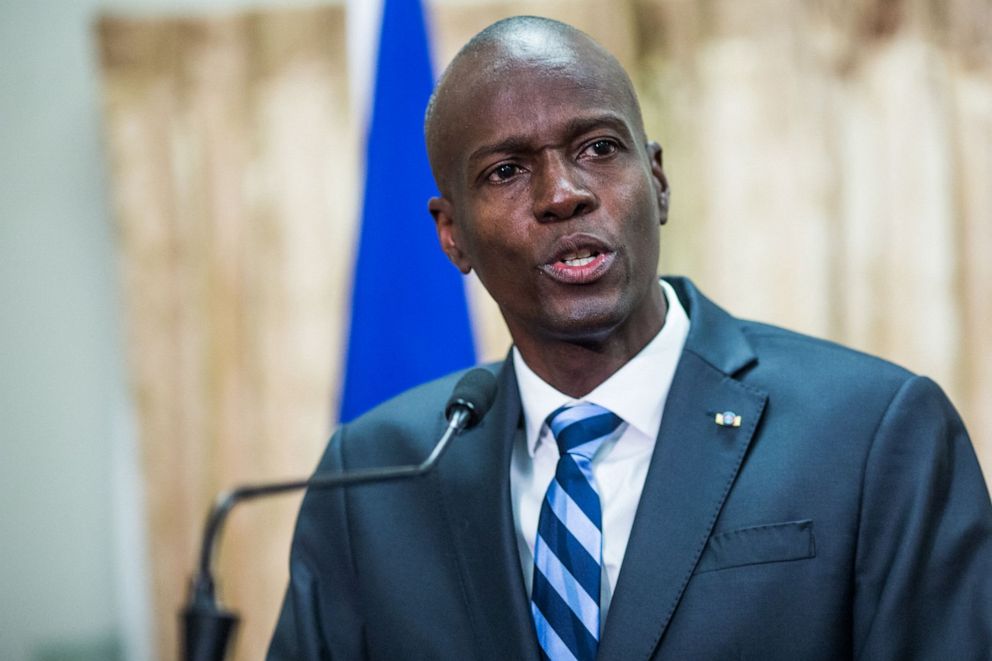
In this post, Petersen states that the main buyers for the Caracol factory’s garment exports are Gap, Target and Walmart, all of which are corporations Petersen claims are “linked” to the Clintons. Petersen states that “family money, not local livelihoods,” were motivating the Clintons to develop the Caracol garment factory. Petersen goes on to discuss how she believes that Hillary Clinton, in her role as Secretary of State, “ensured” that Michel Martelly won the “rigged” Haitian presidential election in 2010, and that the Clintons wanted Martelly’s “hand-picked successor,” Jovenal Moise, to win the 2016 election.
Petersen states that the Clintons wanted Martelly’s successor government to allow Tony Rodham’s VCS Mining to begin mining at Morne Bossa. Petersen also states that the period of mining activity at Morne Bossa “oddly corresponds” to the first and second coups against Haitian President Jean-Bertrand Aristide. Petersen discusses the lack of an assessment of the environmental risks of mining at Morne Bossa, warning about the threat mining at Morne Bossa posed to farmers and the surrounding ecosystem. Petersen states that, regardless of the actual amount of mineral wealth available in Haiti, the Clintons viewed Haiti as just another Third World country to exploit: “a couple billion here, there, everywhere adds up.”
Most crucially, toward the end of her post, Petersen states: “I can’t say to what extent, but there is human trafficking happening through the Clinton’s Caraol [sic] complex. And mining has always been historically linked to trafficking, slavery and labor exploitation.” [Emphasis added.]
Petersen goes on to speculate about the nature of the workforce at the nearby Morne Bossa mine, believing that Dominicans were most likely the contracted managers at the mine, and Haitian workers were most likely being exploited as laborers at the mine as “low or no cost” labor. Petersen states at the end of her post: “That’s two huge human trafficking scandals, an environmental degradation scandal, a social displacement scandal, a Presidential election scandal, a scandal with billions in unaccounted for earthquake aid…all leading back to the Clintons racist cronyism in Haiti.”
Significantly, Petersen specifically mentions two human trafficking scandals, but in this Facebook post, and from what I can find on social media, Petersen only specifically made claims about human trafficking happening at the Caracol factory in Haiti. If Petersen said “two huge human trafficking scandals” were occurring in Haiti that linked back to the Clintons, where else could the other alleged human trafficking be happening in Haiti?
November 2016 Post:
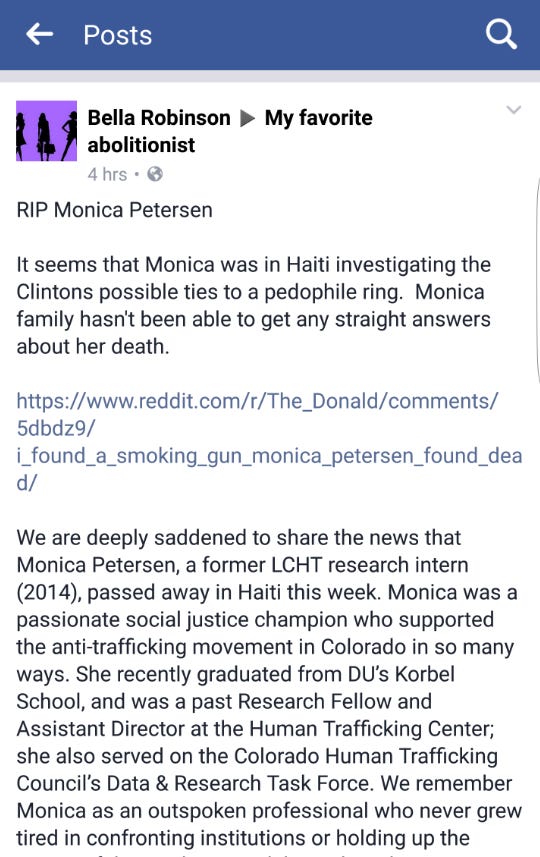
Personal Facebook post from Bella Robinson, which Kessler does not reference in his 2016 Washington Post article. Robinson posted this in the comments section of the “My favorite abolitionist” Facebook group, a pro-sex worker and pro-LGBT Facebook group, soon after Petersen’s death in November 2016. Robinson posted the following: “RIP Monica Petersen…It seems that Monica was in Haiti investigating the Clintons possible ties to a pedophile ring. Monica family hasn’t been able to get any straight answers about her death.”
November 2016 Post:
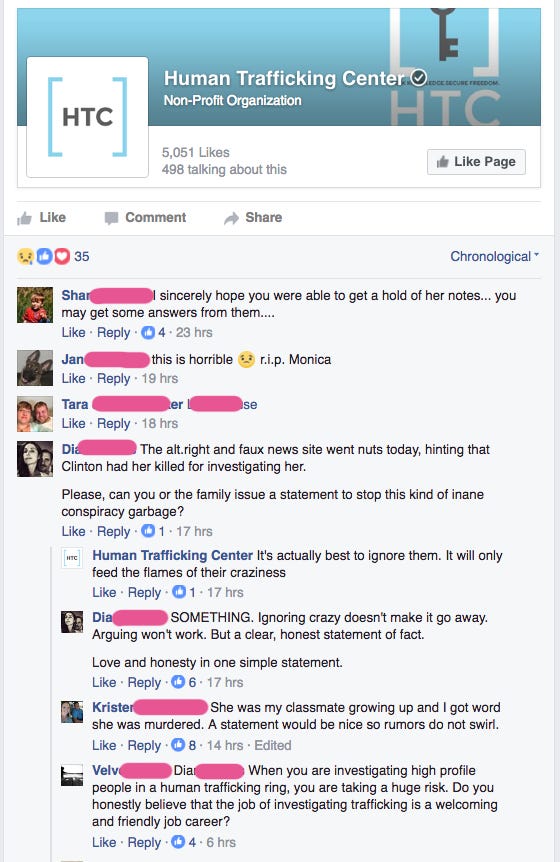
This Facebook post, which Kessler does not reference in his 2016 Post article, is a discussion thread about Petersen’s recent death on the Human Trafficking Center Facebook page, posted shortly after Petersen’s death. In the discussion thread, one poster states: “The alt.right and faux news site went nuts today, hinting that Clinton had [Monica Petersen] killed for investigating her. Please, can you or the family issue a statement to stop this inane conspiracy garbage?”
In the thread, the Human Trafficking Center then responded to this poster, saying, “It’s actually best to ignore them. It will only feed the flames of their craziness.”
However, in the same discussion thread, another poster, claiming to be a childhood friend of Monica Petersen, said the following: “[Monica] was my classmate growing up and I got word she was murdered. A statement would be nice so rumors do not swirl.” (Emphasis added.) Another poster on the same thread commented, “I sincerely hope you were able to get a hold of [Petersen’s] notes…you may get some answers from them….”
Reflections
Given everything just presented here, to say that the Monica Petersen investigation is an unfinished story is an understatement, to say the least. Given the public disclosures now of the Epstein emails and files, the public is finally gaining first-hand knowledge of the extreme depravity of the global economic and political elite, the so-called “Epstein Class,” when it comes to their complicity in child sex trafficking.
Considering what we know now about the Epstein human trafficking network, and especially given what we know about the suspect relationship between the Clintons and Jeffrey Epstein, there is all the more reason to investigate this story. There is good reason to demand a full, government-backed investigation into the true circumstances of University of Denver human trafficking researcher Monica Petersen’s death, nearly ten years ago now, in Haiti.
Looking at these Facebook posts, there are many takeaways. Clearly, first among them is Petersen’s still unexplored and unexplained claim in 2016 that human trafficking was allegedly occurring, to some unknown extent, at the heavily Clinton-connected Caracol Industrial Park in Haiti.
If Petersen’s claim is in true, the follow-up questions are obvious: If human trafficking really was occurring in this community of Caracol, who were the victims? Were the victims children, adults or both, and how many were there? If some type of organized human trafficking operation really was occurring in this community, who were the perpetrators or “string-pullers” behind it? And, critically, if such victims existed, where were they being trafficked from in Haiti, and where were they being trafficked to? Were any victims being trafficked internationally?
We cannot forget that Monica Petersen worked directly for the only graduate-level academic program in the entire U.S. that specialized in studying human trafficking crimes. To re-iterate, Petersen’s known background is the total opposite of the “internet conspiracy kook” stereotype that the establishment media love to use to smear honest investigators of these kinds of crimes.
Furthermore, we also cannot forget the two Facebook posters who commented on the Human Trafficking Center’s Facebook post announcing Monica Petersen’s death in Haiti.
One of these commenters said she grew up with Petersen in the same community in Iowa and claimed to have gotten “word she was murdered.” The other Facebook commenter expressed hope that someone would get ahold of Petersen’s research notes, believing her notes potentially contained valuable information that could answer questions about her death. These are more important leads that have not been followed up on by anyone in the mainstream media (or law enforcement to my knowledge) and deepen by an even greater magnitude the suspect nature of Petersen’s death in Haiti.
Monica Petersen’s writings presented in these Facebook posts paint a picture of an academic-type investigator, doing an actual field investigation into both human trafficking in Haiti, as well as other criminal activities in Haiti that were possibly connected to this human trafficking.
Petersen’s Facebook posts reveal her as someone investigating a wide-ranging criminal enterprise connected to the Clintons in Haiti, involving not just alleged human trafficking, but also allegations of illegal gold mining, labor trafficking, and even claims of the Haitian presidential elections being possibly corrupted or stolen! Given the extent and magnitude of Petersen’s allegations of criminality, there is all the more reason for an honest investigation into her claims.
Recent Developments
Despite the resounding mainstream media silence about Monica Petersen’s death in Haiti for nearly a decade, there was recently a major development in this story. In January 2025, the Ames Tribune, the local newspaper covering Petersen’s hometown of Ames, Iowa, ran a story that mentioned her.
This is the first mention I have seen of Petersen in the mainstream news media since the 2016 Washington Post’s article about her death. The January 2025 Ames Tribune article, by reporter Celia Brocker, covered a then-upcoming anti-human trafficking event held at the Iowa state capitol that month. The event was hosted by the anti-human trafficking organization “Iowa Network Against Human Trafficking” and was headlined by Iowa Governor Kim Reynolds.
Significantly, Brocker reported that, at this event, Monica Petersen received a posthumous award for her anti-human trafficking activism. Critically, in her article Brocker states: “Peterson [sic] was a research fellow at the Human Trafficking Center…She was murdered by traffickers in Haiti.”
This new reporting that Petersen was “murdered by traffickers” contradicts Glenn Kessler’s 2016 reporting that she died by “suicide” in Haiti. To state the obvious , a murder is not the same as a suicide. As of this writing, I have not seen any follow-up reporting from either the Ames Tribune or any other major news outlet, looking deeper into this new report that Petersen was actually murdered by criminals (i.e., “traffickers”) in Haiti.
The fact that we now have Monica Petersen’s hometown newspaper labeling her death as a murder, while The Washington Post, our supposed “newspaper of record,” called her death a “suicide” immediately after she died in Haiti, should itself be a major story. Again, why has no one in our news media followed up on this massive update, and contradiction, in the reporting about this critical element of the investigation, i.e., the actual cause of Monica Petersen’s death?
Please read my other article on Substack, where I explore this new development in the Petersen investigation. In that article, I also explore the circumstances of how Petersen’s former employer, the Human Trafficking Center, shut down five years ago with no explanation—either then or since—from the University of Denver administration as to why that happened.
Why did the Human Trafficking Center at the University of Denver, the one institution that potentially could provide information about the true nature of Petersen’s investigation and death in Haiti, shut down with almost no official notice? Could the Human Trafficking Center’s closure have anything to do with its former employee and student dying suspiciously? These are yet more un-explored leads in this investigation.
Conclusion
For a more complete view of my investigation, please read my full three-part article about the Monica Petersen investigation on Substack. Although much information is presented here, there are other very important dimensions to the story of Petersen’s death in Haiti, and her own investigation into human trafficking there, that I explore in my full investigative article. Here are some important points:
- As unbelievable as it may seem, the Monica Petersen investigation is not the first time the Clintons have been credibly linked to a human trafficking scandal in Haiti. In my full-length article I also explore the Laura Silsby trafficking scandal. Silsby was a supposed Christian evangelical missionary from Boise, Idaho, who was the leader of an evangelical group of American missionaries called the “New Life Children’s Refuge.” In January 2010, Silsby and nine other members of her group traveled to Haiti, immediately following the devastating January 12, 2010, earthquake that claimed hundreds of thousands of lives in the country.
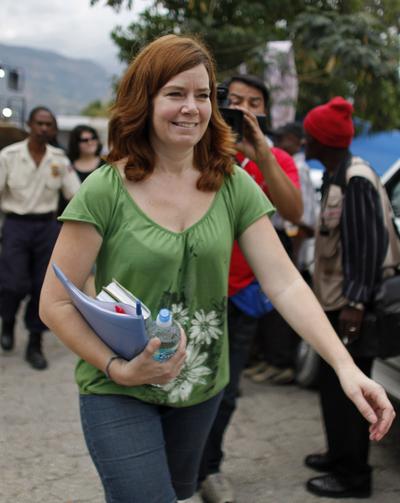
Silsby and her evangelical group supposedly went to Haiti to “rescue children” after the earthquake. Instead, Silsby and her compatriots were arrested and detained in Haiti, under serious suspicions that the group was attempting to traffic 33 Haitian children, ages 2 to 12, out of Haiti on a bus going to the Dominican Republic. Haitian authorities levied criminal kidnapping charges against Laura Silsby and her group.
Haitian police and social workers became suspicious after Silsby’s group claimed that the 33 Haitian children on their bus were all “abandoned children and orphans” whose parents had died in the earthquake. Silsby’s group said they were planning to set up an orphanage for the children in a leased hotel in the neighboring Dominican Republic. Upon inspection, however, Haitian authorities discovered that Silsby’s group was lying. None of the 33 children was actually an orphan. All the kids’ parents were still alive in Haiti.
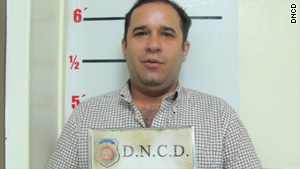
Haitian authorities became even more suspicious when, shortly after Silsby and her group were arrested, a Dominican American man, Jorge Torres Puello, showed up in the chambers of the Haitian judge who was trying Silsby and her fellow missionaries, claiming to be a lawyer representing them. For unexplained reasons, Puello was accompanied by four bodyguards.
It turned out that Torres Puello was lying about being a lawyer, and there was no evidence he ever even was one. Incredibly, once Torres Puello surfaced in Haiti, he was discovered to actually be a fugitive career criminal and the leader of an international human trafficking ring! Torres Puello was wanted in at least four countries, including the U.S., for trafficking girls and women from all over the Caribbean and Central America.
After his bizarre public appearance posing as a lawyer for Silsby’s group in Haiti, Jorge Torres Puello was then arrested on a warrant issued by Interpol and extradited to the U.S. He pleaded guilty to human trafficking charges in federal court in Vermont and was sentenced to a little over three years in federal prison.
Clearly, there was a high level of suspicion that Laura Silsby’s group was possibly attempting to traffic these 33 children out of Haiti. What makes this case even more disturbing is that former President Bill Clinton personally intervened in the case immediately after Silsby and her “New Life Children’s Refuge” group’s arrest in Haiti.
Clinton’s actions in Haiti got the charges against the entire group either dropped or massively reduced, while he was acting as the United Nations Special Envoy for Haiti after the January 2010 earthquake.
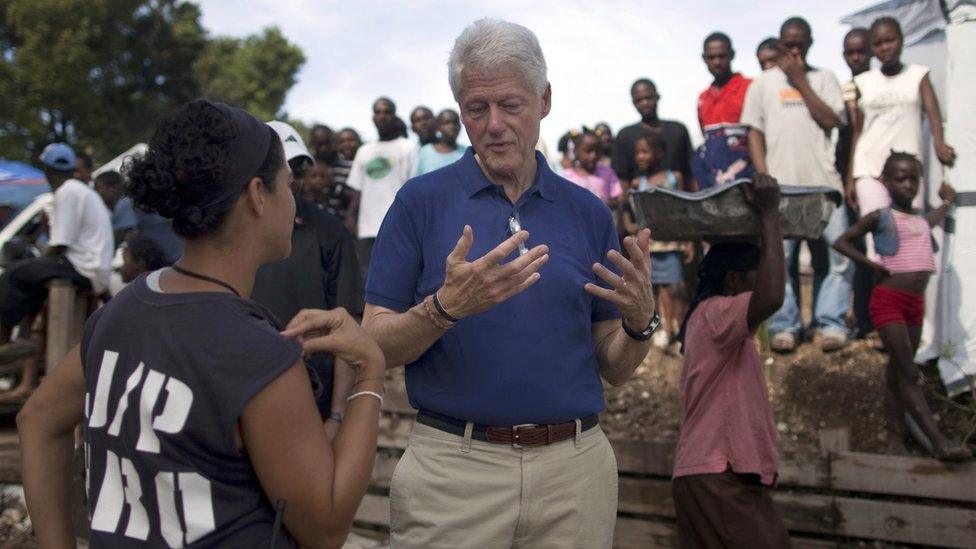
A comprehensive article about the Laura Silsby scandal, published in the Harvard Human Rights Journal in 2012, stated that, as soon as Bill Clinton took over as U.N. Special Envoy, one of his first tasks in Haiti was “to put out the fire of a child abduction scandal involving [Laura Silsby’s group]…In the course of a month, President Clinton brokered the release of all the missionaries, except for the group leader, Laura Silsby.” Silsby herself had her own criminal kidnapping charges in Haiti completely dropped immediately after this “intervention” by Clinton. She spent just a little over 3 months in a Haitian jail before getting released as well.
It is important to point out that Bill Clinton did all of this despite the fact that, according to the Harvard Human Rights Journal article, there was “evidence [Silsby’s group had] association with child traffickers,” and that “Haitian prosecutors argued that there had been intentional wrongdoing” by Silsby’s group. Silby’s American evangelical group clearly had a known, public association with (now convicted) international child sex trafficker Jorge Torres-Puello.
Why would someone of such international stature as Bill Clinton “intervene” in this way? Why would Clinton essentially “quash” the criminal charges in Haiti against Laura Silsby and her “New Life Children’s Refuge” group, despite all the evidence that they may have been child traffickers?
As disturbing as this may be, well over a decade later, we still do not have answers to these questions. Despite a brief “flurry” of news attention back around 2010, the Silsby case has been completely ignored by the mainstream media ever since. The corporate media “silence” around the case has an obvious and eerie parallel with the Monica Petersen case. The Petersen case also involves serious allegations of human trafficking in Haiti with possible connections to the Clintons. This case has also been ignored and, perhaps, censored by the same corporate media, ever since Monica Petersen’s death in Haiti six years later.
- Monica Petersen’s former boss, attorney and professor Claude d’Estrée, founded and directed the Human Trafficking Center at the University of Denver for nearly 20 years. At the same time, he also has a still-unexplained history of working in some capacity for the notorious military defense contractor DynCorp. According to his resume, d’Estrée worked for DynCorp as some type of legal adviser from 1999 to 2003. Despite having a prestigious academic history, it is also true that Professor d’Estrée worked for DynCorp at the same time that it was found to be trafficking women and girls from the Balkan states, during the Yugoslav conflict that was raging at the time.
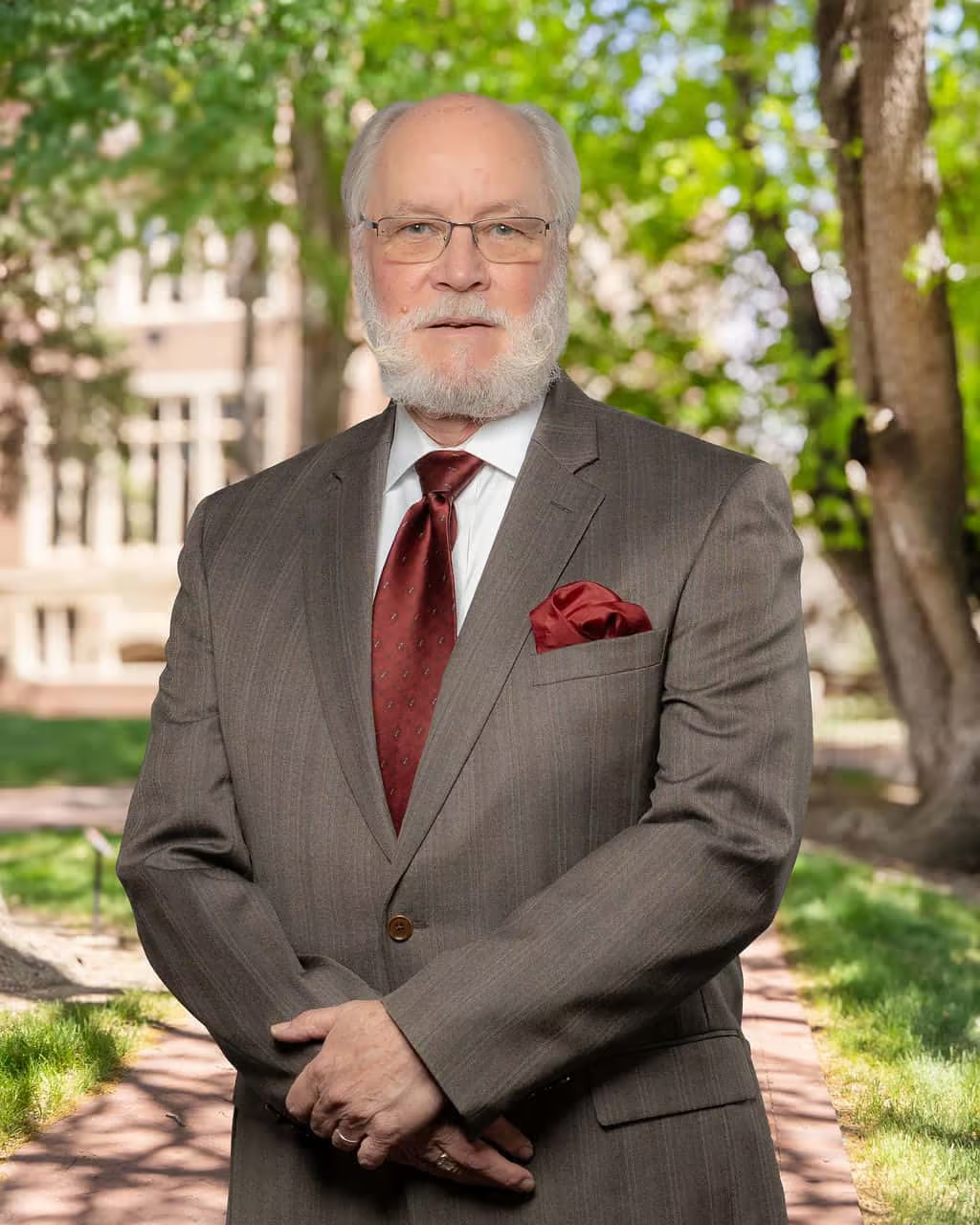
D’Estrée told Glenn Kessler back in 2016 that his former employee, Monica Petersen, died by suicide in Haiti. This claim has now been refuted by the recent reporting in the Ames Tribune that she was “murdered by traffickers” in Haiti. The suspiciousness of this contradiction on Professor d’Estrée’s part is only amplified by his past work for DynCorp.
- I explore the Monica Petersen investigation from the “dimension” of the broader social and political history of Haiti. Petersen herself claimed in her Facebook posts that she believed the Clintons “intervened” in Haiti to get the deeply corrupt former Haitian President Michel Martelly into power in Haiti. Petersen believed the Clintons’ relationship with Martelly was engineered at least in part to get the Clintons and their cronies access to the potential billions of dollars of gold wealth at the Morne Bosa and Grand Bois gold mines in Haiti.
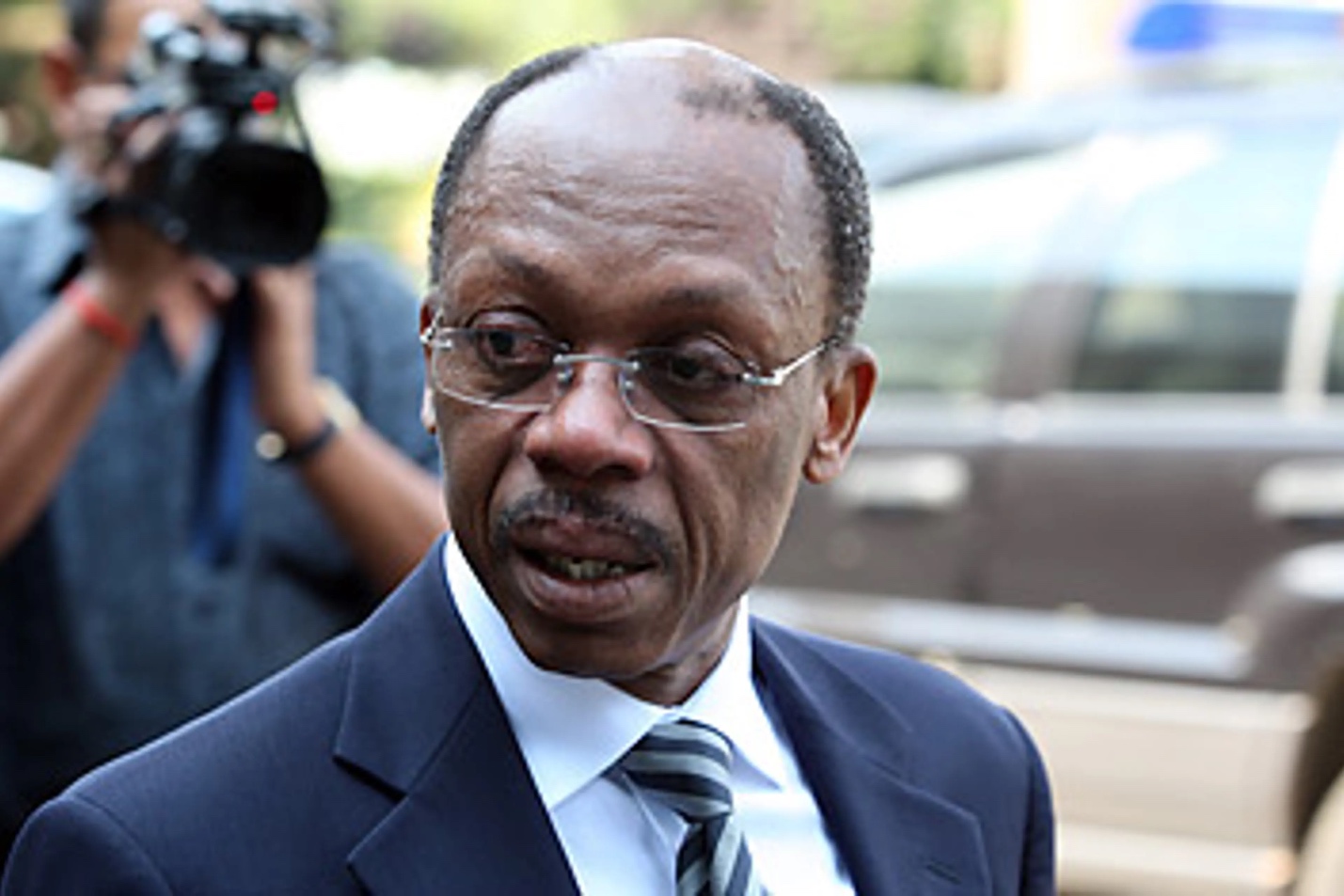
I explore these claims by Petersen in greater detail. I also explore the possibility that, if Monica Petersen’s claim about human trafficking allegedly occurring at the Caracol Industrial Park is true, the culprits behind such human trafficking in Caracol may be the same “bad actors” propped up by the CIA and the U.S. national security state in Haiti for decades. For many years the U.S. Intelligence community has covertly backed militias, gangs and right-wing paramilitary groups in Haiti in order to counter and destroy politically progressive movements in the country. In particular, this was done to quash the progressive-minded Fanmi Lavalas Party in Haiti, the party of left-leaning former Haitian President Artistide.
Many of these criminal groups in Haiti, backed covertly by U.S. and Internationally based Intelligence and corporate interests, are deeply involved in drug trafficking and human trafficking in Haiti as well. If Monica Petersen’s 2015 claim of human trafficking happening in Caracol is true, could these same criminal groups in Haiti also be involved in the human trafficking crimes alleged by Petersen?
[Author’s Note: This article is a shortened version of part one of my three-part investigative series into the death of Monica Petersen in Haiti. For the full version, please go to my “Surviveandheal15” Substack blog. “Surviveandheal15” is this author’s pen name.]

CovertAction Magazine is made possible by subscriptions, orders and donations from readers like you.
Blow the Whistle on U.S. Imperialism

Click the whistle and donate
When you donate to CovertAction Magazine, you are supporting investigative journalism. Your contributions go directly to supporting the development, production, editing, and dissemination of the Magazine.
CovertAction Magazine does not receive corporate or government sponsorship. Yet, we hold a steadfast commitment to providing compensation for writers, editorial and technical support. Your support helps facilitate this compensation as well as increase the caliber of this work.
Please make a donation by clicking on the donate logo above and enter the amount and your credit or debit card information.
CovertAction Institute, Inc. (CAI) is a 501(c)(3) non-profit organization and your gift is tax-deductible for federal income purposes. CAI’s tax-exempt ID number is 87-2461683.
We sincerely thank you for your support.
Disclaimer: The contents of this article are the sole responsibility of the author(s). CovertAction Institute, Inc. (CAI), including its Board of Directors (BD), Editorial Board (EB), Advisory Board (AB), staff, volunteers and its projects (including CovertAction Magazine) are not responsible for any inaccurate or incorrect statement in this article. This article also does not necessarily represent the views the BD, the EB, the AB, staff, volunteers, or any members of its projects.
Differing viewpoints: CAM publishes articles with differing viewpoints in an effort to nurture vibrant debate and thoughtful critical analysis. Feel free to comment on the articles in the comment section and/or send your letters to the Editors, which we will publish in the Letters column.
Copyrighted Material: This web site may contain copyrighted material the use of which has not always been specifically authorized by the copyright owner. As a not-for-profit charitable organization incorporated in the State of New York, we are making such material available in an effort to advance the understanding of humanity’s problems and hopefully to help find solutions for those problems. We believe this constitutes a ‘fair use’ of any such copyrighted material as provided for in section 107 of the US Copyright Law. You can read more about ‘fair use’ and US Copyright Law at the Legal Information Institute of Cornell Law School.
Republishing: CovertAction Magazine (CAM) grants permission to cross-post CAM articles on not-for-profit community internet sites as long as the source is acknowledged together with a hyperlink to the original CovertAction Magazine article. Also, kindly let us know at info@CovertActionMagazine.com. For publication of CAM articles in print or other forms including commercial internet sites, contact: info@CovertActionMagazine.com.
By using this site, you agree to these terms above.
About the Author
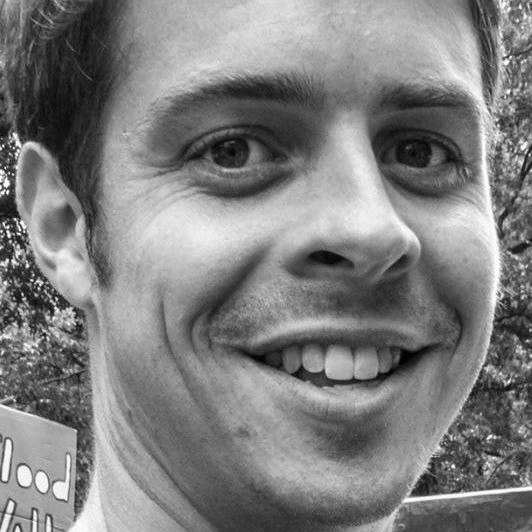
Steven Davis is a U.S.-born journalist and activist. He was born, raised and lives currently in Massachusetts, and has been investigating and writing about human trafficking crimes for the better part of a decade. He has a long history of involvement in labor and environmental activism, including working as a union organizer in different parts of the U.S. He works now as an accountant in his “day-to-day” work.
He travelled to Haiti in December 2022, to personally investigate human trafficking researcher Monica Petersen’s claims of human trafficking in Haiti, as well as help a school for children in Caracol, Haiti. He remains deeply committed to further investigating and writing about human trafficking crimes in Haiti, the most impoverished nation in the Western Hemisphere.
In his down time, Steven loves hiking and the outdoors. His journalism can be found at his Substack blog: surviveandheal15.substack.com, and he is active on Twitter/X: @SurvivenHeal15.
Steven can be reached at steven.davis.15@gmail.com.


.jpg)

