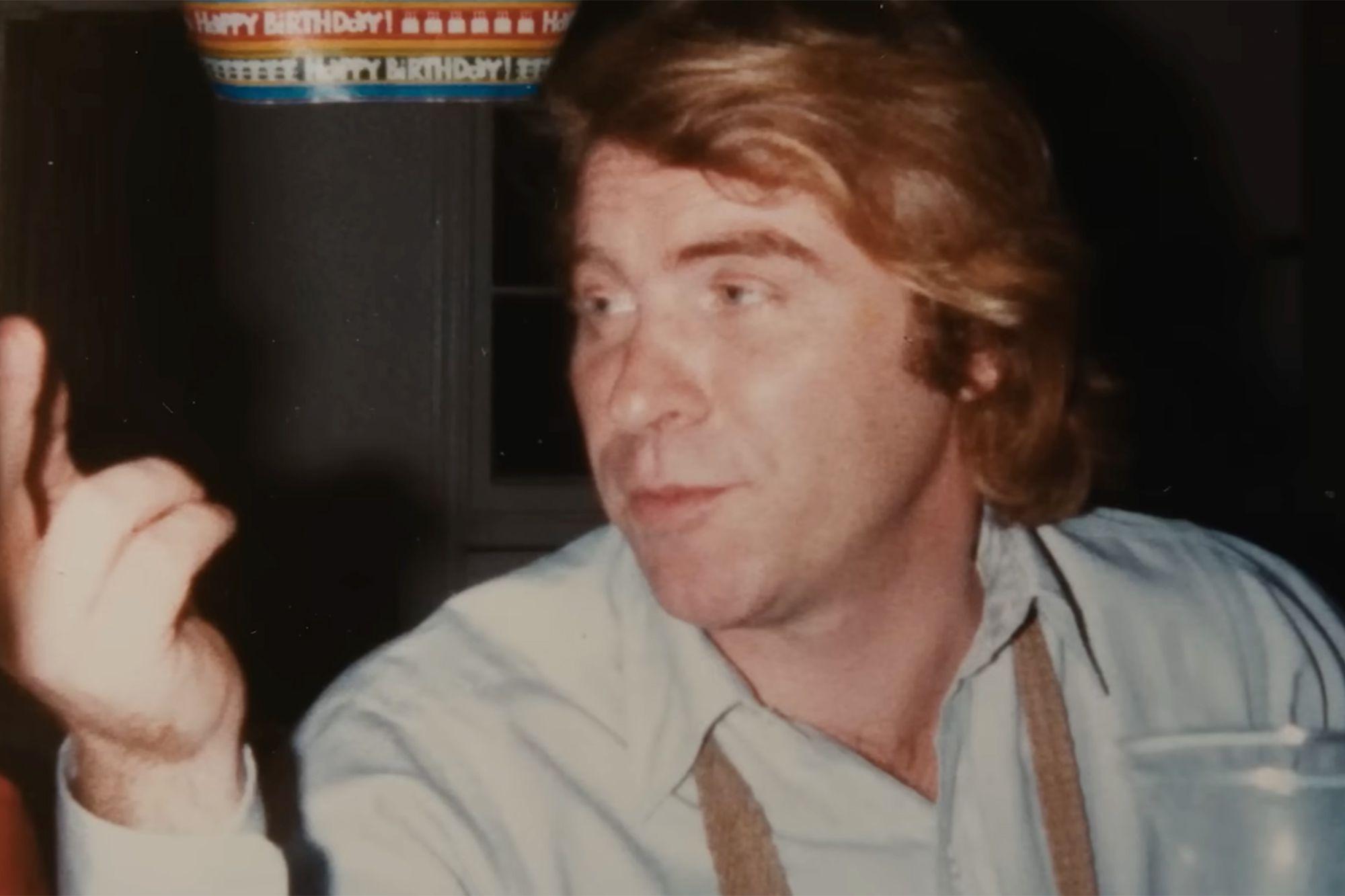
In August 1991, journalist Danny Casolaro was found dead in a bathtub in a Martinsburg, West Virginia, hotel room with his wrists slashed and cuts so deep it severed a tendon.
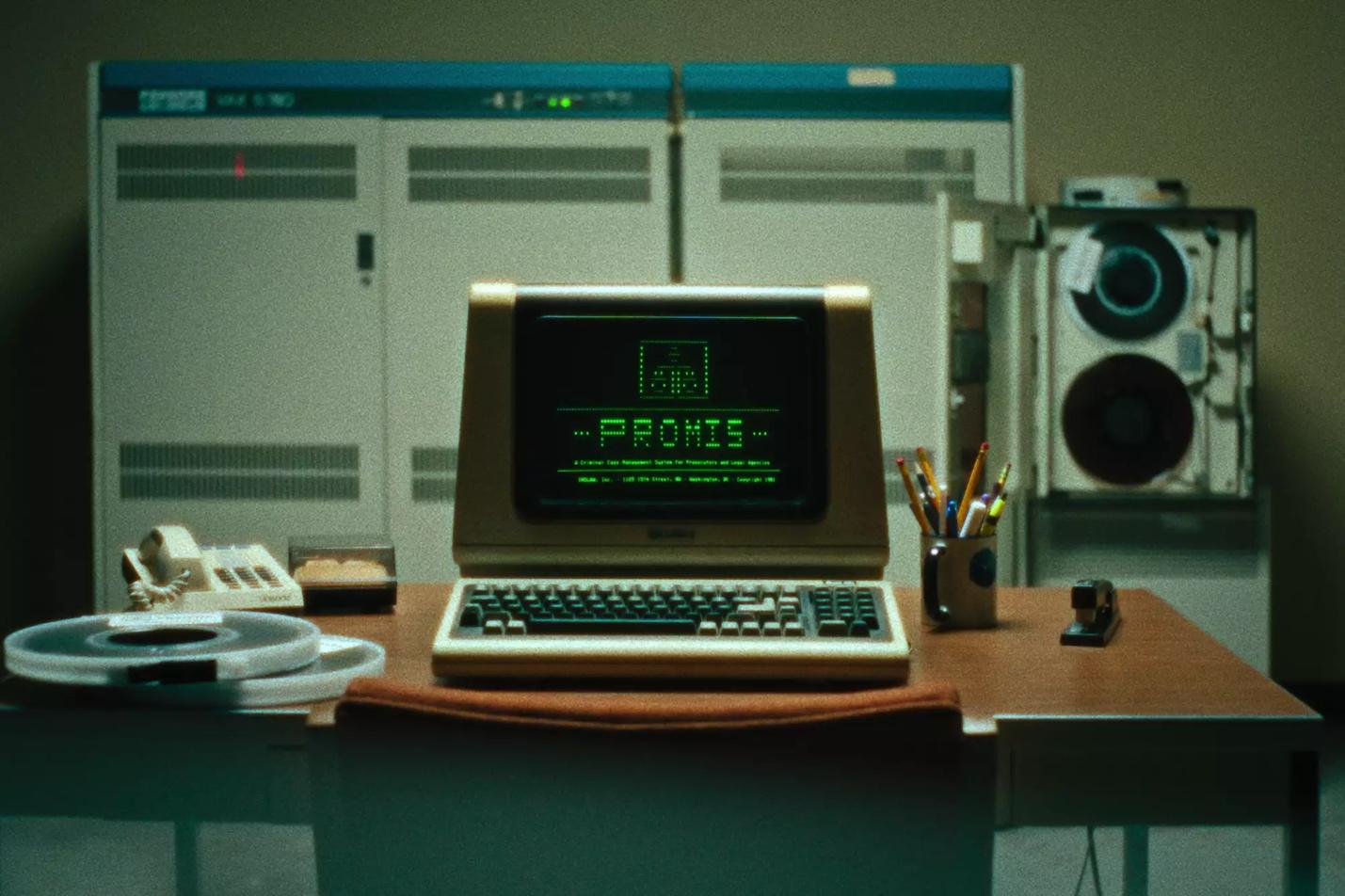
Casolaro had been investigating a web of CIA corruption in the 1980s linked to the Iran-Contra scandal[1] and theft of computer software called PROMIS (Prosecutor’s Management Information System) that could be used to enhance CIA money-laundering and surveillance operations.
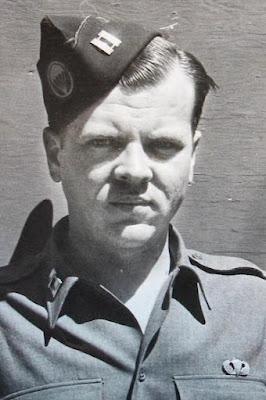
The prime suspect in Casolaro’s murder is Major Joseph Cuellar, a CIA and Special Forces operative who closely resembles the sketch of a man seen entering and leaving Casolaro’s room on the day he was found dead.
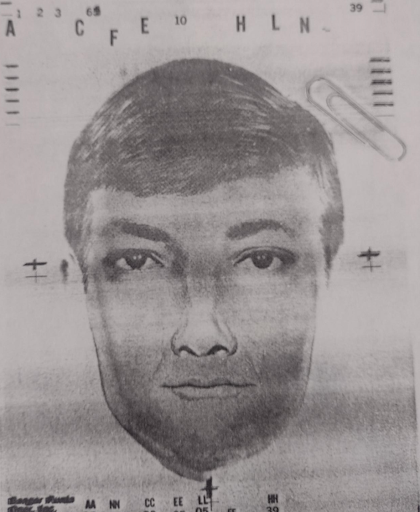
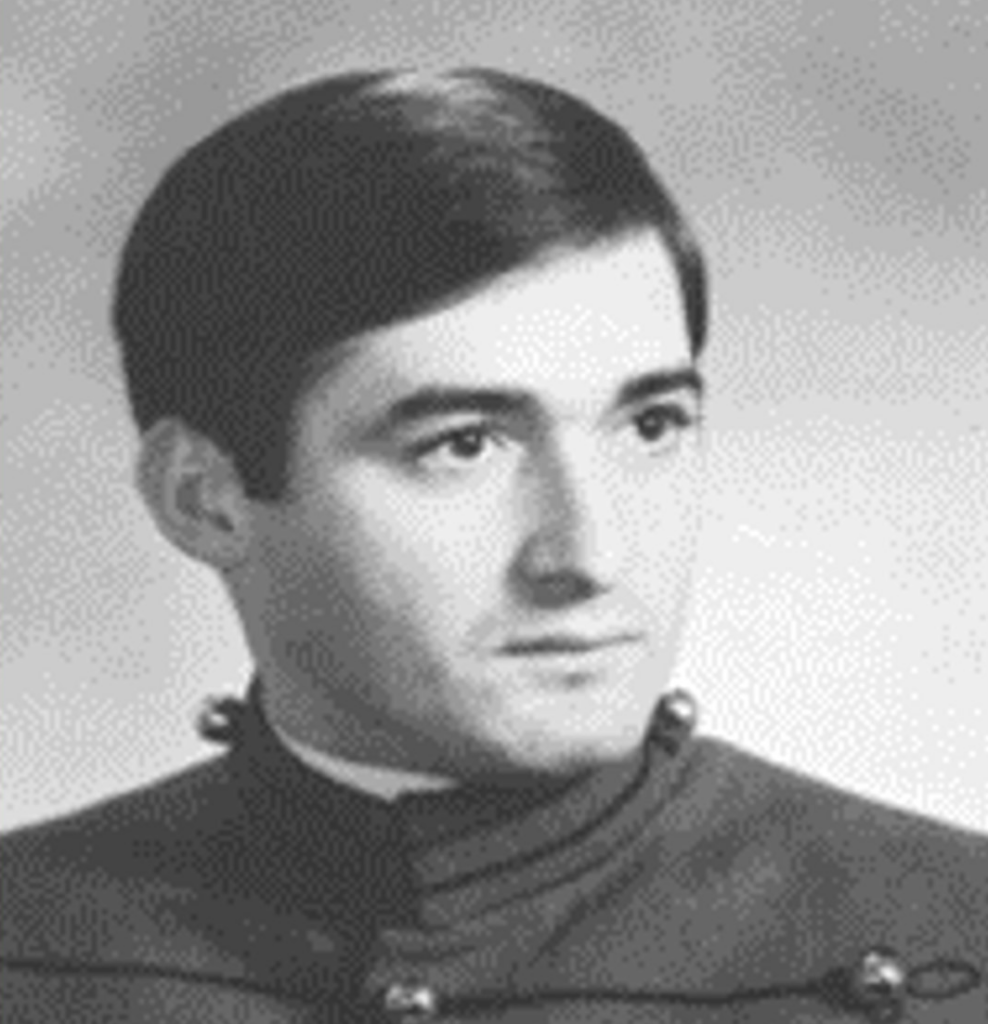
This sketch was obtained in 2024 by Australian researcher Peter Osborne from a Martinsburg police report after filing a Freedom of Information Act (FOIA) request 20 years earlier.
The police report, additionally, contained a cryptic note hidden in Casolaro’s shoe that made reference to the CIA and Mafia involvement with the Australian based Nugan Hand Bank and drugs and arms trafficking and terrorist operations in the Middle East, and the murders of Paul Morasca and Fred Alvarez linked to Wackenhut Cabazon Arms and Casino [discussed below].
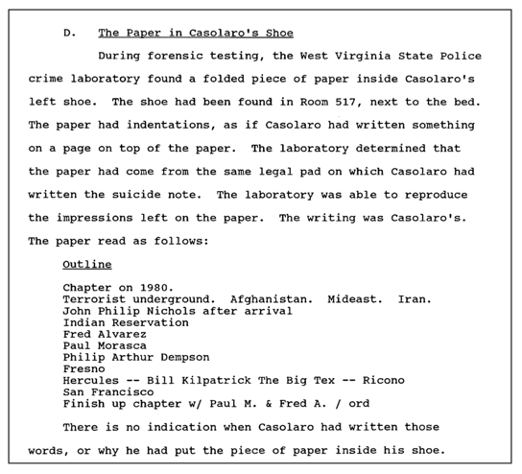
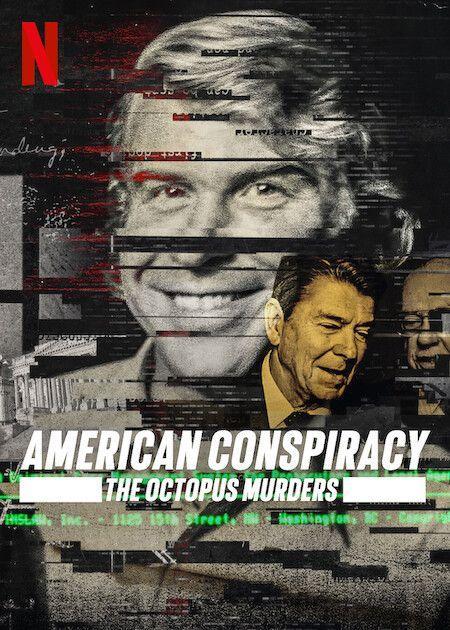
The Martinsburg police file contradicts an Emmy-winning Netflix series on Casolaro, American Conspiracy: The Octopus Murders, which erroneously suggests that Casolaro’s research had hit a dead end and that he had become depressed and likely committed suicide. (See CovertAction Magazine review of film here)
On May 5, Osborne provided a briefing to CovertAction Magazine on some key aspects of the Casolaro case and Casolaro’s research into corrupt CIA activities.
A former science & technology policy adviser to the Australian Federal Liberal Party, Osborne first became interested in Casolaro in 1987 after CIA operatives involved with Project Hammer and Operation Stillpoint [money laundering operations] destroyed his global encryption medical encryption key and certification authority program he had established with the Australian government, UN Secure Electronic Authentication Link (SEAL) Program, the World Health Organization, KPMG and Johns Hopkins School of Medicine.[2]
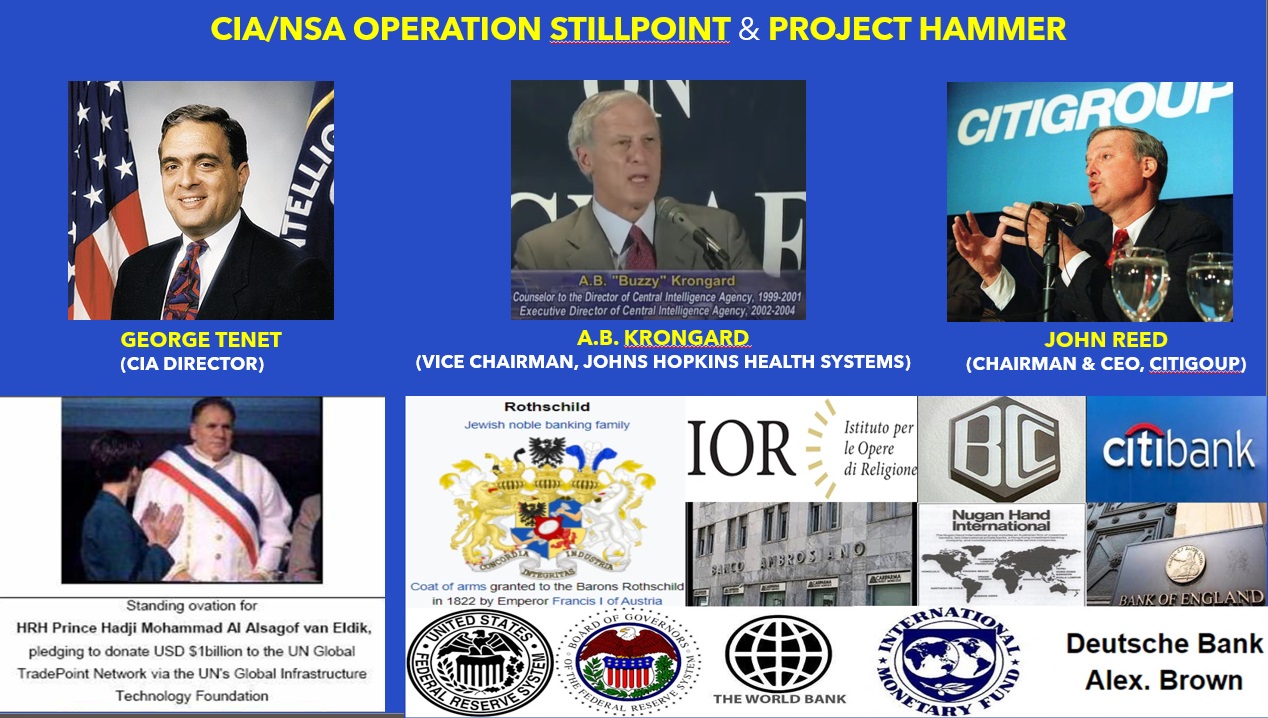
In December 2004, Osborne had his life threatened by CIA operative Robert Booth Nichols, who warned him not to continue his Australian Federal Police Fraud investigation against the directors of The Johns Hopkins institutions.
Osborne later discovered the same Directors of Johns Hopkins Medicine involved with CIA Project Hamer/Operation Stillpoint at Citibank were the ones who carried out the fraud against his companies in Australia and were associated with Business Risk International, the company that employed Joseph Cuellar.
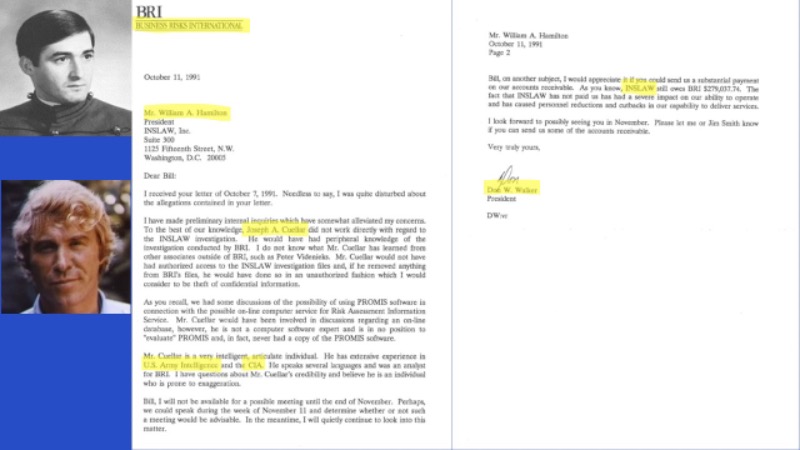
Over the last twenty years, Osborne has carried out first-hand interviews and uncovered important documents and information that is of great value to journalists and historians who want to understand Casolaro’s murder and the corrupt CIA network he was in the process of exposing known as “The Octopus.”[3]
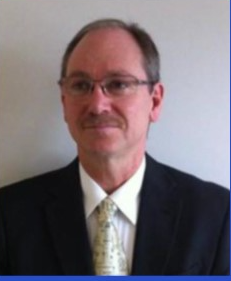
Osborne emphasized that, at the time of his death, Casolaro was investigating a series of murders at the Cabazon Indian Reservation in Riverside, California.
The Cabazon Indian Reservation was home to a casino through which the “Octopus” was laundering money from the Nugan Hand Bank, which had been set up by CIA operatives in Australia at the end of the Indochina War to launder drug money from the Golden Triangle.[4]
In the summer of 1981, Fred Alvarez, the Indian representative at the Cabazon casino who had been investigating irregularities in the casino’s operations, was shot execution-style along with two of his friends in his home.
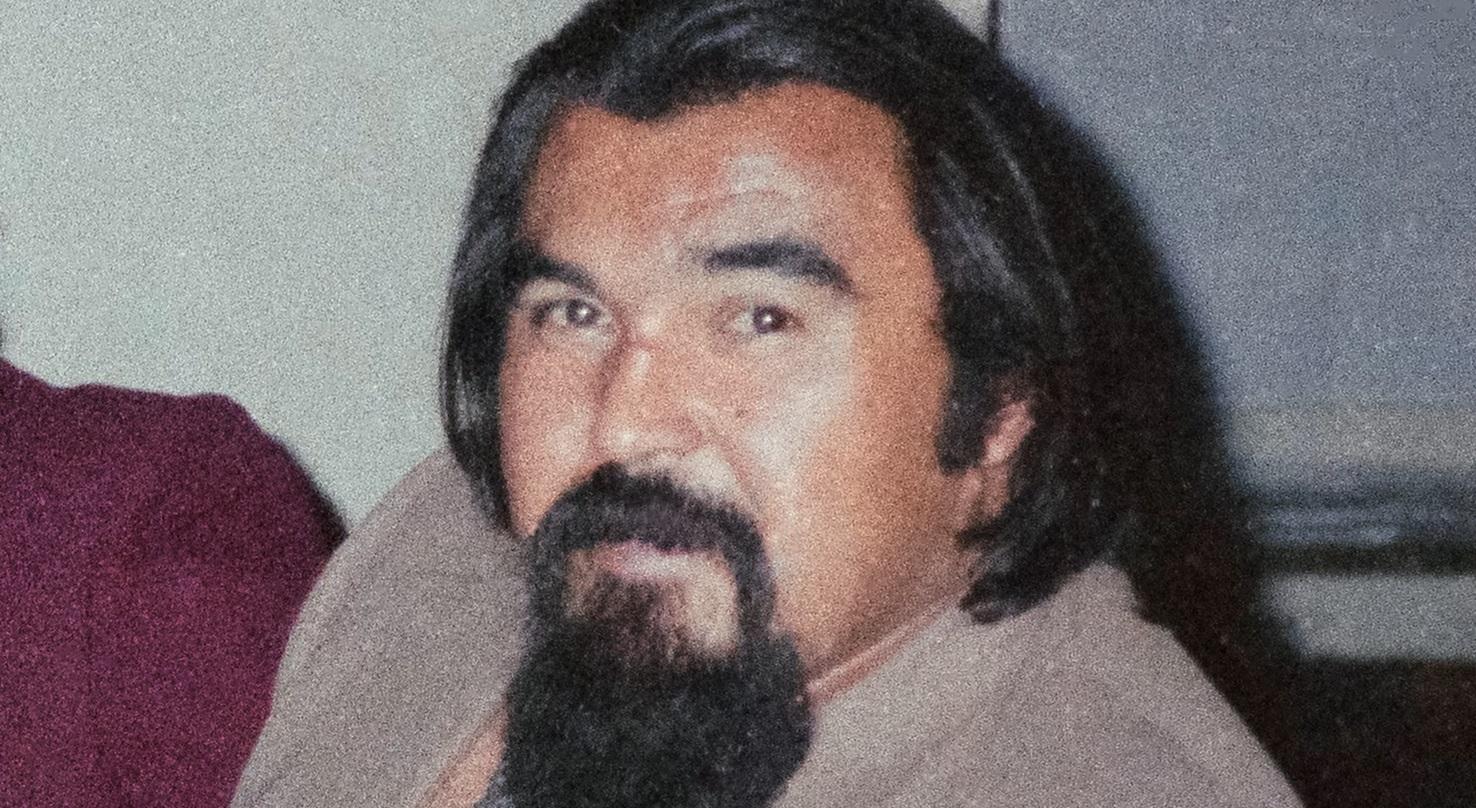
A year before his death, Osborne found out that Alvarez had written a letter to then-presidential candidate Ronald Reagan alerting him to the use of the Cabazon Indian Reservation casino as a front for CIA-Mafia money and drug-laundering operations and asking for a federal investigation.
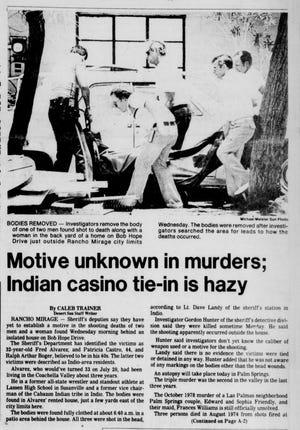
Reagan responded to the letter by saying he had read it and that it was interesting, though he did not order any investigation.
Reagan’s connection to “the Octopus” network Casolaro was investigating was apparent in his appointment of Dr. Earl Brian as Secretary of California’s Health and Welfare Agency, and Edwin Meese, as his chief of staff, during his governorship of California (1967-1975).
A veteran of the Vietnam Phoenix operation where he was directly involved in torture, Brian owned a biotech company that had computer system contracts with U.S. intelligence agencies.
Investigated for his involvement in a jackpot scheme with the Mafia, for which Brian fronted him money, Meese served as Attorney General in the 1980s.[5]
They were both key figures in the theft of the PROMIS software from Bill Hamilton, a former National Security Agency (NSA) employee who developed PROMIS through his company, INSLAW Inc.
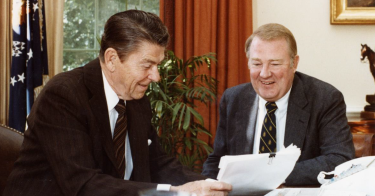
Fluent in Farsi, Brian was allegedly a key figure in the “October Surprise,” in which the Reagan campaign paid the Iranians to delay the release of American hostages during the 1980 election to make incumbent Jimmy Carter look bad and help Reagan win the White House.[6]
In his letter, Alvarez told Reagan about the “October Surprise plot,” and that money from the operation was being laundered through the Nugan Hand Bank.
Since Reagan was the prime beneficiary of the “October Surprise” and tied in with the CIA network that was smuggling drugs through Nugan Hand and that was later involved in Iran-Contra, it is no surprise that Reagan did not order any investigation.[7]
Six months after Alavarez’s murder, in January 1982, Paul Morasca was found dead in his home next to his computer, which had the hard disk ripped out.
Morasca was the business partner of Michael Riconosciuto, an electronics expert who had modified the PROMIS computer software for the CIA at the Cabazon reservation working under the cover of Wackenhut Corporation, a CIA front whose legal counsel at one time was CIA Director Bill Casey.
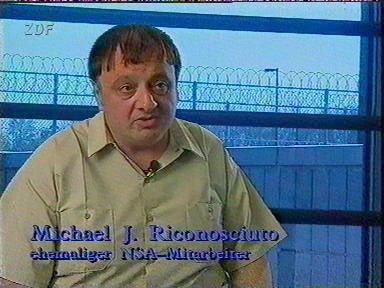
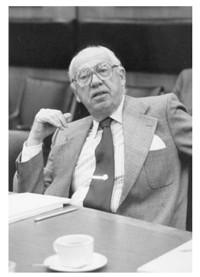
According to Osborne, Casolaro had uncovered that Morasca had been the banker of Michael Hand, a Special Forces veteran who founded the Nugan Hand Bank, and that he had helped oversee the Nugan Hand Bank’s money-laundering operations.
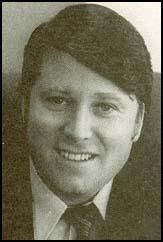
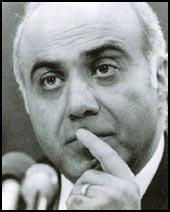
Morasca further worked with Michael Ricionosciuto’s company called SERTIC involving Richard Secord and Albert Hakim selling guns and night-scopes for Nicaraguan Contra fighters, right-wing terrorists that were attempting to overthrow the left-wing Sandinistas who came to power in a 1979 revolution.
Secord and Hakim, an Iranian businessman, were tied to a corrupt CIA cabal involved in the Iran-Contra scandal headed by Oliver North and Theodore Shackley, the director of the Phoenix program who oversaw a deadly secret war in Laos as CIA Station Chief in Vientiane from 1966-1968 and terrorist operations targeting Cuba under Operation Mongoose.[8]
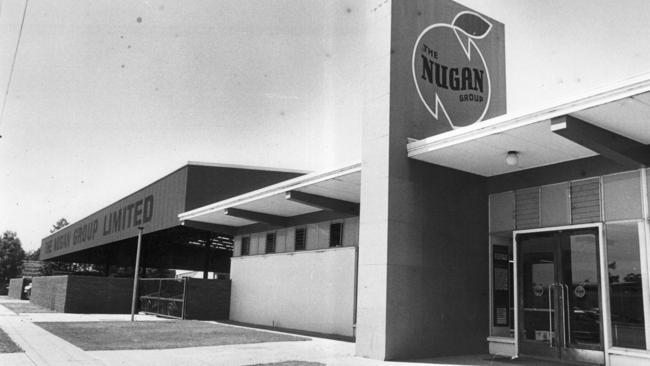
Morasca’s money-laundering operations were conducted under the cover of Nugan Hand Bank and a company, Recovery Technologies Inc., involved with an Australian gold mining company called Southern Goldfields Ltd. owned by Peter Briggs, and Mining Resources (WA) Ltd. owned by Michael Hand and Frank Nugan, which elements of the “Octopus” were invested in.
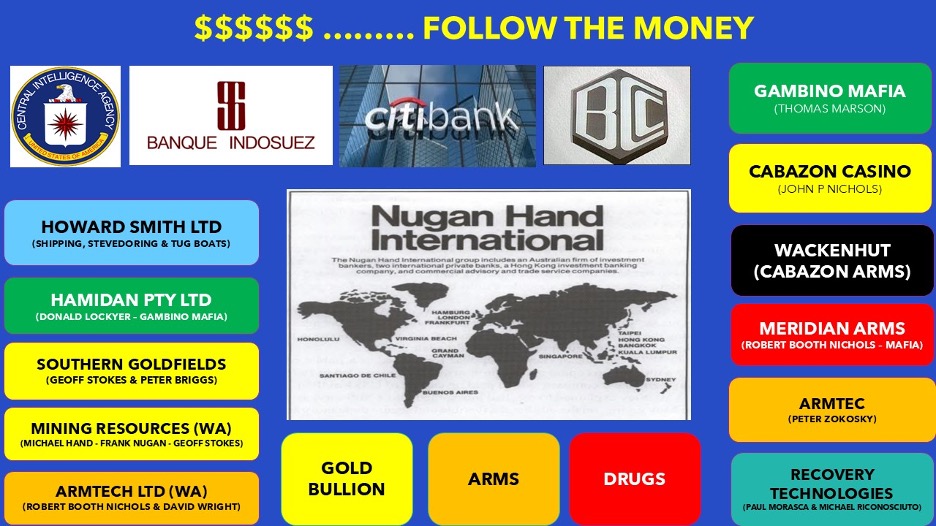
Morasca had moved more than $1 billion in gold bullion from Nugan Hand Bank, which derived from the Yamashita gold that had been stolen from Imperial Japan at the end of World War II and was used to fund black CIA operations during the Cold War.[9]
Under the direction of Thomas G. Clines and other members of Ted Shackley’s “Octopus” network, the Nugan Hand Bank additionally moved over $1 billion for the Shah of Iran and millions more from other U.S. backed dictators like Ferdinand Marcos and drug warlords supported by the CIA like General Vang Pao.
Casolaro had uncovered that Alvarez and Morasca’s murders were carried out by a CIA hit man, Phillip Arthur Thompson, who had been freed from prison to carry out the killings. Thompson’s CIA nickname was Jason [from the Freddy the 13th slasher movie].
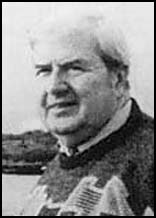
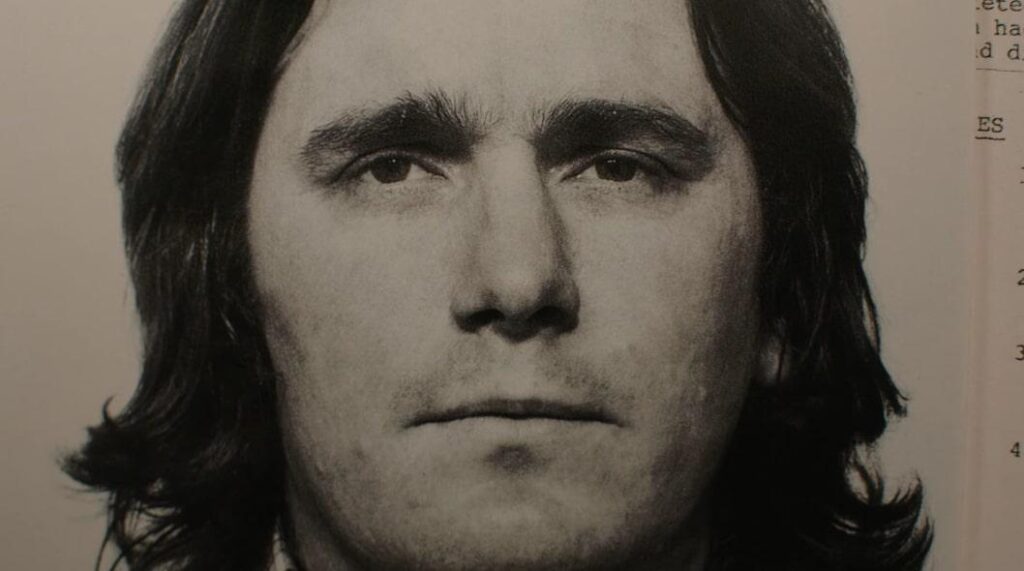
In 2008, Osborne interviewed Australian private detective Sandra Sutherland, who was appointed by the parents of Valley McDonald, who was raped and murdered in 1980 by Thompson. Sutherland said “that during her investigation, it became clear that Thompson was intimately connected to both CIA and DEA, and he was involved in armed robberies in Canada and they recovered a diary confirming that he was involved with a man called Rodriguez flying drugs and arms to and from El Salvador.”
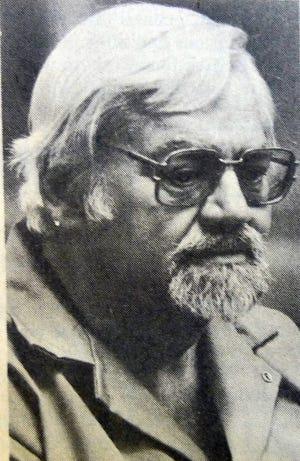
Casolaro had found out that Thompson was hired for the hit on Morasca by John Philip Nichols, a CIA covert operations specialist who worked for the CIA in Brazil and Chile and planned to use the Cabazon tribe’s sovereign status to operate an arms factory on the reservation and ship weapons to Central American rebel groups, including the Contras.
Michael Riconosciuto believed that Thompson and Nichols’ motive in killing Morasca was to recover secret numbered accounts used to transfer funds from Nugan Hand Bank for Michael Hand as well as the records of the CIA’s secret $40 million used for “the October Surprise” blackmail operation.[10]
Before Casolaro travelled to Martinsburg, he had telephoned Curtis (Sam) Cross, former Chief of Indio Police who investigated the murders of Morasca and Alvarez. They agreed to meet at a restaurant in Virginia the following Saturday. Cross told Osborne that he believes that Casolaro was murdered and that the Martinsburg Police, FBI and U.S. Department of Justice covered up the evidence.
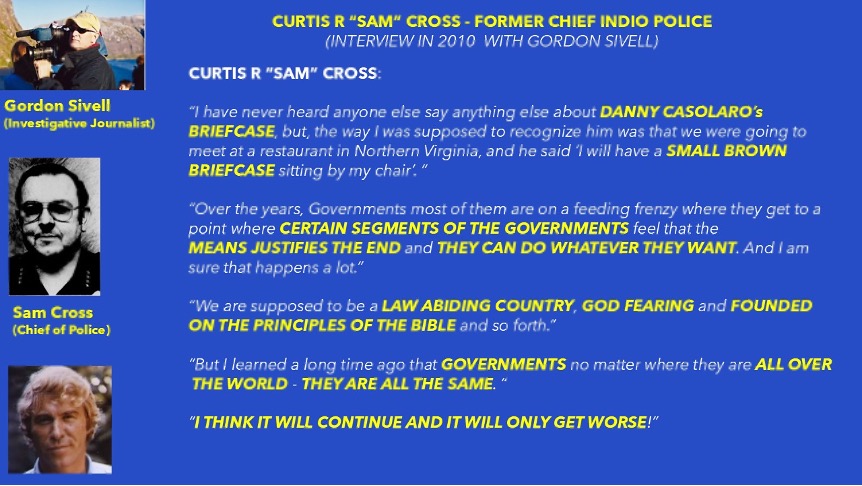
Cross in his interview with Osborne stated:
“You know the whole thing with his death didn’t sit well with a lot of people. There are still a lot of unanswered questions. I also do believe that Danny Casolaro was murdered. The Prosecuting Attorney of Dr. Nichols and myself were contacted by the FBI and told there was a contract out on us. The Prosecuting Attorney of Dr. Nichols was Richard Erwood (Indigo Deputy Attorney General). He is a Judge now still working in Indigo. The person that had the contract on me, his nickname was JASON [reference to Philip Arthur Thompson]. Law Enforcement knew him.
A young highway patrolman stopped him for a bad taillight and found a quantity of C4 explosives and some illegal weapons in his trunk and they sent him to prison. It was a pure fluke, the highway patrolman was fresh out of the academy and didn’t know who he was stopping. The guy had been to a narcotics party and was a little high, he wasn’t watching his P & Q’s, I guess, and he had a taillight out, and they found C4 Explosives and illegal handguns with the serial numbers filed off, in his trunk. The C4 Explosives are usually stolen from the military and sold on the black market. I think he was arrested in San Gabriele, in California, in Los Angeles County. I was tipped off by an agent from the FBI, I previously met him when I went to the FBI Academy in Quantico.”
CIA Masterminds and What Casolaro Knew
Osborne believes that the mastermind of the Casolaro killing was CIA operatives Ted Shackley, George Pender, Robert Maheu, and Robert Booth Nichols [no relation to John Philip Nichols], a CIA-Mafia man involved with the Nugan Hand Bank who befriended Casolaro to stay close to his investigation and to see what he knew.[11]
Nichols owned Meridian International Logistics, an arms company, and was on the board of First International Development Company (FIDCO) with Clint Murchison, Jr., the owner of the Dallas Cowboys linked to both the CIA and Mafia, and George and William Pender, the latter being the CIA Station Chief in Saigon during the Vietnam War who oversaw drug-running operations with Theodore Shackley connected with the Phoenix Program.[12]
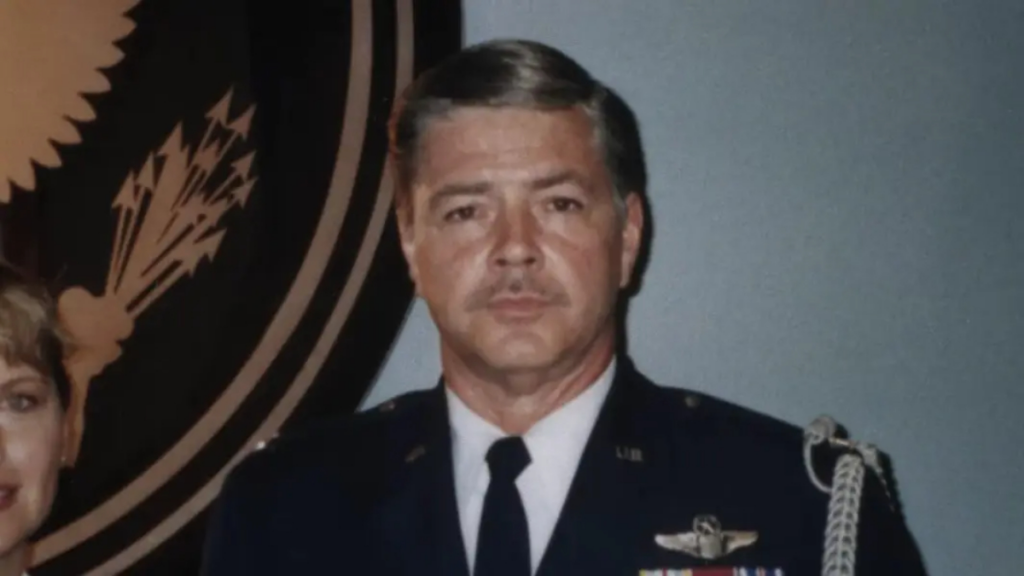
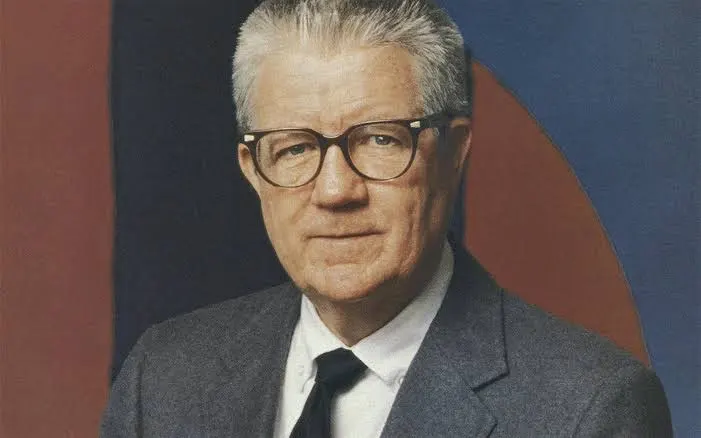
FIDCO’s attorney, Michael A. McManus, Jr., served as White House Communications Director under Ronald Reagan in 1984-1985 and as an assistant to Reagan, pointing to a key link between Reagan and the CIA-Octopus Mafia that Casolaro was investigating.
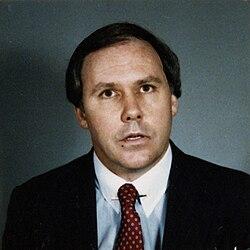
Prior to his visit to Martinsburg, West Virginia, where he was killed, Casolaro had spoken to DEA investigators and attorneys who talked about the DEA’s investigation of Robert Booth Nichols and his links with the Mafia.
Casolaro was planning afterwards to go to Australia to meet with members of the Nugan Hand Bank Royal Commission Inquiry and Costigan Royal Commission Inquiry into the Painters and Dockers Union that were set up in 1980s to investigate evidence of the CIA’s links with the Mafia drugs and arms trafficking operations in Australia.
During his visit, he would have had the opportunity to review confidential reports involving the Nugan Hand Bank and the Nagarramba Arms Deal involving Wackenhut, Cabazon Arms, Armtec and Meridian Arms and Meridian Logistics International, two companies owned by Robert Booth Nichols.
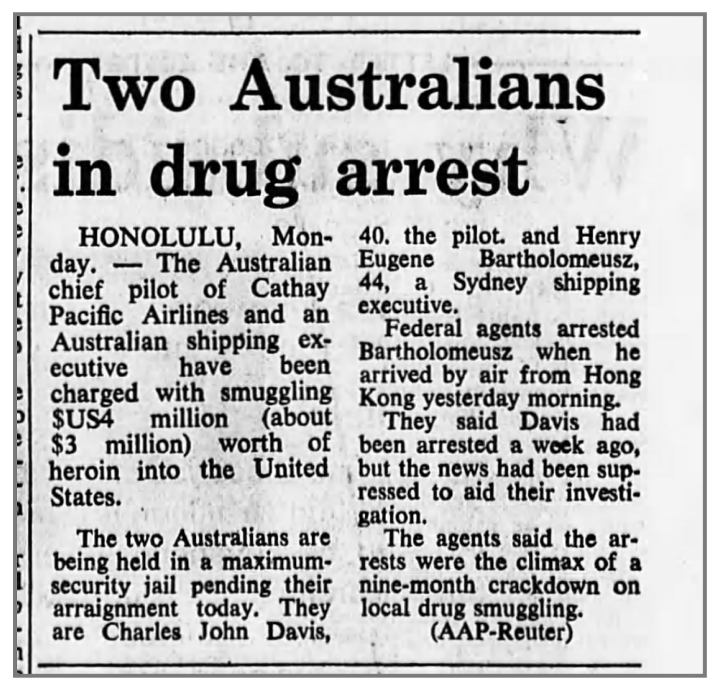
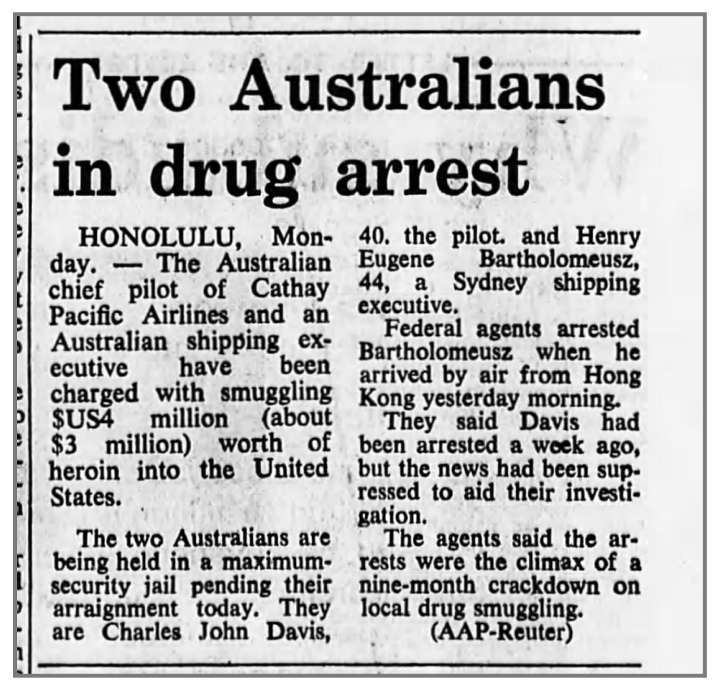
In 1980, the Australian Williams Royal Commission on Drugs seized telexes which indicated dealings between Michael Hand and a Sydney shipping executive, Henry Eugene Batholomeusz, who was arrested in 1974 shipping over $4 million worth of heroin into the U.S. and was later implicated in smuggling arms and nuclear materials to Middle Eastern countries.[13]
Osborne uncovered that in 1991, CIA pilot and arms dealer Richard Brenneck and his attorneys provided Casolaro with documents confirming his dealings with Bartholomeusz, and Bartholomeusz’ involvement in a secret CIA $2.5 billion arms deal with Iran and Iraq that was exposed by U.S. Customs in 1986 during the Iran Contra and Iraq-gate investigations.[14]
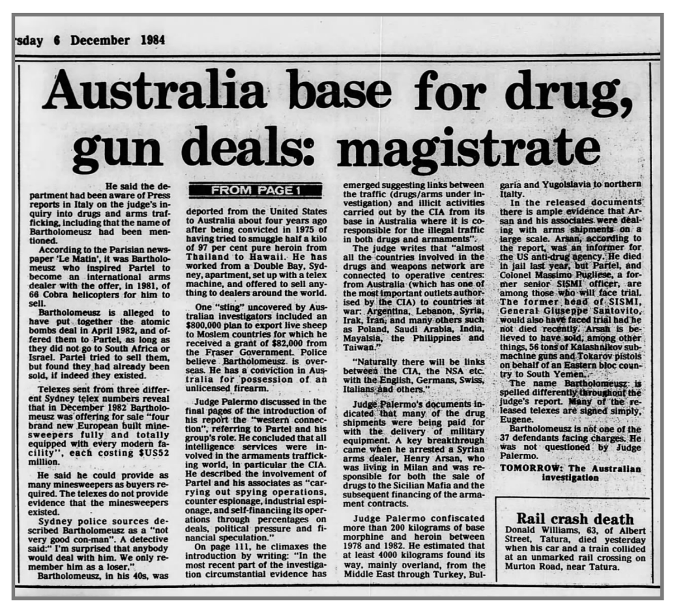
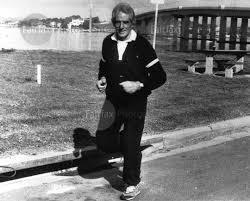
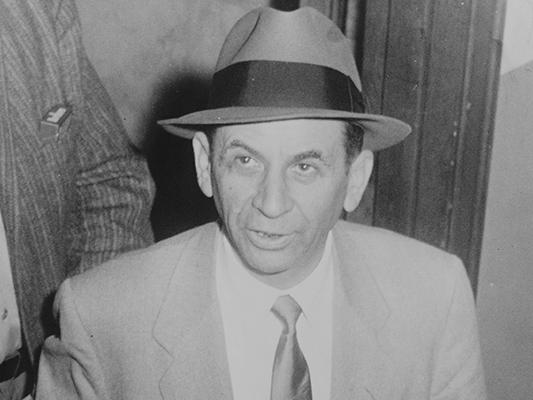
The Costigan Commission uncovered that Australian heroin distributor Murray Riley, a former Olympic rower, worked closely with Michael Hand and Meyer Lansky, the mob accountant, and had been shipping heroin to the U.S. and laundering money through the Nugan Hand Bank.
Police authorities that had tried to crack down on drug flights from the Golden Triangle were less suspicious about Australia or prone to carry out searches on those planes. The Costigan Commission additionally determined that the U.S. Mafia was laundering money in Australia through slot and poker machines.
The Nugan Hand Bank’s corrupting influence in Australia was reflected in its function as a conduit for CIA black funds that were used to carry out a coup in 1975 against left-leaning leader Gough Whitlam who opposed the Vietnam War and wanted to remove U.S. spy bases from Australia and close down the Nugan Hand Bank.[15]
Osborne uncovered that Robert Booth Nichols had used Australia to train Osama bin Laden in 1982 when the CIA recruited him to fight against the Soviets in Afghanistan, something Casolaro appeared to know about.
When Osborne interviewed Dee Ferdinand, the daughter of Albert V. Carone, a bagman for the CIA and Mafia who helped launder Nugan Hand Bank funds in the U.S., she said that Murray Riley came to the U.S. regularly to meet with Carrone.
Carones’s CIA contacts included Ted Shackley and Robert Maheu, a CIA-mob liaison who ran a private intelligence firm featured in the Mission Impossible TV series and worked closely with billionaire Howard Hughes, who ran honey-pot surveillance operations through Las Vegas casinos that he owned. Maheu owned FIDCO with Robert Booth Nichols.[16]
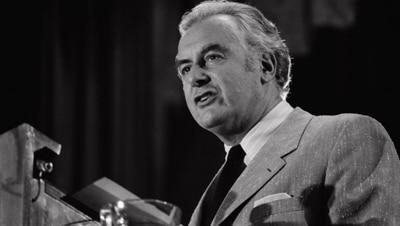
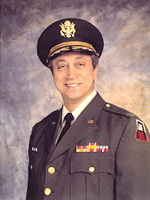
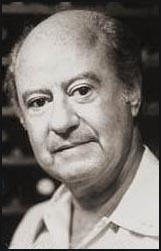
Ferdinand told Osborne that, besides Riley, her home was regularly visited by CIA Directors William Colby and William Casey and by Gambino family crime boss Paul Castellano (1975-1986).
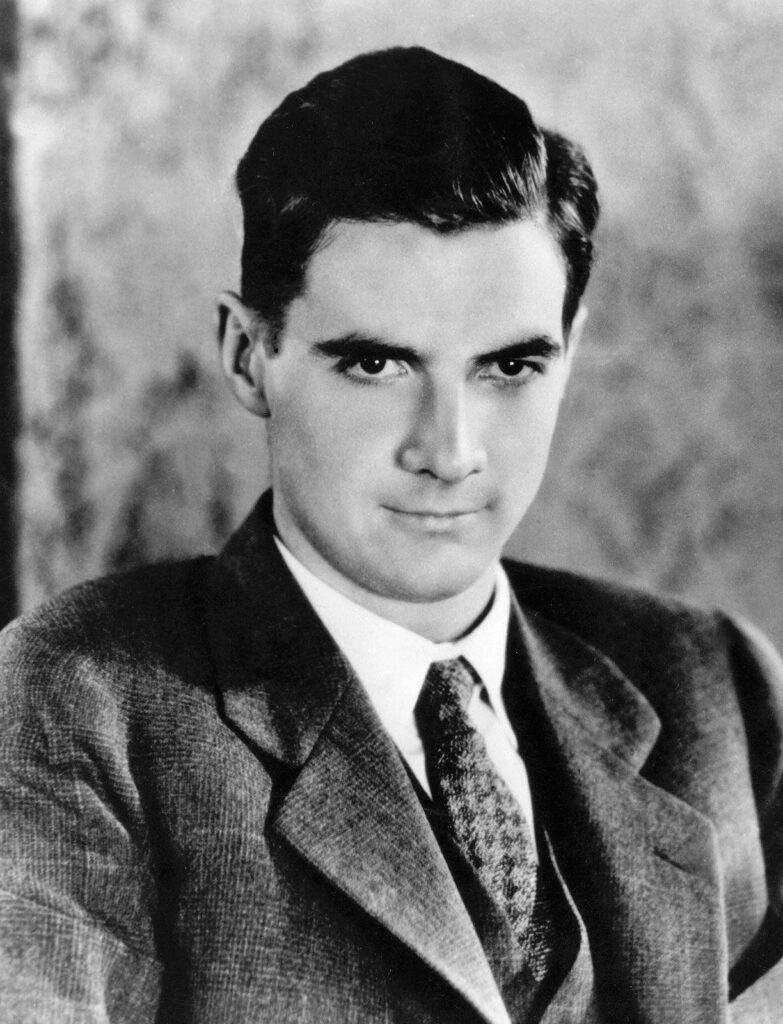
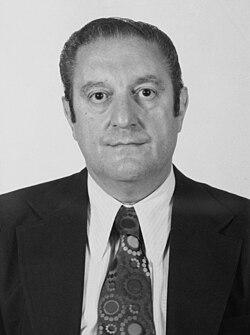
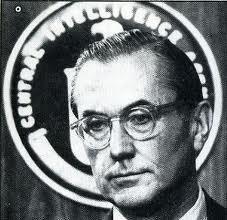
The Costigan Royal Commission Inquiry had amassed information about the Nugan Hand Bank’s business with other members of the Gambino crime family like Aladena “Jimmy the Weasal” Fratianno and Tommy Marsden who worked under Castellano and oversaw the operation to launder funds through the Cabazon casino in Riverside, California.
Some of these funds derived from drug smuggling out of the Middle East, including Afghanistan and Lebanon, which was overseen by Robert Booth Nichols and the FIDCO board.
Osborne believes that Casolaro had felt that Nichols was trying to control Ronald Reagan through McManus, who became his assistant.
He also uncovered information that Howard Hughes had financed the CIA network led by Ted Shackley that had CIA operative Lucien Conein appointed to work under cover for the DEA.
The purpose was to control all narcotics intelligence and eliminate all competition to the CIA’s drug-smuggling operation run through the Nugan Hand Bank, Castle Bank & Trust, and Mercantile Bank & Trust, which were controlled by Paul Helliwell, General George Olmsted and Michael Hand.
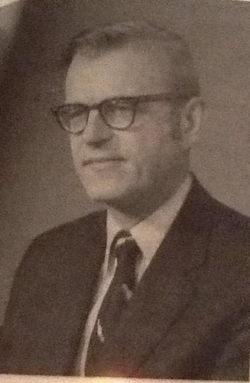
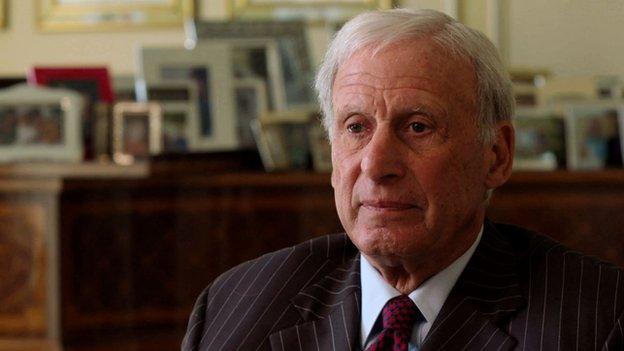
When the Nugan Hand Bank collapsed in 1980, Casolaro found out that the drug and money-laundering operation shifted to other CIA-networked banks, including Bank Ambrosiana, Bank of Commerce and Credit International (BCCI), and Citibank under Operation Hammer, headed by A. B. Krongard, a CIA executive who was on the board of Johns Hopkins Medicine, which has a partnership with the university.
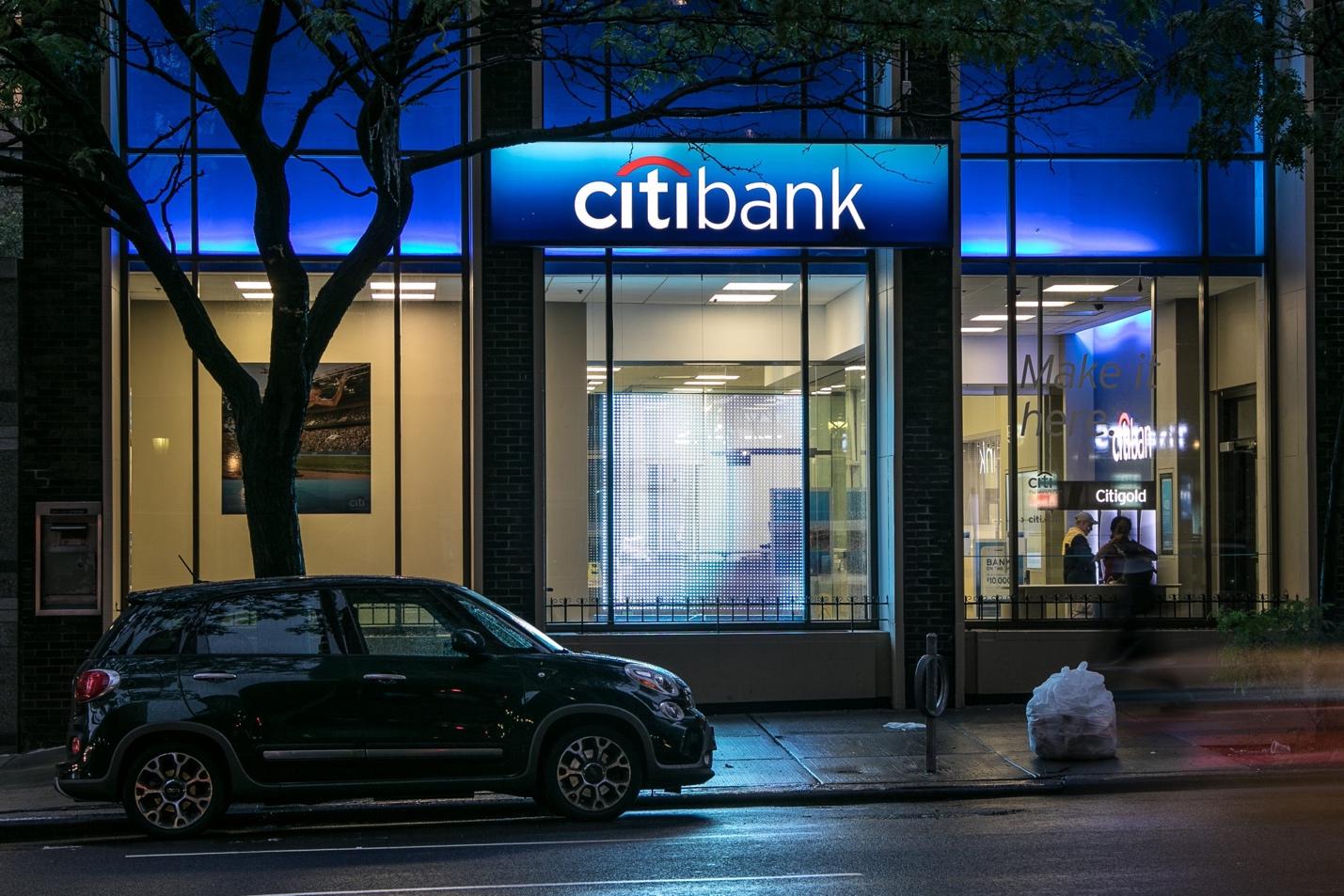
In April 2000, Brigadier-General Erle Cocke, former representative of the Nugan Hand Bank testified in court that Project Hammer was established at Citibank and managed by its CEO John Reed and A.B. Krongard, who also served as Chairman of the Board of Alex, Brown & Sons, the nation’s oldest investment banking firm, and as Vice Chairman of the Board of Bankers Trust.[17]
Project Hammer was the continuation of the complex CIA financial operations of the Nugan Hand Bank and Banca Ambrosiana.
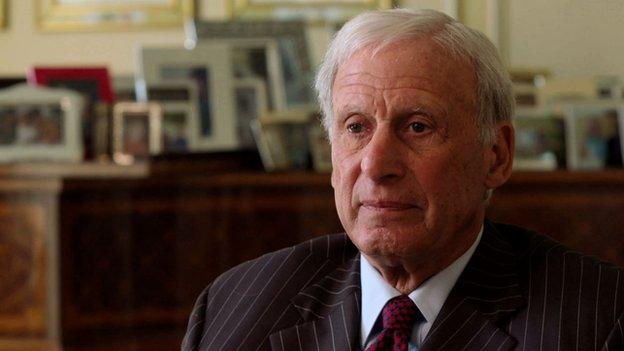
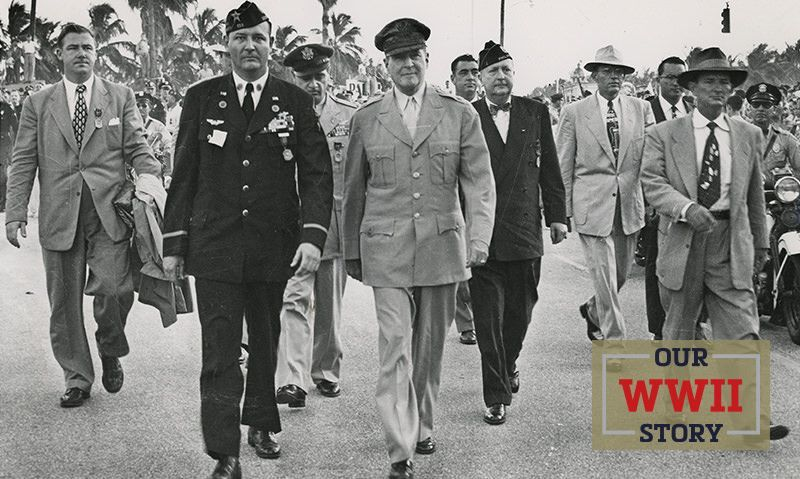
According to Osborne, Ronald Reagan’s close association with the CIA-Mafia Octopus network was apparent not only in his appointments of Brian, Meese and McManus to important positions, but also in the fact that Robert Booth Nichols lived across the street from him and Nancy when he was president and was a personal friend of Ronald’s son Michael Reagan.
Additionally, Teamsters President Jackie Presser (1983-1988), who had ties with the Gambino crime family, also served as one of Reagan’s advisers.
The CIA’s involvement in the cover-up of Casolaro’s murder was apparent in that Casolaro’s girlfriend, Wendy Weaver, was comforted after his death by Robert Maheu’s new girlfriend who happened to have been Wendy’s best friend.
Wendy was taken to a house-boat to cool down after she had been making phone calls to the local police and FBI demanding a proper investigation. Maheu even flew lobster to Wendy and her family to console her while helping to plant in her the idea that her boyfriend had committed suicide.
Meanwhile, all of Casolaro’s documents were removed from his home by Ann Klenk, a journalist who worked for Dr. Earl Brian.
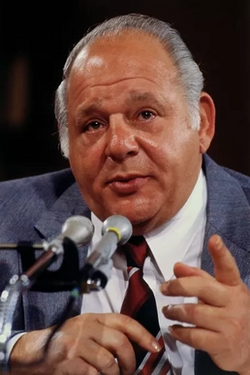
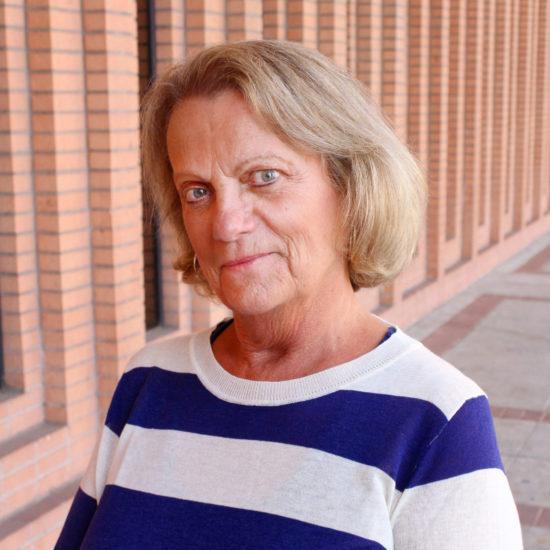
Just before Casolaro was murdered, he encountered Ted Shackley’s girlfriend who snooped around his house for documents after he invited her in. Casolaro had also been spending time with Robert Booth Nichols and Joseph Cuellar, who both disappeared after his death.
These are all just too many coincidences for anyone to credibly believe that Casolaro committed suicide and that the CIA had no involvement in his death or its cover-up.
The Iran-Contra scandal erupted after Oliver North and other members of the Reagan administration’s National Security Council (NSC) were caught illegally supplying weapons funded through arms sales to Iran to Nicaraguan counter-revolutionaries known as the Contras. Congress had barred aid to the Contras after they were implicated in terrorist activities. ↑
Osborne’s business and investment partners, KPMG, were also the auditors of The Johns Hopkins Institutions and Citibank. In 2004, Osborne launched an Australian Federal Police Fraud investigation against the directors of Johns Hopkins Medicine and The Johns Hopkins Applied Physics Laboratory that was covered by two leading Australian TV investigation programs. ↑
Osborne’s website, The Sixth Eye, has many podcasts and offers a treasure trove of information to visitors. ↑
For more on the Nugan Hand Bank, see Jeremy Kuzmarov, “Slain Journalist Was on Threshold of Exposing Large-Scale CIA-Mafia Drug-Smuggling Operation Using Australian Bank Founded by Special Forces Veteran,” CovertAction Magazine, October 10, 2025.Osborne said that Meese “is organized crime.” ↑
Whistleblower Michael Riconosciuto said that Brian’s reward for participating in the “October Surprise” was access to the stolen PROMIS software, which he then sold to law enforcement agencies worldwide for profit and to raise funds for covert government operations. Riconosciuto further claimed that the PROMIS software was brought to him by Brian as part of an intelligence operation, with a request that he install a “trap door,” a type of function that a third party can use to break into a system, PROMIS, they wanted to sell to other governments and spy on what they were tracking. ↑
It is possible that Alvarez’s letter to Reagan sealed his own fate, as Reagan could have alerted the people heading “the Octopus” that Alvarez was a danger who knew too much. ↑
For more on Shackley, see David Corn, Blond Ghost: Ted Shackley and the CIA’s Crusades (New York: Simon & Schuster, 1994). ↑
For more on the Yamashita gold, see Sterling and Peggy Seagrave, Gold Warriors: America’s Secret Recovery of Yamashita’s Gold (Bowstring Books, 2002). Osborne recovered copies of the FBI investigation into the murder of Paul Morasca confirming the recovery of 35 pages of documents containing financial accounts and transactions at the Atlantic Bank and Trust Company and at Banque Pariente, Geneva, Switzerland. ↑
Riconosciuto was framed on drug charges and spent over a quarter century in prison. In 1992, Curtis (Sam) Cross provided a letter of reference and support for the credibility of Ricionosciuto during his trial, stating: “my contact with Mr. Riconosciuto has never given me cause to doubt his credibility, and I would recommend that Mr. Riconosciuto be given reasonable consideration within the existing legal parameters.” ↑
According to Casolaro’s notes, Nichols told him: “These scandals that bubble to the surface—they’re all connected to a rogue intelligence network that goes back decades…I’m speaking of people in intelligence, internationally, across the board—not just the CIA.” Then, Nichols warned him: “I wish you weren’t a writer. You know too much—and now you’re gonna have to die.” Casolaro later wrote: “Was this a sinister joke or a friendly warning? I couldn’t tell the difference.” In hindsight, it clearly was a warning. ↑
Nichols also owned the Baron of Beef steakhouse in Australia, which functioned as a CIA safe-house. He was mentored by Harold Okimoto, a World War II veteran and intelligence operative with ties to former CIA Deputy Director and Defense Secretary Frank Carlucci. Okimoto, owner of Island Tobacco Corporation, had also been linked to racketeering investigations dating back to the 1960s. ↑
In 1984, the same Henry Eugene Batholomeusz was back in Australia and identified by the Costigan Royal Commission Inquiry and Italian magistrate Carlo Palermo investigating evidence that Australia was a base for the CIA’s trafficking in drugs and armaments with the Italian SISMI and Mafia. Bartholomeusz was trafficking Cobra attack helicopters, armored tanks, frigates, mine sweepers, Exocet missiles, machine guns, enriched uranium, plutonian and atomic bombs to Saudi Arabia, Syria, South Africa, Lebanon, Argentina, Poland, India, Malaysia, Philippines, Iran and Iraq. Carlo Palermo led the criminal investigation into an international drug and arms trafficking network, involving politicians in Trento in 1980, and examining ties between the Mafia, freemasonry and Bulgarian and Syrian spy organizations. ↑
See CovertAction Magazine expose related to this based on Osborne’s research here. The documents included the telephone & facsimile numbers and postal address of Bartholomeusz in Sydney Australia. ↑
The coup was orchestrated by creating a fake scandal that succeeded in undermining the popularity of Whitlam’s government. Deputy Prime Minister and Treasurer Jim Cairns was set up and made to look like he had accepted a $4 billion loan from Saudi Arabia in violation of the Australian Constitution. He was forced to resign amidst public pressure, with Whitlam being dismissed soon after. Declassified CIA documents revealed that evidence in the scandal was fabricated. An Australian intelligence officer reported in a confidential 1976 intelligence bulletin that “some of the documents which helped discredit the Labor government in the last year in office were forgeries planted by the CIA.” Rupert Murdoch, future owner of Fox News, publicized the scandal in newspapers that he owned in Australia and even personally wrote articles implicating Cairns that were designed to raise moral outcry about the alleged corruption and misgovernment under Whitlam’s leadership. See Jeremy Kuzmarov, “New Investigation Exposes CIA Role in 1975 Coup Against Australian Government which Wanted to Remove U.S. Spy Base,” CovertAction Magazine, November 15, 2023.According to CIA documents, Maheu over the years was “intimately involved in providing support for some of the Agency’s more sensitive operations.” Quoted in Vince Houghton and Eric Driggs, Covert City: The Cold War and the Making of Miami (New York: Public Affairs, 2024), 23. ↑
Krongard later founded the CIA’s In-Q-TEL with CIA Director George Tenet, Dr Gary Smith, Director of The Johns Hopkins Applied Physics Laboratory, and Norman Augustine, Chairman of Lockheed Martin. Krongard also sits on the board of the John Hopkins Medicine, and was the founder of Apollo Asset Management, Inc with Leon Black (now subject of an ongoing investigation into the Jeffrey Epstein scandal). ↑
CovertAction Magazine is made possible by subscriptions, orders and donations from readers like you.
Blow the Whistle on U.S. Imperialism
Click the whistle and donate
When you donate to CovertAction Magazine, you are supporting investigative journalism. Your contributions go directly to supporting the development, production, editing, and dissemination of the Magazine.
CovertAction Magazine does not receive corporate or government sponsorship. Yet, we hold a steadfast commitment to providing compensation for writers, editorial and technical support. Your support helps facilitate this compensation as well as increase the caliber of this work.
Please make a donation by clicking on the donate logo above and enter the amount and your credit or debit card information.
CovertAction Institute, Inc. (CAI) is a 501(c)(3) non-profit organization and your gift is tax-deductible for federal income purposes. CAI’s tax-exempt ID number is 87-2461683.
We sincerely thank you for your support.
Disclaimer: The contents of this article are the sole responsibility of the author(s). CovertAction Institute, Inc. (CAI), including its Board of Directors (BD), Editorial Board (EB), Advisory Board (AB), staff, volunteers and its projects (including CovertAction Magazine) are not responsible for any inaccurate or incorrect statement in this article. This article also does not necessarily represent the views the BD, the EB, the AB, staff, volunteers, or any members of its projects.
Differing viewpoints: CAM publishes articles with differing viewpoints in an effort to nurture vibrant debate and thoughtful critical analysis. Feel free to comment on the articles in the comment section and/or send your letters to the Editors, which we will publish in the Letters column.
Copyrighted Material: This web site may contain copyrighted material the use of which has not always been specifically authorized by the copyright owner. As a not-for-profit charitable organization incorporated in the State of New York, we are making such material available in an effort to advance the understanding of humanity’s problems and hopefully to help find solutions for those problems. We believe this constitutes a ‘fair use’ of any such copyrighted material as provided for in section 107 of the US Copyright Law. You can read more about ‘fair use’ and US Copyright Law at the Legal Information Institute of Cornell Law School.
Republishing: CovertAction Magazine (CAM) grants permission to cross-post CAM articles on not-for-profit community internet sites as long as the source is acknowledged together with a hyperlink to the original CovertAction Magazine article. Also, kindly let us know at info@CovertActionMagazine.com. For publication of CAM articles in print or other forms including commercial internet sites, contact: info@CovertActionMagazine.com.
By using this site, you agree to these terms above.
About the Author
Jeremy Kuzmarov holds a Ph.D. in American history from Brandeis University and has taught at numerous colleges across the United States. He is regularly sought out as an expert on U.S. history and politics and co-hosts a radio show on New York Public Radio and on Progressive Radio News Network called “Uncontrolled Opposition.”
He is Managing Editor of CovertAction Magazine and is the author of eight books, including Obama’s Unending Wars (Clarity Press, 2019), The Russians Are Coming, Again, with John Marciano (Monthly Review Press, 2018), Warmonger. How Clinton’s Malign Foreign Policy Launched the U.S. Trajectory From Bush II to Biden (Clarity Press, 2023); with Dan Kovalik, Syria: Anatomy of Regime Change (Baraka Books, 2025), and Political Assassinations in America: The Intricate Nexus of Deep State Crime (Clarity Press, 2026).
Besides these books, Kuzmarov has published hundreds of articles and contributed to numerous edited volumes, including one in the prestigious Oxford History of Counterinsurgency .
He can be reached at jkuzmarov2@gmail.com and found on substack here.