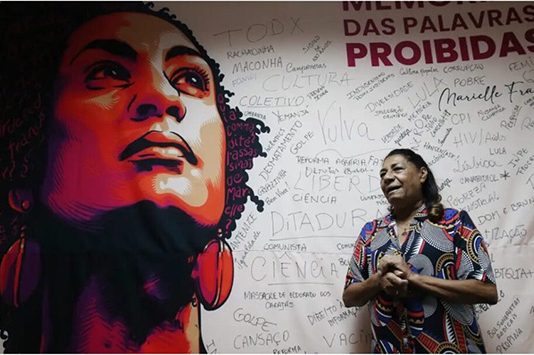
“Blindness that affects the other side also affects us.”
— Mano Brown
The saying goes: Um negócio pra boi dormir.” Literally, the Brazilian aphorism means: (To give) something for the bull to sleep. In practical layman’s terms it pre-figures social interactions where somebody, a group of people or an entity, says...
The magnitude, distinction and dramatic contradictions in the turnaround 2026 presidential election victory of Luíz Inácio Lula da Silva warrants this and other grass-root analysis. Claiming a historic fourth term as Brazil’s head of state, this time defeating the now-fugitive son of the coup-attempt, convicted and disgraced former president,...

Just a few weeks ago, following the first round of Brazil’s presidential election, the world seemed convinced that a victory for Flávio Bolsonaro was inevitable.
History appeared to support that assumption: No candidate had ever overturned the first-round result in a Brazilian presidential runoff. Right-wing forces had been advancing across...

The clash between competing models that has been unfolding globally for decades arrived in October at what is undoubtedly becoming a central event. Brazil’s presidential election offers an extraordinary opportunity to weigh these competing visions of the world—both for the future of South America’s largest country and for its...
We should present our condolences to each other. They do not resuscitate the dead, but they strengthen relationships among the living.—Article 10 of the Charter of Kurukan-Fuga (Constitution of the Mali Empire, circa 13th century AD)
A short list of massacres committed by Brazilian police in Rio de Janeiro favelas...

In private talks with their Brazilian counterparts, U.S. diplomats have expressed interest in resuming unrestricted access and use of air base installations in Natal, capital of the northeastern state of Rio Grande do Norte, as well as on the island of Fernando de Noronha.
Their central argument involves the so-called...

But 1st A “Healthy Left” Recap By British Agents Toning Down Brazil
“Rogério Lemgruber, founder of the Red Command (CV), lived on my block #38…He taught us to be revolutionary. In his house he raised a hammer and sickle because the Red Command evolved from ties between political prisoners of...

He who was born, was born / He who wasn’t born, won’t be born / Get out the way of the bullet train or else you might get torn.—“He Who Was Born, Was Born” by MC G3
Will There Be “Peace, Liberty, And Justice” With Whatever Comes After Brazil?
Recorded circa...

The large-scale operation in Rio de Janeiro carried out on October 28, which has already left at least 121 people dead and once again laid bare the logic of war applied to poverty, should not be understood solely as a local public-security issue.
It is part of a global control...

Trade warfare and interference in the free functioning of the judiciary are the current expressions of United States interventionism in Latin America, particularly in Brazil.
With the largest economy in the region and the eighth-largest in the world, Brazil holds a central strategic importance for the United States in its...


 Radhika Desai is a Professor of Political Studies at the University of Manitoba, Winnepeg, Canada, Director of its Geopolitical Economy Research Group, and Convenor of the International Manifesto Group. Ms. Desai is an author of multiple books, including Geopolitical Economy(2013) and her most recent Capitalism, Coronavirus and War(2022). Ms. Desai hosts a fortnightly show, Geopolitical Economy Hour on the Geopolitical Economy Report website.
 Yan Pan is a Chinese PhD researcher at LUT University, Finland. Her work examines the political economy of China’s technological and industrial development, with a particular focus on the industrialization and governance of neurotechnology in China. Her research concerns industrial policy models for future industries in Chinese and Global South contexts. Prior to her PhD, she researched educational reforms and structural change in labor demand in China.
 Ken Hammond is professor emeritus of East Asian and Global History at New Mexico State University. He has lived and worked in China from time to time since 1982. A lifelong political activist, he is a member of the Party for Socialism and Liberation.